Sauna After Strength Training After 40: Does It Help?
This article may contain affiliate links. If you buy through them, we may earn a small commission at no extra cost to you. See our Affiliate Disclosure and Medical Disclaimer.
Walk into most serious gyms built in the last decade and you’ll find a sauna, sometimes right next to the ice bath. The marketing pitch writes itself: sweat it out, recover faster, build more muscle. But “feels good after a hard session” and “measurably improves muscle growth or recovery” are two different claims, and the research on heat therapy after strength training has grown enough in the last decade that we can actually separate them.
This is a straight look at what heat stress — sauna, hot baths, diathermy, and similar interventions — does and doesn’t do for people lifting weights after 40, including the honest limits of studies that get cited far more confidently than their actual methods support.
At a Glance
| Claim | Verdict |
|---|---|
| Signals muscle-building pathways (mTOR) | Yes — shown directly in human muscle biopsies after resistance exercise |
| Builds muscle with heat alone, no training | Shown in one study, but with 8 hours/day of direct heat — not a sauna dose |
| Protects against muscle loss during immobilization | Yes — multiple studies, a genuinely useful application |
| Blunts strength/hypertrophy gains like cold water immersion does | No strong evidence of this — heat doesn’t carry the same penalty |
| Cardiovascular benefit from regular use | Yes — strong observational and some RCT evidence, independent of lifting |
| Proven dose for post-lifting recovery | No established protocol — most evidence uses research-grade heat exposure |
The Mechanism: Heat Stress Talks to the Same Pathway as Lifting
The most direct evidence comes from a human trial (Kakigi et al., 2011, J Physiol Sci) in which eight men performed resistance exercise with microwave-generated local heat applied to the thigh before and during the workout, with muscle biopsies taken before, immediately after, and an hour after exercise. Heat stress significantly increased phosphorylation of Akt, mTOR, and ribosomal protein S6 — the core signaling cascade that tells muscle fibers to start building new protein — and it sped the recovery of 4E-BP1 phosphorylation, which had dipped right after exercise. In plain terms: adding heat on top of resistance exercise amplified the same anabolic signal the lifting itself triggers.
That finding lines up with earlier rodent work showing heat stress activates the Akt/mTOR pathway on its own, and it’s consistent with a long-running idea in exercise physiology that heat shock proteins (HSP70, HSP90) — the molecules cells produce in response to thermal stress — play a supporting role in muscle repair and remodeling, not just in surviving heat itself.
The eye-catching study, and why it needs a caveat
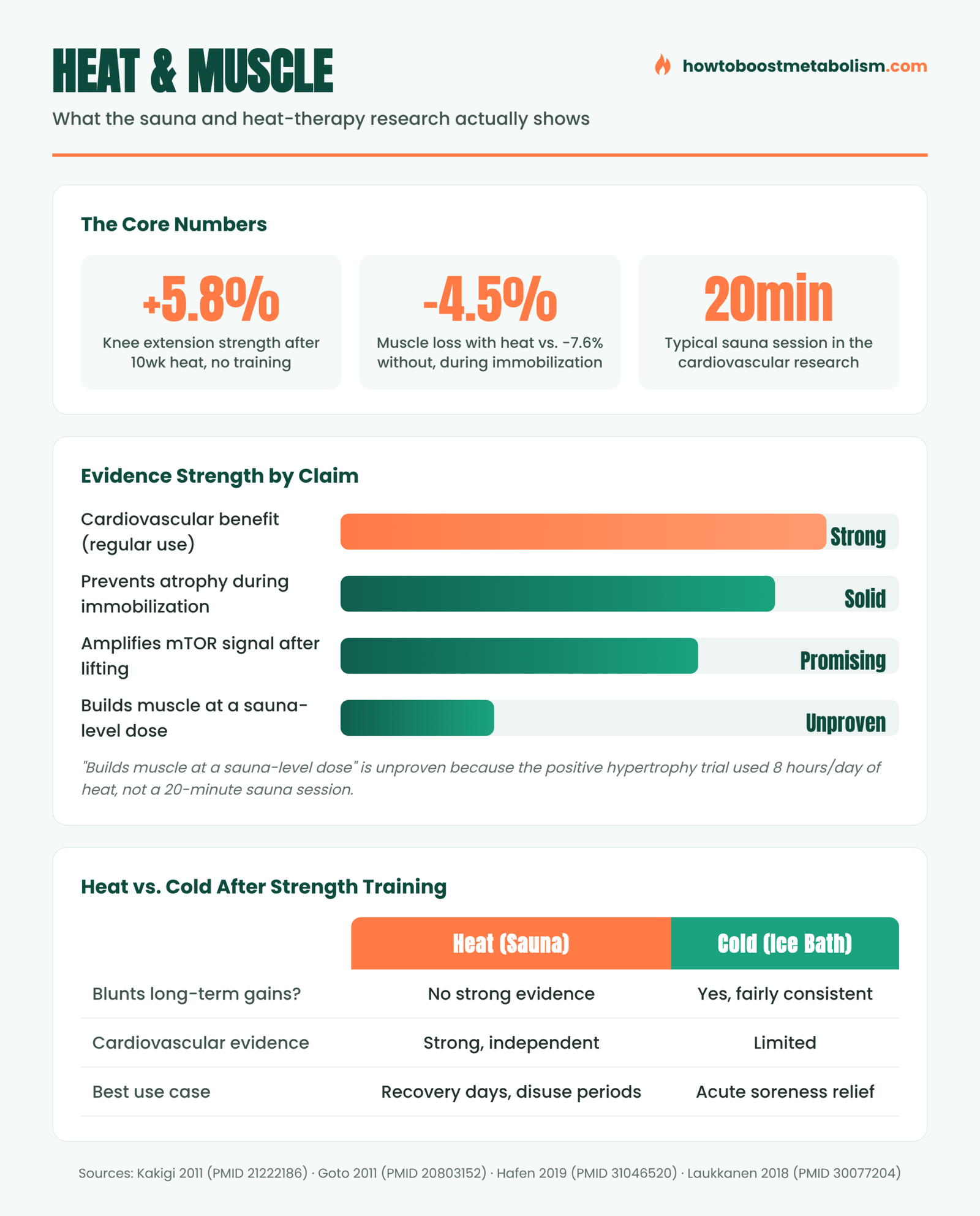
A frequently cited study (Goto et al., 2011, Eur J Appl Physiol) applied heat stress to the quadriceps of eight healthy men for 8 hours per day, 4 days per week, for 10 weeks — using a heat- and steam-generating sheet, with zero exercise training. By the end, the heated leg showed a significant ~5.8% increase in maximum isometric knee extension force and measurable increases in muscle cross-sectional area. That’s a striking result, and it’s genuinely interesting mechanistic evidence that heat alone can nudge muscle growth. But 8 hours a day of direct heat exposure for 10 straight weeks bears no resemblance to a 20-minute post-workout sauna session a few times a week — this study tells us heat stress can drive hypertrophy at a research-grade dose, not that your sauna habit is doing the same thing at a fraction of the exposure.
Free download
🔥 The Metabolism Starter Kit
3 honest guides: a 7-day reset plan, a foods cheat-sheet and 12 metabolism myths debunked. No spam — unsubscribe anytime.
Where Heat Therapy Has Its Strongest Evidence: Preventing Muscle Loss During Disuse
The most practically convincing research on heat and muscle comes from immobilization studies — a useful model because enforced rest (post-injury, post-surgery, or just a stretch of inactivity) is exactly when people over 40 are most at risk of rapid, hard-to-reverse muscle loss. Hafen et al. (2019, J Appl Physiol) immobilized the lower leg of 23 healthy volunteers for 10 days, with one group receiving 2 hours of daily heat therapy via pulsed shortwave diathermy. The heat-treated group showed significantly less loss of muscle cross-sectional area (-4.5% vs. -7.6%) and far better preserved mitochondrial respiratory function, alongside increased heat shock protein levels. A related 2024 trial in athletes recovering from ankle immobilization (Labidi et al., Orthop J Sports Med) found whole-body heat therapy preserved isometric strength and reduced atrophy signaling (lower caspase-3, higher phosphorylated FoxO) compared to a sham treatment, with the authors specifically flagging heat therapy as a candidate intervention to counteract atrophy during forced inactivity.
The takeaway for lifters over 40 isn’t “add heat to every workout” — it’s that if you’re ever sidelined by an injury, surgery, or simply a long break from the gym, regular heat exposure (sauna, hot baths, or clinical diathermy under guidance) has real evidence behind it as a way to slow the muscle and strength loss that comes with time off, which matters more the older you get because that lost muscle is harder to regain.
Heat vs. Cold: The Comparison Everyone Actually Wants
If you’ve read our breakdown of cold water immersion after strength training, you already know the uncomfortable finding there: regular ice baths after resistance training sessions appear to blunt long-term gains in muscle mass and strength, likely by reducing satellite cell activation and anabolic signaling — the same pathways that heat stress appears to support rather than suppress. A review of both approaches (Hyldahl & Peake, 2020, J Appl Physiol) lays out this asymmetry directly: cold water immersion’s evidence for blunting strength and hypertrophy adaptations is fairly consistent, while heat application doesn’t carry that same downside in the literature reviewed. That’s a meaningfully different risk profile, and it’s a reasonable basis for choosing sauna over an ice bath on days when building muscle, not just feeling less sore tomorrow, is the actual goal.
Free download: our Metabolism Starter Kit — a protein calculator, a 7-day meal framework, and a one-page supplement checklist, with zero hype.
Get the Free Starter Kit →The Cardiovascular Case for Sauna, Independent of Lifting
Separate from any muscle-building angle, regular sauna use has one of the stronger observational safety records in all of recovery science. A widely cited review (Laukkanen et al., 2018, Mayo Clin Proc) summarized evidence linking regular sauna bathing to reduced risk of hypertension, cardiovascular disease, and neurocognitive decline, building on Finnish cohort data tracking thousands of sauna users over decades. More recently, a randomized controlled trial in adults with existing coronary artery disease (Debray et al., 2023, J Appl Physiol) found an 8-week Finnish sauna program (4 sessions/week, 20-30 minutes, 79°C) improved brachial artery flow-mediated dilation — a marker of endothelial health — compared to a control group, in a population where that kind of vascular improvement is clinically meaningful. For people over 40 managing blood pressure or general cardiovascular risk alongside a strength training program, this is arguably the stronger, better-supported reason to use a sauna regularly — the muscle-signaling benefits are real but far less proven at a practical dose than the cardiovascular ones.
A Sensible, Evidence-Aligned Approach
- Use sauna for recovery and cardiovascular health, not as a substitute for progressive resistance training — no amount of heat replaces mechanical tension as the primary driver of muscle growth.
- 15-20 minutes, a few times per week at traditional sauna temperatures matches most of the cardiovascular and recovery research, with no strong evidence that longer sessions scale the benefit proportionally.
- Rehydrate aggressively — you’re adding sweat loss from heat exposure on top of sweat loss from the workout itself, and dehydration undermines recovery far more reliably than heat helps it.
- Lean on heat harder during forced breaks from training — injury, travel, illness — where the immobilization research most directly applies, rather than expecting it to meaningfully accelerate normal week-to-week progress.
- Skip it, or check with a doctor first, if you have uncontrolled hypertension or cardiac issues — the cardiovascular research is reassuring for healthy adults, not a blanket clearance for everyone.
For general post-lifting recovery habits that have more direct, practical evidence behind them, see our guides on deload weeks after 40 and foam rolling for recovery after 40 — both are less glamorous than a sauna session but have clearer, more directly applicable evidence for someone training regularly in their 40s, 50s, and beyond.
Chronic stress and poor sleep also interact heavily with how well you recover from training at this age — our piece on overtraining signs and cortisol after 40 covers that side of the recovery equation in more depth.
What About Infrared Saunas and Hot Baths?
Most of the research cited above used traditional Finnish-style sauna (dry heat, 70-90°C) or direct localized heat applied with clinical equipment — not the infrared cabins or hot tubs many gyms and homes use instead. Infrared saunas operate at lower air temperatures but still raise core and tissue temperature through radiant heat, and the limited direct comparisons available suggest broadly similar cardiovascular responses to traditional sauna, though the research base for infrared specifically is thinner and younger. A hot bath (around 40°C/104°F for 20-30 minutes) is a reasonable substitute if you don’t have sauna access, since the core mechanism — raising muscle and core temperature to trigger a heat shock response — doesn’t require a dedicated room, just sufficient heat and duration. What the research doesn’t support is treating any of these as interchangeable at arbitrary intensities; a lukewarm 10-minute bath is unlikely to replicate the thermal stress used in the studies above.
Heat is a recovery add-on; the main event is still a training program you can sustain for years. For readers in their 40s and beyond, Old School New Body is the moderate-load, short-session program we point to most often — the kind that makes a post-workout sauna a pleasure rather than a necessity. One honest caveat: ignore the age-related statistics on its sales page — they aren’t sourced — and judge the program by its structure, not the copy.
The training side of the recovery equation:
Check Availability →Affiliate link — we may earn a commission at no extra cost to you. Disclosure
Frequently Asked Questions
Does sauna use after lifting actually build muscle?
There is real mechanistic evidence that heat stress activates the same mTOR signaling pathway as resistance exercise itself, and one long-term study found 10 weeks of daily heat application increased muscle cross-sectional area and strength without any exercise at all. But that study used 8 hours per day of direct heat on the muscle — nothing like a 15-20 minute sauna session — so “sauna builds muscle” is an overstatement of evidence gathered under very different heat doses.
How long should I sit in a sauna after a workout?
Most of the cardiovascular and recovery research uses 15-20 minute sessions at traditional Finnish sauna temperatures (roughly 80°C/176°F), several times per week. There’s no strong evidence that longer sessions produce proportionally more benefit, and dehydration risk rises with session length, especially after a workout that already cost you fluid through sweat.
Is sauna better or worse than an ice bath after strength training?
They’re not interchangeable, and the honest answer depends on your goal. Regular cold water immersion after strength training sessions has fairly consistent evidence for blunting long-term strength and hypertrophy gains by dampening the same anabolic signaling heat appears to support. Heat therapy doesn’t carry that same blunting signal in the current research, which is one practical reason to default to sauna over ice bath on days when muscle growth is the priority.
Can sauna use help prevent muscle loss as I age?
The most directly relevant evidence comes from immobilization studies, where daily heat treatment preserved muscle mass, mitochondrial function, and strength in people whose limb was in a cast or brace — a reasonable model for the kind of disuse atrophy that becomes more consequential with age. This doesn’t mean sauna replaces resistance training as the primary tool against age-related muscle loss (sarcopenia); it means heat may be a useful adjunct, especially during a forced break from training.
Is sauna safe for everyone after 40?
Most healthy adults tolerate traditional sauna well, and large observational studies link regular use to lower cardiovascular mortality. But anyone with uncontrolled high blood pressure, a recent cardiac event, or who feels dizzy/unwell in heat should talk to a doctor before adding regular sauna sessions, particularly right after an exercise bout that has already raised heart rate and lowered blood pressure through vasodilation.