External Rotator Cuff Strengthening: What Really Works
This article may contain affiliate links. If you buy through them, we may earn a small commission at no extra cost to you. See our Affiliate Disclosure and Medical Disclaimer.
“Do your rotator cuff exercises” is some of the most common advice handed out in gyms and physical therapy offices alike, usually alongside a resistance band and a vague memory of three exercises a trainer once showed you. It’s genuinely good advice. What gets skipped is which exercises, done which way, actually load the muscles you’re trying to target — and a surprising amount of standard shoulder advice turns out to be only partly supported once researchers actually strap electrodes to people’s shoulders and measure it.
This is the deep-dive version of a question we touched on more broadly in our guide to overhead pressing and shoulder health after 40: specifically, which external rotator exercises are actually earning their place in your routine, and which are mostly just moving your arm around.
Why the external rotators matter more as you get older
The rotator cuff is a group of four muscles — supraspinatus, infraspinatus, teres minor, and subscapularis — that stabilize the ball of the upper arm bone inside the shoulder socket. Two of those, the infraspinatus and teres minor, are the primary external rotators: they’re what resist the shoulder caving forward and inward under load, which is exactly the failure pattern behind a lot of shoulder impingement and rotator cuff irritation in lifters. Overhead pressing, rowing, and pulling all put real demand on these muscles, and unlike the much larger deltoid and pressing muscles around them, they don’t get meaningfully trained by general pressing and pulling work — they need targeted attention, which is why dedicated external rotation exercises exist in the first place.
Which exercise actually activates the rotator cuff the most?
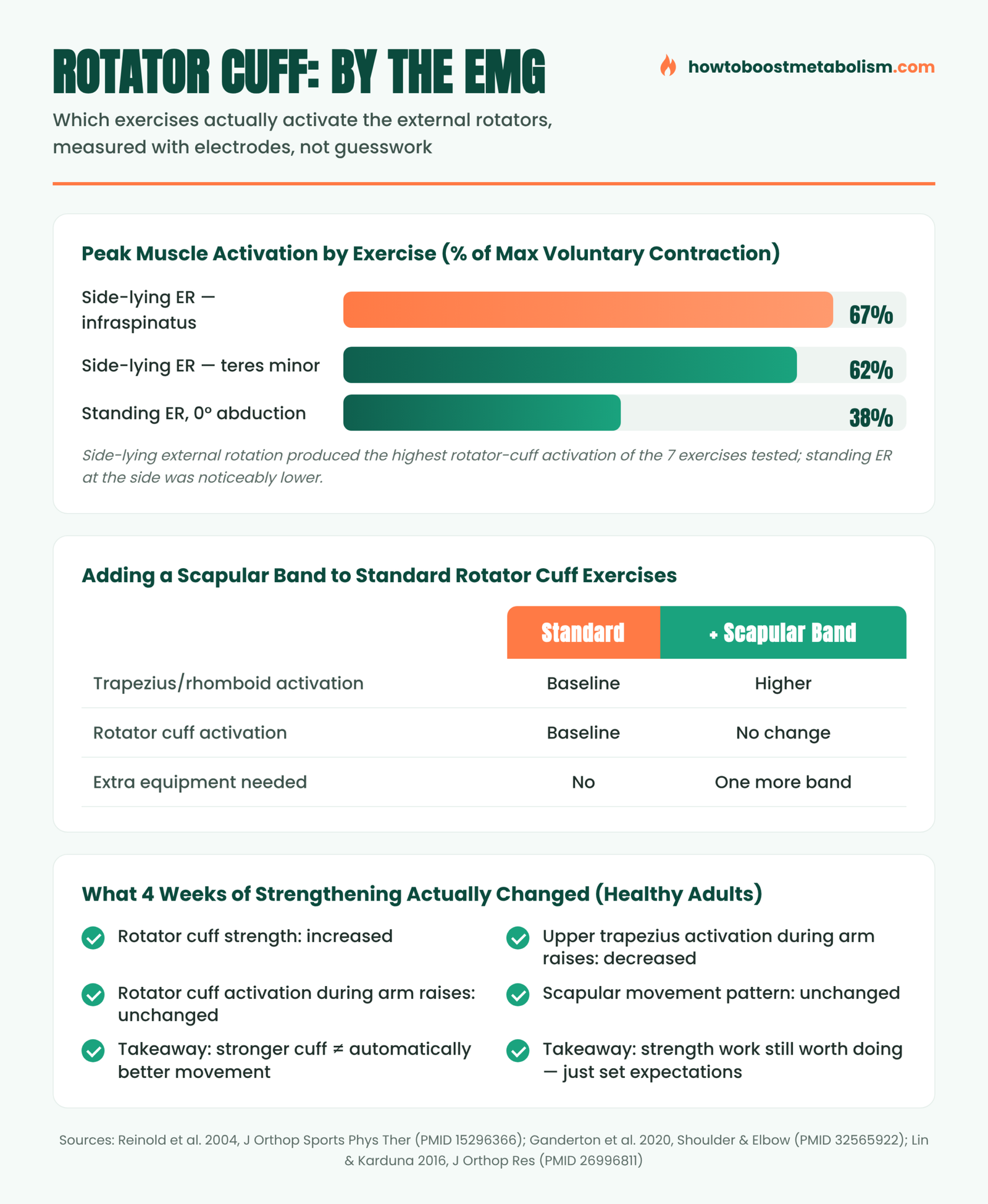
The foundational study here is two decades old but still the most directly useful: researchers at the American Sports Medicine Institute used intramuscular EMG electrodes — fine wires inserted directly into the muscle, not just surface sensors — to measure activation of the infraspinatus, teres minor, supraspinatus, and deltoid across seven commonly prescribed shoulder exercises (Reinold et al., 2004, J Orthop Sports Phys Ther, PMID 15296366). The clear winner for the actual external rotator muscles was side-lying external rotation — lying on your side, elbow bent and tucked to your ribs, rotating a light dumbbell upward — which produced 67% of maximum voluntary contraction in the infraspinatus and 62% in the teres minor, the highest of any exercise tested. For comparison, the commonly prescribed standing external rotation at the side of the body produced meaningfully less activation. If you want maximum bang for your buck on the actual rotator cuff muscles with minimal equipment, side-lying external rotation is the best-supported single exercise.
That same study found a different winner for a different muscle: prone horizontal abduction at 100 degrees of shoulder abduction with the arm externally rotated — essentially lying face-down on a bench and raising a light weight out to the side and slightly back — produced the highest activation of the supraspinatus (82% MVIC), along with the middle and posterior deltoid. This is a useful reminder that “rotator cuff exercise” isn’t one single movement; different positions target different members of the cuff, and a well-built routine uses more than one.
Free download
🔥 The Metabolism Starter Kit
3 honest guides: a 7-day reset plan, a foods cheat-sheet and 12 metabolism myths debunked. No spam — unsubscribe anytime.
Does adding a resistance band to the shoulder blade actually help?
A popular clinical modification has people loop a second resistance band around their shoulder blades while doing standard internal and external rotation exercises, on the theory that it fires up the scapular stabilizing muscles at the same time. Researchers at La Trobe University tested this directly with EMG (Ganderton et al., 2020, Shoulder & Elbow, PMID 32565922) and found the modification does exactly what it claims for the scapular muscles — trapezius and rhomboid activation went up significantly, especially at lower arm positions — but produced no additional activation in the rotator cuff muscles themselves. In plain terms: this is a genuinely useful upgrade if your goal is scapular stability work, but don’t expect it to make your rotator cuff exercise itself more effective. The two muscle groups responded differently to the same modification, which is a good example of why it’s worth checking what a popular “hack” is actually shown to do before assuming it does everything claimed for it.
The honest, slightly uncomfortable finding: strength gains don’t always fix movement
Here’s a result that doesn’t get repeated enough in gym culture. Researchers at the University of Oregon put healthy subjects through a 4-week rotator cuff and scapular strengthening program and measured both strength and actual shoulder movement mechanics before and after (Lin & Karduna, 2016, J Orthop Res, PMID 26996811). The training group did get measurably stronger, and upper trapezius overactivity (a common compensation pattern) decreased — both good outcomes. But the actual activation of the rotator cuff muscles during a normal arm-raising motion, and the scapula’s movement pattern itself, did not change. Getting your rotator cuff stronger in isolation didn’t automatically retrain how your shoulder moves during a real-world task. The honest takeaway isn’t that strengthening is pointless — strength went up, and a stronger cuff is a more resilient cuff — it’s that strengthening exercises and movement-pattern retraining are not automatically the same thing, and if someone’s goal is specifically changing a faulty movement pattern, four weeks of isolated strengthening alone may not be sufficient.
For people with existing shoulder pain, not just healthy prevention
If you already have some shoulder discomfort, there’s encouraging evidence that even a very small daily dose helps. A pilot study out of the University of Kentucky had people with rotator cuff-related shoulder pain perform a single home exercise — prone horizontal abduction — once a day for three weeks (Seitz et al., 2019, Int J Sports Phys Ther, PMID 30746294). That one simple daily exercise produced measurable neuromuscular changes in scapular muscle activity and improvements in self-reported pain and function. You don’t necessarily need an elaborate five-exercise circuit to start seeing benefit — consistency with even one well-chosen exercise, done daily, moved the needle in people who were actually dealing with pain, which is a very different population from the healthy lifters in most of the other studies here.
What about kettlebells and other newer tools?
A more recent EMG study examined five commonly used kettlebell shoulder-stability exercises and found real differences in which muscles each one emphasized (Hedt et al., 2020, J Sport Rehabil, PMID 33333490), with significant activation differences between exercises for every muscle measured except the infraspinatus. The practical implication isn’t that kettlebells are better or worse than a basic resistance band — it’s that exercise selection still matters even within a single piece of equipment, and rotating through a couple of different movements rather than doing the same one forever is a reasonable way to cover more of the shoulder stabilizing musculature.
At a glance: building an actually evidence-based routine
| Question | What the EMG research found |
|---|---|
| Best single exercise for infraspinatus/teres minor | Side-lying external rotation (67%/62% MVIC) |
| Best exercise for supraspinatus specifically | Prone horizontal abduction at 100° with external rotation |
| Adding a scapular band to ER exercises | Boosts scapular stabilizers, not rotator cuff activation itself |
| Will strengthening alone fix faulty shoulder mechanics? | Not necessarily shown in 4 weeks — strength and movement pattern are separate outcomes |
| Minimum effective dose if you already have shoulder pain | As little as one well-chosen exercise, done daily, showed benefit in a pilot study |
Common mistakes that quietly undo this work
- Using weight that’s too heavy. The rotator cuff muscles are small compared to the deltoid and larger shoulder muscles around them. Once the weight is heavy enough that the bigger muscles take over the movement, you lose the targeted activation that made these exercises useful in the first place — most people need surprisingly light dumbbells (2-10 lbs) for these to work as intended.
- Doing only one exercise forever. As the EMG data above shows, different positions and movements emphasize different members of the rotator cuff group. A routine built entirely around standing external rotation, for example, under-trains the supraspinatus relative to what prone horizontal abduction achieves.
- Expecting strengthening alone to resolve a movement-pattern problem. As the Lin & Karduna findings above show, getting stronger and moving better aren’t guaranteed to arrive together. If pain persists despite consistent strengthening, that’s a signal to get a movement assessment from a physical therapist rather than simply adding more sets.
- Skipping it entirely once the shoulder feels fine. Rotator cuff irritation after 40 tends to be cumulative and attritional rather than a single dramatic injury, which makes ongoing, unglamorous maintenance work more valuable here than in almost any other muscle group.
A simple, evidence-informed weekly routine
Based on the exercises above, a sensible twice-weekly add-on for most lifters without an active injury:
- Side-lying external rotation — 2-3 sets of 12-15 reps per side, light dumbbell (often 2-8 lbs is plenty), the single best-supported movement for the infraspinatus and teres minor.
- Prone horizontal abduction with external rotation — 2 sets of 10-12 reps, light weight, face-down on a bench or incline, targeting the supraspinatus and posterior shoulder.
- Standing or band-resisted external rotation at the side — 2 sets of 12-15 reps as a lower-intensity finisher or warm-up movement before pressing days.
This takes under ten minutes and fits easily as a warm-up before upper-body training or as a standalone block twice a week. If you’re dealing with existing pain rather than general prevention, start with just the prone horizontal abduction exercise daily, as in the pilot study above, and add the others once that’s comfortable — and see a physical therapist or sports medicine provider for an actual diagnosis rather than self-treating persistent pain.
Related reading: our guides to scapular health and overhead pressing after 40, isometric training for joint pain after 40, and resistance bands vs. free weights go deeper into related tools and techniques for training around shoulder issues.
Free download: our Metabolism Starter Kit — a protein calculator, a 7-day meal framework, and a one-page supplement checklist, with zero hype.
Get the Free Starter Kit →Rotator-cuff work pays off most when it sits inside a sensible full-body program built for recovery after 40. Return to Prime is a training program for men over 40 that targets the recovery and hormonal systems that quietly decline with age.
Learn More →Affiliate link — we may earn a commission at no extra cost to you. Disclosure
Related: Strengthening small stabilizer muscles only goes so far if your tendons are the limiting factor — see our honest review of collagen for joint and tendon health.
Frequently Asked Questions
What’s the single best rotator cuff exercise, based on actual research?
Side-lying external rotation produced the highest measured activation of the infraspinatus and teres minor (the primary external rotators) among seven commonly prescribed exercises in EMG research, at 67% and 62% of maximum voluntary contraction respectively.
Does putting a band around my shoulder blades make rotator cuff exercises better?
It increases activation of the scapular stabilizing muscles (trapezius, rhomboids), which is useful in its own right, but EMG research found no additional benefit to the rotator cuff muscles themselves from this modification.
If I get my rotator cuff stronger, will that fix my shoulder mechanics?
Not automatically, based on the available evidence. A 4-week strengthening program increased rotator cuff strength without changing how the muscles actually activated during normal arm movement — strength and movement-pattern retraining appear to be somewhat separate outcomes.
How often should I do rotator cuff exercises?
Research supports both daily low-dose work (a single exercise done daily helped people with existing shoulder pain in a pilot study) and a twice-weekly routine of 2-3 targeted exercises for general prevention in people without pain.
Can I just use kettlebells instead of a resistance band for this?
Either can work. EMG research on kettlebell shoulder-stability exercises found real differences in which muscles different kettlebell movements emphasized, so exercise selection matters more than the specific tool — rotating through a couple of movements is a reasonable approach with either.
This article is for educational purposes and is not medical advice. If you have persistent shoulder pain, consult a qualified healthcare provider or physical therapist for a proper diagnosis before starting a new exercise program. See our Medical Disclaimer.