Muscle Cramps When You Lift After 40: The Electrolyte Myth
This article may contain affiliate links. If you buy through them, we may earn a small commission at no extra cost to you. See our Affiliate Disclosure and Medical Disclaimer.
You’re deep into your last set, somewhere between rep eight and failure, and a muscle locks up hard — calf, hamstring, sometimes a forearm mid-grip. The first thought most lifters have is some version of “I need more electrolytes.” It’s a reasonable guess. It’s also, according to the sports medicine literature on exercise-associated muscle cramps (EAMC), probably not the real explanation for most cramps that happen during strength training.
This isn’t a fringe or contrarian take — it’s the direction a large body of research has moved over the past 15 years, and it has real implications for what you should actually do, after 40, if cramping during training is a recurring problem.
The Theory You’ve Heard: Dehydration and Electrolyte Depletion
The traditional explanation is straightforward: sweat heavily, lose sodium and fluid, and your muscles cramp because of the resulting electrolyte imbalance. It’s intuitive, it matches how cramps are marketed (hence the entire sports-drink and electrolyte-powder industry), and it’s not entirely made up — severe, prolonged fluid and sodium loss can contribute to cramping in some circumstances, particularly in endurance events lasting several hours in the heat.
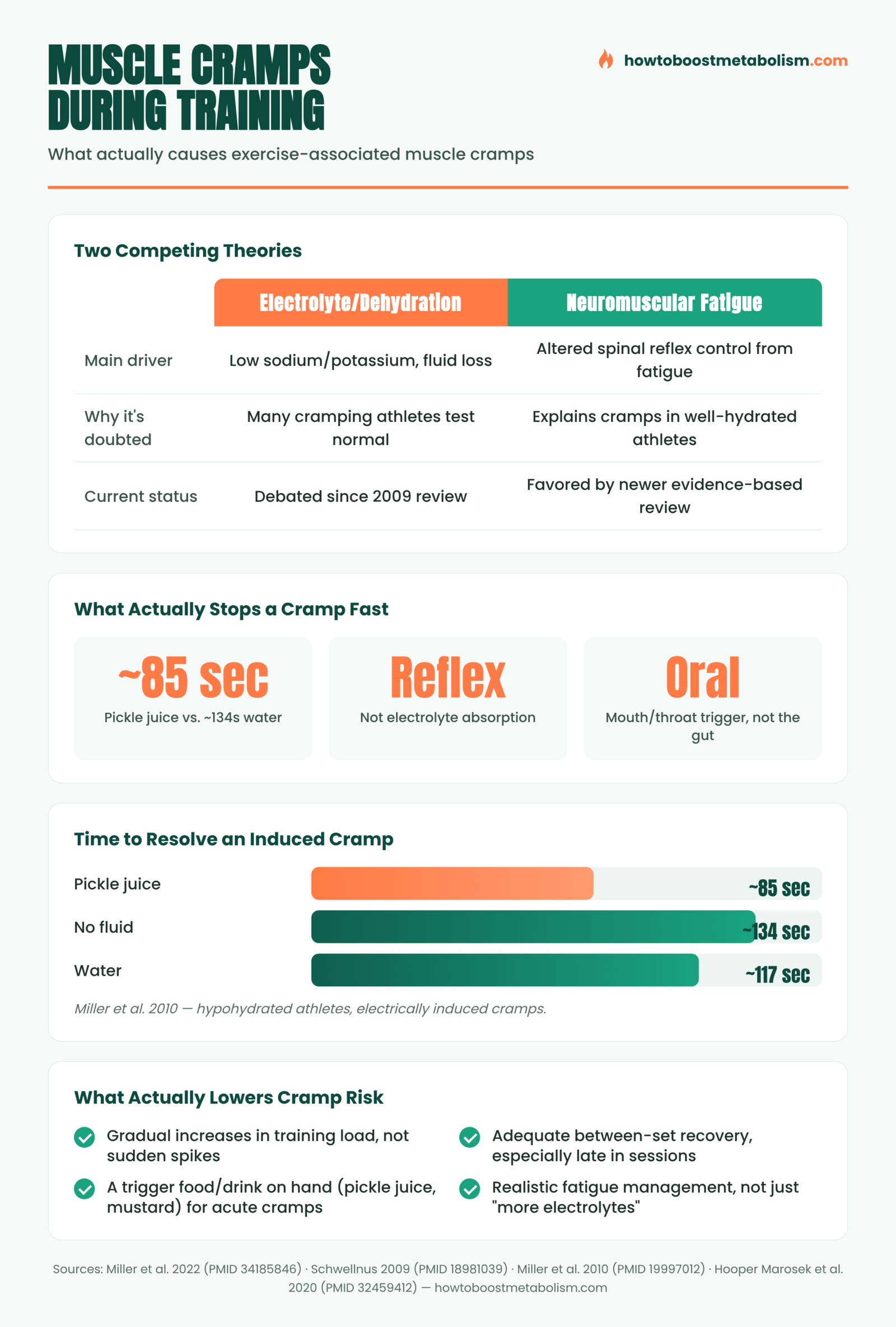
The problem is that this theory doesn’t explain most of the cramping actually observed in research settings. A frequently cited 2009 review directly challenged the dehydration/electrolyte model, pointing out that many athletes who cramp during exercise show normal blood electrolyte levels at the time, and that cramps often occur in muscles that were simply worked hardest, not in a pattern that matches whole-body fluid loss (Schwellnus, 2009, Br J Sports Med).
The Better-Supported Theory: Altered Neuromuscular Control
The alternative model, sometimes called the “altered neuromuscular control” theory, proposes that cramps happen because localized muscle fatigue disrupts the normal balance between excitatory signals (from muscle spindles) and inhibitory signals (from tendon organs) at the spinal cord level. Push a fatigued muscle hard enough, and that balance tips toward excitation — the muscle’s own reflex circuitry essentially gets stuck in the “on” position, producing an involuntary, sustained contraction. That matches real-world patterns much better: cramps cluster in muscles under the heaviest late-set, late-session load, regardless of how hydrated or well-fed the lifter is.
A comprehensive, evidence-based review of EAMC pathophysiology, treatment, and prevention lays out this shift clearly: cramping is now understood as multifactorial, with neuromuscular fatigue as a central driver, rather than a simple electrolyte-deficiency problem (Miller et al., 2022, J Athl Train). A separate review focused specifically on the open questions in this area reaches a similar conclusion: dehydration and electrolyte loss may play a role for some people in some conditions, but fatigue-driven neuromuscular changes better explain the majority of cramps seen during exercise, including resistance training (Maughan & Shirreffs, 2019, Sports Med).
| Finding | What it suggests | Source |
|---|---|---|
| Normal blood electrolytes during cramps | Common finding in cramping athletes | Schwellnus 2009 |
| Cramps cluster in overworked muscles | Matches fatigue pattern, not fluid-loss pattern | Miller et al. 2022 |
| Pickle juice stops a cramp in ~85 sec | Too fast to be electrolyte absorption | Miller et al. 2010 |
| Acetic acid content in “cramp cures” | Tiny amounts, inconsistent with electrolyte dosing | Hooper Marosek et al. 2020 |
Free download
🔥 The Metabolism Starter Kit
3 honest guides: a 7-day reset plan, a foods cheat-sheet and 12 metabolism myths debunked. No spam — unsubscribe anytime.
The Pickle Juice Clue (It’s Not About the Electrolytes Either)
If cramps were really about electrolyte depletion, you’d expect the fastest relief to come from whatever replaces electrolytes fastest. That’s not what the research on pickle juice — genuinely studied as a cramp remedy — actually shows. In a controlled study using electrically induced cramps in hypohydrated participants, a small volume of pickle juice resolved the cramp roughly 45% faster than plain water or no fluid at all (Miller et al., 2010, Med Sci Sports Exerc). The volume involved is far too small, and the effect far too fast, to be explained by electrolyte absorption and redistribution through the bloodstream — that process takes many minutes, not under ninety seconds.
The leading explanation is a neural reflex: a strong sour or acidic taste triggers receptors in the mouth and esophagus that send a signal to the spinal cord, interrupting the runaway motor-neuron firing causing the cramp — essentially the same altered neuromuscular control mechanism described above, interrupted from a different angle. A quantitative analysis of the actual acetic acid content in pickle juice and similar “cramp cure” products found the amounts present are far too small to meaningfully shift electrolyte status, reinforcing that whatever is happening, it isn’t electrolyte replacement (Hooper Marosek et al., 2020, J Strength Cond Res).
What About Magnesium Specifically?
Magnesium supplements are marketed heavily for cramp prevention, and the logic sounds plausible since magnesium is involved in muscle contraction and relaxation at the cellular level. In practice, the cramp research above doesn’t single out magnesium as a reliably effective fix either — it falls under the same broad electrolyte/mineral category that the neuromuscular fatigue model has been displacing as the primary explanation. That doesn’t mean magnesium is irrelevant to health or sleep (we cover that separately in our guide to magnesium, metabolism, and sleep) — it means you shouldn’t expect it to be a dedicated cramp cure on its own, based on what the exercise-cramp literature specifically shows.
Heat, Long Sessions, and Other Edge Cases
The neuromuscular fatigue model is the best general explanation for cramps during typical strength training sessions, which usually last well under two hours in a climate-controlled gym. The picture shifts somewhat for endurance events lasting several hours in genuine heat — marathon and ultra-distance research has shown some cases where very large sweat and sodium losses do appear to contribute meaningfully to cramping, alongside the fatigue mechanism, not instead of it. If your training specifically involves long outdoor sessions in heat (long hikes under load, outdoor strongman training in summer), paying closer attention to fluid and sodium intake is more justified than it is for a standard one-hour indoor lifting session.
So What Should You Actually Do About Cramping?
None of this means hydration and electrolytes are irrelevant to training — chronic under-hydration or genuinely poor nutrition can affect performance and recovery broadly. It means that reaching for an electrolyte drink is unlikely to be the fix for cramps that happen specifically during hard sets of training, and that the more useful levers are about managing fatigue and load:
- Don’t spike training volume or intensity too fast. Sudden jumps in load or volume, especially in a muscle you haven’t trained hard recently, are a classic setup for localized fatigue cramping.
- Watch your rep ranges on your last, hardest sets. Cramps disproportionately show up on the final few reps of a tough set, exactly where neuromuscular fatigue theory predicts they would.
- Keep something acidic or strongly flavored on hand. Pickle juice, mustard, or a dedicated cramp-relief shot work faster than water or a sports drink for an acute cramp, based on the reflex mechanism above.
- Don’t ignore genuinely hot, high-sweat conditions. In prolonged heat exposure, fluid and sodium losses are large enough that the traditional electrolyte picture becomes more relevant — this is mostly a distance-endurance scenario, less so a typical indoor strength session.
- Track when cramps actually happen. A quick mental note of which exercise, which set number, and how fatigued you were tends to reveal a pattern tied to load and fatigue far more often than a pattern tied to how much water you drank that day.
If cramping during fasted training sessions is a specific pattern for you — a common question from readers who combine intermittent fasting with lifting — the fatigue-driven mechanism above is still the more likely explanation than fasting-related electrolyte loss on its own, though staying attentive to fluid and sodium intake within your eating window is still a sensible, low-cost precaution either way.
If you train while following an intermittent fasting approach, Eat Stop Eat lays out a structured way to time eating windows around training, which can help you manage hydration and intake deliberately rather than guessing.
See the Approach →Affiliate link — we may earn a commission at no extra cost to you. Disclosure
Why This Framing Matters More as You Get Older
The fatigue-driven explanation has a practical upside for lifters over 40 specifically: it points toward something you can actually manage — training load, recovery between sets, and how aggressively you progress volume — rather than something that feels like it’s just happening to you regardless of what you do. Recovery between hard sets and between sessions typically needs more deliberate attention after 40, and the same adjustments that help general recovery (adequate rest between sets, sensible week-to-week progression, not chasing failure on every single set) also directly address the mechanism most likely behind your cramps.
It’s a more useful mental model than reaching for an electrolyte tablet after the fact: instead of treating cramping as a mysterious mineral deficiency to patch over, you can look at the specific set or exercise where it happened and ask whether you pushed that movement harder, or recovered from it less, than your current training age can handle. That question tends to be far more productive than asking whether you drank enough water that morning.
A Quick Myth-vs-Evidence Recap
- Myth: cramps mean you’re low on electrolytes. Evidence: many cramping athletes test with normal electrolyte levels; the pattern doesn’t match whole-body fluid loss.
- Myth: drinking a sports drink will stop an active cramp quickly. Evidence: a small dose of something acidic (like pickle juice) works faster, through a nerve reflex, not electrolyte replacement.
- Myth: if you’re well-hydrated, you shouldn’t cramp. Evidence: well-hydrated, well-fed athletes cramp regularly when a muscle is pushed to fatigue, especially on under-recovered or rapidly progressed training.
- What actually helps: sensible progression in training load, attention to fatigue on your hardest sets, and an evidence-based quick remedy on hand for when a cramp does happen.
Free download: our Metabolism Starter Kit — a protein calculator, a 7-day meal framework, and a one-page supplement checklist, with zero hype.
Get the Free Starter Kit →For related reading, see our guides to electrolyte powders, ranked by evidence, magnesium, metabolism, and sleep, and electrolytes and weight loss if you want the broader hydration picture beyond cramping specifically.
Frequently Asked Questions
Do electrolytes actually help with muscle cramps during exercise?
For most cramps that happen during resistance training, the research doesn’t support electrolytes as the main fix. Many people who cramp test with normal blood electrolyte levels, and the leading current explanation is fatigue-driven changes in nerve signaling at the spinal cord level, not a mineral deficiency.
Why does pickle juice stop cramps if it’s not about electrolytes?
Controlled research suggests it works through a fast neural reflex triggered by the strong acidic taste in the mouth and throat, interrupting the nerve signal causing the cramp. The effect happens far too quickly (under 90 seconds) to be explained by electrolyte absorption into the bloodstream.
Should I stop drinking electrolyte drinks before workouts?
Not necessarily — staying adequately hydrated and fed still supports overall training performance. The point isn’t that electrolytes are useless, it’s that they’re an unreliable fix specifically for cramps that happen during hard strength training sets.
What actually causes a muscle to cramp during a heavy set?
The best-supported current explanation is altered neuromuscular control: localized fatigue disrupts the normal balance of excitatory and inhibitory signals controlling the muscle, causing an involuntary, sustained contraction. It’s a nervous-system fatigue response, not primarily a fuel or mineral problem.
Is cramping more common after 40?
There isn’t strong age-specific research isolating this. What matters more than age itself is training load management — sudden jumps in volume or intensity, or pushing sets to failure without adequate recovery, are the more consistent risk factors across age groups. Because recovery capacity often needs more deliberate attention after 40, those same risk factors can be easier to run into if programming isn’t adjusted accordingly.