Foam Rolling After 40: Does It Actually Work?
This article may contain affiliate links. If you buy through them, we may earn a small commission at no extra cost to you. See our Affiliate Disclosure and Medical Disclaimer.
Foam rollers show up in nearly every gym, physical therapy clinic, and fitness influencer’s living room, usually accompanied by claims about “releasing fascia,” melting away knots, and fixing muscle imbalances. Some of that is genuine, evidence-backed benefit. A fair amount of it is marketing that has outrun the actual research. Here’s an honest look at what foam rolling does and doesn’t do, especially relevant if you’re over 40 and thinking about recovery and mobility more deliberately than you used to.
What Foam Rolling Is Supposed to Do
The practice, often called self-myofascial release, involves applying your body weight through a foam cylinder (or a firmer roller or ball) onto a muscle, rolling slowly back and forth to apply sustained pressure. The stated goals usually include improving flexibility and joint range of motion, reducing muscle soreness and speeding recovery after exercise, and “releasing” tight or restricted connective tissue (fascia) that’s supposedly limiting movement or causing pain.
It’s become an especially common recommendation for people over 40, often framed as a way to compensate for stiffer joints, slower recovery, or years of accumulated “tightness.” That framing isn’t entirely wrong; recovery does tend to take longer with age, and anything that reliably improves comfort and range of motion is worth knowing about. The question is which specific claims actually hold up when they’re tested in a controlled trial rather than taken on faith from a trainer, a product page, or a fitness influencer.
Does It Actually ‘Release’ Fascia?
This is the part of the marketing that gets ahead of the science. Fascia is dense, fibrous connective tissue, and meaningfully remodeling it would require sustained mechanical force well beyond what a person can generate by rolling their own body weight over a foam cylinder for a minute or two. The more mechanistically plausible explanation for foam rolling’s real effects involves the nervous system: pressure applied to a muscle can temporarily change pain perception (raising your pressure-pain threshold) and reduce the protective muscle tone that limits how far a joint will move, which would explain the acute flexibility gains researchers consistently find without requiring any literal tissue “release.” None of this makes foam rolling useless; it just means the honest explanation is neurological and perceptual rather than the dramatic mechanical story often used to sell rollers and classes.
Free download
🔥 The Metabolism Starter Kit
3 honest guides: a 7-day reset plan, a foods cheat-sheet and 12 metabolism myths debunked. No spam — unsubscribe anytime.
The Evidence for Flexibility and Range of Motion
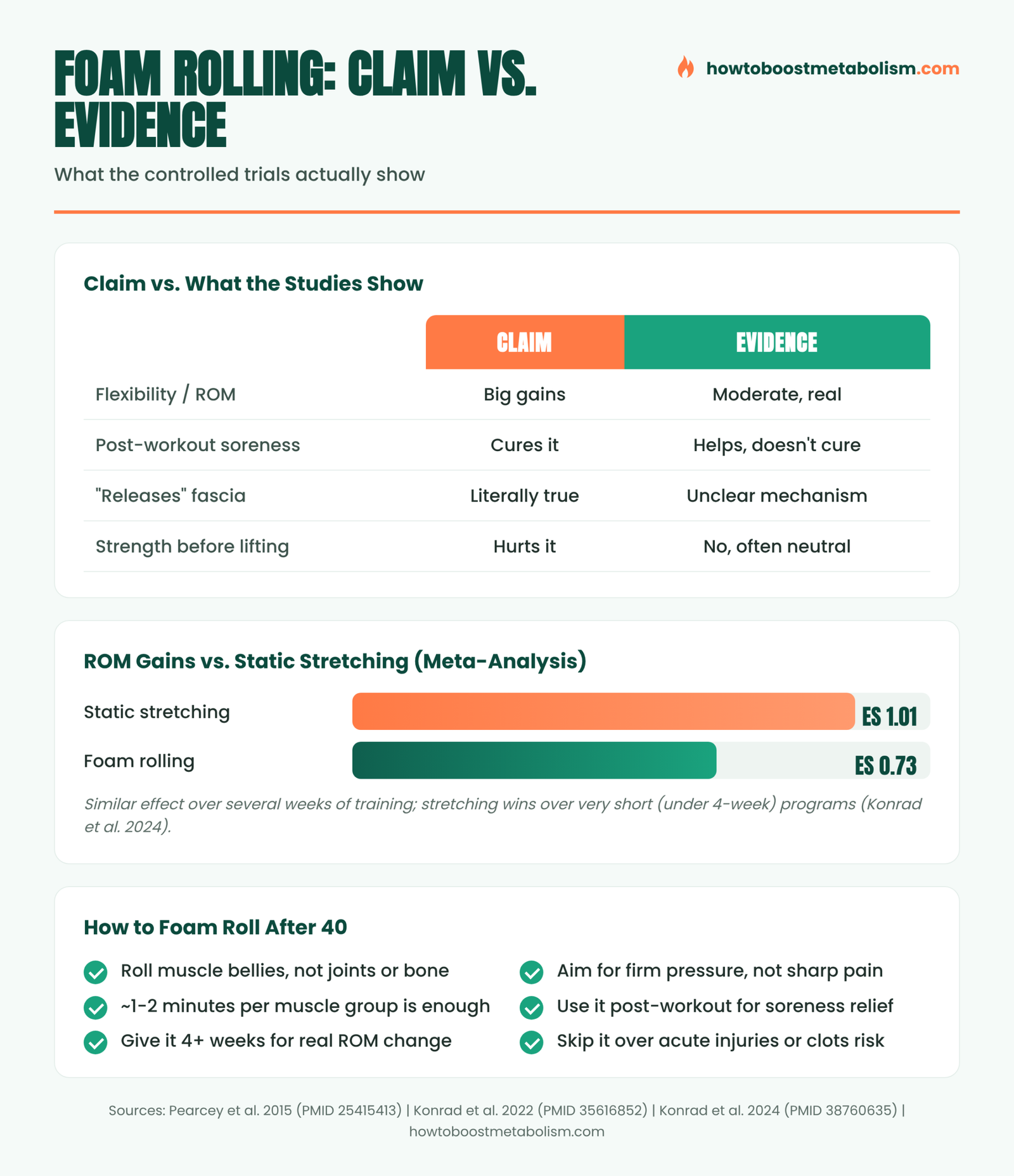
A 2022 systematic review and meta-analysis pooling 11 controlled trials and 290 participants found that foam-rolling training programs produced a moderate improvement in joint range of motion compared to control groups, and that programs lasting longer than four weeks produced significantly better results than shorter ones (Konrad et al., 2022, Sports Medicine, PMID 35616852). Benefits also appeared to depend on the specific muscle and joint; the hamstrings and quadriceps responded, while ankle dorsiflexion via calf rolling didn’t show the same improvement.
A follow-up 2024 meta-analysis from some of the same researchers directly compared foam rolling to static stretching across 85 studies and found both methods produced a similarly moderate improvement in range of motion overall, with one meaningful difference: over short programs of four weeks or less, static stretching clearly outperformed foam rolling for building flexibility, while the two methods converged over longer programs (Konrad et al., 2024, Sports Medicine, PMID 38760635). The honest conclusion is that foam rolling is a legitimate, moderately effective tool for improving range of motion, roughly comparable to stretching over time, but it is not a fast-acting magic fix, and old-fashioned stretching still has an edge if you need quick results.
Does It Help With Post-Workout Soreness and Recovery?
A frequently cited controlled study had healthy, physically active men perform an intense squat protocol (10 sets of 10 reps at 60 percent of their one-rep max) designed to induce delayed-onset muscle soreness, then compared 20 minutes of foam rolling immediately after, and again at 24 and 48 hours, against doing nothing (Pearcey et al., 2015, Journal of Athletic Training, PMID 25415413). The foam-rolling condition produced moderate-to-large improvements in muscle tenderness and in several measures of dynamic performance, including sprint time, jump power, and dynamic strength-endurance, in the days following the fatiguing workout. That’s a genuinely useful, practical finding for anyone whose soreness after a hard leg day interferes with the next few days of training or daily activity. It is not evidence that foam rolling prevents soreness altogether or repairs muscle damage faster; it appears to meaningfully blunt the performance cost of soreness rather than eliminate the soreness itself.
Will Rolling Before a Workout Hurt Your Strength?
A reasonable worry, since static stretching held too long before lifting has been shown in other research to temporarily reduce force output. A crossover study comparing foam rolling, static stretching, and dynamic stretching as warm-up methods found foam rolling produced significantly greater improvements in flexibility of the quadriceps and hamstrings than either stretching method, while knee-extension strength actually improved slightly after foam rolling and dynamic stretching, and was unchanged after static stretching (Su et al., 2017, Journal of Sport Rehabilitation, PMID 27736289). In other words, a brief pre-workout foam-rolling session is unlikely to sap your strength, and the available evidence leans toward it being strength-neutral to mildly positive, in contrast to prolonged static stretching.
Foam Roller vs. Massage Gun vs. Lacrosse Ball: Does the Tool Matter?
Most of the controlled research described above used a standard cylindrical foam roller, so that’s what the strongest evidence actually supports. Percussion “massage guns” and small firm balls (like a lacrosse ball) work on broadly similar principles, applying mechanical pressure and vibration to a muscle, and the practical reasoning for why they’d produce comparable pain-modulation and perceived-recovery effects is reasonable, but there’s considerably less controlled research directly testing them against a classic foam roller on the same outcomes. A firmer tool or a massage gun can reach smaller, harder-to-target areas (like around the glutes or shoulder blades) that a large roller struggles with, which is a genuine practical advantage, not just marketing. If you already own a foam roller and it works for you, there’s little evidence-based reason to replace it; if you’re deciding what to buy, a basic roller remains the best-studied and least expensive option.
What Foam Rolling Is Not a Substitute For
It’s worth being direct about this, because the marketing around recovery tools can blur the line: foam rolling has not been shown to build strength, meaningfully grow muscle, or reverse the structural effects of years of disuse. It’s a short-term tool for comfort, perceived recovery, and modest flexibility gains, layered on top of actual training, not a replacement for it. If your main goal after 40 is staying strong, mobile, and resilient, progressive resistance training and adequate protein and sleep are doing the heavy lifting; foam rolling is a reasonable, low-risk addition around the edges of that foundation, not a substitute for any part of it.
| Claim area | What evidence shows | Practical takeaway |
|---|---|---|
| Flexibility / ROM | Real, moderate effect over weeks | Try it; don’t expect overnight change |
| Post-workout soreness | Real, moderate-to-large effect | Worth doing after a hard session |
| Pre-workout strength | No meaningful negative effect | Fine as part of a warm-up |
| “Fascia release” | Mechanism not well supported | Benefit is likely neurological, not mechanical |
Where the Marketing Gets Ahead of the Science
- “Breaks up adhesions/knots.” There’s no strong imaging or biopsy evidence that a foam roller mechanically breaks apart specific tissue adhesions; the felt relief is more plausibly about pain modulation and temporarily reduced muscle tone.
- “Detoxifies” muscle or “flushes” lactic acid. Lactate clears from muscle within roughly an hour of exercise through normal metabolism regardless of rolling, and foam rolling has no established role in removing toxins.
- “Fixes” structural muscle imbalances. Foam rolling can temporarily change how a muscle feels and how far a joint moves, but it isn’t a substitute for the progressive strength training that actually changes muscle size and balance over time.
- One session changes everything. The clearest range-of-motion benefits in the research come from programs lasting several weeks, not a single five-minute session before your workout.
How to Actually Use a Foam Roller After 40
- Before training: 1-2 minutes per major muscle group you’re about to train, firm pressure, slow rolling, as part of a broader warm-up rather than the whole warm-up.
- After a hard session: 15-20 minutes total across the sore muscle groups, ideally repeated the following day or two, based on the protocol with the strongest soreness-relief evidence.
- For lasting flexibility change: Commit to a regular routine, a few sessions per week, for at least four weeks before judging whether it’s making a real difference in your range of motion.
- Skip it directly over acute injuries, recent surgical sites, varicose veins, or if you’re on blood thinners, without checking with your doctor first.
If joint stiffness and soreness are a recurring issue rather than an occasional one, it is also worth reading our guides to eccentric training and tendon health and what muscle soreness (DOMS) actually means, which cover the bigger picture around recovery that foam rolling is only one small piece of.
Free download: our Metabolism Starter Kit — a protein calculator, a 7-day meal framework, and a one-page supplement checklist, with zero hype.
Get the Free Starter Kit →For a broader look at smart recovery choices as training gets more demanding with age, see our guide to deload weeks after 40.
Frequently Asked Questions
Does foam rolling actually ‘release’ fascia?
Probably not in the literal sense the marketing implies. A hand-held foam roller doesn’t generate enough force to permanently reshape dense connective tissue. The more likely explanation for the real effects researchers do find, like short-term increases in range of motion and reduced perceived soreness, involves changes in pain perception and nervous-system tone around the muscle, not a mechanical ‘unsticking’ of fascia. The practical results can still be genuinely useful; the proposed mechanism in a lot of marketing just isn’t well supported.
Will foam rolling before a workout hurt my strength?
The evidence says no, generally. A controlled study comparing foam rolling, static stretching, and dynamic stretching as warm-ups found foam rolling improved flexibility more than either stretching method while not reducing muscle strength, unlike static stretching held too long, which can temporarily reduce force output. Foam rolling appears to be a safe, reasonable part of a warm-up if you find it helps you feel ready to train.
Does foam rolling actually reduce muscle soreness after a hard workout?
There’s real evidence it helps, though ‘cures’ is too strong a word. A controlled study had participants foam-roll for 20 minutes immediately, 24, and 48 hours after an intense squat protocol, and found moderate-to-large improvements in muscle tenderness and several measures of dynamic performance (sprint time, jump power) compared to not rolling at all. It reduces the magnitude and duration of soreness-related performance loss; it doesn’t eliminate soreness entirely.
How long and how often should I foam roll?
Most of the research showing meaningful range-of-motion improvements used foam rolling several times a week for more than four weeks, not a single session. For acute soreness relief after a hard workout, protocols around 15-20 minutes per affected muscle group, repeated over the following day or two, are closer to what’s been studied. A quick 60-second roll before a workout is a reasonable warm-up habit, but don’t expect one session to produce the lasting flexibility changes that research on repeated use shows.
Is foam rolling safe for people over 40 with joint issues?
Generally yes, when applied to muscle bellies rather than directly over joints, bone, or acutely injured tissue, and at a pressure that feels like firm massage, not sharp pain. If you have a diagnosed joint condition, a blood-clotting disorder, or are on blood thinners, check with your doctor first, since applying sustained pressure to soft tissue isn’t risk-free for everyone.
This article is for educational purposes and is not a substitute for personalized medical or physical-therapy advice. See our Medical Disclaimer.