Progressive Overload After 40: The Safe, Proven Way
This article may contain affiliate links. If you buy through them, we may earn a small commission at no extra cost to you. See our Affiliate Disclosure and Medical Disclaimer.
If you’re over 40 and you’ve started lifting weights again — or never really stopped — you’ve probably heard that you need to “progressively overload” your muscles to keep making progress. That part is true. What’s usually missing is the second half of the sentence: progressive overload after 40 does not mean adding 10 pounds to the bar every week, training to complete failure, or doing the kind of volume a 25-year-old bodybuilder posts on social media. The research on resistance training in midlife and older adults is now large enough to say, with real confidence, what a safe and effective approach actually looks like — and it’s simpler, and more forgiving, than most gym advice suggests.
What Progressive Overload Actually Means
Progressive overload is just the principle that your muscles and connective tissue adapt to a demand, and once they’ve adapted, that same demand stops being a growth stimulus. To keep building strength or muscle, you need to gradually increase the challenge over weeks and months. That’s the whole concept. It says nothing about how fast you have to increase it, and it says nothing about training to the point of failure. Those extra rules get added on by gym culture, not by the physiology.
There are four legitimate ways to apply more overload over time, roughly in order of how beginner- and joint-friendly they are:
- More reps with the same weight (go from 3 sets of 8 to 3 sets of 10 before adding load).
- Small load increases once you can comfortably complete your target reps with 1–2 reps left in the tank.
- More sets for a given exercise, spread across the week rather than crammed into one session.
- Harder exercise variations (e.g., a goblet squat to a barbell squat, or a knee push-up to a standard push-up) once the simpler version stops being challenging.
Why It Feels Different After 40 (Even Though Muscle Still Responds)
Muscle tissue itself doesn’t suddenly stop responding to training at 40, 50, or even 80. What changes are the things around it: recovery between sessions tends to take a bit longer, tendons and joints are usually less tolerant of sudden spikes in load, and most people in this age group are also juggling work, kids, old injuries, and less sleep than they had at 25. None of that means you should train less aggressively than the evidence supports — it means the margin for sloppy programming is smaller, so it pays to actually follow what the research says works, instead of winging it.
Free download
🔥 The Metabolism Starter Kit
3 honest guides: a 7-day reset plan, a foods cheat-sheet and 12 metabolism myths debunked. No spam — unsubscribe anytime.
What the Research Actually Shows
You Probably Don’t Need to Train to Failure
A 2022 systematic review and meta-analysis in the Journal of Sport and Health Science (PMID 33497853) pooled 15 studies comparing training to muscular failure against stopping a few reps short (non-failure). It found no significant difference between the two approaches for either strength or hypertrophy outcomes overall. In fact, when training volume wasn’t equalized between groups, non-failure training actually came out ahead for strength gains. The one place failure training showed a small edge was muscle growth in already well-trained lifters — not the population most people over 40 restarting a program fall into. Translation: you can get real, measurable results while still leaving a rep or two in reserve on most sets, which is also the safer choice for joints and connective tissue.
A Modest Training Volume Is Enough to Build and Keep Muscle
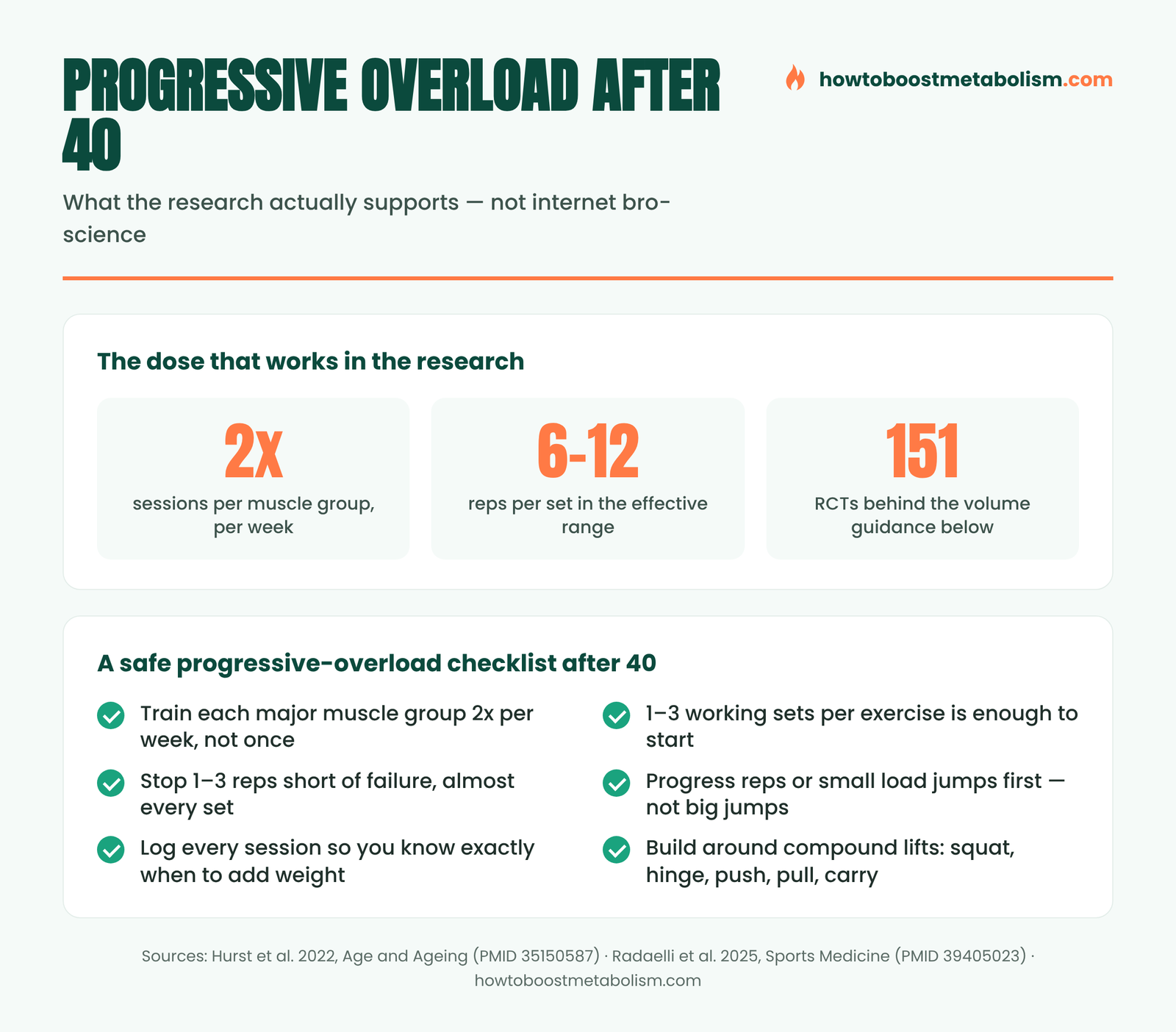
The most useful single data point for this topic comes from a 2025 network meta-analysis in Sports Medicine (PMID 39405023) that pooled 151 randomized trials and over 6,300 older adults (60+, so the results are, if anything, conservative for people in their 40s and 50s). It found that a low resistance-training volume — think one to a few sets per exercise — was already enough to meaningfully improve lean body mass and lower-body muscle size, and was actually the most effective volume tier for improving walking speed and get-up-and-go function. Moderate and high volumes pulled ahead specifically for maximum strength gains, but even there, the gap wasn’t enormous. The practical takeaway: you don’t need a two-hour, high-volume program to maintain or build muscle after 40. You need consistency at a dose that’s realistic to sustain for years, not months.
The Prescription That Actually Gets Used in Clinical Research
When researchers design resistance-training programs to treat age-related muscle loss (sarcopenia), they tend to converge on something strikingly simple. A 2022 review in Age and Ageing (PMID 35150587) lays out the core prescription: two sessions per week, combining upper- and lower-body exercises, performed for 1–3 sets of 6–12 reps at a relatively high — but not maximal — level of effort. That’s the entire evidence-based starting template. It’s not flashy, and it won’t sell a $200 program on its own, but it’s what actually shows up when you follow the research instead of a influencer’s “what I do” video.
A Realistic 12-Week Progression (At a Glance)
| Weeks | Sets x Reps | Effort Level | How You Progress |
|---|---|---|---|
| 1–2 | 2 sets x 10–12 | Leave 3–4 reps in reserve | Learn the movement pattern; don’t chase load yet |
| 3–4 | 2–3 sets x 10–12 | Leave 2–3 reps in reserve | Add 1–2 reps per set before adding any weight |
| 5–8 | 3 sets x 8–10 | Leave 1–2 reps in reserve | Small load increase (2–5%) once top of rep range is easy |
| 9–12 | 3 sets x 6–8 | Leave 1–2 reps in reserve | Alternate adding load and adding a 4th set on key lifts |
This isn’t a rigid prescription — it’s a template. If a week feels harder than usual because you slept badly or you’re stressed at work, repeating the previous week’s numbers is a completely legitimate choice. Progressive overload is measured in months, not individual sessions.
The Mistakes That Actually Cause Problems After 40
- Jumping load too fast. A 10–20% week-over-week increase can outrun how quickly tendons adapt, even when muscles feel ready.
- Skipping a warm-up ramp. Two or three light-to-moderate warm-up sets before your working sets cost two minutes and meaningfully lower injury risk.
- Training to failure on every set, every session. The research above suggests this adds risk without adding much benefit for most people in this stage of training.
- Programs with zero progression plan. Lifting the same weight for the same reps for six months isn’t overload — it’s maintenance, which has its place but won’t build strength.
- Ignoring one joint that keeps complaining. Mild muscle fatigue the next day is normal; the same sharp joint pain showing up after every session is a signal to modify the exercise, not push through it.
Recovery Matters As Much As the Workout
Progressive overload only works if your body actually recovers between sessions — otherwise you end up accumulating fatigue instead of adaptation. Two things matter most here: sleep and protein. Most research in this age group uses roughly 1.2–1.6 grams of protein per kilogram of body weight per day to support muscle repair, spread across 3–4 meals rather than one large dose at dinner. If you are not sure which protein source fits your routine, we compared the options in whey vs. plant protein for fat loss and muscle. Skipping sleep, on the other hand, blunts strength gains even when the training program itself is perfect — aim for 7+ hours on the nights before and after your harder sessions, since that is when most of the actual muscle-building happens.
Where a Structured Program Can Help
Following a template like the one above works well once you understand the principles. If you’d rather not build your own spreadsheet, a structured program that’s explicitly built around people in midlife can shortcut a lot of the guesswork — the main thing to check is whether it actually follows progressive-overload logic (gradually increasing reps, sets, or load over defined phases) rather than just handing you a random new workout every week.
Old School New Body is a structured strength program built specifically for the 40+ crowd, using short full-body sessions and a defined progression scheme (the author’s F4X method) instead of random daily workouts. We reviewed it in full, including where its marketing oversells the science — worth reading before you buy anything.
Read Our Full Review →Affiliate link — we may earn a commission at no extra cost to you. Disclosure
For a deeper look at why building muscle matters for your metabolism in the first place, see our honest breakdown of whether building muscle really boosts metabolism. And if you are brand new to lifting, start with our beginner’s guide to strength training before layering on a progression scheme.
Free download: our Metabolism Starter Kit — a protein calculator, a 7-day meal framework, and a one-page supplement checklist, with zero hype.
Get the Free Starter Kit →Signs You’re Progressing Too Fast
- Joint pain (not muscle soreness) that shows up during the lift itself, not the next day
- Your form breaks down noticeably before you hit your target reps
- You’re sore for more than 4–5 days after a session that used to leave you fine in 2
- Your resting heart rate or sleep quality is trending worse week over week
- You dread the next session instead of feeling ready for it
If any of that sounds familiar, it is worth revisiting your plan with the help of our guide on how to structure training and recovery after 40, or checking in with a physical therapist or trainer experienced with this age group before adding any more load.
Related: Once you’ve got the overload principle down, the next question is usually about rep speed — we tested the evidence on whether lifting slower builds more muscle.
Related: If you’re sore after a progressive-overload session and wondering what that means, see our breakdown of what muscle soreness actually signals about growth.
Related: Progressive overload is only half the equation — see how rep range affects muscle growth vs. fat loss for the other half.
Related: Supplements are a distant second to training basics like progressive overload — but if you’re also weighing whether HMB is worth adding, we broke down what two meta-analyses found about HMB and muscle loss.
Related: Once you’ve got the progression dialed in, the next question is how many sets per week you actually need — see what the research says about training volume landmarks (MEV, MAV, and MRV).
Related: Progressive overload isn’t the only tool for a cranky joint — our guide to isometric training for joint pain after 40 covers a research-backed way to keep training through a flare-up.
Related: Progressive overload applies to single-limb work too — here’s what the research says about unilateral vs. bilateral training after 40.
Frequently Asked Questions
Is it safe to lift heavy weights after 40?
Yes, for most healthy adults — the research cited above includes people well into their 60s, 70s, and even 80s making real strength and muscle gains. “Heavy” should still be reached gradually, with a proper warm-up and 1–3 reps left in reserve on most sets, rather than jumping straight to maximal loads.
How often should I increase the weight when applying progressive overload after 40?
Roughly every 1–2 weeks for a given exercise, and only once you can complete all your target sets and reps with 2–3 reps left in reserve. Smaller, more frequent increases (2–5%) are easier on tendons than occasional big jumps.
Do I need to train to failure to build muscle after 40?
No. A 2022 meta-analysis (PMID 33497853) found no significant overall advantage of training to failure versus stopping a few reps short for either strength or muscle growth, and non-failure training actually favored strength gains when volume wasn’t matched between groups.
How many sets and reps are actually needed for progressive overload in your 40s and 50s?
Clinical exercise research on this age group commonly uses 1–3 sets of 6–12 reps per exercise, twice per week per muscle group, at a challenging but sub-maximal effort. That modest dose is enough to meaningfully improve lean mass, strength, and function.
What’s the biggest mistake people over 40 make with progressive overload?
Increasing load too quickly without a progression plan, and skipping a proper warm-up ramp. Tendons and connective tissue typically adapt more slowly than muscle does, so load jumps that feel fine for the muscle can still overload a joint.
This article is for educational purposes and isn’t personalized medical or fitness advice. If you have an existing injury, joint condition, or chronic health condition, talk to a doctor or physical therapist before starting or changing a resistance-training program.