Partial Reps vs. Full Range of Motion for Muscle After 40
This article may contain affiliate links. If you buy through them, we may earn a small commission at no extra cost to you. See our Affiliate Disclosure and Medical Disclaimer.
If you’ve spent any time in a gym after 40, you’ve probably heard both pieces of advice with equal confidence: “go all the way down, full range of motion builds real muscle” and “partial reps protect your joints and let you load more weight.” Both can’t be the default best answer, so which one actually holds up? A cluster of research from 2020 through 2026 gives a surprisingly clear general answer — with one specific, well-documented exception that’s worth knowing about.
| At a Glance | Partial Reps vs. Full Range of Motion |
|---|---|
| General rule | Full range of motion builds more strength and hypertrophy on average |
| Key exception | Lengthened partials (stretch-position partials) can match full ROM |
| Squat-specific finding | Full-depth squats reduced pain and stiffness more than partial squats |
| Best use for partials | Targeted extra volume, not a wholesale replacement for full ROM |
| Who should be most careful | Lifters assuming shallow reps are automatically the ‘joint-friendly’ choice |
What the Biggest Review Found
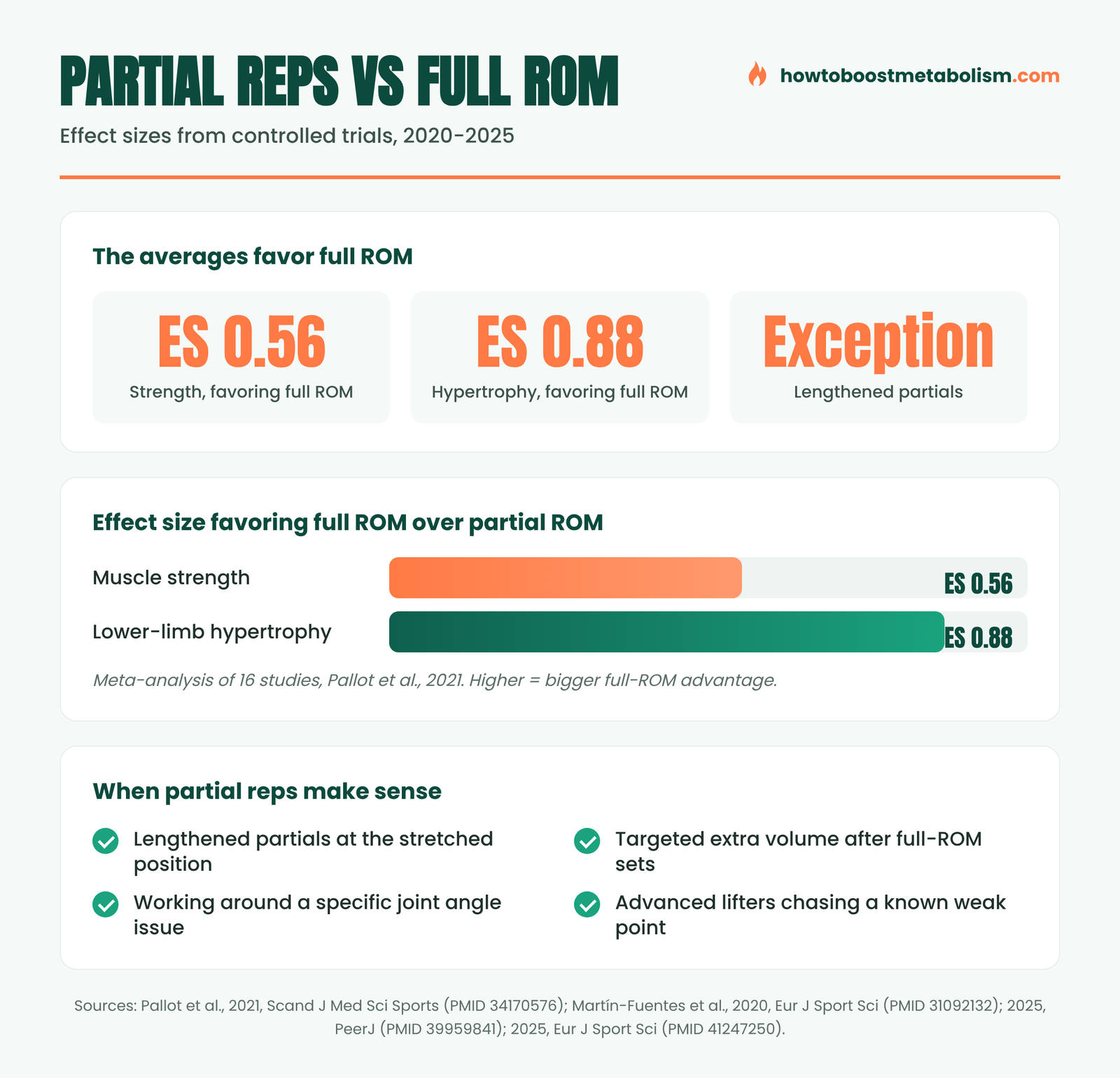
The most comprehensive answer so far comes from a 2021 systematic review and meta-analysis in the Scandinavian Journal of Medicine & Science in Sports (https://pubmed.ncbi.nlm.nih.gov/34170576/), which pooled 16 studies comparing full and partial range-of-motion resistance training. The result wasn’t close: full ROM training produced significantly greater gains in muscle strength (effect size 0.56, p = 0.004) and lower-limb hypertrophy (effect size 0.88, p = 0.027) than partial ROM training. Functional performance trended in favor of full ROM too, though that particular comparison didn’t reach statistical significance. Only one measure showed no real difference between the two approaches: changes in muscle architecture itself — muscle thickness, pennation angle, and fascicle length were broadly similar either way.
In plain terms: if you’re doing the same exercise, the same number of sets, and comparing full depth to a shortened range, full depth is the better bet for getting stronger and building muscle, based on the weight of evidence available right now.
The Real Exception: Lengthened Partials
Here’s where it gets genuinely interesting. A 2025 study in PeerJ (https://pubmed.ncbi.nlm.nih.gov/39959841/) compared lengthened partial repetitions — reps performed specifically in the stretched half of a movement — against full range-of-motion training in already-trained individuals, and found the two approaches produced similar muscular adaptations. That’s not a one-off finding, either: a separate 2025 study on elbow flexor training (https://pubmed.ncbi.nlm.nih.gov/41247250/) using partial reps limited to the stretched portion (0-70 degrees) versus full range (0-140 degrees) found partial-ROM training showed a trivial-to-small advantage at the longer muscle lengths specifically, with comparable gains in muscle thickness overall.
The pattern across this newer research is specific, not general: it’s partial reps taken in the stretched position of a lift — think the bottom portion of a dumbbell fly, a Romanian deadlift, or a deep lunge — that come close to matching full ROM. Partial reps taken from the top, shortened half of a movement (think quarter squats or the top half of a bicep curl) are a different animal entirely and are not what these studies tested — there’s no comparable evidence that top-range partials carry the same benefit.
Free download
🔥 The Metabolism Starter Kit
3 honest guides: a 7-day reset plan, a foods cheat-sheet and 12 metabolism myths debunked. No spam — unsubscribe anytime.
The Squat-Specific Finding That Surprises People
A lot of lifters over 40 default to shallower squats on the assumption that less depth means less stress on aging knees. A controlled 10-week trial (https://pubmed.ncbi.nlm.nih.gov/31092132/) tested exactly this assumption directly: 53 resistance-trained men were split into full squat, parallel squat, half squat, and control groups, training with the same relative load and the same linear periodization for 10 weeks. The full squat group was the only one that improved 1-rep max and bar velocity across all three squat depths tested, achieved the best functional performance (countermovement jump, 20-meter sprint, Wingate test), and — this is the part that cuts against the common assumption — reported the biggest reductions in pain and stiffness. The half squat group showed essentially no improvement in neuromuscular or functional performance at all.
This doesn’t mean everyone with cranky knees after 40 should force themselves into ass-to-grass squats tomorrow — individual mobility, injury history, and pain response vary, and working with a coach or physical therapist on your specific limitations matters more than any general study. But it does mean the common assumption — “shallow equals safer for aging joints” — isn’t automatically true, and in this particular trial, the opposite held. Our guide to Bulgarian split squats covers a related option for lifters working around limited squat depth or mobility.
If working through a full, controlled range of motion on your main lifts feels like more than your current program accounts for, a structured plan built for lifters returning to training after 40 — rather than a generic routine built for 25-year-olds — tends to make that transition much smoother. Old School New Body’s F4X method is built around exactly that kind of gradual, moderate-load progression.
Learn More →Affiliate link — we may earn a commission at no extra cost to you. Disclosure
Note: the program’s sales page uses marketing claims like “your body ages six months faster for every year after 35” — that’s promotional language, not a cited statistic, so weigh it accordingly. The underlying training approach is a reasonable, well-established one regardless of how it’s marketed.
Why Does Full Range of Motion Usually Win?
The leading explanation isn’t just “more range equals more work,” though that’s part of it. Training a muscle through its full length — especially its lengthened, stretched position — appears to create a stronger hypertrophy stimulus than training only the mid-range or shortened portion of a lift. Researchers sometimes call this stretch-mediated hypertrophy: the idea that mechanical tension applied while a muscle is stretched sends a particularly strong growth signal, which is also why lengthened partials — reps that isolate exactly that stretched portion — perform almost as well as the full movement despite covering less total distance. Shortened, top-range partials don’t get that same benefit, because they skip the stretched position entirely rather than emphasizing it.
There’s a practical side to this too. Full range of motion also trains the joint and surrounding tissue through the positions it actually needs to be strong and mobile in day-to-day life — getting up from a low chair, picking something up off the floor, stepping down a curb. A muscle that’s only ever strong through a narrow mid-range doesn’t necessarily transfer that strength to the end ranges most real-world tasks require, which may be part of why the full-squat group in the 10-week trial above saw bigger functional performance gains, not just bigger strength numbers on paper.
Common Mistakes
- Treating any shortened, top-range partial rep as equivalent to a “lengthened partial” — the research exception applies specifically to the stretched portion of a lift, not the top half.
- Cutting range of motion to move more weight on a lift, then counting that as progress — a heavier partial rep is not the same achievement as a heavier full rep, and comparing the two numbers is misleading.
- Avoiding full depth indefinitely out of a general fear of knee or joint stress, rather than identifying and addressing the specific mobility limitation that makes full range uncomfortable.
- Using lengthened partials as the entire session rather than as a deliberate add-on to full-ROM work — the supporting studies tested partials as a comparison condition or a targeted technique, not as someone’s only training method long-term.
How to Actually Use This
- Default to full range of motion on your main compound lifts (squats, presses, rows, deadlifts) where your mobility allows it comfortably.
- Add lengthened partials deliberately — for example, after your working sets on an exercise like a Romanian deadlift or a deep lunge — as extra, targeted stretch-position volume, not a replacement for your main sets.
- Don’t assume shallow equals joint-friendly. If depth genuinely hurts, work on the specific mobility limiting you (ankles, hips) with a professional’s input rather than permanently training in a shortened range as a workaround.
- Combine with smart intensity techniques. Full-ROM training pairs well with approaches like cluster sets or myo-reps and rest-pause training if you’re trying to add intensity without adding a lot of extra time under the bar.
A Note on Rep Range and Tempo
Range of motion is one variable among several that interact with how a set actually trains your muscles — rep range and tempo matter too. If you’re also unsure whether you should be chasing 5 reps or 15, our guide to rep ranges for muscle growth versus fat loss covers that piece, and our breakdown of rep tempo and time under tension covers how fast or slow you move through whatever range of motion you choose. None of these variables works in isolation — range of motion, tempo, and rep range all combine to determine how much actual stimulus a set delivers.
The bottom line for most lifters past 40: don’t shorten your range of motion by default in the name of joint safety, and don’t dismiss partial reps outright either — the honest, evidence-based position sits in between. Full range of motion is the better general default on your main lifts, and lengthened partials earn a specific, deliberate place as an add-on technique rather than a wholesale replacement.
Free download: our Metabolism Starter Kit — a protein calculator, a 7-day meal framework, and a one-page supplement checklist, with zero hype.
Get the Free Starter Kit →Frequently Asked Questions
Do partial reps build less muscle than full range of motion?
On average, yes — a 2021 systematic review and meta-analysis found full range-of-motion training produced significantly greater gains in both muscle strength (effect size 0.56) and lower-limb hypertrophy (effect size 0.88) than partial range-of-motion training. But averages hide an important exception: partial reps performed specifically at a long muscle length (near full stretch) have come close to matching full ROM in several more recent trials.
What are ‘lengthened partials’ and why do they seem to work?
Lengthened partials are partial reps performed in the stretched portion of a movement — for example, the bottom half of a squat or the bottom half of a biceps curl, where the muscle is under the most tension while lengthened. A 2025 trial found lengthened partials produced muscle adaptations similar to full range of motion in trained lifters, and other recent research on elbow flexors found a similar pattern. This looks like a genuine exception to the general full-ROM advantage, not just marketing.
Are partial squats safer for sore or stiff knees after 40?
Not necessarily, and the evidence actually points the other way for squats specifically. A controlled 10-week trial comparing full, parallel, and half squats found the full-depth squat group had the largest reductions in pain and stiffness, plus the biggest strength and functional performance gains — partial squats didn’t protect the group that used them from pain, and produced smaller gains across the board.
Should I switch entirely to full range of motion training?
For most main compound lifts, full ROM within a comfortable, controlled range is the better default based on the overall evidence. But lengthened partials have a legitimate place as an intentional technique — for example, as a way to add targeted volume to a specific muscle at the end of a workout, or to work around a joint angle that genuinely bothers you — rather than as a shortcut used throughout an entire session.
Does training age or being over 40 change any of this?
The specific studies cited here were done mostly in trained or recreationally active adults rather than exclusively older populations, so some caution in extrapolating is warranted. That said, nothing in the research suggests the general pattern reverses with age — if anything, the full-squat trial’s finding of less pain and stiffness with full-depth training is a useful data point for lifters over 40 who assume shallower, more ‘protective’ reps are automatically the safer choice.