Overtraining After 40: Normal Fatigue or Doing Too Much?
This article may contain affiliate links. If you buy through them, we may earn a small commission at no extra cost to you. See our Affiliate Disclosure and Medical Disclaimer.
If you’re over 40 and lifting or training hard, you’ve probably had this thought: is this normal tired, or have I actually overdone it? It’s a fair question, because the two feel similar in the moment and the advice online ranges from “just push through it” to “your cortisol is destroying your gains.” Neither is quite right. Here’s what the research on overtraining actually shows, including the uncomfortable part: the simple blood test you’d expect to settle this doesn’t work very well.
Three Different Things, Often Confused
Sports medicine treats fatigue on a spectrum, and the terms matter because the fix is different for each one, according to the widely cited practical guide on overtraining syndrome (OTS) by Kreher & Schwartz, 2012, Sports Health:
- Normal training fatigue — you’re tired after a hard session or a hard week, performance dips slightly, and you bounce back within a few days of easier training.
- Functional overreaching — a deliberate, short block of harder-than-usual training (common in periodized programs) that causes a temporary performance dip, followed by a supercompensation bounce once you back off. This is often intentional and not a problem.
- Overtraining syndrome (OTS) — performance decline and fatigue that persist for weeks to months despite rest, often with mood changes, sleep disruption, and hormonal and immune disturbances. This is the one you want to avoid.
The authors are blunt about one thing: OTS “remains a clinical diagnosis” with no single definitive test. That’s the part most “check your cortisol” advice skips over.
Why Checking Your Cortisol Doesn’t Actually Settle It
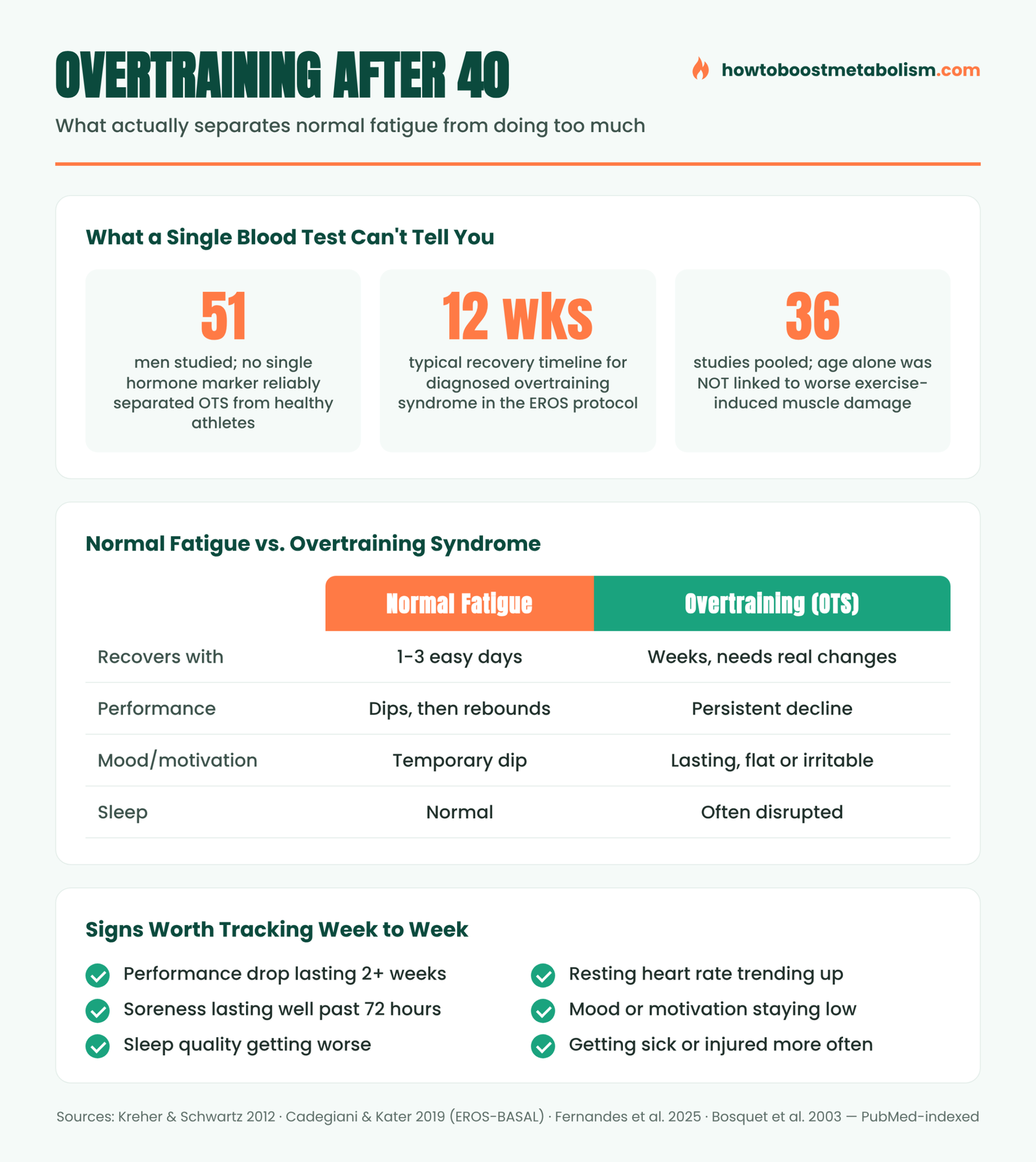
It’s a reasonable instinct — cortisol and testosterone are stress and anabolic hormones, so a testosterone:cortisol ratio sounds like it should flag overtraining. In practice, it’s much messier. In the EROS-BASAL study (Cadegiani & Kater, 2019, Journal of Athletic Training), researchers compared 51 men — athletes diagnosed with overtraining syndrome, healthy athletes, and sedentary controls — across a full panel of hormonal and biochemical markers (testosterone, cortisol, thyroid hormones, catecholamines, inflammatory markers, and more). No single marker, including the testosterone:cortisol ratio, reliably separated the OTS group from the healthy athletes on its own.
A separate study on recovery from diagnosed OTS (Cadegiani et al., 2021, International Journal of Sports Physiology and Performance) found that after a 12-week intervention — more calories, less training, better sleep, and stress management — several hormone markers did shift in the expected direction (cortisol awakening response, growth hormone response, testosterone:estradiol ratio), but body composition and overall metabolism barely moved in that window. In other words: hormones can move in the right direction before you feel or look any different, and they can look fine while you still feel terrible. A single lab test, taken on its own, isn’t a reliable yes/no answer.
Free download
🔥 The Metabolism Starter Kit
3 honest guides: a 7-day reset plan, a foods cheat-sheet and 12 metabolism myths debunked. No spam — unsubscribe anytime.
What About a Smartwatch and Heart Rate Variability?
Heart rate variability (HRV) monitoring is popular now, and the logic is appealing: more training stress, less HRV. The evidence is mixed. In one small but telling study of nine endurance athletes who deliberately doubled their training volume for four weeks (Bosquet et al., 2003, Journal of Sports Medicine and Physical Fitness), overtraining was confirmed in six of them using physiological and psychological criteria — but their overnight HRV showed no statistically significant change compared to baseline. The authors concluded that night-time HRV, at least in that protocol, wasn’t a dependable marker of overtraining. Newer consumer wearables use different algorithms and longer tracking windows, so this isn’t the final word — but it’s a reason not to treat a single “low HRV” morning as proof you’re overtrained. A trend over weeks tells you more than any one reading.
The “I’m 40+, So I Need Way More Recovery” Assumption
A lot of overtraining anxiety after 40 comes from the belief that older muscle is simply more fragile and slower to repair — so any missed rest day is riskier. A 2025 systematic review and meta-analysis (Fernandes et al., Journal of Aging and Physical Activity) pooling 36 studies that directly compared older and younger adults after muscle-damaging exercise found something that cuts against the common narrative: advancing age, on its own, was not associated with greater exercise-induced muscle damage. That’s a genuinely useful, if unglamorous, finding — it means the recovery gap many lifters over 40 assume they have may be smaller than they think, and it reframes overtraining risk as mostly about training load, sleep, stress, and nutrition rather than age being an automatic penalty. It does not mean recovery habits stop mattering — it means age by itself is a weaker predictor than how you’re actually managing training stress.
At a Glance: Normal Fatigue vs. Overreaching vs. Overtraining
| Type | Typical recovery time | Performance pattern | Mood & sleep |
|---|---|---|---|
| Normal training fatigue | 1-3 easy/rest days | Dips briefly, then normal | Unaffected |
| Functional overreaching | A few days to 1-2 weeks | Dips, then rebounds higher | Brief dip, recovers |
| Overtraining syndrome | Weeks to months, needs real changes | Persistent decline | Often disrupted, flat mood |
The Signs That Actually Matter More Than a Lab Test
Since no single biomarker nails the diagnosis, the most practical approach — consistent with Kreher and Schwartz’s clinical guidance — is tracking a small set of simple signals over 2-4 weeks, not any one bad day:
- Performance that won’t rebound. A few bad sessions is normal. The same weight feeling heavier for 2+ weeks, with no life stressors to explain it, is the clearest red flag.
- Resting heart rate creeping up over several mornings in a row, not just one.
- Soreness that outlasts 72 hours repeatedly, especially from sessions that used to feel normal.
- Motivation and mood that stay low, not just “I don’t feel like training today.”
- Sleep that’s getting worse despite being tired — trouble falling asleep, or waking up unrefreshed.
- Getting sick, injured, or achy more often than usual over a multi-week stretch.
One or two of these for a day or two is just a hard week. Several of them, stacking for two or more weeks, is the actual signal worth acting on.
What to Do If This Sounds Like You
The intervention that produced measurable (if slow) recovery in the EROS-LONGITUDINAL study wasn’t exotic: more calories, a real reduction in training load, better sleep, and active stress management, sustained for 12 weeks. For most lifters over 40 who are closer to overreaching than full-blown OTS, a shorter version works:
- Cut training volume (not necessarily intensity) by roughly a third for 1-2 weeks.
- Prioritize 7-9 hours of sleep — this moves the needle more than almost any other single change.
- Make sure you’re eating enough, especially protein and total calories, not under-fueling a hard training block.
- Track resting heart rate, sleep, and mood for 2 weeks before deciding whether you need a longer break.
- If nothing improves after 2-3 weeks of genuinely easier training, that’s the point to involve a doctor — persistent fatigue has other causes worth ruling out, from thyroid issues to iron deficiency to simple underfueling.
Related: if a lot of your fatigue is showing up as soreness that won’t quit, our breakdown of what DOMS actually means and when it is worth worrying about covers that specific signal in more depth. And if you suspect your training volume itself is the real culprit, see our guide to volume landmarks (MEV/MAV/MRV) for how to find the ceiling before you hit it.
Planned Rest Beats Reactive Rest
The cheapest fix is the one that happens before a problem shows up: a deload. Scheduling a lighter week every 4-8 weeks, rather than waiting for performance to crater, is standard practice in strength programming for exactly this reason — see our full guide on deload weeks after 40 for how to structure one. Lifters who build this in rarely need the more drastic 12-week reset described above.
If you’re newer to structured lifting, it’s also worth knowing that early, fast progress naturally slows down on its own — see why “newbie gains” happen and why they fade — so a normal plateau isn’t automatically a sign that something has gone wrong.
Triggers That Hit Harder After 40 (Even If Age Itself Isn’t the Core Problem)
The Fernandes meta-analysis above is reassuring, but it doesn’t mean nothing changes after 40 — it means the usual suspects are rarely age by itself. A few things do tend to stack up more at this stage of life, and they’re worth naming because they’re fixable, unlike age:
- Training load plus everything else. A demanding job, kids, caregiving, and a hard training block don’t show up separately on any biomarker — but they share the same recovery budget. Total life stress, not just the workout, is what the EROS research treats as part of the overtraining picture.
- Sleep quality shifting with age, independent of training. Lighter, more fragmented sleep is common from the 40s onward for reasons that have nothing to do with the gym, which means the same training load now has less recovery to work with than it did at 25.
- More years of accumulated joint and tendon wear. Tendons adapt more slowly than muscle, so a training error that a 25-year-old shrugs off can show up as a nagging ache that lingers for weeks in a lifter with two decades of prior wear and tear.
- Underestimating how much easier “easy” needs to be. Many lifters over 40 keep every session at a similar effort level instead of building in genuinely easy days, which removes the contrast that makes a deload actually restorative.
None of these require giving up hard training — they just mean the recovery side of the equation deserves as much deliberate planning as the programming side.
A Simple Weekly Check-In
You don’t need a lab or a $300 wearable to apply any of this. A two-minute weekly check, written down somewhere you’ll actually see again, catches most real problems early:
- Rate this week’s training performance 1-5 compared to a typical week.
- Rate sleep quality 1-5 for the week, not just last night.
- Rate mood and motivation to train 1-5.
- Note resting heart rate on 2-3 mornings, if you track it.
- Note any soreness that lasted past 72 hours, and from which session.
A single bad week on this log is normal life. Two or three consecutive weeks where performance, sleep, and mood are all trending down together is the specific pattern the research above points to — and it’s the point to deliberately back off before it becomes a multi-month problem.
If you’re structuring a fasting-and-training approach and want a plan that accounts for recovery rather than just pushing harder, Brad Pilon’s Anabolic Fasting program is one option many lifters over 40 use. A fair warning: marketing lines about building muscle and burning fat “at the same time” are sales copy, not a guarantee — think of it as a structured fasting-plus-training framework, not a shortcut around recovery.
See the Program →Affiliate link — we may earn a commission at no extra cost to you. Disclosure
Free download: our Metabolism Starter Kit — a protein calculator, a 7-day meal framework, and a one-page supplement checklist, with zero hype.
Get the Free Starter Kit →Related Reading
For supplements that may blunt the cortisol response, see ashwagandha vs. L-theanine for cortisol.
Frequently Asked Questions
Can a blood test tell me if I’m overtrained?
Not reliably on its own. In a 2019 study of 51 men (EROS-BASAL), no single hormone marker — including the testosterone:cortisol ratio — clearly separated athletes with diagnosed overtraining syndrome from healthy athletes. Diagnosis is still mostly clinical: tracking performance, mood, sleep, and recovery trends over weeks.
Does my smartwatch’s HRV score mean anything?
Treat a single low reading as noise, not a diagnosis. A small 2003 study found overnight heart rate variability didn’t significantly change in athletes who were independently confirmed to be overtrained. A multi-week downward trend is more informative than any one night.
Do I really need more recovery time than a 25-year-old?
Maybe less than you’d think. A 2025 meta-analysis of 36 studies found that age alone was not associated with greater exercise-induced muscle damage. Training load, sleep, and nutrition likely matter more than age by itself.
How long does it take to recover from real overtraining syndrome?
In the 12-week EROS-LONGITUDINAL intervention — more calories, less training, better sleep, stress management — hormone markers moved toward recovery, but full normalization of metabolism and body composition was still incomplete at 12 weeks. Mild overreaching recovers much faster, often in 1-2 weeks.
What’s the single best early warning sign?
A performance decline that doesn’t bounce back within a few easier days, especially when it’s paired with low motivation and worse sleep. Any one of those alone is common; all three together for two or more weeks is the pattern worth acting on.
This article is for educational purposes and is not medical advice. Persistent fatigue, mood changes, or performance decline can have several causes — see our Medical Disclaimer and talk to a doctor if symptoms persist beyond a few weeks of easier training.