Ice Baths After Lifting: Do They Block Muscle Growth?
This article may contain affiliate links. If you buy through them, we may earn a small commission at no extra cost to you. See our Affiliate Disclosure and Medical Disclaimer.
Jumping into a cold tub after a brutal leg day has become a fitness-culture ritual — ice baths, cold plunge tubs, and even dedicated cold-therapy studios have exploded in popularity. The sensory payoff is real: cold water genuinely reduces soreness and makes you feel recovered faster. But if the actual goal of your training is building or keeping strength and muscle after 40, the research asks a less comfortable question: are you accidentally undoing part of the workout you just did?
We went through the foundational studies and the most recent (2026) umbrella review pooling 15 separate systematic reviews to give you a straight answer, not a wellness-industry one.
You may also find this useful: Does Cardio Cancel Out Your Strength Gains?
The Study That Started the Debate
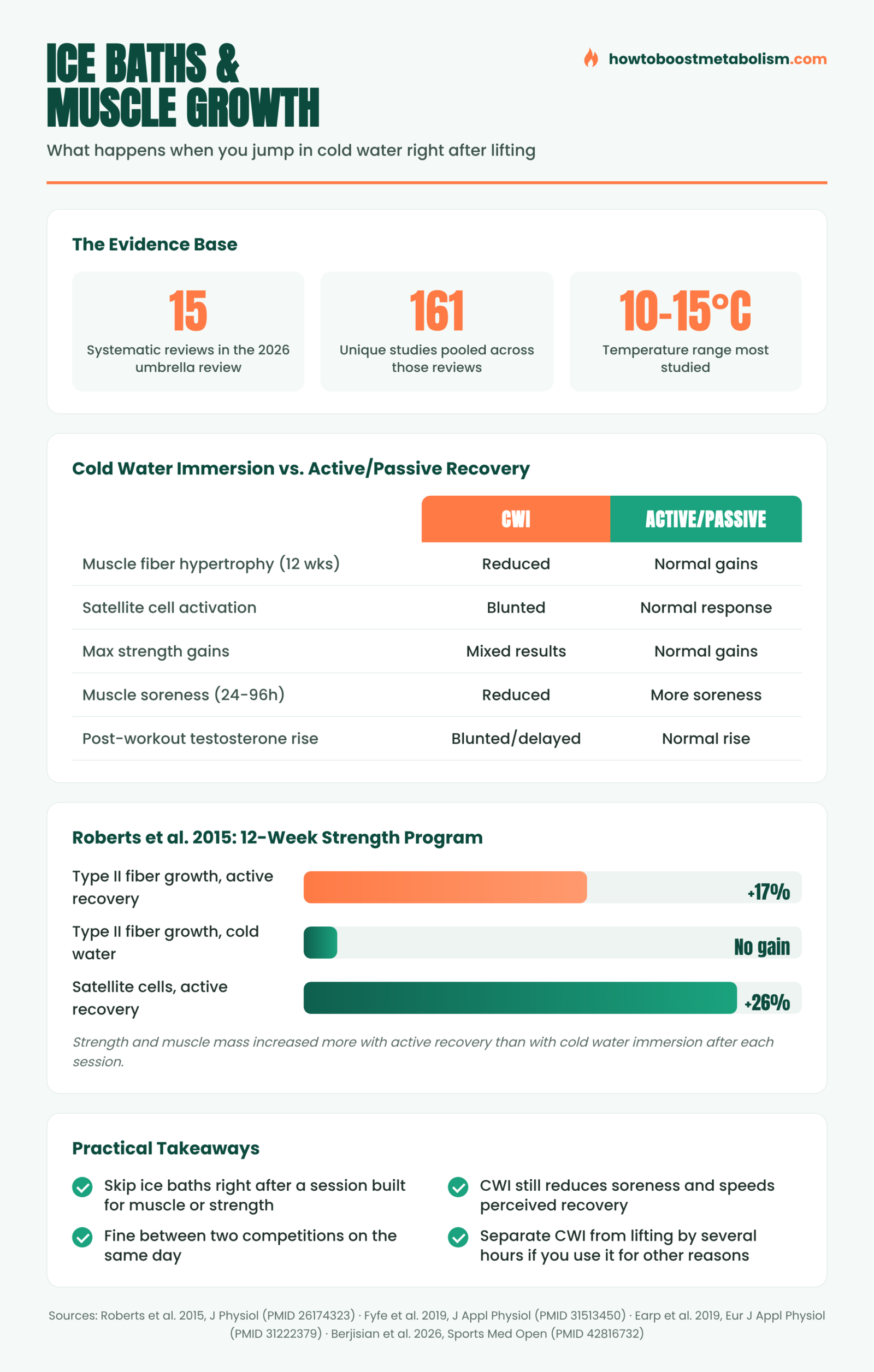
The clearest answer comes from a pair of studies published in The Journal of Physiology in 2015, led by researcher Llion Roberts (PMID 26174323). In the first, 21 physically active men strength trained twice a week for 12 weeks, with half doing 10 minutes of cold water immersion after each session and the other half doing active recovery instead. Strength and muscle mass increased more in the active-recovery group. Isokinetic work capacity, type II (fast-twitch) muscle fiber cross-sectional area, and the number of myonuclei per fiber — all key markers of real hypertrophy — increased significantly in the active-recovery group but not in the cold water group.
See also: muscle soreness (DOMS): what it actually signals
In a second part of the same study, muscle biopsies after a single bout of leg exercise showed that satellite cells — the specialized cells that get activated to help repair and grow muscle fiber — increased markedly less with cold water immersion than with active recovery. The researchers’ own conclusion was blunt: “The use of CWI as a regular post-exercise recovery strategy should be reconsidered.”
A Second Trial Found a More Nuanced Picture
A 2019 study in the Journal of Applied Physiology, led by Jackson Fyfe, tested 16 men over 7 weeks of whole-body resistance training, 3 days a week, comparing 15 minutes of cold water immersion at 10°C against passive recovery at a neutral temperature (PMID 31513450). The result was more specific than a blanket “cold water is bad”: one-rep-max strength gains in the leg press were similar between groups, but type II muscle fiber cross-sectional area — the actual size gain — was significantly attenuated in the cold water group. At the molecular level, markers of muscle protein synthesis signaling were blunted after training, while a marker of protein breakdown was increased. The authors’ conclusion, directly from the paper: “Post-exercise CWI should therefore be avoided if muscle hypertrophy is desired.”
That’s an important nuance for anyone training primarily for strength rather than size: the strength signal may survive cold water immersion better than the size signal does. But if visible muscle, not just a number on the bar, is part of your goal — which it is for most people doing structured hypertrophy-focused training after 40 — the evidence leans toward skipping the ice bath.
Free download
🔥 The Metabolism Starter Kit
3 honest guides: a 7-day reset plan, a foods cheat-sheet and 12 metabolism myths debunked. No spam — unsubscribe anytime.
It’s Not Just Muscle Fibers — Hormones Take a Hit Too
A 2019 study published in the European Journal of Applied Physiology, led by Jacob Earp, had 11 resistance-trained men complete a standardized heavy squat workout (6 sets of 10 reps at 80% of their max) on two separate occasions, once followed by 15 minutes of cold water immersion and once by passive recovery, measuring blood hormone and inflammatory markers afterward (PMID 31222379). Circulating free testosterone rose less, and more slowly, after cold water immersion compared to passive recovery. Since the post-exercise hormonal response is one of several signals your body uses to drive adaptation, blunting it — even temporarily — fits the broader pattern of cold water interfering with the anabolic (muscle-building) side of training.
The 2026 Umbrella Review: Pulling 15 Reviews Together
The most current and comprehensive look at this question is a 2026 umbrella review in Sports Medicine – Open, led by Ershad Berjisian, which pooled 15 separate systematic reviews with meta-analyses covering 161 unique studies on post-exercise cold water immersion (PMID 42816732). Its conclusions are the most balanced summary available: cold water immersion reduced muscle soreness for up to 96 hours, improved jump performance and muscular power at 24-48 hours after high-intensity or eccentric exercise, and lowered creatine kinase (a marker of muscle damage) between 24 and 72 hours — real, measurable recovery benefits. But for anyone training to get stronger or bigger, the review found the opposite pattern for long-term adaptation: cold water immersion did not improve strength performance, and specifically impaired both strength and hypertrophic (muscle-building) gains over time. The review also rated the overall certainty of evidence as low to very low — a lot of small studies, not one slam-dunk trial — but the direction of the effect was consistent across the umbrella review.
At a Glance: Cold Water Immersion, Outcome by Outcome
| Outcome | What cold water immersion does |
|---|---|
| Muscle soreness (next 1-4 days) | Reduces it — a real, consistent benefit |
| Perceived recovery / readiness | Improves it short-term |
| Jump performance at 24-48h after hard training | Can improve it |
| Long-term strength gains | Mixed — may not be significantly impaired in every study |
| Long-term muscle hypertrophy | Consistently impaired across multiple trials |
| Post-workout testosterone response | Blunted and delayed |
A Narrative Review Summed It Up as “Mode-Dependent”
A widely cited 2021 narrative review in Frontiers in Sports and Active Living, titled plainly “Adaptations to Post-exercise Cold Water Immersion: Friend, Foe, or Futile?”, reached a similar conclusion: the effect of cold water immersion on training adaptations appears to be mode-dependent — resistance training adaptations tend to be diminished, while aerobic endurance performance seems largely unaffected and may even show some benefit in certain contexts (PMID 34337408). That distinction matters for how you use it: an endurance athlete icing down after a long run is in a different situation than a lifter icing down after a hypertrophy block.
What About the “Cold Exposure Boosts Metabolism” Claims?
It’s worth separating this question from a different one you may have seen floating around: whether cold exposure itself raises metabolic rate or helps with fat loss through brown fat activation. That’s a genuinely different topic from what’s covered here — we’ve looked at the calorie-burning claims around cold water and metabolism separately, and the honest short version is that any calorie effect from cold exposure is small and not a meaningful weight-loss strategy on its own. Today’s question is narrower and more specific to lifters: does putting your muscles in cold water right after a strength session interfere with how they adapt to that session. Those are two different cold-water conversations, and it’s easy to see headlines blur them together.
If You Do Use It, Here’s the Protocol the Research Actually Tested
| Variable | What most studies used |
|---|---|
| Water temperature | 10-15°C (roughly 50-59°F) |
| Duration | 10-15 minutes |
| Timing relative to training | Immediately to within a few minutes post-session |
| Frequency | After each training session, 2-4x per week in the long-term trials |
That’s useful context if you’re trying to make sense of a cold plunge tub marketed for home use: much milder or much shorter exposures than this haven’t been tested nearly as thoroughly, so claims about them blocking or not blocking hypertrophy are mostly guesswork extrapolated from these specific protocols.
Alternatives If You Want the Recovery Feel Without the Tradeoff
If what you’re really chasing is the feeling of being recovered — looser muscles, less soreness, a mental reset after a hard session — there are options that don’t carry the same documented interference with muscle-building signaling. Active recovery (light movement, a walk, easy cycling) was the comparison condition that outperformed cold water immersion in the original Roberts et al. trial. Foam rolling addresses some of the same soreness-and-stiffness complaint without the cold-water tradeoff, and simply respecting your deload and recovery scheduling addresses the underlying fatigue rather than masking it. None of these carry the same body of evidence showing interference with hypertrophy that cold water immersion does.
Watch for Signs You Need Recovery Help in the First Place
One more honest point: if you’re reaching for an ice bath after every single session because you feel wrecked, it may be worth stepping back and asking whether your overall training load, sleep, or stress is the real issue. The signs of overtraining and elevated cortisol after 40 are worth knowing, since no recovery modality — cold water or otherwise — fixes a program that’s simply asking more of your body than it can currently handle.
So Should You Give Up the Ice Bath?
Not necessarily — it depends entirely on what you’re using it for and when. If cold water immersion is your go-to recovery ritual right after a strength or hypertrophy-focused session, and your main goal is building or preserving muscle and strength after 40, the honest read of the research says you’re likely working against part of the adaptation you trained for. If you use it occasionally for how it feels, or you’re competing twice in one day and just need to feel less beat up for the second event, the soreness-reduction and recovery-feel benefits are real and well documented. The safest practical compromise suggested by several of these researchers: separate cold water immersion from your training session by several hours — same day is fine, but not immediately after — so you still get some of the perceived-recovery benefit without dousing the acute signaling window your muscles need to adapt. For most people training specifically to preserve or build muscle after 40, that small scheduling change costs nothing and sidesteps the entire debate.
Free download: our Metabolism Starter Kit — a protein calculator, a 7-day meal framework, and a one-page supplement checklist, with zero hype.
Get the Free Starter Kit →Related: Wondering if heat is a better recovery choice than cold after a lifting session? We looked at the flip side of this question in sauna and heat therapy after strength training after 40.
The best recovery tool for lifters over 40 isn’t an ice bath or a sauna — it’s a program that doesn’t require heroic recovery in the first place. Old School New Body is designed around that: moderate loads, short sessions, and progress that doesn’t depend on grinding. One honest caveat: ignore the age-related statistics on its sales page — they aren’t sourced — and judge the program by its structure, not the copy.
If recovery is the bottleneck, start with a program that respects it:
Check Availability →Affiliate link — we may earn a commission at no extra cost to you. Disclosure
Frequently Asked Questions
Do ice baths really block muscle growth?
The strongest controlled trials say yes, specifically for hypertrophy (muscle size). A 2015 study found reduced muscle fiber growth and satellite cell activity with cold water immersion compared to active recovery after 12 weeks of strength training (PMID 26174323), and a 2019 trial found the same pattern for muscle fiber size even though strength gains were similar between groups (PMID 31513450).
Does cold water immersion hurt strength gains too, or just muscle size?
The evidence is more mixed for pure strength than for hypertrophy. Some trials found strength gains were similar regardless of cold water use, while the 2026 umbrella review of 15 systematic reviews concluded cold water immersion did not improve strength performance and impaired both strength and hypertrophic gains across the pooled evidence (PMID 42816732).
Is it fine to use an ice bath if I just want less soreness?
Yes — reduced muscle soreness over the following 1-4 days is one of the most consistently reported benefits of cold water immersion across the research, including the 2026 umbrella review (PMID 42816732). The tradeoff is specifically with long-term muscle-building adaptations, not with how sore you feel the next day.
How long should I wait after lifting before an ice bath?
There’s no single proven number, but several researchers studying this question suggest separating cold water immersion from resistance training by several hours rather than doing it immediately post-workout, to avoid blunting the acute signaling window your muscles use to adapt.
Does cold water immersion affect endurance training the same way?
No — the research suggests the effect is mode-dependent. Resistance-training adaptations are the ones shown to be diminished by cold water immersion, while aerobic endurance performance appears largely unaffected and may even see some benefit in certain contexts (PMID 34337408).
Is cold exposure the same thing as the ‘cold boosts metabolism’ claim?
No — that’s a separate question about calorie burn and brown fat activation, not about training adaptation. Any metabolic effect from cold exposure on its own is small and not a meaningful weight-loss strategy; the topic here is specifically whether cold water right after lifting interferes with how your muscles adapt to that session.