EAA vs. Whey Protein for Muscle After 40: What Works
This article may contain affiliate links. If you buy through them, we may earn a small commission at no extra cost to you. See our Affiliate Disclosure and Medical Disclaimer.
Walk into any supplement aisle or scroll any fitness forum and you’ll find two camps shouting past each other: the whey protein loyalists and the EAA (essential amino acid) true believers. Both sides cite studies. Both sides are partly right. If you’re over 40 and trying to hold onto or build muscle while your recovery capacity and appetite aren’t quite what they were at 25, the EAA-vs-whey question isn’t academic — it affects your grocery bill, your gym bag, and whether you actually stick with a protein strategy long enough for it to matter.
This is not a “best supplement of 2026” listicle. It’s a breakdown of what the muscle protein synthesis (MPS) research actually shows about essential amino acids versus intact whey protein, where the two are functionally similar, where they diverge, and which one makes more sense for your specific situation after 40.
At a Glance
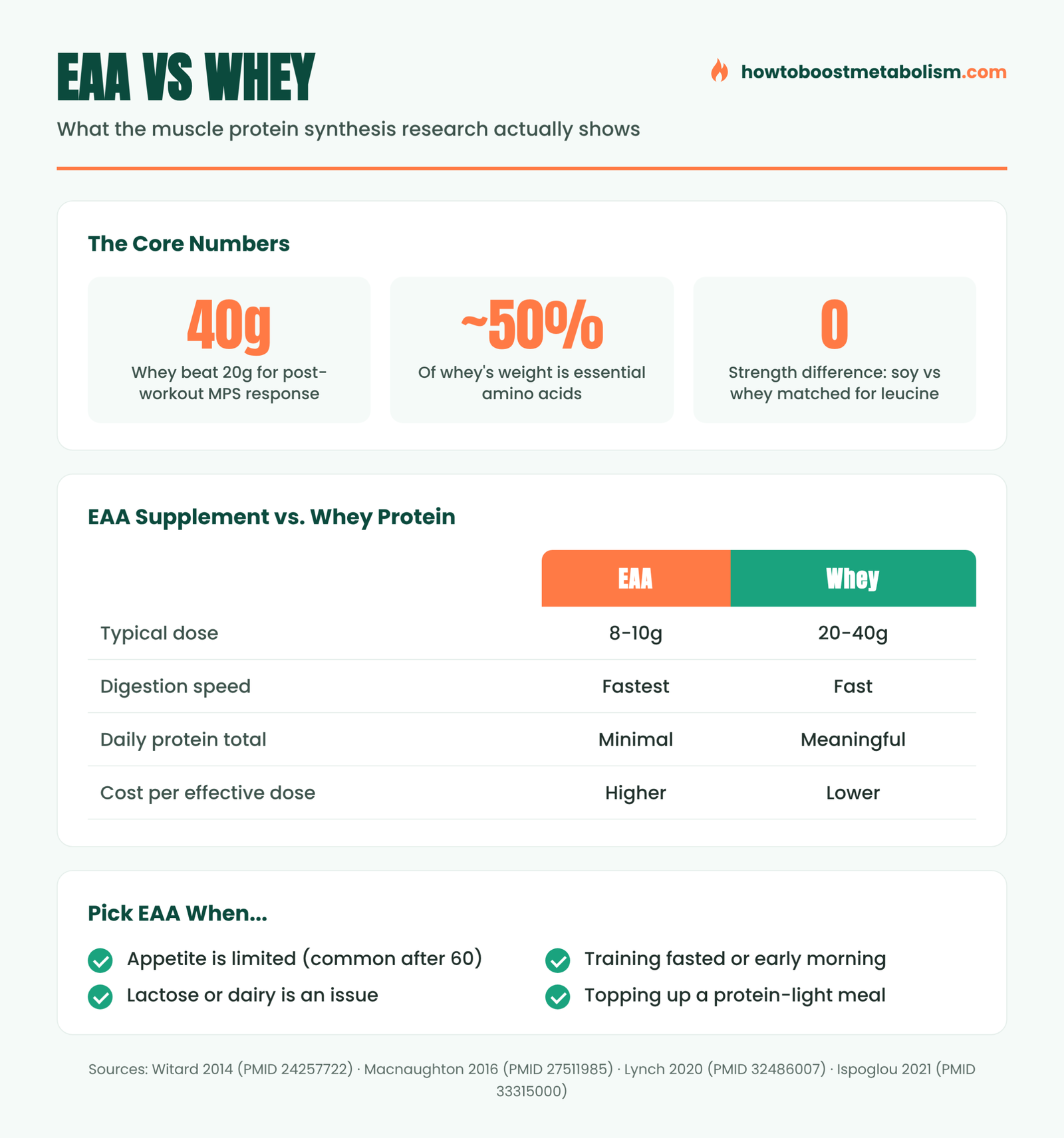
| EAA Supplement | Whey Protein | |
|---|---|---|
| Primary building block | Leucine-triggered mTOR activation | Leucine-triggered mTOR activation |
| Typical effective dose | ~8-10g EAA (includes 2-3g leucine) | 20-40g whey (includes 2-3g leucine) |
| Digestion speed | Very fast — minimal digestion needed | Fast, but slightly slower than free-form EAA |
| Total protein / satiety | Low — not a meal replacement | Higher — contributes to daily protein target |
| Cost per effective dose | Generally higher per gram of EAA | Generally lower per gram of protein |
| Best fit | Low appetite, lactose issues, minimal gut load | Hitting daily protein totals affordably |
The Shared Mechanism: Why Both Work
Muscle protein synthesis after resistance training is driven largely by amino acid availability, and within that, leucine plays an outsized signaling role by activating the mTOR (mechanistic target of rapamycin) pathway. A classic dose-response study (Witard et al., 2014, Am J Clin Nutr) found that myofibrillar MPS rates after resistance exercise rose progressively with increasing doses of whey protein, establishing the dose-response relationship researchers still reference today. Because whey is roughly half essential amino acids by weight and is unusually leucine-rich among protein sources, it produces an amino acid profile in the blood that looks a lot like a free-form EAA supplement — which is exactly why the two options perform similarly when matched for key amino acid content.
A 2021 proceedings review (Ispoglou et al., 2021, Proc Nutr Soc) focused specifically on older adults and concluded that EAA-based supplements are non-satiating and can be layered on top of a meal that’s a bit short on protein, boosting the anabolic response without requiring someone to eat more food — a genuinely useful property for people whose appetite has declined with age, which is common after 40 and more pronounced after 60.
Free download
🔥 The Metabolism Starter Kit
3 honest guides: a 7-day reset plan, a foods cheat-sheet and 12 metabolism myths debunked. No spam — unsubscribe anytime.
Where the Head-to-Head Evidence Actually Points
Matched for leucine, soy and whey performed the same — a clue about aminos, not brands
A 12-week randomized trial in untrained adults (Lynch et al., 2020, Int J Environ Res Public Health) compared whey protein isolate and soy protein isolate, both dosed to deliver the same 2g of leucine per serving. The result: statistically indistinguishable gains in total body mass, lean body mass, and leg extensor/flexor strength between groups. This matters for the EAA-vs-whey question because it’s direct evidence that when you match the leucine (and broader amino acid) delivery, the specific protein source stops being the deciding factor — supporting the idea that a well-dosed EAA supplement should produce a similar outcome to whey, at least for building strength and lean mass over time.
Honest counterpoint: more protein can still beat more amino acids
A tracer study in resistance-trained men (Macnaughton et al., 2016, Physiol Rep) found that 40g of whey protein after whole-body resistance exercise produced a significantly greater MPS response than 20g — directly challenging the old “20-25g ceiling” idea. EAA supplements are typically dosed much lower (8-15g total) because they skip the non-essential amino acids and inactive bulk, so if your goal is maximizing the single largest MPS spike after a hard session, a bigger whey dose currently has more direct supporting data than a typical EAA serving. The honest caveat: this study measured a single meal’s MPS response in trained young men, not long-term muscle growth, and the extra 20g of protein also meant extra calories — not a free lunch if you’re managing weight.
The “leucine threshold” idea is weaker than it used to be
A 2021 systematic review (Zaromskyte et al., 2021, Frontiers in Nutrition) evaluated the popular “leucine trigger hypothesis” — the idea that MPS turns on like a switch once blood leucine crosses a certain threshold. The reviewers found a disconnect between blood leucine concentration profiles and the actual MPS response in several studies, meaning the simple threshold story doesn’t fully hold up in young or older adults. Practically, this means neither “EAA hits the leucine trigger faster” nor “whey has plenty of leucine too” is a knockout argument on its own — the full amino acid composition, total dose, and digestion kinetics all interact in ways that aren’t reducible to one number.
So Which One Should You Actually Use After 40?
- Appetite is your limiting factor (common after 40, more common after 60) — EAA’s non-satiating, low-volume dose can add an anabolic boost on top of a lighter meal without forcing more food.
- Hitting a daily protein target (1.2-1.6g/kg body weight) is the actual goal — whey is the cheaper, more filling way to get there; EAA alone won’t cover your daily protein needs.
- Lactose intolerance or dairy sensitivity is an issue — EAA powder (or a whey isolate/hydrolysate with minimal lactose) solves this; plant protein matched for leucine is another evidence-backed option.
- You train fasted or first thing in the morning — EAA’s fast, low-volume absorption is convenient when a full protein shake feels heavy pre-workout.
- Budget matters — whey protein delivers more total grams of protein per dollar than most EAA formulas, which charge a premium for the “free-form” processing.
For most people over 40 with a normal appetite, whey protein (or an equivalent complete protein) remains the more practical default — it builds toward your daily total while supplying the same anabolic amino acid signal. EAA supplements earn their place as a targeted tool: pre-fasted training, appetite-limited days, or topping up a protein-light meal without adding volume.
Free download: our Metabolism Starter Kit — a protein calculator, a 7-day meal framework, and a one-page supplement checklist, with zero hype.
Get the Free Starter Kit →If you’re weighing whey against a plant-based option for other reasons (allergies, ethics, GI comfort), we’ve covered that trade-off separately in our whey vs. plant protein comparison. And if hitting your protein target across the day — not just around training — is the bigger challenge, our guide to protein timing and even distribution is the more useful next read than any single supplement choice.
Can You Just Use Both? A Practical Protocol
You don’t have to pick a permanent winner. Most people over 40 who are serious about preserving or building muscle end up using both tools for different jobs, and the research above actually supports that split rather than contradicting it:
- Around training (pre- or intra-workout): a smaller EAA dose (8-10g) when a full protein shake would sit heavy, especially for early-morning or fasted sessions.
- Immediately post-workout: a standard 25-40g whey protein serving, since the Macnaughton data suggests more total protein — not just more essential aminos — drives a larger MPS response in the window right after a hard session.
- Through the rest of the day: whole-food protein (meat, fish, eggs, dairy, legumes) covering the bulk of your 1.2-1.6g/kg daily target, since no supplement should be replacing real meals long-term.
This isn’t a case of “more supplements are always better.” It’s recognizing that EAA and whey solve slightly different practical problems — digestive speed and convenience versus total protein volume and cost-efficiency — and that most of the muscle-building benefit in either case still comes down to showing up consistently to resistance training and eating enough protein across the week, not which white powder you choose.
A Short History: Why This Debate Even Exists
Free-form essential amino acid supplements aren’t new — they’ve circulated in bodybuilding and sports nutrition circles since at least the 1990s, originally marketed on the (correct) observation that EAAs require no digestion and hit the bloodstream faster than intact protein. What changed by the 2010s is that researchers could directly measure muscle protein synthesis with tracer techniques and compare the two approaches head-to-head instead of relying on blood amino acid curves alone. That more rigorous evidence is largely what this article draws on, and it’s part of why the marketing claims around EAA powders (“3x faster muscle building,” “the only protein you need”) have gotten more conservative in recent product literature — the honest research doesn’t support the more dramatic versions of that pitch, even though the underlying science (fast absorption, leucine-driven signaling) is real.
A Note on Protein Quality and Why It’s Not Just About Leucine
Protein quality scores like DIAAS (Digestible Indispensable Amino Acid Score) exist precisely because muscle building depends on the full essential amino acid profile, not leucine in isolation — you need adequate lysine, methionine, and the rest to actually build new tissue, not just trigger the signal to start. Whey scores near the top of nearly every quality ranking for exactly this reason: it’s not just leucine-rich, it’s essential-amino-acid-complete in roughly the proportions human muscle needs. A cheap EAA blend with a skewed amino acid ratio (heavy on leucine, light on the rest) can look impressive on a label while actually underdelivering on the raw materials needed to turn that mTOR signal into real tissue.
Other muscle-building supplements get evaluated the same way on this site: see our honest breakdowns of HMB for muscle loss after 40 and omega-3 and muscle protein synthesis after 40 for where those fit alongside your protein strategy.
The EAA-vs-whey question gets much more concrete once you’ve decided when you eat around training. One approach that tackles both at once — timing protein around lifting while running periodic fasts for fat loss — is Anabolic Fasting, also by Brad Pilon. Its “build muscle and burn fat at the same time” pitch is marketing language, not a guarantee; treat it as a structured program, not a promise.
A program that puts protein timing and fasting in one structure:
Learn More →Affiliate link — we may earn a commission at no extra cost to you. Disclosure
Frequently Asked Questions
Is EAA better than whey protein for building muscle after 40?
Neither is clearly “better” for muscle protein synthesis (MPS) when the dose is matched for key amino acids — the research shows comparable anabolic signaling. The real differences are practical: whey delivers more total protein, fiber-filling calories, and costs less per gram of muscle-building amino acids; EAA powder delivers a smaller, faster-absorbed dose with less volume and no dairy, which matters more if you’re managing appetite, lactose, or simply don’t want to drink 25+ grams of protein again.
How much EAA do I need to match 25g of whey protein?
Roughly 8-9 grams of essential amino acids approximates the EAA content of a 25g whey protein dose, since whey is about 50% EAA by weight. But “approximates” isn’t “identical” — whey also brings non-essential amino acids, which contribute to total nitrogen balance and may matter for people with low overall protein intake.
Does the leucine content matter more than total protein?
Leucine gets the spotlight because it activates the mTOR pathway that kicks off muscle protein synthesis, and both whey and EAA supplements are leucine-rich. But a 2021 systematic review found the simple “leucine threshold” story doesn’t fully hold up — blood leucine levels don’t reliably predict the size of the MPS response, so the full amino acid profile and total dose still matter, not leucine alone.
Can EAA supplements replace meals or whole protein sources?
No. EAA powders are a tool for hitting an anabolic trigger quickly and with minimal digestion, not a substitute for whole-food protein, which also supplies micronutrients, satiety, and non-essential amino acids useful for overall nitrogen balance. Most research supports using EAA or whey around training and letting whole food cover the rest of your day.
Is 40g of protein better than 20g after a workout?
For a single post-workout dose, research in resistance-trained men found 40g of whey stimulated a measurably greater muscle protein synthesis response than 20g, challenging the older idea of a hard 20-25g “ceiling.” People with more total lean body mass may need more protein per sitting to maximize the response, though the practical difference over a full day of adequate protein intake is smaller than single-meal studies suggest.