Does Lifting Slower Build More Muscle? The Science
This article may contain affiliate links. If you buy through them, we may earn a small commission at no extra cost to you. See our Affiliate Disclosure and Medical Disclaimer.
Walk into any gym and you’ll see both camps: lifters grinding out 4-second negatives with a whispered count, and lifters moving the bar as fast as clean form allows. Both groups will tell you, with total confidence, that their way builds more muscle. A 2025 systematic review pooling 14 controlled studies finally put real numbers behind the argument — and the answer disappoints both camps a little.
What “Tempo” and “Time Under Tension” Actually Mean
Rep tempo refers to how fast or slow you move through each phase of a lift — typically described as seconds for the lowering (eccentric), pausing, and lifting (concentric) portions of a rep. “Time under tension” is the related idea that a muscle’s total working time during a set, not just the rep count, drives how much it grows. The theory sounds intuitive: a slower rep means more total time generating force, which should mean more muscle damage and more growth signal. It’s a reasonable hypothesis. The question is whether it actually plays out in controlled studies.
The 2025 Meta-Analysis: 14 Studies, One Clear Pattern
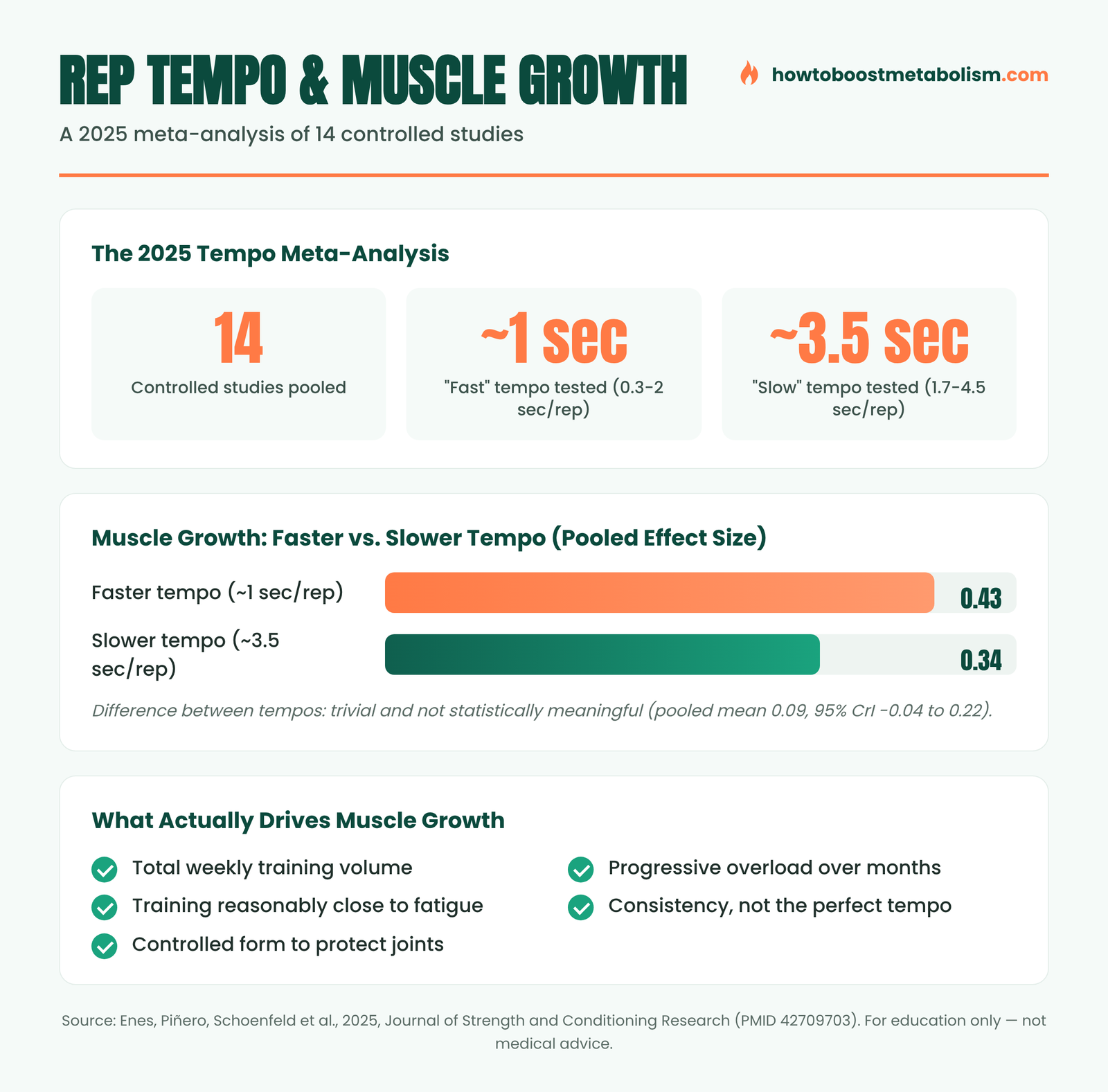
Researchers systematically searched the literature for studies that isolated tempo as the only variable — same exercises, same total volume, same training frequency, with only the speed of the eccentric or concentric phase changed (Enes, Piñero, Schoenfeld et al., 2025, Journal of Strength and Conditioning Research). Across 14 studies, they compared a “faster” tempo (roughly 0.3-2 seconds per rep, averaging about 1 second) against a “slower” tempo (roughly 1.7-4.5 seconds per rep, averaging about 3.5 seconds) and measured the resulting change in lean or muscle mass.
| Measurement | Result |
|---|---|
| Muscle growth, faster tempo (~1 sec/rep) | Pooled effect size 0.43 |
| Muscle growth, slower tempo (~3.5 sec/rep) | Pooled effect size 0.34 |
| Difference between the two | Trivial, favoring faster tempo slightly (mean 0.09, 95% CrI -0.04 to 0.22) |
| Probability the real difference was at least medium-sized | 0.1% (essentially none) |
In plain terms: both tempos built muscle. Neither tempo clearly beat the other by a meaningful margin, and the small edge that did show up favored the faster tempo, not the slower one — the opposite of what the “time under tension” theory would predict. The authors’ own conclusion was direct: resistance training tempo appears to have a minimal overall effect on muscle hypertrophy, with potential differences emerging only under specific, narrower conditions (certain muscle groups or whether sets were taken to failure) rather than as a general rule.
Free download
🔥 The Metabolism Starter Kit
3 honest guides: a 7-day reset plan, a foods cheat-sheet and 12 metabolism myths debunked. No spam — unsubscribe anytime.
Why the “Time Under Tension” Theory Doesn’t Hold Up Perfectly
The likely explanation is that total training volume — how many hard sets you do, not how slowly you do each rep — is the dominant driver of muscle growth, and tempo changes mostly just trade reps for seconds without changing the total stimulus much. A slower rep means fewer total reps fit into the same set before fatigue, which roughly cancels out the extra time per rep. This lines up with other well-established findings in the strength training literature, including the fact that training a set to complete failure doesn’t meaningfully outperform stopping a couple of reps short of failure for strength or size, provided total volume is similar (Grgic & Schoenfeld et al., 2022, Journal of Sport and Health Science). Across both bodies of research, the pattern is the same: lifters tend to overweight the fine details of how a set feels and underweight the much bigger variable of how much total hard work gets done week over week.
How to Read Tempo Notation
If you’ve seen a program prescribe something like “3-1-1-0” next to an exercise, that’s tempo notation, and it’s worth knowing how to read even if the research above suggests it matters less than commonly assumed. The four numbers represent, in order: the eccentric (lowering) phase, the pause at the bottom, the concentric (lifting) phase, and the pause at the top, each measured in seconds. “3-1-1-0” on a squat would mean a 3-second descent, a 1-second pause at the bottom, a 1-second drive back up, and no pause at the top before the next rep. A “normal” or uncontrolled tempo is often written as “X” for the concentric portion, meaning “as fast as possible with good form.”
Does Eccentric-Only Tempo Work Differently?
The meta-analysis above pooled studies that manipulated either the eccentric (lowering) or concentric (lifting) phase, and found that the pattern held in subgroup analyses by muscle action type — slowing down the eccentric portion specifically didn’t produce a meaningfully larger effect than slowing the concentric portion. This is a little surprising, since eccentric contractions are generally understood to produce more muscle damage per repetition than concentric ones, and more damage was once assumed to translate directly into more growth. The current evidence suggests that relationship is weaker and more complicated than that simple logic implies — muscle damage is one contributor to hypertrophy among several (mechanical tension and metabolic stress are generally considered the bigger drivers), and tempo changes alone don’t appear to move the needle much on any of them within the normal range lifters use.
Where Tempo Might Still Matter
- Extreme ends of the spectrum. The studies pooled here compared a roughly 1-second tempo to a roughly 3.5-second tempo — neither is extreme. Very fast, bouncing, momentum-driven reps or extremely slow, multi-minute sets are different and far less studied territory, and are generally a question of injury risk and practicality rather than a muscle-growth advantage either way.
- Joint-friendly lifting. Controlling the eccentric (lowering) portion of a rep, even if it doesn’t change muscle growth much, reduces reliance on momentum and tends to feel safer on joints and connective tissue — a real reason to lift in control, just not a muscle-building one.
- Specific strength goals. If your actual goal is performing a lift at a certain speed (a competition deadlift, a specific athletic movement), practicing at or near that speed has its own logic that’s separate from the hypertrophy question this research addresses.
- Mind-muscle connection for some lifters. Some people find a controlled tempo helps them feel the target muscle working and stay focused through a set — a real, if subjective and individual, benefit that a meta-analysis of muscle size on a scan won’t capture.
A Practical Default If You’re Not Sure What Tempo to Use
Given that the research shows a wide window of tempos work about equally well, the simplest approach is also the most evidence-consistent one: lower the weight under control (roughly 1-3 seconds, never bouncing or dropping), briefly pause or reverse direction at the bottom without momentum, and lift at a natural pace that doesn’t collapse your form. That’s it. There’s no evidence-based reason to count out a precise 4-second negative on every set, and no evidence-based reason to avoid doing so either if you find it helps you focus — the deciding factor is whatever lets you add weight or reps over time while staying consistent and keeping your joints comfortable.
What Actually Matters More Than Tempo
- Total weekly training volume. The number of hard sets per muscle group per week, tracked over months, is one of the most consistently supported drivers of muscle growth in the research.
- Progressive overload. Gradually adding weight, reps, or sets over time so your muscles keep facing a new challenge — covered in detail in our guide to progressive overload after 40, linked below.
- Training reasonably close to fatigue. Sets don’t need to end in complete failure, but they should feel genuinely challenging in the last few reps.
- Consistency over months, not the perfect tempo in any one session. Showing up and doing the work reliably outperforms optimizing any single training variable to the decimal point.
If you would rather have those bigger variables — weekly volume, effort and progression — laid out for you than argue about rep speed, a ready-made plan helps. Old School New Body is a strength program built for adults over 40 around short full-body sessions and a set progression scheme. Its sales page leans on a few unsourced statistics, so read our full review before you decide.
Common Tempo Mistakes
- Chasing an exact tempo prescription instead of progressive overload. Counting seconds precisely on every rep while neglecting to add weight or reps over time is optimizing the variable the research says matters least while ignoring the one that matters most.
- Using momentum to move more weight than you can control. Bouncing out of the bottom of a squat or heaving a curl with body English isn’t a “fast tempo” — it’s a loss of tension on the target muscle and a real injury risk, which is a separate issue from the tempo research discussed here.
- Assuming slower is always safer. A controlled tempo is generally joint-friendly, but an extremely slow tempo on a heavy compound lift can also mean spending more total time under a heavy load in a fatigued, form-breaking position — moderate and controlled beats either extreme.
- Abandoning a training log to focus on “feeling” the tempo. Since tempo has a trivial effect on growth, time spent perfecting it is often better spent tracking weights and reps from week to week, which is where the real, measurable progress happens.
If tempo isn’t the lever to pull, the variables that actually matter are covered elsewhere on the site: our guide to progressive overload after 40 walks through how to structure that steady increase in challenge, and if you’re deciding between equipment options for your sets, our comparison of resistance bands vs. free weights covers that choice. For a realistic sense of what consistent training actually produces over time, see how much muscle you can build after 50.
Free download: our Metabolism Starter Kit — a protein calculator, a 7-day meal framework, and a one-page supplement checklist, with zero hype.
Get the Free Starter Kit →Related: Slower reps can leave you sorer the next day — we cover why, and what that soreness does (and doesn’t) mean, in our guide to muscle soreness and DOMS.
Related: Wondering if your rep count matters as much as your training tempo? We broke down what 3-5 vs. 8-12 vs. 15-20 reps actually do for muscle growth and fat loss.
Related: Tempo and the eccentric phase also matter for tendon health specifically — see whether “negatives” actually protect your tendons after 40.
Related: Rep tempo is one small training variable; periodization model is a bigger one — we dug into whether linear or undulating periodization actually wins out for strength and muscle.
Related: Tempo isn’t the only cueing tool worth testing — the mind-muscle connection has its own research behind it, with real caveats.
Frequently Asked Questions
What is “time under tension” exactly?
Time under tension is simply how long a muscle is actively working during a set — a function of how many reps you do and how slowly or quickly you do each one. A set of 10 reps done at a slow, controlled tempo spends more total seconds under load than the same 10 reps done quickly, even though the number of reps is identical.
So does tempo matter at all for building muscle?
Based on the current evidence, not much, within a fairly wide range. The 2025 meta-analysis found a trivial, not statistically meaningful, difference between tempos averaging about 1 second per rep and tempos averaging about 3.5 seconds per rep. Extremely fast, uncontrolled reps or extremely slow, multi-minute sets are different stories and less studied, but the normal range lifters argue about doesn’t appear to matter much.
Should I stop controlling my reps and just lift fast, then?
Not for safety reasons. Controlling the weight, especially on the way down (the eccentric phase), protects your joints and keeps tension on the target muscle instead of letting momentum do the work. The research says tempo doesn’t meaningfully change muscle growth, not that form stops mattering — a controlled, non-bouncing rep is still the safer and more effective way to lift regardless of exact tempo.
Does tempo matter more for strength than for muscle size?
The 2025 meta-analysis specifically looked at muscle size (hypertrophy), not maximal strength. Strength has a skill component tied to lifting at the specific speed you’ll be tested at, so if your goal is a one-rep max in a powerlifting meet, practicing lifts at or near competition speed still makes sense. For general strength and size goals, tempo appears to be a minor variable either way.
What actually matters more than tempo for building muscle?
Based on the broader strength training literature, total training volume (sets taken reasonably close to fatigue over time), progressive overload (gradually adding weight or reps), and consistency over months matter far more than the exact seconds per rep. Lifters chasing an ideal tempo are often better served putting that attention into adding weight to the bar or adding a set.
This article is for educational purposes only and is not medical advice. Consult a doctor or qualified trainer before starting a new resistance training program, especially if you have an existing injury. See our full Medical Disclaimer.