VO2 Max and Longevity: What the Science Actually Shows
This article may contain affiliate links. If you buy through them, we may earn a small commission at no extra cost to you. See our Affiliate Disclosure and Medical Disclaimer.
If you had to pick one number from a medical test that predicts how long you’ll live better than almost anything else your doctor can measure, it wouldn’t be your cholesterol, your blood pressure, or your weight. It would be your VO2 max — a measure of how efficiently your body uses oxygen during hard exercise. That claim sounds like supplement-marketing hyperbole. It isn’t. It comes from a study of over 122,000 people followed for a median of 8.4 years, and the gap in death risk between the fittest and least fit patients in that study was five-fold.
This article walks through exactly what that research found, what VO2 max actually measures, how much of it you can realistically change through training (including strength training, which is not the first thing most people reach for), and where the honest limits of this evidence are.
What VO2 Max Actually Measures
VO2 max is the maximum rate at which your body can take in, transport, and use oxygen during intense exercise, measured in milliliters of oxygen per kilogram of body weight per minute (ml/kg/min). It reflects how well your heart pumps blood, how well your lungs move oxygen into that blood, how many capillaries deliver it to your muscles, and how efficiently your muscle cells’ mitochondria burn it for fuel. In short: it’s a whole-system score for your cardiorespiratory fitness, not a single organ’s performance.
The gold-standard way to measure it is a lab test on a treadmill or stationary bike while breathing into a mask connected to a metabolic cart that analyzes your inhaled and exhaled air. Most people never do this test. Instead, clinics often estimate cardiorespiratory fitness from a standard exercise treadmill test (the kind used to screen for heart disease), and many wearables estimate it from resting heart rate, age, sex, and pace data during runs or walks. Both estimates are useful for tracking your own trend, even though neither replaces a true lab measurement.
The Study: 122,007 Patients, One Clear Pattern
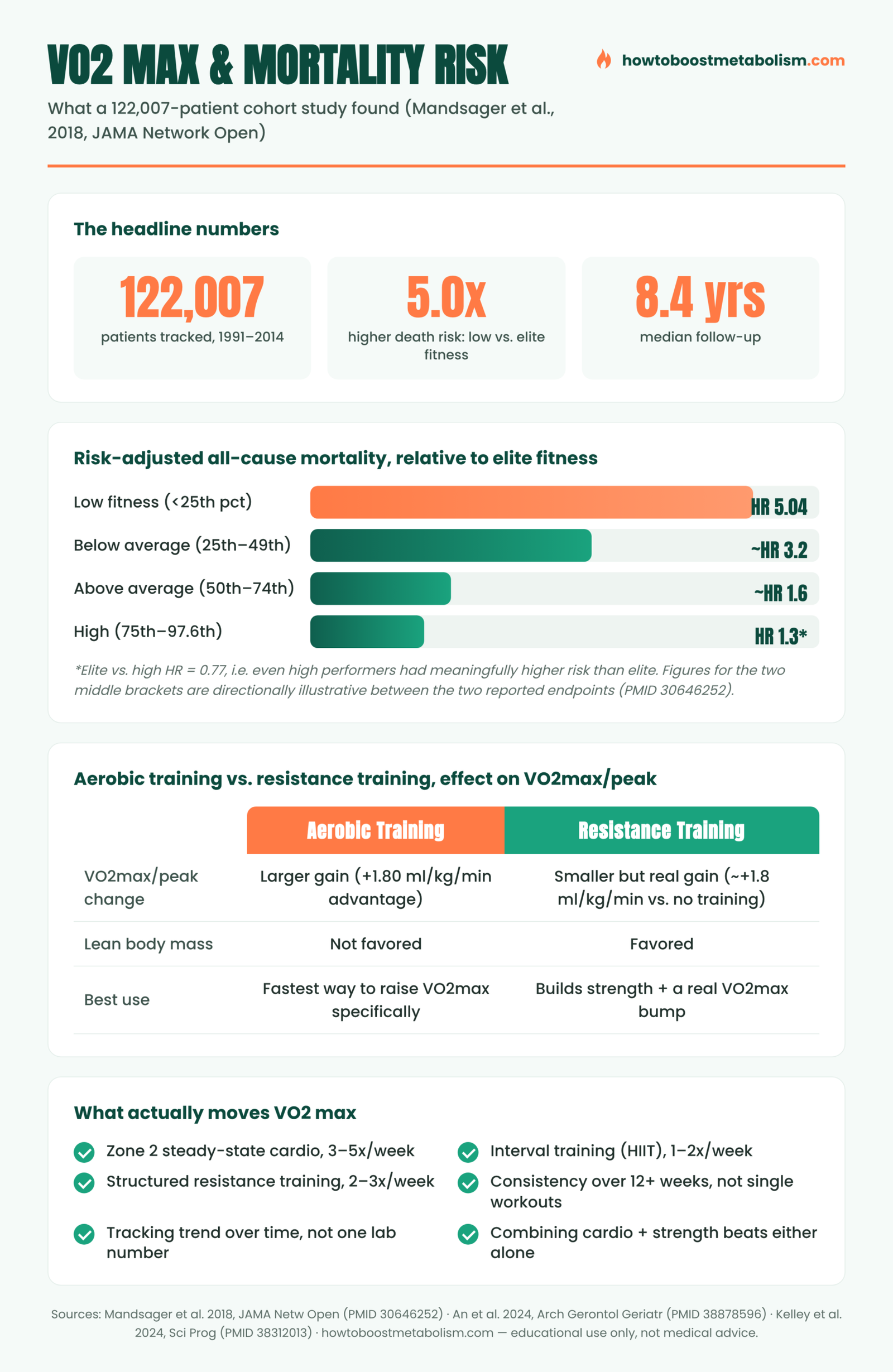
The key paper here is a 2018 retrospective cohort study from the Cleveland Clinic, published in JAMA Network Open (Mandsager et al., PMID 30646252). Researchers followed 122,007 adults (average age 53.4) who underwent a standard exercise treadmill test between 1991 and 2014, for a median of 8.4 years. They split patients into five fitness brackets by age- and sex-adjusted performance: low (bottom 25%), below average, above average, high, and elite (top 2.4%).
During the follow-up period, 13,637 patients died. After adjusting for other risk factors, the pattern was stark and consistent across every bracket: the less fit a patient was, the higher their risk of dying from any cause. Patients in the low-fitness group had roughly 5 times the mortality risk of elite performers (adjusted hazard ratio 5.04, 95% CI 4.10–6.20). Even the gap between the two best groups was significant: elite performers still had meaningfully lower mortality risk than the merely ‘high’ performers one tier below them (adjusted HR 0.77 for elite vs. high).
| Fitness Bracket | What It Represents | Relative Mortality Risk |
|---|---|---|
| Low (bottom 25%) | Reference point — highest risk bracket | ~5.0x the mortality risk of elite |
| Below average (25th–49th pct) | Still well below the fitness curve | Substantially elevated risk |
| Above average (50th–74th pct) | Typical, moderately active adult | Moderately elevated risk |
| High (75th–97.6th pct) | Regularly active, trained | ~1.3x the risk of elite |
| Elite (top 2.4%) | Highly trained | Reference — lowest observed risk |
A few honest caveats on this data, because the FAQ-bait version of this article would skip them. This is an observational cohort, not a randomized trial — it shows a strong association between fitness and survival, not airtight proof that raising your VO2 max by X points will extend your life by Y years. People referred for a treadmill test also aren’t a perfectly random sample of the population. And fitness itself is partly a marker of other things going right — fewer underlying illnesses, more consistent activity, often better access to healthcare. None of that erases the finding; it just means you should read ‘5x higher risk’ as a strong, well-adjusted signal, not a precise multiplier on your personal future.
Free download
🔥 The Metabolism Starter Kit
3 honest guides: a 7-day reset plan, a foods cheat-sheet and 12 metabolism myths debunked. No spam — unsubscribe anytime.
Does Strength Training Actually Raise VO2 Max?
This is where most VO2 max content stops at ‘do more cardio’ and moves on. Worth asking directly: if you’re someone who lifts weights and does little steady cardio, is your VO2 max just stuck?
A 2024 systematic review and meta-analysis in Archives of Gerontology and Geriatrics (An et al., PMID 38878596) pooled 38 randomized controlled trials in middle-aged to older adults comparing aerobic training against resistance training head-to-head. The honest result: aerobic training produced a larger improvement in VO2max/peak than resistance training (mean difference 1.80 ml/kg/min in favor of aerobic training). If raising VO2 max as fast as possible is your only goal, cardio wins that specific contest.
But resistance training isn’t doing nothing. A separate 2024 meta-analysis in Science Progress (Kelley et al., PMID 38312013), pooling 22 randomized trials in adults 60 and older, found resistance training alone raised VO2 max by an average of 1.8 ml/kg/min compared with no training at all (95% CI 0.4–3.3, p=0.01). Just as notably, the researchers found no meaningful ‘non-responder’ pattern — the benefit wasn’t limited to a lucky subset who happened to respond well. Most people who did the training got a real, if modest, bump.
Put those two findings together and the practical picture is this: cardio is the more efficient lever for VO2 max specifically, but strength training also raises it — while doing something cardio training doesn’t reliably do, which is build and preserve the muscle mass that both your metabolism and your functional strength depend on as you age. Neither one makes the other optional.
What This Means If You’re 40, 50, or 60+
Cardiorespiratory fitness and muscle mass both decline with age if you don’t actively train against it. VO2 max in particular tends to fall roughly 1% per year after your early 30s if you stay sedentary — faster after 50. The research above is encouraging on exactly this point: both of the key trials pooling resistance-training data were run in adults over 60, and the VO2 max improvements held up in that older population. This is not a young person’s metric that stops responding to training once you hit a certain age.
The practical takeaway for a 40+ or 50+ reader isn’t ‘go run marathons.’ It’s that a mixed program — most weeks including some zone 2 or interval cardio and 2–3 structured resistance-training sessions — covers both bases: the faster VO2 max gains from cardio, and the muscle-preserving, modest-but-real fitness gains from lifting. If you’re already following a structured strength program built for adults over 40, adding two to three weekly cardio sessions on top of it is a reasonable way to close the rest of the gap, rather than treating the two as competing priorities.
If you’re looking for a structured strength-training program built around building and keeping muscle after 40, Old School New Body lays out a specific routine rather than a generic ‘lift sometimes’ plan. One honest note: its landing page cites some attention-grabbing aging statistics that aren’t tied to a published source — treat those as marketing copy, not data, and judge the program on its actual training structure instead.
Check It Out →Affiliate link — we may earn a commission at no extra cost to you. Disclosure
How to Actually Train for a Better VO2 Max
- Zone 2 cardio, 3–4x/week, 30–45 minutes: steady effort where you can still hold a conversation. This builds the aerobic base most efficiently over time.
- One interval session per week: short, hard efforts (e.g. 4 x 4 minutes near-maximal effort with recovery between) are one of the more time-efficient ways to raise VO2 max specifically.
- Resistance training, 2–3x/week: full-body compound lifts (squats, rows, presses, hip hinges) at a challenging load. Won’t out-pace dedicated cardio for VO2 max, but adds a real, independent benefit plus the muscle mass cardio alone doesn’t build.
- Consistency over 12+ weeks: the trials behind these numbers ran for months, not days. A single hard workout doesn’t move this number; a repeated habit does.
- Track your own trend, not a population chart: a watch-based or treadmill-test estimate, checked every few months under similar conditions, tells you more about your own direction than comparing yourself to a published ‘ideal’ number for your age.
Common Myths Worth Correcting
“You need an expensive lab test to know anything useful.”
Not true for tracking purposes. A consistent, repeatable estimate — same device, similar conditions, checked every 8–12 weeks — is enough to tell whether your training is working. A precise lab number matters more for competitive athletes fine-tuning performance than for someone trying to move from ‘low’ to ‘above average.’
“Only runners and cyclists have a ‘real’ VO2 max worth improving.”
The resistance-training data above directly contradicts this. VO2 max is a trainable system-level trait, not something exclusive to endurance athletes, and it responds — modestly but measurably — to structured strength training alone.
“If my VO2 max is below average, there’s not much point improving it further.”
The treadmill-testing study found no ‘floor’ effect where improvement stopped mattering — moving up even one fitness bracket was associated with lower mortality risk at every level measured, not just at the very top.
Free download: our Metabolism Starter Kit — a protein calculator, a 7-day meal framework, and a one-page supplement checklist, with zero hype.
Get the Free Starter Kit →The Honest Bottom Line
VO2 max is one of the better-supported fitness-to-longevity links in the research literature, backed here by a 122,000-person cohort with a clear, graded pattern. It isn’t proof that a specific training plan adds a specific number of years to your life — observational data can’t promise that. What it does support is straightforward: cardio raises VO2 max more directly than strength training does, strength training still raises it meaningfully on its own while building muscle cardio doesn’t, and the combination of both, done consistently for months rather than days, is the approach the evidence actually points to.
Related reading: See how a weaker handshake predicts the same kind of risk in our guide to grip strength as a longevity marker, pair your cardio with zone 2 training for fat loss, and if you’re new to lifting, start with our beginner strength training guide. For how much muscle you can realistically expect to build later in life, see how much muscle you can build after 50.
Related: If you’re building an aerobic base for longevity, rucking is a popular way to add load to that work — but the bone-density claims around it are often overstated. See our honest look at the rucking research.
Related: Building your VO2max with cardio while also lifting? We covered exactly how much interference to expect between the two, and how to minimize it.
Related: Structuring your training over time matters for longevity goals too — see our breakdown of linear vs. undulating periodization after 40.
Frequently Asked Questions
Can I estimate my VO2 max without a lab test?
Yes, roughly. Many fitness watches and chest-strap heart rate monitors estimate VO2 max from your resting heart rate, age, and pace during runs or walks. These estimates are typically within 5–15% of a true lab-measured value (which uses a treadmill or bike test with a metabolic cart) — close enough to track your own trend over time, but not precise enough to compare yourself against population percentiles with confidence.
Does strength training alone raise VO2 max?
It can, modestly. A 2024 meta-analysis of 22 randomized trials in adults over 60 found resistance training increased VO2 max by about 1.8 ml/kg/min on average compared with no training (PMID 38312013). That’s a real, measurable gain, but a separate head-to-head meta-analysis found aerobic training produces a larger VO2 max improvement than resistance training when compared directly (PMID 38878596). Strength training is not the fastest way to raise VO2 max specifically, but it still moves the number in the right direction while also building the muscle that cardio alone doesn’t.
Is it ever too late to improve VO2 max?
No. VO2 max responds to training at essentially any age studied, including in adults in their 70s and 80s. The rate of improvement tends to be slower than in younger adults and the training needs to be more consistent, but the trials behind the numbers in this article were run in middle-aged and older adults specifically — the benefit is not reserved for people who were already fit.
What’s a ‘good’ VO2 max for my age?
This varies by lab and population, and we’re intentionally not printing a single chart of target numbers here, because most of the public ones aren’t sourced to a transparent, current dataset for US adults. The more useful framing from the research is relative, not absolute: moving from the bottom 25% of fitness for your age and sex into the next bracket up is associated with a meaningfully lower mortality risk, regardless of the exact number you start or end at.
Should I worry if my VO2 max is below average?
Being below average is common and not a medical emergency — in the treadmill-testing study discussed above, ‘below average’ was still a large group with a wide range of life outcomes, not a cliff edge. What the data supports is that moving up even one performance bracket is associated with lower long-term mortality risk, which is a reason to train consistently, not a reason to panic over a single number from a smartwatch.
This article is for educational purposes only and is not medical advice. Talk to your doctor before starting a new exercise program, especially if you have a heart condition. See our Medical Disclaimer.