Cluster Sets vs. Traditional Sets: Which Wins?
This article may contain affiliate links. If you buy through them, we may earn a small commission at no extra cost to you. See our Affiliate Disclosure and Medical Disclaimer.
Cluster sets have become one of the more fashionable set structures in strength coaching circles: instead of grinding out, say, 10 straight reps, you break the set into smaller clusters of 2–5 reps with short 15–30 second rest periods between them, then move on. The pitch is that the mini-breaks let you lift heavier, keep your bar speed up, and ultimately build more muscle or strength than a traditional, uninterrupted set. After 40, when joint-friendly ways to push intensity are worth a lot, that pitch is worth testing against the actual evidence.
The short version: cluster sets really do let you move faster and fight off fatigue better within a session. Whether that translates into more muscle growth over months, though, is a different question — and the newest head-to-head evidence says, mostly, no.
What a Cluster Set Actually Looks Like
A traditional straight set of, say, 8 reps at a given load is performed continuously until the set ends. A cluster set takes that same 8 reps and chops it into pieces — commonly 2 reps × 4 clusters, or 4 reps × 2 clusters — with a short intra-set rest (often 15–30 seconds) inserted between each mini-cluster. The total work performed and the external load can be identical; what changes is how continuously you’re asked to produce force.
The Core Promise: Less Fatigue, More Speed
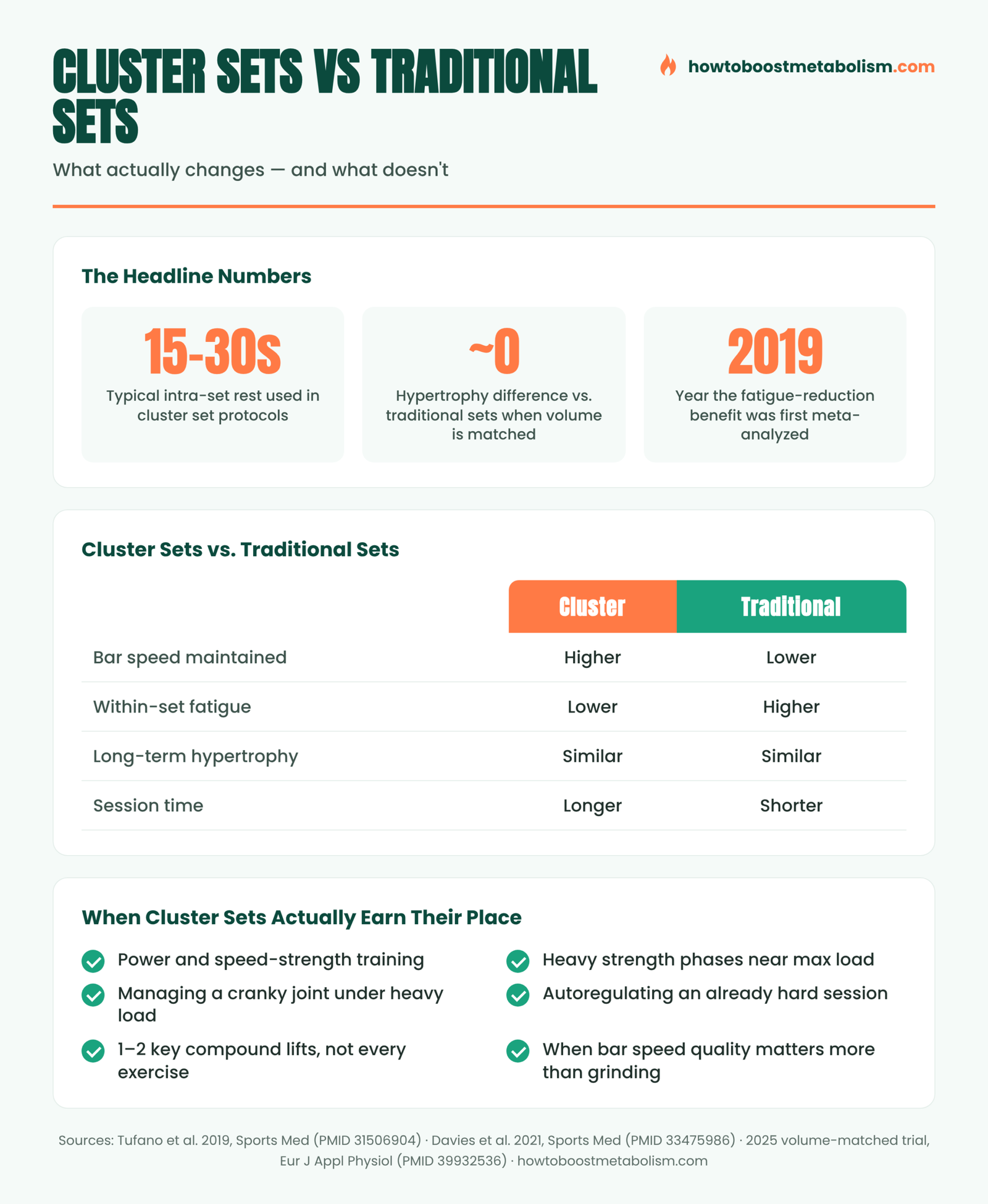
This part of the cluster-set story is well established. A 2019 systematic review and meta-analysis of the acute neuromuscular responses to cluster set training found that breaking up a set with short rest periods consistently preserves bar velocity and reduces the mechanical, metabolic, and perceptual fatigue that builds up during a continuous set (Tufano et al., 2019, Sports Med, PMID 31506904). A broader follow-up meta-analysis on acute fatigue and set-structure changes confirmed the same pattern: cluster and rest-redistribution structures blunt the drop-off in force and velocity you’d otherwise see across a hard set (Latella et al., 2020, Sports Med, PMID 32901442). If your goal in a single session is to lift a given load with less grinding and better bar speed, cluster sets deliver on that promise reliably.
Free download
🔥 The Metabolism Starter Kit
3 honest guides: a 7-day reset plan, a foods cheat-sheet and 12 metabolism myths debunked. No spam — unsubscribe anytime.
Does Less Fatigue Mean More Muscle Over Time? The New Evidence
This is where the story gets more interesting — and more humbling for cluster-set enthusiasts. A 2025 volume- and effort-matched study directly compared cluster sets against traditional sets in resistance-trained individuals, carefully equating the total work performed and the effort required in both conditions, then measured actual muscle growth over a full training block. The result: cluster sets and traditional sets produced similar muscular hypertrophy — the better bar speed and reduced within-set fatigue didn’t translate into a meaningfully bigger hypertrophic stimulus (2025, Eur J Appl Physiol, PMID 39932536).
That lines up with a 2021 systematic review and meta-analysis on the chronic effects of cluster set configurations, which similarly found no clear long-term advantage for hypertrophy or strength when volume and load were comparable to traditional training — cluster sets changed the acute training experience far more than they changed the eventual outcome (Davies et al., 2021, Sports Med, PMID 33475986). A 2026 meta-analysis pooling several “advanced” resistance training systems — including cluster sets, drop sets, and supersets — against standard straight sets in recreationally trained adults reached a consistent conclusion across methods: these set structures are largely interchangeable for building muscle and strength when the fundamentals (volume, proximity to failure, progression) are matched (2026, J Funct Morphol Kinesiol, PMID 41718208). If you’ve read our breakdown of supersets vs. straight sets, this will sound familiar — it’s the same pattern showing up again with a different set structure.
Why Doesn’t Less Fatigue Translate to More Growth?
This is a reasonable thing to be confused by — if cluster sets let you move faster and feel less beat up within a set, why doesn’t that show up as more muscle over months? The most likely explanation comes down to what actually drives hypertrophy: total volume (sets × reps × load) and proximity to muscular failure, not how smoothly any individual set feels while you’re doing it. A cluster set and a straight set using the same load for the same total reps put a very similar amount of mechanical tension through the muscle by the time the set ends — the mini-rests change the experience of accumulating that tension, but not the total tension accumulated. Mechanical tension, metabolic stress, and muscle damage are the three commonly cited drivers of hypertrophy, and none of them appear to scale meaningfully with how continuously a set is performed, as long as the total work and effort are held constant.
There’s also a practical offset working against cluster sets: because they preserve strength and speed better within a set, lifters sometimes end up doing less total work in the same timeframe, or feel deceptively fresh and under-load the set relative to what a straight set would force. Done correctly — matching total volume and genuinely pushing the effort level on each cluster — that offset disappears, which is exactly what the better-controlled, volume-matched 2025 trial did, and is likely part of why it found no advantage (PMID 39932536).
Cluster Sets vs. Rest-Pause Sets: Are They the Same Thing?
Not quite, though they’re cousins. Rest-pause training typically takes a set closer to or at failure, pauses for a short rest (often 10–20 seconds), and then squeezes out a few more reps with the same load — the intent is usually to extend a single set past the point you could otherwise reach. Cluster sets, by contrast, are typically planned in advance to stop well short of failure on each mini-cluster, preserving bar speed rather than chasing extra fatigue. In practice, the research on both set structures reaches a similar conclusion: breaking up continuous effort with brief rest changes the acute experience of the set — how hard it feels, how fast the bar moves — more reliably than it changes the eventual training outcome once total volume is accounted for.
So Is There Any Point to Cluster Sets?
Yes — just not the point most marketing around them implies. Cluster sets aren’t a hypertrophy hack that beats straight sets rep-for-rep. Where they earn their place is in situations where maintaining bar speed and force output matters on its own, independent of total muscle growth:
- Power and speed-strength work, where the whole point is training at high velocity — letting fatigue creep in defeats the purpose.
- Heavier strength-focused phases, where cluster sets let you accumulate more total reps at a near-maximal load than you could manage in one continuous set.
- Joint-friendly intensity after 40, since the mini-rest periods mean you’re rarely grinding out a rep under severe fatigue with breakdown in technique — useful if you’re managing a cranky shoulder or knee while still training heavy.
- Autoregulating a hard training day when you want the loading stimulus of a heavy set without the all-out grind of the last couple of reps.
In short: use cluster sets when bar speed, technique quality, or joint comfort under heavy load matters more than squeezing out the absolute last rep of fatigue — not because they’ll out-build a well-executed straight set.
A Practical Way to Try Cluster Sets
- Pick a compound lift where bar speed and technique matter — squat, deadlift, bench press, or overhead press are good candidates.
- Choose a load you’d normally use for a straight set of 6–8 reps.
- Break it into clusters: for example, 2 reps, rest 20 seconds, 2 reps, rest 20 seconds, repeat until you hit your total rep target.
- Keep the external load and total reps roughly the same as your usual straight-set programming — don’t treat the mini-rests as an excuse to simply add more weight or more reps indiscriminately.
- Use cluster sets for 1–2 key lifts per session rather than your entire workout; they’re a tool for your heaviest, most technique-sensitive work, not a wholesale replacement for your training structure.
If you’d rather not micromanage intra-set rest periods, the volume and progression framework we laid out in training volume landmarks and rep ranges for muscle growth will get you most of the same long-term result with a lot less bookkeeping.
One more practical note for lifters over 40 specifically: cluster sets add real time to a session once you account for all the intra-set rest periods stacking up across multiple exercises, so they’re best reserved for the handful of lifts where joint comfort or bar speed genuinely matters, rather than applied across an entire workout. If a session is already running long, you’re usually better served by trimming exercise selection than by cluster-ifying everything on the program.
| Factor | Verdict |
|---|---|
| Bar speed / fatigue within a set | Cluster sets clearly win |
| Long-term hypertrophy (volume-matched) | No meaningful difference |
| Long-term strength (volume-matched) | No meaningful difference |
| Session time required | Cluster sets take longer (rest breaks add up) |
| Best use case | Heavy compound lifts, power work, joint-friendly intensity |
| Worth doing on every exercise? | No — reserve for 1–2 key lifts per session |
A Structured Program Still Does the Heavy Lifting
Set structure — cluster, straight, superset, or otherwise — is a relatively small lever compared to showing up consistently with a progressive, well-dosed program. If you’re looking for that kind of structure built specifically for lifters over 40, the Old School New Body program is one option worth a look; just go in with realistic expectations about any single exercise variable.
Old School New Body’s F4X method is built around efficient, joint-friendly strength training for people over 40 — useful if you want a structured program rather than piecing one together yourself.
Check It Out →Affiliate link — we may earn a commission at no extra cost to you. Disclosure
Note: this program’s marketing claims about rapid transformation results are promotional and are not independently verified — treat them as marketing, not a guarantee.
Free download: our Metabolism Starter Kit — a protein calculator, a 7-day meal framework, and a one-page supplement checklist, with zero hype.
Get the Free Starter Kit →Related: Set structure isn’t the only variable worth testing on isolation work — internal attentional focus has its own real, if modest, research-backed effect on hypertrophy.
Frequently Asked Questions
Do cluster sets build more muscle than traditional sets?
Generally, no — when total volume and load are matched, the best current evidence shows cluster sets and traditional straight sets produce similar muscle growth. Cluster sets mainly change how fatigued you feel during the set, not the end result after weeks of training.
What’s the ideal rest period inside a cluster set?
Most research protocols use somewhere between 15 and 30 seconds of intra-set rest between mini-clusters of 2–5 reps, which is enough to meaningfully restore bar speed without turning the set into several separate sets.
Are cluster sets safer for joints than straight sets?
They can feel that way in practice, since you’re less likely to be grinding out a rep in a fatigued, technically compromised position. That’s a reasonable, if indirect, argument for using them on heavy compound lifts if you’re managing a joint issue, even though the direct hypertrophy research is neutral.
Should I use cluster sets on every exercise?
No. They add time to your session and the hypertrophy research doesn’t support a blanket advantage, so they’re best reserved for 1–2 heavy, technique-sensitive compound lifts where bar speed and consistency under load actually matter.
Are cluster sets better for strength or for size?
The current evidence doesn’t show a clear long-term edge for either outcome when volume is matched. Their most defensible use is for power and speed-strength training, where maintaining velocity within the set is the actual training goal, not an incidental benefit.
This article is for educational purposes only and is not a substitute for professional medical or fitness advice. See our Medical Disclaimer for more.