Does the Mind-Muscle Connection Really Build More Muscle?
This article may contain affiliate links. If you buy through them, we may earn a small commission at no extra cost to you. See our Affiliate Disclosure and Medical Disclaimer.
“Feel the muscle working.” It is one of the most repeated cues in bodybuilding, passed down from gym to gym for decades: stop thinking about moving the weight and start thinking about squeezing the target muscle itself. The idea has a name in the research literature — an internal focus of attention, as opposed to an external focus on the outcome of the movement — and it has actually been tested, more than once, in controlled studies. The answer is more interesting than a flat yes or no.
For building muscle size specifically, directing your attention inward toward the working muscle appears to provide a real, if modest, advantage. For moving the most weight or performing a skilled, technical lift, the opposite is usually true. Treating “mind-muscle connection” as a universal law misses that distinction entirely.
What “Internal” and “External” Focus Actually Mean
In the exercise science literature, an internal focus of attention means directing your mental attention to the body part doing the work — consciously feeling your biceps contract during a curl, for instance. An external focus means directing attention to the effect of the movement in the environment — the path of the bar, the floor you are pushing away from, or simply lifting the weight from point A to point B. Most of this research started in motor-skill learning, where external focus consistently produces better movement efficiency and skill acquisition, long before anyone applied it specifically to building muscle.
The Key Study: Internal Focus and Long-Term Muscle Growth
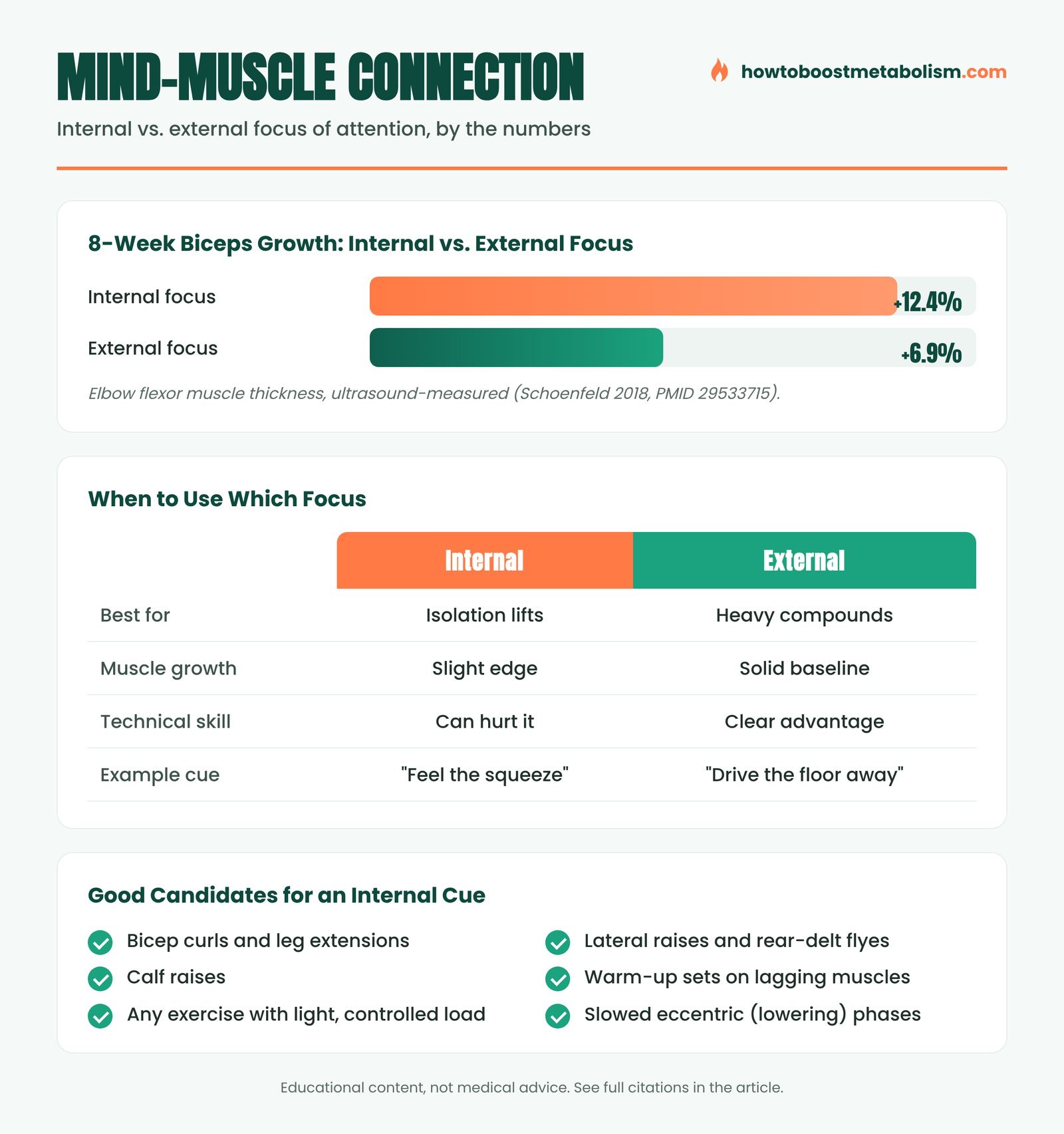
The most directly relevant study assigned thirty untrained young men to eight weeks of identical resistance training, with one group instructed to focus internally on contracting the target muscle throughout each set, and the other instructed to focus externally on the outcome of the lift. Elbow flexor (biceps) muscle thickness, measured by ultrasound, increased by 12.4% in the internal-focus group compared with 6.9% in the external-focus group (Schoenfeld et al., 2018, Eur J Sport Sci, PMID 29533715). A similar, smaller advantage showed up in quadriceps thickness. Isometric strength told a split story: elbow flexion strength favored the internal-focus group, while knee extension strength favored the external-focus group — though neither strength difference reached statistical significance in this relatively small sample.
That is one study, with real limitations — thirty untrained participants, eight weeks, two specific exercises. It is also, as of this writing, the single best piece of direct evidence anyone has that an internal focus can meaningfully change long-term hypertrophy outcomes, not just how a single set feels in the moment.
| Outcome (8 weeks) | Internal focus | External focus |
|---|---|---|
| Elbow flexor (biceps) thickness | +12.4% | +6.9% |
| Quadriceps thickness | Greater increase | Smaller increase |
| Isometric elbow flexion strength | Favored | Not favored |
| Isometric knee extension strength | Not favored | Favored |
Free download
🔥 The Metabolism Starter Kit
3 honest guides: a 7-day reset plan, a foods cheat-sheet and 12 metabolism myths debunked. No spam — unsubscribe anytime.
What About Muscle Activation (EMG) During a Single Set?
Separate from long-term growth, several studies have measured muscle electrical activity (EMG) during a single set under different focus instructions. A 2018 study in resistance-trained men found that both internal and external focus instructions increased EMG amplitude in several upper-body muscles during the bench press, compared with no specific focus instruction at all — meaning simply being told to pay attention to something raised muscle activation, regardless of exactly what (Kristiansen et al., 2018, J Strength Cond Res, PMID 30137029). Other work has shown that cueing a lifter to focus specifically on the prime mover (say, the pectoral muscles during a bench press, rather than the triceps) can selectively shift activation toward that target muscle — a plausible mechanism for why internal focus might help hypertrophy for an isolated muscle, specifically.
The Honest Trade-Off: Mind-Muscle Focus Can Hurt Performance
This is the part that gets left out of most “just feel the muscle” gym-floor advice. A widely cited commentary on this research area points out that the broader motor-learning literature has repeatedly found internal focus of attention can impair movement efficiency, coordination, and force output on skilled or compound movements — the opposite effect you want when the goal is moving a heavy barbell safely (Halperin & Vigotsky, 2016, Eur J Appl Physiol, PMID 26896956). A 2016 study comparing focus strategies across single-joint and multi-joint tasks found the advantage of internal focus shrinks, and can reverse, as a movement becomes more technical and involves more joints working together (Marchant et al., 2016, PLoS One, PMID 27898743). A squat, deadlift, or overhead press under heavy load is exactly that kind of multi-joint, coordination-dependent movement — the worst-case scenario for trying to also think hard about squeezing an individual muscle.
A 2021 meta-analysis looking specifically at muscular endurance (not hypertrophy) across several attentional-focus studies found a modest benefit from an internal focus overall, but with considerable variation between studies and movement types (Grant & Lee, 2021, Int J Environ Res Public Health, PMID 35010348) — consistent with the idea that the effect is real but task-dependent, not a blanket rule.
Why Would Thinking About a Muscle Change How It Grows?
The proposed mechanism isn’t mystical, even if “mind-muscle connection” sounds that way. Motor control research has long shown that where you direct conscious attention changes which motor units your nervous system preferentially recruits and how long it keeps them active during a contraction. An internal focus appears to increase the duration and consistency of activation in the specific muscle you’re attending to, which — over the course of dozens of training sessions — could plausibly add up to a meaningfully larger hypertrophic stimulus in that one muscle. An external focus, by contrast, appears to let the nervous system distribute the work more efficiently across whichever muscles get the job done fastest, which is exactly what you want when the goal is raw output rather than isolating one specific muscle.
This also explains why the effect shows up most clearly on single-joint, single-muscle exercises like the biceps curl used in the main study above. There is only one prime mover to direct attention toward, and no competing technical demand pulling focus away from it. On a squat, there are at least four or five major muscle groups working in a tightly coordinated sequence, plus balance and bar-path demands competing for the same limited pool of attention — which is exactly where trying to “feel” one specific muscle can disrupt the coordination the lift actually depends on.
Common Mistakes People Make With Mind-Muscle Focus
- Trying to apply it to every single exercise in a session, including heavy compound lifts, rather than reserving it for isolation work.
- Using so much weight on an isolation exercise that maintaining a mental focus on the muscle becomes impossible anyway — the cue only works at a load you can actually control.
- Confusing ‘feeling the burn’ (a sign of local metabolic fatigue, not necessarily better activation) with genuine mind-muscle focus; they often coincide, but one doesn’t guarantee the other.
- Giving up on it after one or two attempts. Several coaches and researchers in this area note that deliberately directing attention to a specific muscle is itself a skill that tends to improve with practice, not something that either clicks immediately or never will.
- Ignoring form to chase the feeling. If slowing down and focusing internally causes your joints to move into an uncomfortable or unstable position, the cue has stopped being useful.
Does Experience Level Change Any of This?
The underlying study used untrained participants, which raises a fair question about whether more experienced lifters would see the same gap. There’s a reasonable argument either way. A novice may have less refined body awareness to begin with, so an explicit internal-focus cue could matter more for them simply by teaching basic muscle awareness they don’t yet have. On the other hand, experienced lifters often report that mind-muscle connection becomes easier and more automatic specifically because years of training have already built that body awareness, which could make the practice more, not less, useful once a lifter is no longer fighting basic technique at the same time. Neither hypothesis has been tested head-to-head in trained versus untrained groups yet, so this remains a reasonable extrapolation rather than a settled finding.
So When Should You Actually Use an Internal Focus?
Putting the hypertrophy evidence and the motor-learning evidence together gives a fairly clean practical rule: the simpler and more isolated the exercise, the more room there is to safely use an internal, muscle-focused cue. The more technical, heavy, or multi-joint the lift, the more you should default to an external focus on the task itself — moving the bar, driving through the floor, hitting your form cues.
| Exercise type | Better default focus |
|---|---|
| Bicep curls, leg extensions, cable flyes, lateral raises | Internal (feel the target muscle) |
| Face pulls, rear-delt work, calf raises | Internal (hard-to-feel muscles benefit most) |
| Heavy squats, deadlifts, overhead press | External (focus on the bar path / the floor) |
| Olympic lifts, any technical or ballistic movement | External, full stop |
A Practical Way to Use This
- On isolation exercises, deliberately slow the eccentric (lowering) phase slightly and consciously think about the target muscle lengthening and shortening.
- On your heaviest compound lifts of the session, switch your attention outward — the bar, the rack, the rep count — and let technique run on autopilot.
- If a specific muscle consistently seems to lag in a compound lift (say, the glutes in a squat), try an internal cue for it only during your warm-up sets, then shift external once the working weight gets heavy.
- Don’t force it. If actively ‘feeling’ a muscle on an exercise makes you lose the rep or your form breaks down, that exercise is a poor candidate for an internal focus, whatever the general rule says.
This is really a cueing strategy, not a training system you need a dedicated program for — it layers on top of whatever rep ranges, volume, and weekly set targets you are already using. Pairing it with deliberately controlled rep tempo on isolation work, rather than rushing through reps, tends to make an internal focus easier to actually maintain. If you train around a joint issue, it can also be combined with isometric holds, where there is nothing to do but focus on the muscle under tension anyway.
Free download: our Metabolism Starter Kit — a protein calculator, a 7-day meal framework, and a one-page supplement checklist, with zero hype.
Get the Free Starter Kit →Frequently Asked Questions
Is the mind-muscle connection just a bodybuilding myth?
No — it has real, if limited, controlled-study support for muscle size specifically. The myth is treating it as a universal rule that applies the same way to every exercise and goal, including heavy compound strength work, where it tends to backfire.
Will focusing internally help me lift heavier?
Generally no, and it can work against you. The evidence for internal focus improving strength is weak and inconsistent, while external focus (attention on the bar, the floor, the outcome) is more consistently linked to better force output on technical lifts.
How exactly do I ‘feel’ a muscle working if I never have before?
Start with light weight on a simple isolation exercise and deliberately slow down, especially the lowering phase, while picturing the muscle shortening and lengthening. It’s a trainable skill that typically improves with a few weeks of deliberate practice, not something you either have or don’t.
Does this matter more for certain muscles?
Anecdotally and in some EMG research, it seems to help most with muscles that are easy to under-use without noticing — like the glutes, rear delts, or triceps on pressing movements — more than with muscles that are hard to avoid feeling, like the quads in a squat.
Should beginners worry about mind-muscle connection at all?
It’s a low priority for beginners. Learning basic technique and simply accumulating consistent training volume will do far more for a new lifter’s results than optimizing attentional focus, which is more of a refinement for someone who already trains consistently.
This article is for educational purposes only and is not a substitute for professional medical or fitness advice. See our Medical Disclaimer for more.