Do ‘Negatives’ Really Protect Your Tendons After 40?
This article may contain affiliate links. If you buy through them, we may earn a small commission at no extra cost to you. See our Affiliate Disclosure and Medical Disclaimer.
If you’ve spent time around physical therapy clinics or strength-training forums, you’ve probably heard that “negatives” — the slow, controlled lowering phase of a lift, done deliberately and often with extra load — are the gold standard for fixing or preventing tendon problems. It’s one of the more durable pieces of exercise folklore, and like most durable folklore, it’s rooted in real research that’s gotten somewhat flattened in the retelling. Eccentric training genuinely is one of the best-supported interventions for a specific, common problem: Achilles tendinopathy. Whether that same advice generalizes to every tendon, and to tendon health in general as people pass 40, is a more complicated answer than the gym-floor version suggests.
If you’d rather follow a program that already sequences loading progressions for you instead of assembling your own eccentric protocol, a structured plan can do that legwork.
Learn More →Affiliate link — we may earn a commission at no extra cost to you. Disclosure
What “Eccentric” Actually Means
Every resistance exercise has two phases: the concentric phase, where the muscle shortens under load (the “up” of a squat), and the eccentric phase, where it lengthens under load while still resisting it (the “down”). Eccentric training deliberately emphasizes or isolates that lowering phase — often with a slow count, sometimes with extra load since muscles can tolerate more force eccentrically than concentrically. “Negatives,” as the term is used colloquially in gyms, usually refers to the same thing: a controlled, slowed-down lowering phase, sometimes assisted on the way back up.
Where the Evidence Is Genuinely Strong: Achilles Tendinopathy
The strongest, longest-standing evidence for eccentric training and tendon health comes from Achilles tendinopathy — chronic pain and thickening at or near the Achilles tendon, extremely common in runners and in anyone who ramps up impact activity. A 2023 systematic review and meta-analysis by Migliorini and colleagues, pooling eight studies that met inclusion criteria, found that eccentric exercise produced a significant improvement in pain compared to other forms of exercise treatment, with a mean difference of -1.21 on a standard pain scale (https://pubmed.ncbi.nlm.nih.gov/36698184/).
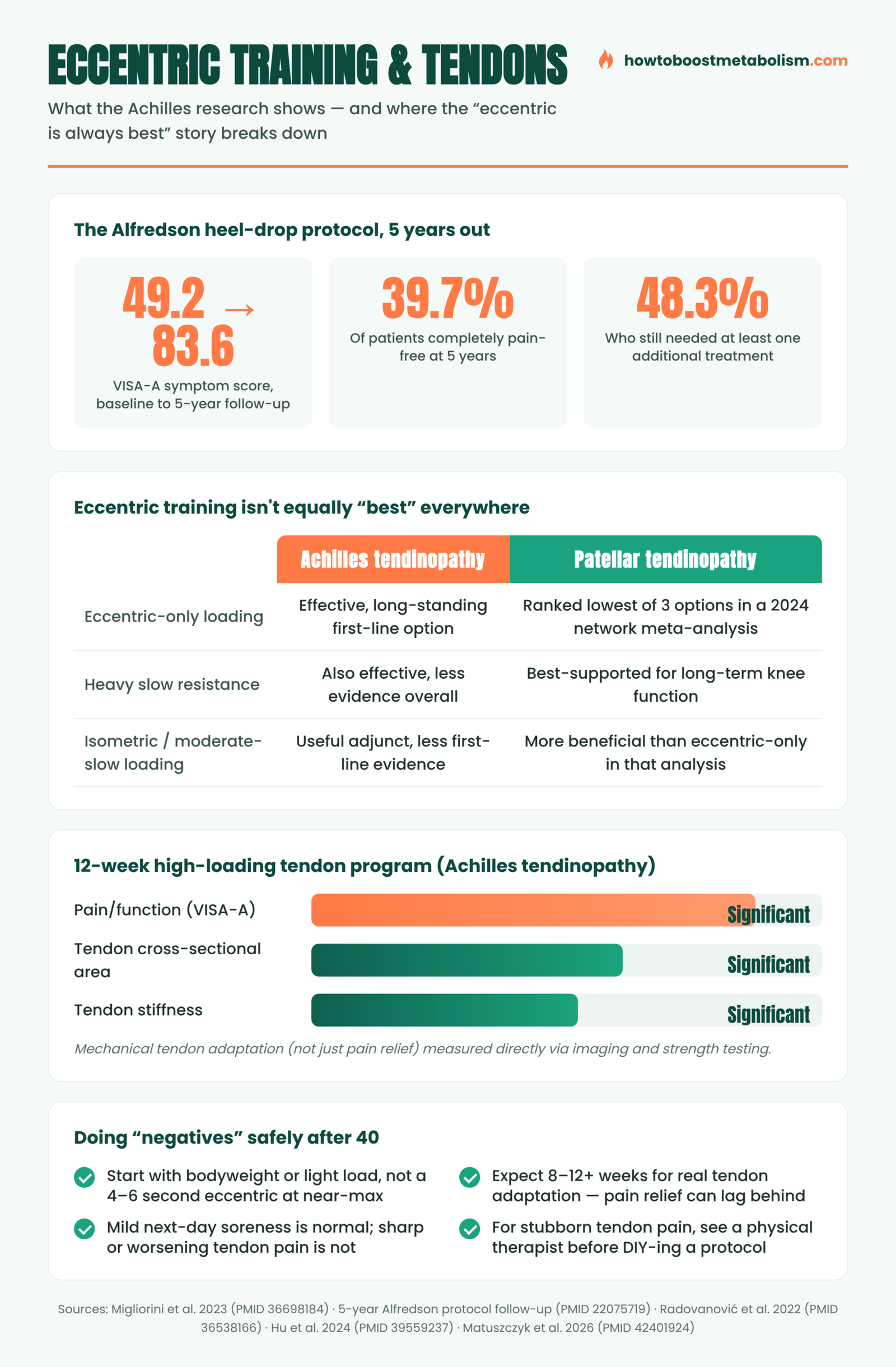
Longer-term data backs this up. A 5-year follow-up of patients originally treated with the classic Alfredson heel-drop protocol — a specific, well-studied eccentric calf-raise program — tracked 58 patients (70 affected tendons) using the VISA-A questionnaire, a validated symptom and function score. The average score rose from 49.2 at baseline to 83.6 at 5 years, and 39.7% of patients were completely pain-free at that point. The honest caveat sits right alongside those numbers: 48.3% of patients had received at least one additional treatment beyond the original exercise program by the 5-year mark, and mild residual pain was common even among those who improved substantially (https://pubmed.ncbi.nlm.nih.gov/22075719/). Eccentric loading clearly helps here — it isn’t a guaranteed, one-time fix for everyone.
A 2022 controlled clinical trial adds the mechanistic piece: 12 weeks of high-loading tendon exercise in patients with Achilles tendinopathy produced measurable increases in tendon stiffness and cross-sectional area — not just reported pain relief, but an actual structural and mechanical adaptation in the tendon tissue itself, alongside improved VISA-A scores (https://pubmed.ncbi.nlm.nih.gov/36538166/). That matters because it answers a reasonable skeptical question — is this just exercise distracting from pain, or is the tendon actually changing? The imaging and strength data say the tendon itself adapts.
Free download
🔥 The Metabolism Starter Kit
3 honest guides: a 7-day reset plan, a foods cheat-sheet and 12 metabolism myths debunked. No spam — unsubscribe anytime.
Where the “Eccentric Is Always Best” Story Breaks Down
Here’s the part that rarely makes it into gym-floor advice: the evidence for eccentric-only training isn’t uniformly strongest across every tendon. A 2024 systematic review and network meta-analysis compared eccentric, isometric, and heavy slow resistance (HSR) training specifically for patellar tendinopathy — the kneecap-tendon equivalent of the Achilles problem, common in jumping and cutting sports. Across the seven studies that qualified, eccentric training ranked lowest of the three approaches for improving the VISA-P symptom score, while moderate-to-heavy slow resistance training and isometric loading performed better, particularly for longer-term knee function (https://pubmed.ncbi.nlm.nih.gov/39559237/).
This isn’t a contradiction so much as a reminder that tendons aren’t interchangeable. The Achilles and patellar tendons sit in different biomechanical environments, see different loading patterns in daily movement, and — based on the studies above — don’t necessarily respond identically to the same rehab strategy. The honest summary: eccentric loading is well-supported, specifically, for Achilles tendinopathy. For patellar tendinopathy, heavy slow resistance or isometric approaches currently have at least as much, if not more, supporting evidence. “Do negatives for tendon health” is too broad a rule to apply uniformly.
| Tendon / condition | Better-supported approach | Why |
|---|---|---|
| Achilles tendinopathy | Eccentric loading (e.g., Alfredson heel-drops) | Strong, long-standing evidence |
| Patellar tendinopathy | Heavy slow resistance or isometric loading | Outperformed eccentric-only in recent network meta-analysis |
| General tendon loading tolerance | Progressive loading of any well-chosen type | Matters more than the specific “eccentric” label |
Why Tendons Respond Differently Than Muscle
Part of why this is confusing is that tendons adapt on a different, slower timeline than muscle. Muscle can show measurable strength changes within a few weeks of consistent training; tendon collagen turnover and stiffness changes generally take longer — the 12-week high-loading study above is a fairly typical timeframe before structural changes show up on imaging. That mismatch is a common reason people quit eccentric or tendon-loading programs too early: muscle-level soreness and perceived effort show up immediately, while the actual tendon remodeling that reduces pain long-term takes two to three months of consistency to show up. After 40, when recovery between loading sessions typically takes somewhat longer than it did at 25, that patience requirement matters even more — rushing the progression is a common way people aggravate an already-irritated tendon rather than rehabilitating it.
A Sensible Default If You’re Adding “Negatives” to Your Training
- Identify which tendon and which problem you’re actually trying to address — general strength-training technique versus an existing diagnosed tendinopathy call for different approaches, and the evidence above doesn’t generalize uniformly across tendons.
- For an existing, diagnosed Achilles issue, a structured eccentric heel-drop protocol (like Alfredson’s) has real, long-term supporting evidence — but set realistic expectations: meaningful improvement over months, not days, and a reasonable chance you’ll still want a therapist’s input along the way.
- For a knee/patellar tendon issue, don’t assume eccentric-only is automatically the best choice — heavy slow resistance or isometric loading have at least comparable, and in some comparisons better, supporting evidence.
- For general strength training with no diagnosed tendon problem, a controlled eccentric phase (a 2–3 second lowering count on your main lifts) is a reasonable, low-risk addition — not because it’s a magic tendon-protection trick, but because it’s simply well-executed, effortful training.
- Give it 8–12 weeks before judging whether a tendon-loading protocol is working, and see a physical therapist or sports medicine provider for a tendon problem that isn’t improving or is getting worse.
What About Eccentric Tempo and Soreness?
A 2026 systematic review by Matuszczyk and colleagues looked specifically at how the tempo of the eccentric phase — how slowly you lower a weight — affects acute fatigue, muscle damage markers, and short-term recovery in healthy trained and recreationally active adults. The practical relevance for anyone adding deliberate negatives to their training: a slower, more controlled eccentric phase tends to increase next-day soreness and short-term neuromuscular fatigue compared to a faster tempo, even when the total work performed is similar. That’s not a reason to avoid eccentric work — it’s a reason to expect more soreness when you first add it, and to introduce it gradually rather than all at once in a single session, especially before a hard training day you still need to recover for (https://pubmed.ncbi.nlm.nih.gov/42401924/).
This also explains a common, confusing experience: someone adds slow negatives to their program, feels unusually sore for a few days, and assumes something went wrong with their tendon or joint. In most cases that’s simply exercise-induced muscle soreness responding to an unfamiliar stimulus — the same mechanism behind DOMS after any new exercise — and it resolves within about a week. The distinction that actually matters is between dull, symmetric, whole-muscle soreness (normal) and sharp, localized pain right at the tendon itself that doesn’t ease up or that worsens with daily activity (a signal to back off and get it assessed).
Where a Structured Training Plan Can Help
Sequencing loading progressions correctly — how much, how often, how fast you add difficulty — is exactly the kind of detail that’s easy to get wrong when you’re assembling your own program from articles and videos. Anabolic Fasting, a structured training-and-nutrition program built by Brad Pilon, lays out a progression framework rather than leaving loading decisions to guesswork. One honest note: the program’s marketing language about building muscle and burning fat “simultaneously” is exactly that — marketing framing, not an independently verified guarantee — so judge it on its actual training structure rather than that specific claim. It is not a substitute for seeing a physical therapist if you have a diagnosed tendon injury.
Free download: our Metabolism Starter Kit — a protein calculator, a 7-day meal framework, and a one-page supplement checklist, with zero hype.
Get the Free Starter Kit →Signs a Tendon Problem Needs Professional Attention
Not every ache near a tendon needs a formal workup, but certain patterns are worth getting checked rather than training through:
- Pain that’s sharp, localized to a specific point on the tendon, and consistently reproducible by the same movement — rather than a general, diffuse soreness.
- Pain that’s worse first thing in the morning or after a period of rest, then eases somewhat once you’re moving (a classic tendinopathy pattern).
- Swelling, warmth, or a thickened, nodular feel directly over the tendon.
- Symptoms that persist or worsen over 2–3 weeks despite reducing the aggravating activity.
- Any sudden, sharp pain with a popping sensation, which can indicate a partial or full tendon tear and needs prompt medical evaluation, not a loading program.
A physical therapist or sports medicine physician can confirm what’s actually going on — tendinopathy, a muscle strain, bursitis, and referred joint pain can all feel similar to someone without training in musculoskeletal assessment — and set an appropriate starting load, which matters because starting too aggressively with eccentric loading on an acutely irritated tendon can make symptoms worse rather than better.
Related: If you’re managing tendon pain, it’s also worth reading how isometric holds can ease joint and tendon pain — a different loading strategy than eccentric work, with its own evidence base.
Related: If heavy external load on the joint is the main problem rather than the movement itself, blood flow restriction training is another evidence-backed way to keep building muscle with lighter weight.
Frequently Asked Questions
Frequently Asked Questions
Are “negatives” and eccentric training the same thing?
Essentially yes — “negatives” is gym shorthand for the eccentric, or lengthening, phase of a lift, usually done with a slower, controlled tempo and sometimes with extra load.
Does eccentric training prevent tendon injuries before they happen?
Most of the strongest evidence is for treating an already-diagnosed tendinopathy (especially Achilles), not for preventing injury in healthy tendons. Well-executed progressive loading in general is reasonable for long-term tendon health, but “eccentric-specifically-prevents-injury” is a bigger claim than the current research directly supports.
Is eccentric training the best option for every tendon problem?
No. It has strong, long-standing evidence for Achilles tendinopathy specifically. For patellar tendinopathy, a 2024 network meta-analysis found heavy slow resistance and isometric loading outperformed eccentric-only training. Match the approach to the tendon and condition rather than assuming one protocol fits all.
How long before eccentric exercise actually helps a tendon problem?
Measurable structural changes (tendon stiffness, cross-sectional area) in the research above showed up around 12 weeks of consistent loading. Meaningful symptom improvement in the long-term Achilles follow-up study continued building over months and years, not days or a couple of weeks.
Should I just start doing heel drops if my Achilles hurts?
A structured eccentric heel-drop protocol has solid evidence for Achilles tendinopathy, but getting an actual diagnosis first matters — heel and Achilles pain has several possible causes, and a physical therapist or sports medicine provider can confirm the diagnosis and the right starting load before you begin a self-directed program.
Related reading: tempo and tendon loading connect to broader training variables — see how rep tempo and time under tension actually affect muscle growth, what normal post-workout soreness should (and shouldn’t) feel like, why progressive overload needs to be paced carefully after 40, and why deload weeks protect the same recovery capacity that tendon adaptation depends on.
This article is for educational purposes and is not medical advice. If you have tendon pain that persists, worsens, or follows an injury, see a physical therapist or physician for an evaluation before starting a self-directed loading program. See our full Medical Disclaimer.