Full-Body vs. Split Workouts After 40: Which Wins?
This article may contain affiliate links. If you buy through them, we may earn a small commission at no extra cost to you. See our Affiliate Disclosure and Medical Disclaimer.
Walk into most gyms and you’ll find two tribes: the full-body crowd hitting legs, back, and chest in every session, and the split crowd dedicating entire days to “chest day” or “leg day.” Both groups will tell you their way builds more muscle. After 40, with less time to waste and a recovery curve that isn’t what it was at 25, the question of which actually works better — and which fits real life — matters more than ever.
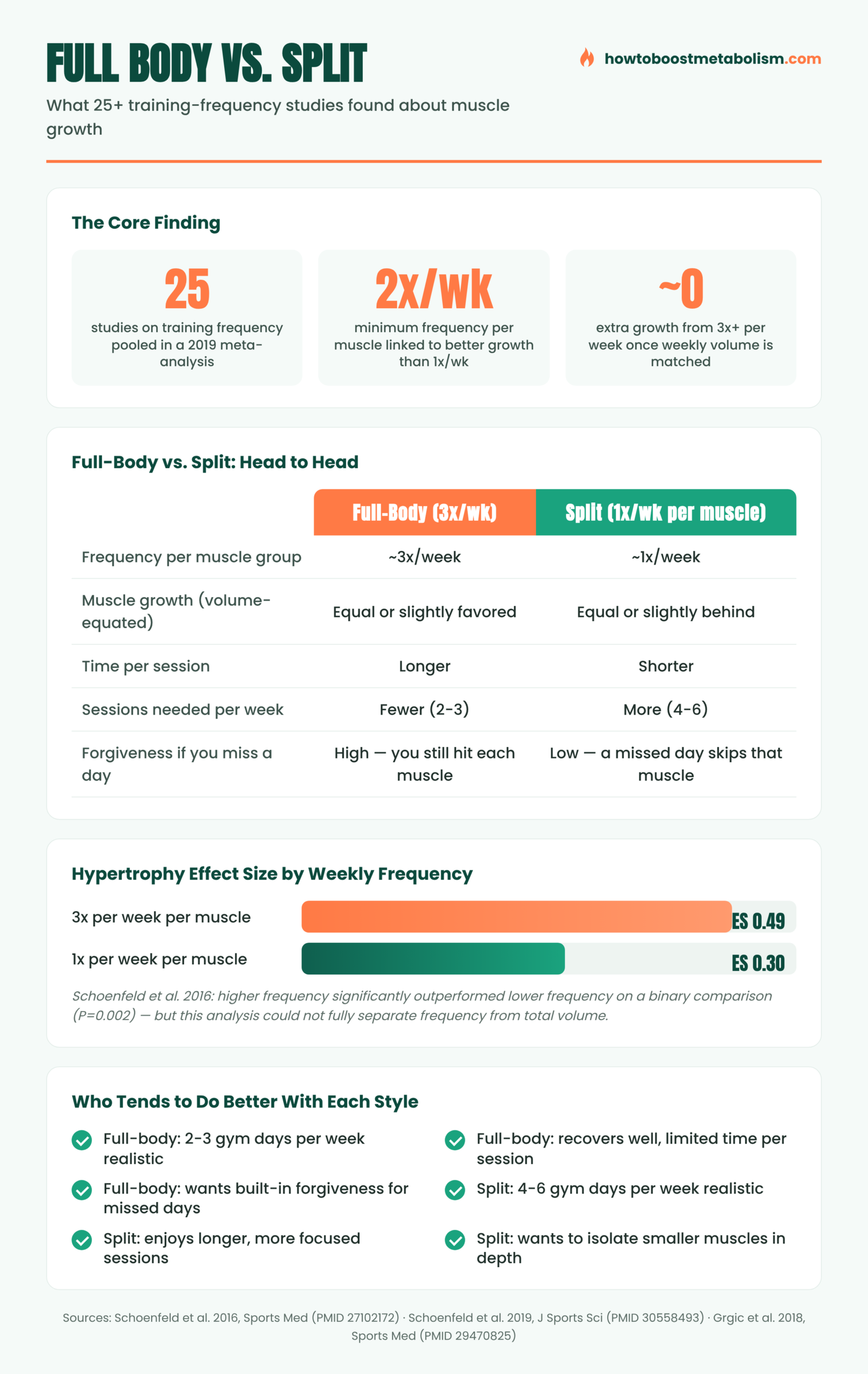
The short answer from the research: when weekly training volume is equal, full-body and split routines build muscle at essentially the same rate. The real differences between them are about time, recovery, and how forgiving each style is when life gets in the way — not about which one has some hidden hypertrophy advantage.
What “Frequency” Actually Means in the Research
Training frequency, in exercise science, usually means how many times per week a given muscle group is trained — not how many days you’re in the gym. A full-body routine done three times a week trains each muscle three times weekly. A four-day split that hits chest once, back once, legs once, and shoulders/arms once trains each muscle group only once a week, even though you’re in the gym four days instead of three.
A 2016 systematic review and meta-analysis in Sports Medicine pooled ten studies that directly measured muscle growth across different weekly frequencies (Schoenfeld, Ogborn & Krieger, 2016, Sports Medicine). Using frequency as a simple binary predictor, higher frequency was associated with a meaningfully larger hypertrophy effect size than lower frequency (0.49 vs. 0.30, P = 0.002). But the authors were upfront about a key limitation: they couldn’t fully separate the effect of frequency from the effect of total training volume, because the available studies didn’t let them run that comparison cleanly.
The Study That Clarified the Picture: Volume Is the Real Variable
A follow-up systematic review and meta-analysis in the Journal of Sports Sciences addressed exactly that gap by pooling 25 studies and specifically asking what happens to muscle growth when weekly training volume is held equal across different frequencies (Schoenfeld, Grgic & Krieger, 2019, Journal of Sports Sciences). The finding: once total weekly volume is matched, there is no significant difference in muscle growth between higher and lower training frequencies — including when the data were split into upper-body and lower-body muscle groups separately. A meta-regression of the non-volume-equated studies did find a modest edge favoring higher frequencies, but the magnitude of the difference between training a muscle once versus three or more times per week was described as modest, not game-changing.
A related 2018 meta-analysis looking specifically at strength gains (not just muscle size) reached a similar conclusion for 1RM outcomes (Grgic, Schoenfeld, Davies, Lazinica, Krieger & Pedisic, 2018, Sports Medicine): frequency mattered less than the total training volume and intensity behind it. Put the three papers together and the conclusion is consistent — volume and effort are the main drivers; frequency, and by extension the full-body-vs-split choice, is mostly a scheduling decision dressed up as a training-philosophy debate.
| Condition | What the research found |
|---|---|
| Weekly volume matched | No significant difference in muscle growth between frequencies |
| Weekly volume NOT matched | Higher frequency shows a modest statistical edge, likely because it’s easier to accumulate volume across more, shorter sessions |
| Strength (1RM) outcomes | Similar pattern — volume and intensity outweigh frequency alone |
Free download
🔥 The Metabolism Starter Kit
3 honest guides: a 7-day reset plan, a foods cheat-sheet and 12 metabolism myths debunked. No spam — unsubscribe anytime.
So Why Do So Many Lifters Swear by Splits?
Splits aren’t wrong — they’re often just an indirect way of getting more total volume in. A dedicated “leg day” with 90 minutes to burn naturally invites more sets per muscle than a 45-minute full-body session trying to hit everything. If a split routine produces better results for someone, it’s very often because it quietly increased their weekly volume, not because once-a-week frequency has a secret hypertrophy edge over three-times-a-week frequency.
The reverse is also true: a full-body routine done sloppily, with too few hard sets per muscle spread too thin across the body, will underperform a well-dosed split — again, because of volume, not frequency.
Why the Calculation Tilts Toward Full-Body After 40
If the two styles build muscle about equally well at matched volume, the deciding factors become practical — and several of them favor full-body training for a 40+ schedule and recovery profile.
1. Fewer required sessions per week
A well-designed full-body routine can deliver adequate weekly volume in 2-3 sessions. A traditional 5- or 6-day split needs that many separate trips to the gym to hit the same muscle groups with comparable total volume. For anyone juggling work, family, and everything else that fills up a week after 40, fewer required sessions is a real adherence advantage — and a program you actually do consistently beats one that’s theoretically optimal but gets skipped.
2. Built-in forgiveness when life interrupts training
Miss a day on a full-body plan and every muscle group still got trained at least once or twice that week. Miss “leg day” on a split and legs get zero direct work until next week. Recovery needs and schedule conflicts tend to increase with age and responsibility — a structure that tolerates a missed session without losing an entire muscle group’s weekly stimulus is a meaningful practical edge.
3. More frequent, lower-per-session joint stress
Spreading total weekly sets for a muscle across three shorter sessions, rather than concentrating them into one long, exhausting session, tends to be easier on joints and connective tissue that don’t bounce back as quickly as they used to. This lines up with the same proximity-to-failure and total-volume principles that drive rep-range choices — see our breakdown of rep range for muscle growth vs. fat loss for more on how effort and volume, not a single number, drive results.
When a Split Still Makes Sense
| If this is true for you… | …a split may fit better |
|---|---|
| You can realistically train 4-6 days per week | A split lets you dedicate focused time to lagging muscle groups |
| You enjoy longer, single-focus sessions | Splits suit lifters who prefer depth over breadth per session |
| You’re chasing a specific muscle group’s growth | More exercises per muscle in one session can target it more precisely |
| You have 60-90+ minutes per session available | Splits need that time to deliver adequate volume per muscle |
Mistakes People Make Switching Between the Two
| Mistake | Fix |
|---|---|
| Copying a 5-day split’s exercise list into 3 full-body days | Cuts per-muscle exercises down to 1-2 per session, not 4-5 — full-body sessions need fewer total exercises, done more often |
| Treating full-body as automatically “less work” | A properly dosed full-body session takes nearly as long as a split day — it’s the schedule that’s lighter, not the per-session effort |
| Switching styles every 1-2 weeks chasing novelty | Give either structure 6-8 weeks minimum; volume accumulates and adaptations show up over blocks, not single sessions |
| Assuming a split guarantees more volume | Only true if you’re actually using the extra time to add sets — a rushed split day can deliver less volume than a focused full-body one |
One more practical wrinkle specific to busy adults: a full-body structure is also easier to keep honest. It’s simple to tell whether you did “enough” when every session touches every major muscle group — you can feel if squats, a push, and a pull all happened. A split is easier to quietly let slide, where “leg day” keeps getting pushed to tomorrow and tomorrow never quite arrives. Over a full training year, the structure you don’t skip wins, regardless of which one a meta-analysis mildly favors on paper.
The honest bottom line: this isn’t a question with one universally correct answer. It’s a question of which structure makes it easiest for you to accumulate enough hard weekly volume per muscle group, consistently, for months. For most people over 40 juggling a busy schedule, that tends to be full-body training two to three times a week — but a well-run split works just as well for someone who genuinely has the time and enjoys the format.
What About Warm-Up Time?
One underrated factor in the full-body-vs-split decision is warm-up overhead. Training squats, a bench or overhead press, and a row or pulldown pattern all in one full-body session means warming up multiple joints and movement patterns every time you train. A split day usually needs a more focused warm-up for one or two movement patterns. Over three full-body sessions a week, that adds a modest but real chunk of total gym time compared with the same total volume spread across more, narrower split days — worth factoring in if session length, not weekly frequency, is the actual constraint.
Making Either Style Work Long-Term
Whichever structure you choose, the variable that actually predicts results is whether you can sustain it through a realistic progressive-overload progression, with planned recovery weeks built in before fatigue forces a break. Programs designed specifically around brief, full-body sessions for people over 40 who don’t have hours to spend in the gym are built around exactly this time-efficiency logic.
Full-body, time-efficient training programs built for people over 40 are marketed as a way to build muscle without requiring 5-6 gym days a week. That’s the vendor’s framing of its own program, not an independent clinical guarantee — but the underlying structure (shorter, full-body sessions, 2-3x per week) matches what the frequency research above actually supports for a busy schedule.
See the Program →Affiliate link — we may earn a commission at no extra cost to you. Disclosure
Free download: our Metabolism Starter Kit — a protein calculator, a 7-day meal framework, and a one-page supplement checklist, with zero hype.
Get the Free Starter Kit →At a Glance
| Question | Short answer |
|---|---|
| Does a split build more muscle than full-body? | No — not when weekly volume per muscle is matched (PMID 30558493) |
| Is more frequency always better? | Training a muscle twice a week beats once a week; beyond that, gains flatten out |
| What matters more than frequency? | Total weekly training volume and effort (proximity to failure) |
| Best fit for most people over 40? | Full-body, 2-3x/week — fewer required sessions, more forgiving of a missed day |
Related: Once you’ve settled on full-body or split training, the next time-saving question is how you structure your sets — see what a 2025 meta-analysis found when comparing supersets to straight sets.
Related: How you split your sessions changes how that weekly volume gets distributed — see our breakdown of training volume landmarks and how many sets per week you actually need.
Related: How you split your training days interacts with how you periodize it over weeks — see our comparison of linear vs. undulating periodization for lifters over 40.
Related: Exercise selection matters beyond full-body vs. split — unilateral training is worth adding for strength specificity and catching hidden imbalances.
Frequently Asked Questions
Is full-body training better than a split routine for building muscle?
Neither is inherently better. A 2019 meta-analysis of 25 studies found no significant difference in muscle growth between training frequencies when weekly volume per muscle was equal. The practical differences are about time commitment and recovery, not a hidden hypertrophy advantage for either style.
How many times per week should I train each muscle group?
Research suggests training a muscle group at least twice a week tends to outperform once a week, especially when it’s hard to fit in enough total volume in a single session. Training three or more times per week doesn’t reliably add much more once weekly volume is already adequate.
Is a split routine a waste of time if I’m over 40?
No. A split works fine if you can realistically commit to 4-6 sessions a week and enjoy longer, focused training days. The practical risk after 40 is usually schedule and recovery, not the split structure itself — full-body tends to be more forgiving, not inherently superior.
Can I switch between full-body and split training?
Yes. Many well-designed programs rotate — for example, full-body phases during busy stretches and a short split block when more time and recovery are available. Since muscle growth tracks total volume and effort more than the specific split structure, switching doesn’t cost you progress.
What matters more than choosing full-body or split?
Consistently training close to (not always at) failure, accumulating roughly 10-20 hard sets per muscle group per week, and progressing load or volume gradually over months. The full-body-vs-split decision mostly affects how that volume gets scheduled, not how much muscle you ultimately build.