
Grip Strength: The Longevity Marker You Can Train
This article may contain affiliate links. If you buy through them, we may earn a small commission at no extra cost to you. See our Affiliate Disclosure and Medical Disclaimer.
If you had to guess which simple, 10-second test best predicted how long someone was likely to live, blood pressure would be a reasonable first answer. According to one of the largest studies ever done on the question, it’s wrong. A hand dynamometer — the squeeze-and-read device you’ve probably seen in a doctor’s office — outperformed it.
The Study: 139,691 People, 17 Countries
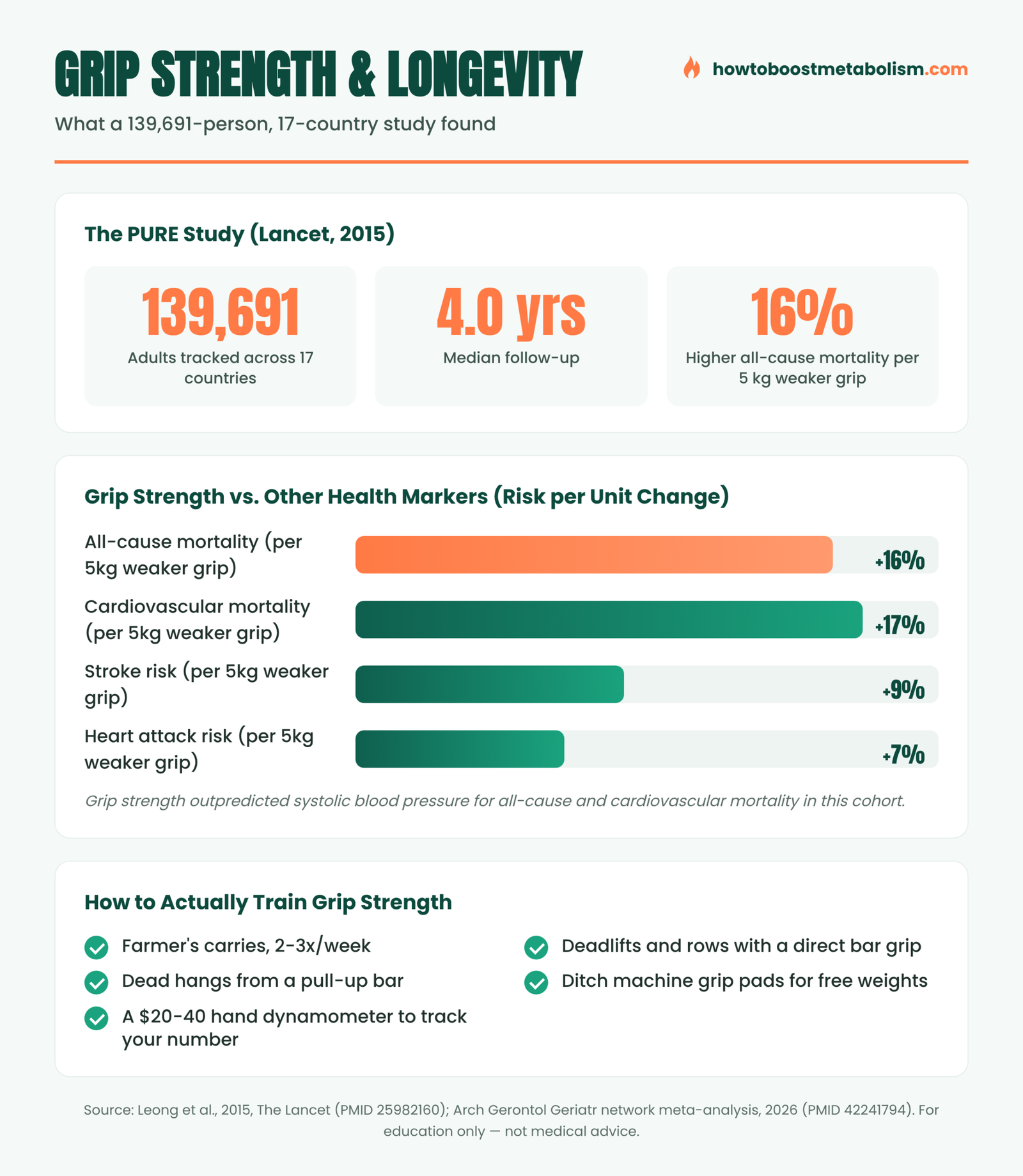
The Prospective Urban Rural Epidemiology (PURE) study enrolled over 140,000 adults aged 35-70 across 17 countries spanning the full range of national income levels, then tracked their health outcomes for a median of four years (Leong et al., 2015, The Lancet). Every participant had their grip strength measured with a standard hand dynamometer at the start. The question the researchers were after: does a simple, cheap strength test actually predict who dies and who doesn’t, independent of age, smoking, existing disease, and dozens of other factors they controlled for?
The answer was yes, and the size of the effect was larger than most people expect. For every 5 kilograms of grip strength a person was missing, their risk of dying from any cause during the study rose by 16%, and their risk of dying from cardiovascular disease specifically rose by 17%. Grip strength also predicted heart attack and stroke risk. Most strikingly, the researchers found grip strength was a stronger predictor of all-cause and cardiovascular mortality than systolic blood pressure — a measurement doctors check at nearly every visit specifically because of how predictive it is.
| Outcome | Association With Grip Strength |
|---|---|
| All-cause mortality | +16% risk per 5 kg weaker grip |
| Cardiovascular mortality | +17% risk per 5 kg weaker grip |
| Stroke | +9% risk per 5 kg weaker grip |
| Heart attack (myocardial infarction) | +7% risk per 5 kg weaker grip |
| Comparative strength as a predictor | Outperformed systolic blood pressure for all-cause and CV mortality |
Correlation, Not a Magic Switch
It’s worth being precise about what this study does and doesn’t show, because the honest version is more useful than the headline version. Grip strength almost certainly isn’t a cause of longevity by itself — squeezing a hand gripper harder doesn’t directly protect your heart. What it most likely reflects is overall muscular health, nervous system function, and general physiological reserve: weaker grip tends to track with less total muscle mass, less physical activity, and sometimes undiagnosed illness that affects strength before it’s obviously detected elsewhere. The researchers themselves describe it as a simple, inexpensive way to risk-stratify — flag who might benefit from closer attention — not a standalone treatment target. The practical value is that it’s a fast, honest snapshot of your overall physical condition, measurable in the time it takes to make a cup of coffee.
A separate, more recent analysis found the same marker shows up in sarcopenia and frailty research: a retrospective cohort study of adults 60 and older found that low handgrip strength, especially combined with elevated uric acid, was independently associated with higher mortality risk, particularly in women (Doğan & Akın et al., 2026, Metabolic Syndrome and Related Disorders). The pattern keeps showing up across very different study designs, which is part of why grip strength has become a standard component of frailty and sarcopenia screening tools.
Free download
🔥 The Metabolism Starter Kit
3 honest guides: a 7-day reset plan, a foods cheat-sheet and 12 metabolism myths debunked. No spam — unsubscribe anytime.
The Good News: It’s One of the More Trainable Markers
Unlike some risk factors that are largely outside your control, grip strength responds reliably to training, at any age. A 2026 network meta-analysis pooling 47 randomized controlled trials in older adults compared different exercise approaches head-to-head for their effect on hand grip strength and functional mobility (Arch Gerontol Geriatr, 2026). Multicomponent exercise programs paired with nutritional support produced the largest improvement in grip strength, followed closely by resistance training combined with adequate protein intake. The clear message: structured strength training, done consistently and backed by enough protein to actually build muscle, is the most effective lever researchers have found for improving this specific number — not grip-specific gadgets or isolated hand exercises.
Why Grip Strength Declines With Age
Grip weakens for a combination of reasons that overlap with how muscle changes throughout the body as we age. Starting in a person’s 30s and accelerating after 50, the nervous system gradually loses motor units — the nerve-and-muscle-fiber teams that produce force — and the remaining ones have to pick up the slack, which they do less efficiently over time. Tendons and connective tissue also stiffen with age, slightly reducing how efficiently force generated by the forearm muscles transfers into the hand. On top of the biology, there’s a simple behavioral factor: most daily life and most modern exercise equipment don’t ask much of the hands anymore. Machines with padded handles, assisted grips, and a general shift away from manual labor and carrying heavy objects all mean grip strength quietly atrophies from disuse well before it would from biology alone. That combination — a genuine physiological decline plus a near-total lack of practice — is part of why grip strength tends to fall faster than overall strength as people get older, and why it responds so well when people actually start training it again.
Three Types of Grip, and Why It Matters Which One You Train
| Grip Type | What It Means | How to Train It |
|---|---|---|
| Crush grip | Squeezing the hand shut (shaking hands, closing a hand gripper) | Deadlifts, farmer’s carries, hand grippers |
| Support grip | Holding something heavy for time without it slipping | Farmer’s carries, dead hangs, heavy carries |
| Pinch grip | Gripping an object between the thumb and fingers without wrapping the hand around it | Plate pinches, pinching a loaded weight plate |
The PURE study and most of the research on grip strength and mortality used a standard hand dynamometer, which primarily measures crush grip. In everyday life, support grip (how long you can hold something heavy) tends to matter more for daily tasks — carrying groceries, holding onto a railing, managing a suitcase — and it’s also the type that fails first as people age. The practical takeaway is that training all three with compound lifts, carries, and hangs covers the full picture better than focusing on any single type, including the crush-grip hand gripper most people reach for first.
How to Actually Train Grip Strength
- Farmer’s carries. Pick up a heavy pair of dumbbells or kettlebells and walk for 30-45 seconds, 2-3 sets, 2-3 times a week. Few exercises tax grip endurance this directly.
- Deadlifts and rows, gripped directly on the bar. Any pulling movement that requires you to hold a loaded barbell or dumbbell trains grip as an automatic side effect of the main lift.
- Dead hangs. Simply hanging from a pull-up bar for time (starting at 10-20 seconds and building up) is a low-skill, equipment-light way to build grip and shoulder health together.
- Skip the machine grip pads. Machines with built-in handles that strap or cradle your hand train the target muscle but let your grip off the hook; free weights that require you to hold on force your hands to do real work.
- A hand dynamometer. A basic model costs $20-40 and lets you actually track your number over time instead of guessing — the same kind of device used in the research above.
Grip rarely needs a program of its own: it improves fastest as a by-product of regular rows, carries and deadlifts inside a general strength routine. If you would rather follow a plan than design one, Old School New Body lays out short full-body workouts aimed at the over-40 crowd. Our review covers what holds up and where the marketing oversells.
Common Grip-Training Mistakes
- Relying only on a hand gripper. Spring-loaded grippers train crush grip in a narrow range of motion; they’re a fine addition but a poor substitute for compound lifts and carries that also build the forearm and upper-body muscle that supports real-world grip demands.
- Using wrist straps on every heavy pull by default. Straps are a legitimate tool for genuinely grip-limited heavy singles, but using them as standard practice on moderate sets removes the training stimulus that would otherwise build your grip alongside your back and legs.
- Expecting overnight results. Like any strength adaptation, measurable grip strength improvement from a dynamometer test typically takes 8-12 weeks of consistent training to show up clearly, not days.
- Ignoring wrist and forearm pain. Grip training that causes sharp or persistent wrist pain, as opposed to normal forearm fatigue, is a sign to scale back load or see a professional, not a sign to push through.
A Simple Weekly Grip-Training Add-On
You don’t need a separate “grip day” to see improvement — grip work layers easily onto a normal strength training schedule that already includes a couple of pulling or carrying movements per week. A simple version: at the end of two training sessions per week, add one farmer’s carry (as heavy as you can hold with good posture for 30-40 seconds, 2-3 sets) and finish with a dead hang for as long as you can hold it, resting and repeating for 2-3 rounds. If your main lifts already include deadlifts, rows, or pull-ups, make sure you’re gripping the bar directly rather than using lifting straps every set — straps have their place for very heavy pulls, but using them by default removes the exact stimulus that trains grip in the first place.
At a Glance: What the Evidence Actually Supports
| Question | What the Research Says |
|---|---|
| Is grip strength worth tracking? | Yes — it’s a strong, cheap, well-replicated marker of overall physical health |
| Does training grip directly extend life? | Not shown — it’s a marker of broader muscular health, not an isolated fix |
| Is it trainable? | Yes — resistance training plus adequate protein shows the largest effects in trials |
| Should it replace standard checkups? | No — it complements blood pressure and other screening, not a substitute |
Grip strength is really a proxy for how much overall muscle and strength you’re carrying, which is exactly what our metabolic age guide digs into from a different angle. If you want to start building the kind of full-body strength that moves this number, our strength training for beginners guide and our piece on how much muscle you can realistically build after 50 are good next stops, and does building muscle boost metabolism covers the metabolic side of the same story.
Free download: our Metabolism Starter Kit — a protein calculator, a 7-day meal framework, and a one-page supplement checklist, with zero hype.
Get the Free Starter Kit →Related: Grip strength isn’t the only fitness number tied to longevity — see our breakdown of VO2 max as a mortality predictor for the cardiorespiratory side of the picture.
Related: Grip strength is one marker of healthy aging through loaded movement — walking with added weight is another angle on the same idea. Here’s what the trials actually found about rucking for metabolism and bone density after 40.
Want a Goal for That Stronger Grip?
Hanging and pulling are among the most practical ways to put grip strength to work. The Ultimate Pull-Up Program by strength coach Meghan Callaway is a digital, step-by-step plan that builds toward your first pull-up — or more of them — through gradual progressions. You will need access to a pull-up bar. It is a training program, not a longevity shortcut, and anyone with shoulder, elbow or wrist problems should check with a doctor or physio first. Sold through ClickBank.
Affiliate link — we may earn a commission at no extra cost to you. See our Affiliate Disclosure.
Related: Grip strength isn’t the only tissue that benefits from targeted loading — see what the research shows on eccentric training (“negatives”) and tendon health after 40.
Related: A weak grip isn’t the only lopsided strength marker worth checking — unilateral training can reveal, and help fix, a left-right strength gap that bilateral lifts tend to hide.
Frequently Asked Questions
What counts as a “weak” grip strength for my age?
There’s no single universal cutoff, because grip strength varies by sex, height, and measurement method, but clinical sarcopenia guidelines commonly flag grip strength below about 27 kg in men and 16 kg in women as a warning sign worth discussing with a doctor. A hand dynamometer (sold for home use for $20-40) is the only accurate way to know your own number — guessing from how strong your hands feel isn’t reliable.
Does grip strength actually cause longer life, or is it just correlated?
Correlated, and the researchers behind the largest study on this are explicit about that distinction. Grip strength is almost certainly a marker of overall muscular health, nervous system function, and general physical reserve, rather than a cause of longevity on its own. Squeezing a hand gripper harder doesn’t directly extend your life — but the broader strength and muscle mass it reflects does appear to matter, which is why training the whole body, not just grip, is the practical takeaway.
Can I improve my grip strength without any special equipment?
Yes. Any compound lift that requires you to hold onto something heavy — deadlifts, farmer’s carries, pull-ups, rows — trains grip as a side effect. Simply switching from machines with built-in hand pads to free weights that require you to grip the bar directly is often enough to see steady improvement over a few months.
How often should I train grip strength specifically?
For most people, dedicated grip work 2-3 times a week is plenty — things like farmer’s carries, dead hangs from a pull-up bar, or direct hand-gripper work for a few sets. If your regular strength training already includes deadlifts, rows, and carries, you’re likely training grip adequately without adding anything extra.
Is grip strength more important than cardio for how long I’ll live?
The research doesn’t support ranking them against each other that way — both matter, and they’re not interchangeable. What the data does show is that grip strength is a surprisingly strong predictor in its own right, strong enough that some clinicians now treat a quick grip test as a useful, low-cost screening tool alongside standard measures like blood pressure, not as a replacement for them.
This article is for educational purposes only and is not medical advice. A single strength measurement is not a diagnosis — talk to a doctor if you’re concerned about unexplained weakness or declining strength. See our full Medical Disclaimer.