Muscle Soreness (DOMS): What It Actually Signals
This article may contain affiliate links. If you buy through them, we may earn a small commission at no extra cost to you. See our Affiliate Disclosure and Medical Disclaimer.
You finish a hard lower-body session, and the next morning your legs barely cooperate on the stairs. For a lot of people, that soreness feels like proof the workout worked — a receipt for effort delivered. Researchers who’ve actually tracked muscle damage and muscle growth side by side, across the same training program over time, found something that complicates that story: soreness and growth become disconnected as your body adapts, and the soreness you feel in week one is telling you something different than the soreness (or lack of it) you feel in week ten.
This article walks through that research directly, what delayed-onset muscle soreness (DOMS) actually is, what it does and doesn’t tell you about your training, and what’s actually worth doing about it.
What DOMS Actually Is
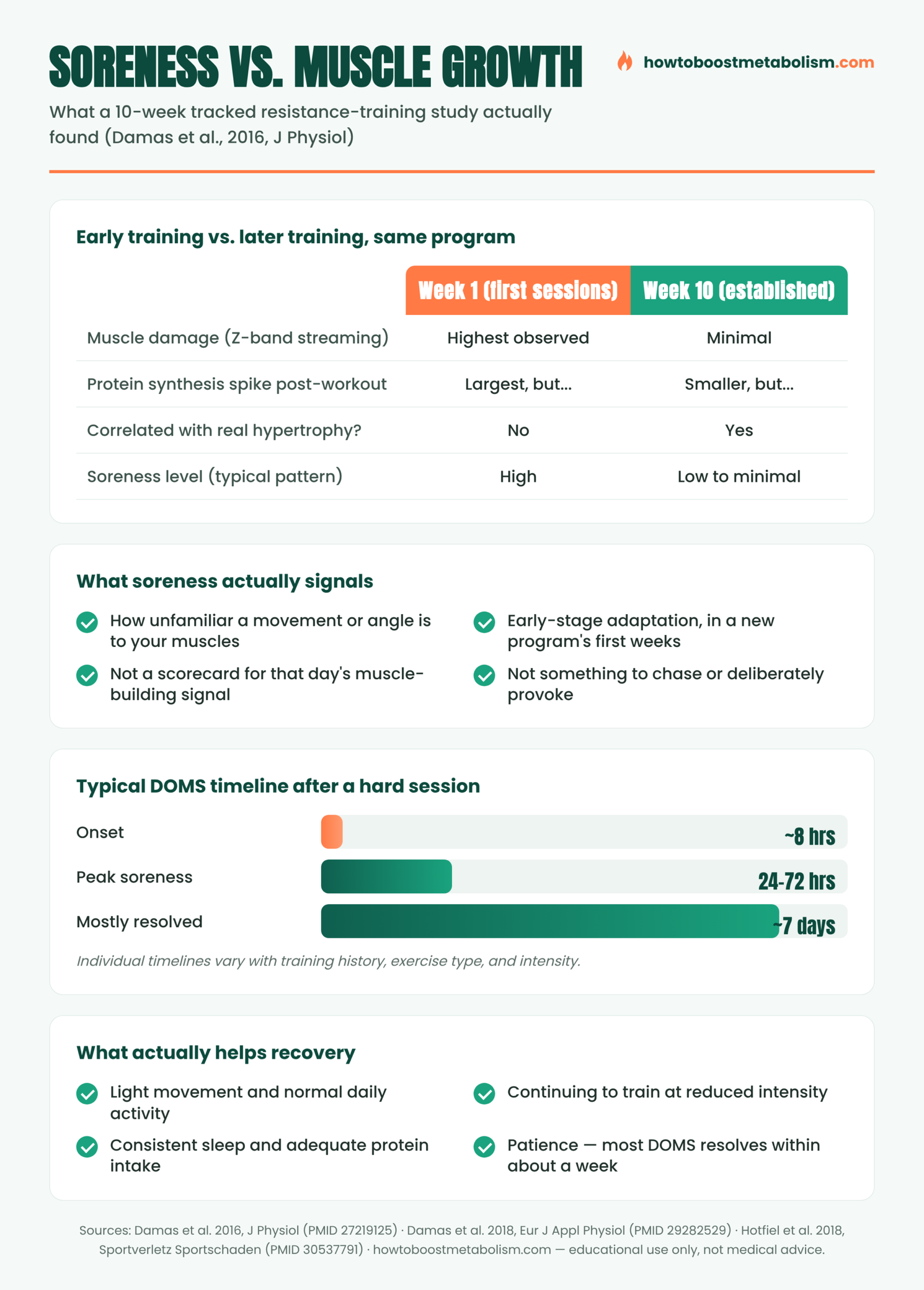
Delayed-onset muscle soreness is exactly what it sounds like: muscle pain and stiffness that shows up hours after exercise rather than during it, typically peaking 24 to 72 hours later and resolving within about a week. It’s most associated with eccentric muscle contractions — the lengthening phase of a movement, like lowering a weight during a squat or the downward part of a bicep curl — and with unfamiliar exercise generally, which is why starting a new program or trying a new movement tends to produce more soreness than repeating a familiar one. A 2018 review in Sportverletz Sportschaden (Hotfiel et al., PMID 30537791) describes DOMS as a type of mild ultrastructural muscle injury — microscopic disruption to muscle fibers, not the same thing as a strain or tear, but a real, measurable form of muscle damage nonetheless.
The Study That Separates Soreness From Growth
The clearest evidence on this comes from a 2016 study in the Journal of Physiology (Damas et al., PMID 27219125). Researchers put participants through a 10-week structured resistance-training program and directly measured two things at three points along the way (after their first session, after roughly 3 weeks, and after roughly 10 weeks): muscle damage, using a technique called Z-band streaming that visualizes structural disruption in muscle fibers, and muscle protein synthesis, the process your body uses to actually build new muscle tissue.
The pattern they found: muscle damage was highest after the very first training session of the entire program, lower by week 3, and minimal by week 10 — the classic ‘newbie soreness fades’ pattern most lifters already notice anecdotally. What’s more revealing is what happened to muscle protein synthesis alongside it. Early in the program, the protein-synthesis spike after a workout was large, but it did not correlate with how much actual muscle growth participants ended up with. Later in the program, once muscle damage had dropped to minimal levels, the protein-synthesis response became smaller in absolute size but was now clearly correlated with real, measured hypertrophy.
A related 2018 review by the same lead author in the European Journal of Applied Physiology (Damas et al., PMID 29282529) lays out the practical interpretation: in the earliest sessions of a program (roughly the first 4 sessions), a meaningful part of any size increase you might see is muscle swelling from damage and repair, not true fiber growth. Modest real hypertrophy starts to show up after about 10 sessions, and more substantial, reliable hypertrophy is seen only after roughly 18 sessions in — specifically once muscle damage has been progressively attenuated by repeated exposure to the same stimulus.
| Training Stage | Muscle Damage Level | Relationship to Actual Hypertrophy |
|---|---|---|
| Week 1 (first sessions) | Highest | Large spike, not correlated with final hypertrophy |
| Week 3 (early adaptation) | Reduced | Smaller spike, beginning to correlate |
| Week 10 (established program) | Minimal | Smaller spike, clearly correlated with real growth |
The short version: the soreness you feel when you’re brand new to a program, or when you try something unfamiliar, is mostly your body reacting to novelty and repairing structural damage — not a direct readout of how much muscle that session built. The soreness fades as your body adapts, but the muscle-building process doesn’t stop; if anything, it becomes more consistently tied to real growth once the damage response calms down.
Free download
🔥 The Metabolism Starter Kit
3 honest guides: a 7-day reset plan, a foods cheat-sheet and 12 metabolism myths debunked. No spam — unsubscribe anytime.
So Why Do We Assume Soreness = Progress?
It’s an intuitive but flawed shortcut. Soreness is tangible and immediate — you feel it the next morning, which makes it feel like direct feedback. Muscle growth is slow, gradual, and invisible day to day, which makes it a much less satisfying signal to rely on. The research above suggests the two aren’t tracking the same thing: soreness tracks novelty and unaccustomed stress, while actual growth depends on progressive overload and consistency applied over weeks and months, with or without soreness along the way.
This also explains a pattern a lot of experienced lifters notice: they stop getting sore from their regular routine within a few weeks, yet they keep adding weight to the bar and keep building muscle. That’s not a contradiction — it’s exactly what the research above predicts. Adaptation reduces the damage response long before it reduces your capacity to keep progressing.
Should You Ever Try to Get Sore on Purpose?
Generally, no. Deliberately chasing soreness — for example, by adding extra slow-eccentric sets purely to feel wrecked the next day — tends to extend your recovery time without a clear payoff in extra growth, and can interfere with training that same muscle group again on schedule. If a new exercise leaves you unable to train effectively for 4–5 days afterward, that’s a cost to your overall training volume for the week, not a bonus. The research-backed approach is the less exciting one: progressive overload, meaning gradually increasing the weight, reps, or sets you can handle over time, applied consistently, whether or not you happen to be sore from the last session.
“No Pain, No Gain” — Where That Idea Falls Apart
The phrase implies a direct trade: more pain purchases more gain. The research above suggests the relationship is closer to the opposite once you’re a few weeks into a consistent program. Soreness is highest when a stimulus is new and your body hasn’t adapted to it yet — exactly the period when the protein-synthesis response, while large, isn’t yet translating into measured hypertrophy. As your body adapts and soreness fades, the muscle-building signal becomes smaller in absolute terms but more tightly linked to actual growth. If ‘no pain, no gain’ were literally true, the most productive phase of training would be the first unfamiliar session of a new program — which the data says is actually the least efficient phase for turning that soreness into muscle.
None of this means pain is irrelevant to training, just that soreness specifically is the wrong kind of pain to use as a progress metric. The signals actually worth tracking are more boring: the weight on the bar, the reps you complete, how many sets you can do before form breaks down, and whether those numbers trend upward over weeks and months.
DOMS vs. a Real Injury: How to Tell the Difference
Ordinary DOMS is diffuse, affects the muscle belly broadly rather than one sharp spot, builds gradually over the first day or two after training, and improves steadily from there. It’s uncomfortable but doesn’t typically prevent you from moving the joint through its range, just makes it unpleasant. A real injury — a strain or tear — tends to announce itself differently: pain that’s sharp and localized to one specific point rather than spread across the muscle, pain that shows up during the activity itself rather than appearing a day later, swelling or bruising, or a noticeable loss of strength or range of motion that doesn’t improve or gets worse over the following days. Unusually dark or tea-colored urine after an intense, unfamiliar workout is a separate warning sign worth taking seriously and mentioning to a doctor promptly, since in rare cases extreme muscle breakdown can affect the kidneys. When in doubt about which you’re dealing with, treating it as a possible injury and getting it checked is always the safer call.
What Actually Helps With DOMS When You Have It
- Keep moving: light activity and normal daily movement tend to ease stiffness faster than complete rest.
- Train through it, lighter: reducing intensity or working a different muscle group while sore is usually better than skipping training entirely.
- Sleep and protein: both support the underlying repair process your body is already running.
- Give it about a week: most DOMS resolves within 5–7 days on its own, which is the single most reliable ‘treatment.’
- Don’t over-rely on ice, heat, or massage for performance: these can help with comfort, but the evidence that they meaningfully speed muscle repair itself is limited.
Free download: our Metabolism Starter Kit — a protein calculator, a 7-day meal framework, and a one-page supplement checklist, with zero hype.
Get the Free Starter Kit →The Honest Bottom Line
Muscle soreness is real, it’s a legitimate (if mild) form of muscle damage, and it’s a useful signal the first few times you try a new exercise or restart training after time off. It is not a reliable scoreboard for how effective any single workout was at building muscle — the research tracking both side by side found them becoming disconnected as training progressed, with soreness fading while real hypertrophy became more consistent. If your goal is long-term muscle and strength, the signal worth tracking is whether you’re progressively adding weight, reps, or sets over weeks and months — not whether you can comfortably sit down the next morning.
Related reading: If you’re new to training, our beginner strength training guide covers how to build a routine without overdoing early soreness. For the progression strategy this article points to, see our guide to progressive overload after 40, and if slower reps have you extra sore, our piece on rep tempo and time under tension explains why. If you’re feeling run down rather than just sore, see when to take a deload week after 40.
If soreness keeps derailing your week, a program with sensible progression helps more than chasing the burn. Old School New Body is a follow-along program built around short, F4X-style strength sessions for adults over 35 — the shorter sessions make gradual progress easier to sustain.
Learn More →Affiliate link — we may earn a commission at no extra cost to you. Disclosure
Related: Soreness from a new eccentric-heavy routine is normal, but tendon pain is a different signal — see how to tell the difference in our guide to eccentric training and tendon health after 40.
Frequently Asked Questions
Does being sore the next day mean I built more muscle?
Not reliably, and research tracking this directly found the opposite pattern over time: soreness and muscle damage were highest after the very first sessions of a training program, when muscle protein synthesis was elevated but not yet linked to actual hypertrophy. By weeks 3 and 10 of the same program, soreness and damage markers dropped sharply, while the muscle-building signal that did correlate with real hypertrophy was still present. Soreness tracks how unfamiliar a stimulus is to your muscles, much more than it tracks how much growth that session is producing.
Is it bad if I’m never sore after training?
No. As your body adapts to a consistent training routine — often within 2–4 weeks — soreness naturally fades even while you continue progressing, adding weight, or adding reps. Lack of soreness in an established program is a normal sign of adaptation, not a sign that your workouts have stopped working.
Should I chase soreness by training harder or adding more eccentric work?
That’s generally not a good strategy. Deliberately provoking more muscle damage and soreness, for example through excessive eccentric-focused training, tends to increase recovery time and can interfere with your ability to train the same muscle group effectively a few days later. Progressive overload — gradually increasing weight, reps, or sets over time — is the strategy linked to long-term results, not soreness for its own sake.
What actually helps with DOMS once I have it?
Time is the main factor — DOMS typically peaks 24–72 hours after the triggering exercise and resolves within about a week on its own. Light movement, walking, and continuing to train (at a reduced intensity if needed) tend to help more than complete rest. Ice, heat, and massage have modest evidence for temporary comfort but don’t meaningfully speed the underlying repair process.
Is soreness a useful way to tell if a new exercise is ‘working’?
It tells you the exercise, angle, or range of motion was unfamiliar to that muscle — which is informative the first few times you try something new, like switching from machines to free weights or changing your rep tempo. It stops being a useful signal once you’ve repeated the same movement for a few weeks and your body has adapted to it.
This article is for educational purposes only and is not medical advice. Persistent, severe, or unusual muscle pain (especially with dark urine or severe swelling) should be evaluated by a doctor, as it can occasionally signal a more serious condition. See our Medical Disclaimer.