Linear vs. Undulating Periodization for Lifters Over 40
This article may contain affiliate links. If you buy through them, we may earn a small commission at no extra cost to you. See our Affiliate Disclosure and Medical Disclaimer.
If you’ve spent any time reading strength-training forums, you’ve likely run into a debate that sounds more complicated than it needs to be: should you periodize your training in a straight line — gradually getting heavier and doing fewer reps over weeks — or should you undulate it, flipping between heavy, medium, and light days within the same week? Coaches have strong opinions on both sides. The research, once you actually read it rather than the marketing built on top of it, is a lot less dramatic than either camp suggests.
Here’s the honest summary up front: for most lifters, especially those with years of training already behind them, the two approaches land in roughly the same place for strength and muscle gain when total training volume is equal. The real argument for picking one over the other after 40 has more to do with joint recovery and week-to-week consistency than with some hidden physiological edge.
What Linear and Undulating Periodization Actually Mean
Linear periodization moves in one direction over weeks or months: you start with higher reps and lighter loads, and gradually shift toward lower reps and heavier loads as a training block progresses — the classic hypertrophy-to-strength-to-peaking sequence used in powerlifting and bodybuilding alike. Undulating periodization — sometimes called DUP, daily undulating periodization — changes the rep range and intensity much more frequently, often from one session to the next within the same week: a heavy, low-rep day on Monday, a moderate day on Wednesday, and a lighter, higher-rep day on Friday, for example, repeated week after week rather than progressing in a straight line.
The Classic Study That Started the Debate
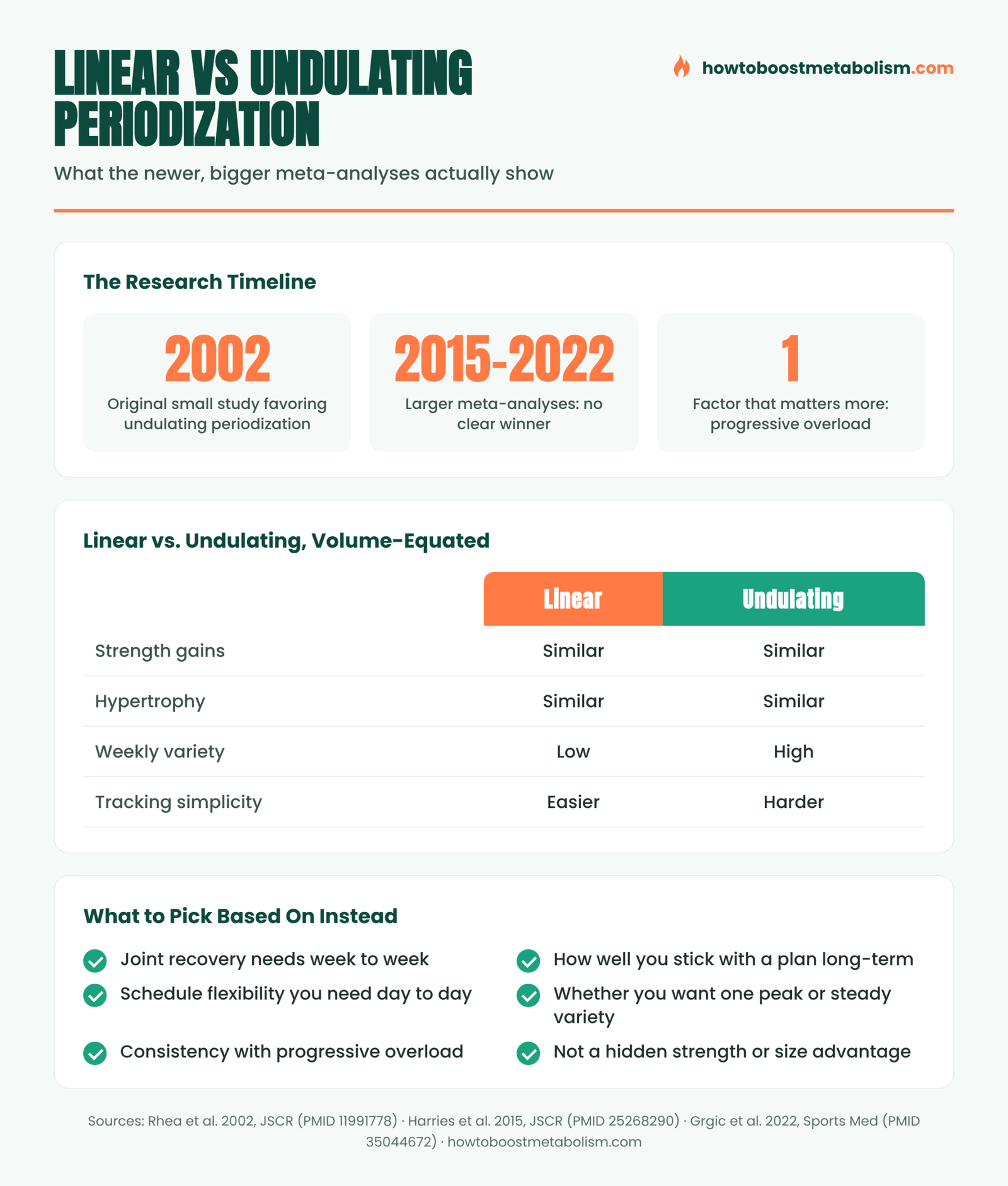
The modern version of this argument traces back to a pair of studies by Rhea and colleagues in the early 2000s. Comparing linear and daily undulating periodization with volume and intensity equated, they found DUP produced significantly greater strength gains than linear periodization in trained individuals over a 12-week program (Rhea et al., 2002, J Strength Cond Res, PMID 11991778). A follow-up study from the same group found a similar pattern for local muscular endurance (Rhea et al., 2003, J Strength Cond Res, PMID 12580661). These two studies are still cited constantly as evidence that undulating periodization is simply superior — but they’re also small, older studies, and the field has moved well past them since.
Free download
🔥 The Metabolism Starter Kit
3 honest guides: a 7-day reset plan, a foods cheat-sheet and 12 metabolism myths debunked. No spam — unsubscribe anytime.
What the Bigger, Newer Meta-Analyses Actually Show
When researchers pooled many more studies together, the dramatic early finding mostly disappeared. A 2015 systematic review and meta-analysis comparing linear and undulating periodized resistance training programs on muscular strength found no statistically significant difference between the two approaches overall (Harries et al., 2015, J Strength Cond Res, PMID 25268290). A 2017 meta-analysis focused specifically on hypertrophy outcomes — comparing linear and daily undulating periodized programs for muscle growth — reached the same conclusion: no meaningful difference between the two models (Grgic et al., 2017, PeerJ, PMID 28848690). A larger, more recent 2022 systematic review and meta-analysis examining periodized versus non-periodized, volume-equated resistance training for both strength and hypertrophy outcomes again found periodization model made little difference once total volume was matched (Grgic et al., 2022, Sports Med, PMID 35044672). Separately, a 2017 meta-analysis directly comparing periodized training to simple non-periodized programs found periodized approaches in general produced modestly greater maximal strength gains than non-periodized training — but this comparison doesn’t distinguish which periodization model (linear or undulating) is superior, just that having some structured progression beats having none (Williams et al., 2017, Sports Med, PMID 28497285).
Put plainly: the original Rhea findings haven’t been well replicated at scale. The current best-evidence position is that linear and undulating periodization produce broadly similar results for strength and hypertrophy when the fundamentals — total volume, intensity, and effort — are equated. What actually predicts progress is less about which calendar pattern you follow and more about whether you’re consistently applying progressive overload within whichever structure you pick.
Why the Early Studies May Have Overstated the Difference
A few things likely inflated the apparent DUP advantage in those early 2000s trials. They were small (dozens of participants, not hundreds), used specific populations (often college-aged trained lifters), and ran for a relatively short window. Meta-analyses that pool many trials with more diverse populations and longer durations tend to smooth out effects that look large in any single small study — this is a common pattern across exercise science, not unique to periodization research. None of this means the original researchers did anything wrong; it just means a 20-person, 12-week study is a fragile foundation for a sweeping claim, and the field has since built a sturdier one.
Why This Debate Matters Differently After 40
If the two models produce similar outcomes on average, the decision for a lifter over 40 comes down to practical factors rather than a hidden physiological edge:
- Joint and connective tissue recovery. Undulating periodization’s built-in lighter days give joints and tendons more frequent breaks from maximal loading within the same week, which can matter more as recovery capacity shifts with age.
- Training monotony and motivation. Some lifters find a straight linear progression mentally easier to follow over months; others find the variety of undulating sessions keeps training more engaging week to week — this is a real factor in long-term adherence, which matters more than any small physiological difference.
- Life schedule flexibility. Undulating periodization’s day-to-day variation can make it easier to adjust a session on the fly — a lighter day if you’re run down, a heavier day when you’re fresh — compared to a linear plan that assumes you’ll hit a specific intensity on a specific calendar week regardless of how you feel.
- Interaction with planned deload weeks. Linear periodization typically builds toward a single peak and then deloads; undulating periodization spreads lighter stimulus throughout, which can reduce the need for a dedicated deload as often.
What About Block, Conjugate, or Other Models?
Linear and undulating are the two most-studied models, but they’re not the only ones coaches use. Block periodization groups training into focused phases (e.g., a hypertrophy block, then a strength block, then a peaking block) with more deliberate transitions than classic linear periodization. Conjugate methods, popularized in powerlifting circles, train multiple qualities (max strength, speed-strength, hypertrophy) within the same week using varied exercises rather than varied rep ranges on the same lifts. The honest takeaway that applies across all of these variations is similar to the linear-versus-undulating finding: once you control for total volume, intensity, and effort, the differences between reasonably well-designed periodization models tend to shrink. The model you pick is less important than picking one you’ll actually follow for months at a time without constantly switching.
Autoregulation — adjusting a session’s load or reps based on how you feel that day, often using a rate-of-perceived-exertion scale — can be layered onto either linear or undulating periodization rather than treated as a separate, competing system. A lifter over 40 managing variable sleep, stress, or minor aches often benefits from this flexibility regardless of which underlying periodization model they’re nominally following, since it lets a single heavy day move to a different day in the week without derailing the whole block.
One more honest point worth making: neither model is a shortcut around the two things that most reliably predict long-term progress — showing up consistently and gradually increasing the demand on your muscles over time. If you haven’t already, it’s worth reading through our guide on full-body vs. split routines, since that structural decision tends to interact with whichever periodization model you choose — a full-body linear block, for example, looks different week to week than an undulating split routine, even if the underlying progression principles are identical.
A Practical Starting Template
Both approaches work. Here’s a simple way to run each one over a typical week of full-body or upper/lower training:
Linear Periodization (12-Week Block Example)
- Weeks 1–4: higher reps (10–15), moderate load, building work capacity.
- Weeks 5–8: moderate reps (6–10), higher load, the main hypertrophy-strength phase.
- Weeks 9–11: lower reps (3–6), heaviest load, strength-focused.
- Week 12: deload, then test or retest key lifts.
Daily Undulating Periodization (Weekly Example)
- Day 1: heavy, low reps (3–6) on main compound lifts.
- Day 2: moderate reps (8–12), moderate load.
- Day 3: lighter, higher reps (12–20), focused on technique and joint-friendly volume.
- Repeat weekly, gradually increasing load within each rep category as weeks progress.
| Factor | Verdict |
|---|---|
| Strength gains, volume-equated | Similar between models (newer meta-analyses) |
| Hypertrophy, volume-equated | Similar between models |
| Original 2002/2003 studies | Favored undulating — small, dated, not well replicated at scale |
| Best for joint recovery variety | Undulating (built-in lighter days each week) |
| Best for simple long-term tracking | Linear (one clear direction over the block) |
| What actually matters more | Consistent progressive overload within either model |
Whichever template you start with, give it a full training block — 8 to 12 weeks — before deciding whether it’s working. Switching models every two or three weeks based on how a single session felt makes it almost impossible to tell whether the periodization structure or simple week-to-week variability is driving your results.
If You’d Rather Not Design Your Own Periodization
Picking a periodization model is only useful if you actually follow it consistently for months — which is exactly where a pre-built program can help more than another spreadsheet. Anabolic Fasting pairs a structured training progression with a fasting-based nutrition approach aimed at building muscle while managing body fat; if you’d rather follow a plan than build a periodization scheme from scratch, it’s worth a look.
Anabolic Fasting combines a structured strength progression with an intermittent fasting approach — a ready-made option if you’d rather follow a plan than build your own periodization scheme.
Learn More →Affiliate link — we may earn a commission at no extra cost to you. Disclosure
Note: marketing claims about building muscle and losing fat “simultaneously” reflect the program’s own promotional language, not an independently verified guarantee — read the specifics before buying.
Free download: our Metabolism Starter Kit — a protein calculator, a 7-day meal framework, and a one-page supplement checklist, with zero hype.
Get the Free Starter Kit →Frequently Asked Questions
Is undulating periodization actually better than linear periodization?
Not clearly, based on the larger and more recent meta-analyses. The original early-2000s studies favored undulating periodization for strength, but bigger pooled analyses since then have found the two models produce broadly similar strength and hypertrophy outcomes when training volume is equated.
Which periodization model is better for beginners?
Neither model shows a clear edge for beginners specifically in the research, and beginners tend to respond well to almost any structured, progressive program. A simpler linear structure is often easier for a beginner to track and stick with.
Can I switch between linear and undulating periodization?
Yes — there’s no evidence that switching models periodically causes a problem, and many lifters use linear periodization for a dedicated strength or hypertrophy block and undulating periodization during maintenance phases when schedule flexibility matters more.
Does undulating periodization help with joint pain or recovery?
It may help indirectly, since it builds lighter days into every week rather than concentrating the heaviest loading at the end of a long block. This is a practical, not a purely physiological, advantage — it hasn’t been shown to produce a different training outcome, just a different weekly loading pattern.
Do I need to periodize my training at all?
Research comparing periodized to non-periodized training generally favors having some structured progression over none, though the specific periodization model you choose appears to matter less than simply following a progressive plan consistently.
This article is for educational purposes only and is not a substitute for professional fitness or medical advice. See our Medical Disclaimer for more.