Whey vs Plant Protein: Which Is Better for Fat Loss? (2026)
This article may contain affiliate links. If you buy through them, we may earn a small commission at no extra cost to you. See our Affiliate Disclosure and Medical Disclaimer.
Walk down the supplement aisle and you face a binary choice: a tub of whey on one side, a tub of pea-and-rice on the other, both promising to “support lean muscle and metabolism.” The marketing on each is nearly identical. The science behind them is not. In this guide to whey vs plant protein we compare the two on the things that actually matter for fat loss — amino acids, calories per gram of protein, fullness, cost, and what randomized trials show — and give you honest picks in each category.
Short version first: if you eat enough total protein, both work. Whey is more efficient per scoop; plant protein can match it with a slightly larger dose and the right blend. The details below will tell you which one deserves a place in your kitchen.
Whey vs Plant Protein: Head-to-Head
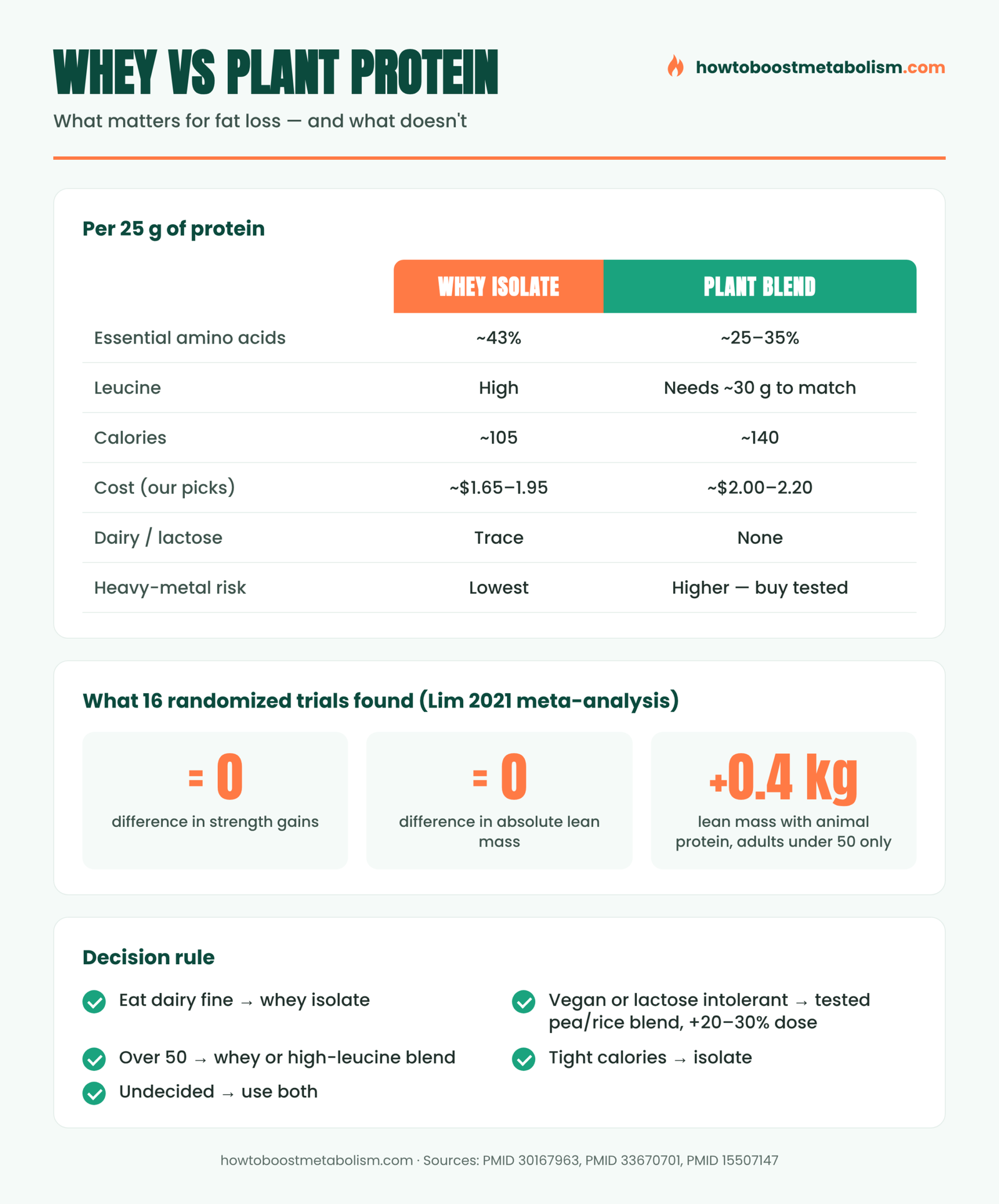
| Whey | Plant (pea, rice, soy, hemp) | |
|---|---|---|
| Protein per typical scoop | 24–27 g | 20–22 g |
| Essential amino acids (% of protein) | ~43% (highest of any food protein) | ~21–35% depending on source; oat and wheat lowest, soy and pea higher |
| Leucine (the muscle trigger) | High — ~2.5–3 g per 25 g serving | Lower — most single-source plant isolates need ~30 g to match |
| Calories per 25 g protein | ~100–115 (isolate) to ~125 (concentrate) | ~130–160 (more carbs and fat per scoop) |
| Digestibility (PDCAAS/DIAAS) | 1.0 / ~1.09 | Soy ~0.9–1.0; pea ~0.8; rice ~0.4–0.6 alone; blends ~1.0 |
| Lactose / dairy | Isolate: trace; concentrate: some | None — suitable for vegans and lactose intolerance |
| Heavy-metal risk | Lowest | Higher — choose third-party-tested brands |
| Cost per 25 g protein (our picks) | $1.65–$1.95 | $2.00–$2.20 |
How Protein Helps You Lose Fat in the First Place
Before comparing sources, it helps to be clear about why protein matters, because the mechanism decides which differences are important.
- Thermic effect. Digesting protein costs 20–30% of its calories, versus 5–10% for carbohydrate and 0–3% for fat (Westerterp, PMID 15507147). Swap 100 calories of carbs for 100 calories of protein and you net roughly 15–20 fewer usable calories. This effect is similar for whey and plant protein.
- Satiety. Protein is the most filling macronutrient per calorie. A 2015 review in the American Journal of Clinical Nutrition (Leidy et al., PMID 25926512) found that higher-protein diets of roughly 1.2–1.6 g/kg improved appetite control, weight loss, and weight maintenance.
- Muscle preservation. In a calorie deficit, protein plus resistance training protects lean mass — the tissue that sets your resting metabolic rate. This is where the source starts to matter, because muscle protein synthesis responds to the essential amino acids, and especially leucine, in what you eat.
Our protein intake guide covers the daily targets; the rest of this article is about getting there with the right powder.
Free download
🔥 The Metabolism Starter Kit
3 honest guides: a 7-day reset plan, a foods cheat-sheet and 12 metabolism myths debunked. No spam — unsubscribe anytime.
The Amino Acid Gap: What the Lab Data Shows
The most useful study on this question measured the actual amino acid content of commercial protein isolates with mass spectrometry (Gorissen et al., Amino Acids, 2018, PMID 30167963). The findings are blunt. Whey was 43% essential amino acids by weight; milk 39%, casein 34%, egg 32%. Oat, lupin, and wheat isolates were 21–22%. Soy, pea, and rice landed in between. Leucine — the amino acid that flips the switch on muscle protein synthesis — ranged from 5.1% of protein in hemp to 9.0% in milk, with whey at the top of the range. Methionine and lysine, two other essentials, were consistently about half as abundant in plant proteins as in animal proteins.
The practical conclusion the authors drew is the one we recommend: blends of plant proteins (for example pea plus rice) or plant-plus-dairy blends can closely match the amino acid profile of whey. A single-source plant powder, especially rice or hemp alone, cannot.
What Randomized Trials Actually Show
Amino acid profiles predict what should happen; trials show what does. Here the gap narrows considerably.
Lean mass and strength
A 2021 systematic review and meta-analysis in Nutrients (Lim et al., PMID 33670701) pooled 16 randomized trials comparing animal and plant protein. Protein source made no difference to changes in absolute lean mass or muscle strength. Animal protein had a small advantage for percent lean mass, and in adults under 50 it produced about 0.4 kg more lean mass — real, but small. Notably, total protein intake in these trials was already above the recommended allowance, which is the key condition.
A 2018 meta-analysis focused specifically on soy versus animal protein (Messina et al., PMID 29722584) reached the same conclusion: no difference in muscle mass or strength gains with resistance training.
Fat loss
Direct head-to-head fat-loss trials are scarce and short. The consistent pattern across the protein-and-weight-loss literature is that total protein and adherence drive results, and the source is a second-order variable. Where whey earns its edge is efficiency: you get the same muscle-protecting dose in fewer calories, which matters more the tighter your deficit is.
The honest verdict
Whey wins per gram. Plant protein ties when you adjust the dose and use a blend. If you are vegan, lactose intolerant, or simply prefer plants, you are not sacrificing results — you are sacrificing a little convenience and a few dollars.
Whey Protein: Pros, Cons, and Our Picks
Pros
- Highest essential amino acid and leucine content of any protein
- Fewest calories per gram of protein (isolate)
- Fast-digesting; well studied around training
- Lowest heavy-metal exposure
- Cheapest per gram of protein
Cons
- Dairy — not suitable for vegans or milk-protein allergy
- Concentrate can cause bloating in lactose-sensitive people (isolate largely solves this)
- Flavored versions often contain sucralose or acesulfame-K
Best overall whey: unflavored isolate
For fat loss specifically, an unflavored whey isolate is the smartest buy: around 27 g of protein for 110 calories, trace lactose, no sweeteners, and it disappears into oatmeal, yogurt, or coffee. California Gold Nutrition’s Sport Whey Isolate is the budget benchmark in this category — a single ingredient, cold-processed, and rated 4.7★ by more than 42,000 buyers.
Best value flavored whey
If you want a flavored shake and are not lactose sensitive, Optimum Nutrition’s Gold Standard 100% Whey is the most-tested whey on the market and the 5-pound tub brings the cost down to roughly $1.60 per serving. It is a blend of isolate and concentrate at 24 g protein per scoop. Our full Gold Standard review covers the sweeteners and flavors.
Plant Protein: Pros, Cons, and Our Pick
Pros
- Dairy-free, vegan, and usually free of common allergens other than soy
- Often includes fiber and some micronutrients
- Blends (pea + rice, or multi-seed) match whey’s amino acid profile closely
- Easier on digestion for many people with lactose intolerance
Cons
- Lower essential amino acid density — plan on ~20–30% more per serving
- More calories per gram of protein
- Earthier taste and grittier texture
- Higher heavy-metal risk: an independent 2025 analysis found plant powders contained several times more lead on average than whey; choose third-party-tested products
Best plant protein: a certified organic multi-source blend
Garden of Life RAW Organic Protein is a 13-source sprouted blend (pea, brown rice, chia, lentil and others) that is USDA Organic, Non-GMO Project Verified, NSF Certified for Sport and Informed Choice certified — that last pair matters because it means independent batch testing for contaminants and banned substances. The unflavored version has 22 g protein per 28 g scoop with no added sugar or stevia. Take a slightly heaped scoop to reach the leucine threshold.
Free download: our Metabolism Starter Kit — a protein calculator, a 7-day meal framework, and a one-page supplement checklist, with zero hype.
Get the Free Starter Kit →How to Choose: A 60-Second Decision Guide
- Eat dairy without issues and want maximum results per dollar? Whey isolate (unflavored for fat loss, flavored if it keeps you consistent).
- Vegan, dairy-allergic, or lactose intolerant? A third-party-tested pea/rice or multi-source blend. Use 30 g instead of 25 g.
- Over 50? Lean toward whey or a high-leucine blend: older muscle needs a bigger amino acid signal per meal. See our guide for women over 50.
- Trying to keep calories very low? Isolate. The 30–50 calorie difference per serving adds up over a 12-week cut.
- Can’t decide? Use both. Whey post-workout, plant blend in the morning smoothie. You get the best amino acid coverage and halve any single-source contaminant exposure.
Common Mistakes With Protein Powder
- Treating powder as the main source. Whole foods come with iron, zinc, B12, calcium and fiber. Powder should fill a gap of 20–50 g a day, not replace meals — see our guide to high-protein breakfasts.
- Buying by label claims. “Fat-burning,” “metabolism-boosting” and “thermogenic” on a protein tub mean nothing; the protein itself is the thermogenic ingredient.
- Ignoring the calorie line. Some “mass gainer” style plant blends carry 200+ calories per scoop. For fat loss, look for under 130 calories per 25 g of protein.
- Expecting it to work without lifting. Protein protects muscle you are actively using. Pair it with the plan in our beginner strength guide.
Bottom Line
Whey protein is the more efficient tool: more essential amino acids and leucine per scoop, fewer calories, lower cost, and the lowest contaminant risk. Plant protein is a fully viable alternative when you choose a tested multi-source blend and use a slightly larger serving. The research is clear that once total daily protein is adequate, the difference in muscle and fat-loss outcomes between the two is small. Pick the one you will actually drink every day, and spend the rest of your attention on total protein, strength training, and sleep.
This article is for educational purposes and is not medical advice. People with kidney disease should discuss protein intake with their clinician. Read our full Medical Disclaimer.
Related: Protein isn’t the only nutrient worth checking — see whether zinc deficiency is actually slowing your metabolism.
Whichever protein you choose, it needs regular strength training to turn into muscle. Old School New Body is a follow-along program built around short, F4X-style strength sessions for adults over 35 — a ready-made plan if you don’t want to build workouts yourself.
Learn More →Affiliate link — we may earn a commission at no extra cost to you. Disclosure
Frequently Asked Questions
Is whey or plant protein better for weight loss?
For fat loss, total daily protein matters far more than the source. Whey has a small edge per gram: it is more concentrated (fewer calories per 25 g of protein), richer in leucine and essential amino acids, and slightly more filling in short-term studies. But a 2021 meta-analysis of 16 randomized trials found no difference between animal and plant protein for absolute lean mass or strength gains when total protein was adequate. If you hit 1.6–2.2 g/kg a day, either works.
Does whey protein boost metabolism more than plant protein?
Marginally, and mostly through the thermic effect of food, which is similar for all proteins at roughly 20–30% of calories consumed. Whey’s higher leucine content stimulates muscle protein synthesis a little more per serving, which over months can mean slightly more lean mass — the tissue that actually raises your resting metabolic rate. Plant protein closes most of that gap when you use a blend (pea + rice) or a slightly larger scoop.
How much plant protein equals one scoop of whey?
Because plant isolates contain fewer essential amino acids per gram, most researchers suggest about 20–30% more plant protein to match whey’s muscle-building signal. In practice, if a whey scoop gives you 25 g, aim for roughly 30–32 g from a pea/rice blend, or simply take a slightly heaped scoop.
Is plant protein powder safe? What about heavy metals?
Protein powders are legal foods, not drugs, and most are safe. However, independent testing (Consumer Reports, 2025) found that plant-based powders contained on average several times more lead than whey, because plants absorb metals from soil. Choose plant proteins that publish third-party testing (NSF, Informed Sport, or a posted certificate of analysis), rotate sources, and do not use more than one or two servings a day.
Can I mix whey and plant protein?
Yes, and it is a smart approach. Blending improves the amino acid profile of plant protein, reduces the lactose load of whey, and spreads any contaminant exposure. Many people use whey after training and a plant blend in a smoothie or oatmeal.