Unilateral Training After 40: Do Single-Leg Lifts Help?
This article may contain affiliate links. If you buy through them, we may earn a small commission at no extra cost to you. See our Affiliate Disclosure and Medical Disclaimer.
Split squats, single-arm rows, Bulgarian split squats, single-leg deadlifts — unilateral training (working one limb at a time instead of both together) has become a staple recommendation for lifters past 40, usually sold on three promises: it fixes left-right strength imbalances, it builds more usable, functional strength than bilateral lifts, and it’s easier on an aging spine since you’re often loading less total weight. Two of those claims hold up reasonably well. The third is more nuanced than the typical gym-floor pitch suggests.
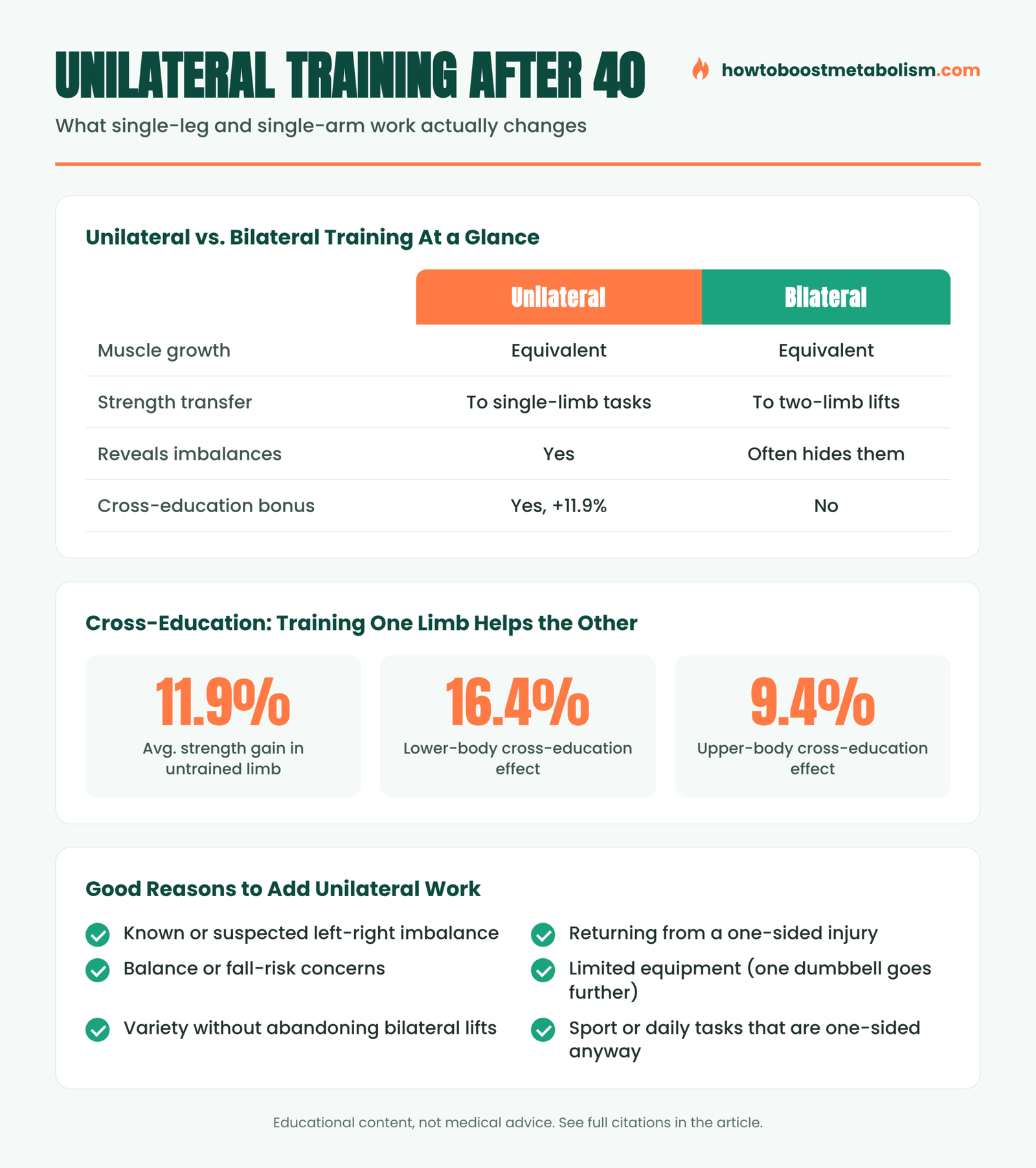
The short version: training one limb at a time builds muscle about as well as training both together, but the strength you gain is largely specific to however you trained — unilateral work makes you stronger unilaterally, and bilateral work makes you stronger bilaterally. That specificity, not some inherent superiority of one over the other, is the real reason to include both in a well-rounded program after 40.
What Counts as Unilateral Training?
Unilateral exercises load one limb independently: split squats, step-ups, single-arm dumbbell presses and rows, single-leg Romanian deadlifts, lateral lunges, and single-arm farmer’s carries are all common examples. Bilateral exercises load both limbs simultaneously and symmetrically: back squats, deadlifts, bench press, and barbell overhead press. Most lifters do almost all of their heavy compound training bilaterally and treat unilateral work as an accessory afterthought — which, as the research below shows, undersells what unilateral training is actually good for.
Does Training One Limb at a Time Build Less Muscle?
No — and this is the newest, best-quality evidence available on the topic. A 2025 systematic review and meta-analysis pooling nine controlled trials found no significant difference in muscle hypertrophy between unilateral and bilateral resistance training when programs were otherwise comparable (effect size -0.21, 95% CI -3.56 to 3.13, not significant) (Kassiano et al., 2025, Sports Med, PMID 39794667). For anyone training primarily for muscle size, that’s a genuinely useful, low-stakes finding: you can choose unilateral or bilateral variations of an exercise based on what feels better on your joints, what equipment you have, or simple preference, without worrying that you’re sacrificing growth either way.
Free download
🔥 The Metabolism Starter Kit
3 honest guides: a 7-day reset plan, a foods cheat-sheet and 12 metabolism myths debunked. No spam — unsubscribe anytime.
Strength Gains Are a Different Story — and It’s About Specificity
The same 2025 meta-analysis found that bilateral training produced significantly larger gains in bilateral strength (effect size 0.56), while unilateral training produced significantly larger gains in unilateral strength (effect size -0.65, favoring unilateral training on that outcome). In other words, strength adaptations follow the principle of specificity almost exactly: training two limbs together mostly transfers to lifting with two limbs together, and training one limb at a time mostly transfers to tasks performed one limb at a time, like walking up stairs, lunging, or recovering your balance on one foot.
| Outcome | What the evidence shows | Practical takeaway |
|---|---|---|
| Muscle size (hypertrophy) | No significant difference | Equivalent; choose based on preference/joints |
| Bilateral strength (both limbs loaded) | Bilateral training wins | Train bilaterally if that’s your goal |
| Unilateral strength (one limb loaded) | Unilateral training wins | Train unilaterally if that’s your goal |
| Real-world carryover (stairs, balance, single-step tasks) | Favors unilateral work | Worth including regardless of main goal |
The “Bilateral Deficit”: Why Two Legs Don’t Simply Add Up
There’s a well-documented quirk in how the nervous system handles bilateral contractions called the bilateral deficit: in many people, the force produced by both limbs contracting together is less than the simple sum of what each limb can produce alone. A comprehensive review found this deficit is inconsistent in size and even direction across individuals and tasks — some people show a bilateral facilitation (better together) instead of a deficit — but that it’s generally more pronounced in dynamic, ballistic movements than steady isometric ones, and appears to involve both neural inhibition and biomechanical factors like differences in how fast each limb can shorten under load (Škarabot et al., 2016, Eur J Appl Physiol, PMID 27582260). The practical upshot is that testing or training only bilateral lifts can genuinely mask how strong a single limb actually is — which matters for anyone trying to catch a developing left-right imbalance before it becomes a nagging injury.
The Cross-Education Effect: Training One Side Helps the Other
One of the stranger, well-replicated findings in strength research is cross-education: training one limb unilaterally produces a measurable strength increase in the opposite, completely untrained limb. A meta-analysis of thirty-one randomized trials found an average 11.9% strength increase in the untrained contralateral limb following unilateral resistance training of the other side — with larger effects in the lower body (+16.4%) than the upper body (+9.4%) (Manca et al., 2017, Eur J Appl Physiol, PMID 28936703). This effect is driven by changes in the nervous system rather than muscle tissue itself, and it’s part of why unilateral training is a standard rehabilitation tool: a physical therapist can keep a strength-training stimulus flowing to an injured, immobilized limb by training its healthy opposite number.
What About Injury Prevention and Limb Asymmetry?
This is where unilateral training earns a lot of its reputation, and the supporting evidence — while not specific to unilateral exercise alone — is genuinely strong. A large systematic review and meta-analysis of 108 randomized controlled trials on hamstring injury prevention found that eccentric-focused training, much of which is performed unilaterally (Nordic curls, single-leg Romanian deadlifts), reduced hamstring injury incidence by 56.8% to 70.0% and significantly reduced limb strength asymmetry (Rudisill et al., 2023, Am J Sports Med, PMID 35384731). That is not proof that unilateral training specifically, in isolation, prevents injury — the review covers several training types — but it is strong supporting evidence that correcting limb asymmetry through targeted, often one-sided training genuinely matters for injury risk, which is exactly the mechanism unilateral training is meant to address.
After 40, this matters more than it did at 25. Left-right strength and mobility differences tend to accumulate quietly over decades — a knee you favored after an old sprain, a hip you unconsciously load less — and bilateral exercises are notoriously bad at exposing that kind of gap, because the stronger side simply compensates for the weaker one without you noticing.
Why Unilateral Exercises Often Feel Harder Than They Look
Anyone who has tried a Bulgarian split squat for the first time after years of only back squatting knows the surprise: a weight that feels trivial bilaterally can wreck you unilaterally, long before the target muscle is actually the limiting factor. Balance, core stabilization, and the stance leg’s ability to control the hip and knee through a single-leg range of motion all demand a kind of coordination that two-legged lifting never asks for, since the base of support is simply wider and more forgiving. That extra demand is a feature, not a flaw — it is a big part of why unilateral work carries over so well to real-world balance and fall-prevention outcomes — but it also means you should expect to use noticeably less load per leg than half of your bilateral lift, and that regressing to an easier unilateral variation (a split squat instead of a single-leg squat, holding a rail for balance at first) is a sensible starting point rather than a failure.
A Few Reliable Unilateral Exercises by Body Region
| Region | Example exercises |
|---|---|
| Quads / glutes | Split squat, step-up, reverse lunge |
| Hamstrings / glutes | Single-leg Romanian deadlift, single-leg hip thrust |
| Back / lats | Single-arm dumbbell row, single-arm lat pulldown |
| Shoulders / chest | Single-arm dumbbell press, single-arm incline press |
| Core / anti-rotation | Single-arm farmer’s carry, single-arm suitcase carry |
A Few Mistakes Worth Avoiding
- Loading the stronger side to its true limit while the weaker side quietly does fewer effective reps at the same assigned weight — defeating the entire point of training the imbalance.
- Skipping a proper warm-up on single-leg work specifically, since the balance and stabilization demand is higher even before the target muscle is taxed.
- Expecting unilateral accessory work alone to replace heavy bilateral compound training for raw strength — the specificity research above says that trade doesn’t hold up.
- Rushing the eccentric (lowering) portion of single-leg movements, which is usually where the balance challenge — and the injury-prevention benefit — actually lives.
Anabolic Fasting pairs a structured strength-and-fasting framework for building muscle and managing body composition — useful if you want programmed exercise selection, including single-side work, rather than building your own split from scratch.
Check It Out →Affiliate link — we may earn a commission at no extra cost to you. Disclosure
How to Actually Add Unilateral Work to Your Program
- Keep your main bilateral compound lifts (squat, deadlift, bench, overhead press) as the backbone of your strength work — the specificity research says bilateral strength needs bilateral training.
- Add 1-2 unilateral accessory exercises per session for the lower body (split squats, step-ups, single-leg RDLs) and upper body (single-arm rows, single-arm presses).
- Train the weaker side first, and match reps on the stronger side to whatever the weaker side could complete with good form — don’t let the stronger limb pull further ahead.
- Retest periodically. A simple single-leg press or single-arm row for reps-to-near-failure, tracked every few months, will reveal an asymmetry long before it becomes a nagging ache.
- Prioritize unilateral work after an injury or a long layoff on one side, both for the direct training effect and to take advantage of cross-education while the affected limb recovers.
Unilateral training pairs naturally with other joint-friendly tools covered on this site — isometric holds for a limb that is actively painful, or blood flow restriction training for a single-leg accessory movement when you want the metabolic stimulus without heavy unilateral loading. It also fits naturally into a full-body or split routine as accessory work rather than requiring its own dedicated day.
One last practical note: unilateral training is also simply convenient. A single pair of adjustable dumbbells, or even one kettlebell, lets you load most of the exercises in the table above through a useful range of intensity, which is part of why unilateral work travels so well — it’s a mainstay of home-gym and hotel-room training, not just a clinical rehabilitation tool. If equipment access is ever a limiting factor in your training, leaning more heavily on single-limb work is a practical way to keep making progress without needing a fully loaded barbell and rack.
Free download: our Metabolism Starter Kit — a protein calculator, a 7-day meal framework, and a one-page supplement checklist, with zero hype.
Get the Free Starter Kit →Frequently Asked Questions
Is unilateral training better than bilateral training for building muscle?
Neither is better — the best current meta-analysis found no significant difference in muscle growth between the two approaches. Choose based on joint comfort, equipment, and variety rather than a presumed hypertrophy advantage.
Will single-leg exercises fix my left-right strength imbalance?
They can help you both detect and address one, since bilateral lifts let a stronger side compensate for a weaker one without you noticing. Training the weaker limb to the same effort level as the stronger one, tracked over months, is the direct way to close a real gap.
What is the bilateral deficit, in plain terms?
It’s the tendency for both limbs working together to produce less combined force than the sum of each limb working alone — a real neuromuscular phenomenon, though its size varies a lot between people and even reverses in some.
Can training one leg really make the other leg stronger?
Yes, through a well-documented phenomenon called cross-education — on average, about a 12% strength increase in the completely untrained opposite limb, driven by nervous-system changes rather than muscle growth on that side.
Should I replace my squats and deadlifts with single-leg versions?
No. Keep heavy bilateral compound lifts as your strength foundation, and add unilateral accessory work alongside them — the research supports a combination, not a wholesale replacement.
This article is for educational purposes only and is not a substitute for professional medical or fitness advice. See our Medical Disclaimer for more.