Supersets vs. Straight Sets: Which Builds Muscle?
This article may contain affiliate links. If you buy through them, we may earn a small commission at no extra cost to you. See our Affiliate Disclosure and Medical Disclaimer.
“No time to lift” is the single most common reason people give for skipping strength training altogether. Supersets — pairing two exercises back-to-back with little or no rest between them — are the standard answer gyms and trainers give for squeezing a full workout into a tighter window. The question that actually matters is whether that time savings costs you anything in results. A 2025 meta-analysis finally gave this a proper head-to-head test, and the answer is more reassuring than the gym-bro skepticism around supersets would suggest.
At a Glance
| Question | Short Answer |
|---|---|
| Do supersets build less muscle than straight sets? | No — meta-analysis found no significant difference in hypertrophy |
| Do supersets build less strength? | No — no significant difference in maximal strength gains either |
| What do you actually gain? | A significantly shorter session — large effect size for training efficiency |
| What’s the trade-off? | Higher perceived exertion and more metabolic/lactate stress during the session |
| Best superset style? | Agonist-antagonist pairs (opposing muscle groups) for preserving total reps/volume |
What the Research Actually Compared
A 2025 systematic review and meta-analysis in Sports Medicine (PMID 39903375) pooled 19 controlled studies covering 313 participants, comparing superset training against traditional, straight-set training with full rest between exercises. This is the most comprehensive look at the question to date, examining mechanical outcomes (strength, volume), metabolic outcomes (lactate, energy cost), and perceptual outcomes (how hard it felt) side by side.
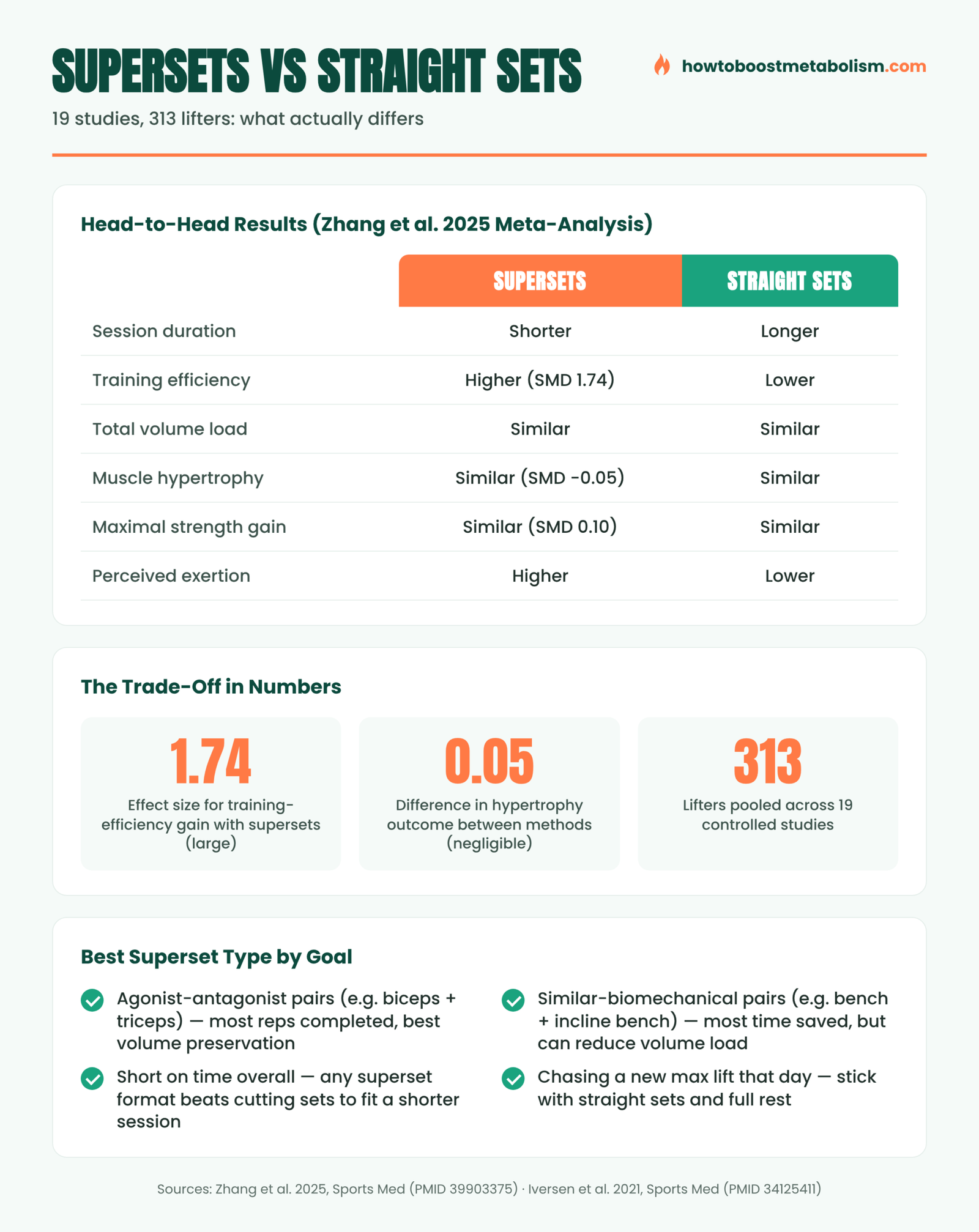
The headline result: supersets let lifters complete a similar total number of repetitions and a similar total volume load, while meaningfully cutting session duration — the training efficiency effect size was 1.74, which is a large effect in research terms. In practice, that means you can do roughly the same amount of productive work in noticeably less time on the clock.
Free download
🔥 The Metabolism Starter Kit
3 honest guides: a 7-day reset plan, a foods cheat-sheet and 12 metabolism myths debunked. No spam — unsubscribe anytime.
The Part That Surprises People: No Hypertrophy or Strength Penalty
The result most lifters assume going in — that cramming exercises together with less rest must come at the cost of muscle growth or strength — wasn’t supported by the pooled data. Chronic adaptations in maximal strength (effect size 0.10), strength endurance (0.07), and muscle hypertrophy (-0.05) were all statistically similar between superset and straight-set groups. Surface electromyography readings (a measure of muscle activation during the lift) were also nearly identical between methods, and markers of acute muscle damage (creatine kinase) and muscle swelling showed no significant difference either.
In other words, once total training volume is held roughly constant, the specific way you sequence your rest periods and exercise pairings doesn’t appear to change how much muscle or strength you build over time. This fits with the broader resistance-training literature, which consistently points to total volume and proximity to failure as the primary drivers of hypertrophy — not the particular set-structuring technique used to accumulate that volume.
What You Actually Give Up
Supersets aren’t free. The same meta-analysis found meaningfully higher blood lactate concentration both during and after superset training (effect sizes 0.94 and 1.13, respectively), higher energy cost during the session, and higher ratings of perceived exertion (effect size 0.77) compared with straight sets. Translated out of research language: supersets feel considerably harder while you’re doing them, and they tax your metabolic and cardiovascular systems more in the moment, even though the muscle-and-strength outcomes end up similar.
This has two practical implications. First, if you’re chasing a true one-rep max or testing strength on a given day, straight sets with full recovery between attempts are still the better choice — you want to be as fresh as possible for each max effort, and supersets work against that. Second, because superset sessions are harder on your metabolic system, they may require a bit more recovery between sessions than an equivalent straight-set workout, even though the muscle damage markers came out similar in the pooled data.
Not All Supersets Are the Same
The meta-analysis’s subgroup analysis found a meaningful difference between two common superset styles, and it’s worth knowing which one fits your goal:
| Superset Type | Example Pairing | What the Research Found |
|---|---|---|
| Agonist-antagonist | Biceps curl + triceps extension; chest press + row | Significantly more total reps completed vs. straight sets (effect size 0.68) — the opposing muscle gets to recover while the other works |
| Similar biomechanical | Bench press + incline bench press; squat + leg press | Significantly less volume load than straight sets — both muscle groups are fatigued simultaneously, so performance in the second exercise drops more |
If your main goal is saving the most time without sacrificing any training volume, agonist-antagonist pairings are the stronger choice — pairing opposing muscle groups means one side gets a built-in rest while the other works. If you’re pairing similar movements that hit the same muscles back-to-back, expect your total load on the second exercise to drop somewhat, even if the time savings are still real.
Why This Matters More After 40
Time pressure doesn’t ease up as careers, caregiving, and family responsibilities stack up through your 40s and 50s — if anything, it gets worse right as resistance training becomes more important for preserving muscle and bone density. The research reviewed above matters practically because it removes a false trade-off: you don’t have to choose between a program that fits your actual schedule and one that produces real results. A 35-40 minute superset-based session, done consistently three or four times a week, outperforms a theoretically “optimal” 75-minute session that gets skipped half the time because it doesn’t fit your calendar.
This is also where the metabolic cost of supersets (higher lactate, higher energy expenditure during the session) can work in your favor if fat loss is part of the goal alongside muscle preservation. While the meta-analysis didn’t measure fat loss directly, a session that burns more calories in less time, without sacrificing the muscle and strength outcomes that matter most, is a reasonable fit for anyone managing both goals at once — a common situation for readers in their 40s and 50s balancing body composition, time, and energy.
A Practical Time-Efficient Template
A separate 2021 narrative review in Sports Medicine (PMID 34125411) laid out broader principles for time-efficient strength training that pair well with superset structuring: prioritize compound, multi-joint exercises; include at least one squat-pattern, one upper-body pull, and one upper-body push each session; and aim for a minimum of around 4 weekly sets per muscle group using a 6-15 rep range as the default loading zone. Combine that framework with agonist-antagonist supersets, and a complete, productive session can realistically fit into 30-40 minutes.
- Pair opposing muscle groups: e.g., chest press paired with a back row, or leg extension paired with leg curl.
- Rest within the pair: little to no rest between the two exercises in a superset.
- Rest between pairs: 60-90 seconds before starting the next superset, enough to keep quality reasonably high.
- Keep loads honest: supersets feel harder, which can tempt you to drop weight prematurely — track your numbers so volume doesn’t quietly slip.
- Save true straight sets for your main lift: if a session includes a heavy, low-rep primary movement, do that one first with full rest, then superset the accessory work.
Common Superset Mistakes That Erase the Time Savings
A few setup mistakes can quietly undo the efficiency benefit the research actually supports, or turn a good idea into a sloppy, lower-quality workout.
- Pairing two exercises that need the same equipment across the gym from each other — walking back and forth cancels out the time saved; pick pairs you can do in the same corner or with dumbbells you’re already holding.
- Supersetting two heavy compound lifts — squats paired with deadlifts, for example, compounds fatigue and central nervous system demand in a way the research on moderate-rep accessory work doesn’t fully cover; save heavy compounds for straight sets.
- Letting form break down to keep pace — the point is cutting rest time, not cutting technique corners; if your form degrades noticeably by the second exercise, you’ve paired the wrong movements or gone too heavy.
- Ignoring your own recovery signals — the higher perceived exertion found in the research is real; if superset sessions are leaving you wiped out for days, dial back frequency or volume rather than pushing through.
None of these mistakes mean supersets don’t work — they mean the technique, like any training tool, rewards a bit of thought in how it’s applied. Done well, the time savings are close to free; done carelessly, you can end up with a workout that’s both rushed and lower quality.
If a packed schedule is the main thing standing between you and consistent training, a structured, time-efficient program removes the guesswork of building your own split. Old School New Body is built around short, focused F4X-style sessions designed for people over 35 who don’t have an hour to spend in the gym. Note: some of the landing page’s statistics about age-related muscle loss aren’t independently sourced, so treat those specific numbers as marketing rather than verified research — the underlying time-efficient training structure is the part worth evaluating.
Learn More →Affiliate link — we may earn a commission at no extra cost to you. Disclosure
Related Reading
For the question of how many total weekly sets you actually need regardless of how you structure them, see our progressive overload guide. If you’re deciding between training each muscle group once or multiple times a week, we covered that separately in full-body vs. split workouts after 40. And if rep range is part of your programming decision too, see our breakdown of rep ranges for muscle vs. fat loss. For recovery between sessions, our deload-week guide covers when to back off.
Free download: our Metabolism Starter Kit — a protein calculator, a 7-day meal framework, and a one-page supplement checklist, with zero hype.
Get the Free Starter Kit →Practical Takeaways
- Supersets produce similar hypertrophy and strength gains to straight sets when total volume is matched — the 2025 meta-analysis found no significant difference in either outcome.
- The real benefit of supersets is time: a large effect size (1.74) for training efficiency, meaning meaningfully shorter sessions for similar work done.
- The trade-off is higher perceived exertion and metabolic stress during the session, not worse long-term results.
- Agonist-antagonist supersets (opposing muscle groups) preserve more total volume than similar-biomechanical supersets (same muscle groups back-to-back).
- Save straight sets with full rest for true max-effort or heavy low-rep work; superset the accessory and moderate-rep work to save time without a measurable cost.
Related: Supersets aren’t the only set structure worth a second look — we also broke down whether cluster sets actually build more muscle than traditional sets.
Frequently Asked Questions
Do supersets build muscle slower than straight sets?
No. The best current meta-analysis found no significant difference in muscle hypertrophy between superset and straight-set training when total training volume is similar. The main difference is time, not results.
Are supersets harder to recover from?
They feel harder during the session — higher perceived exertion and blood lactate — but measured muscle damage markers (creatine kinase) were similar between methods in the pooled research. If anything, treat superset sessions as moderately more fatiguing in the short term, but not more damaging long term.
What’s the best type of superset for saving time without losing volume?
Agonist-antagonist pairings — pairing opposing muscle groups like biceps/triceps or chest/back — preserved the most total repetitions in the research, since one muscle group gets a built-in rest while the other is working.
Should beginners use supersets?
Supersets are generally fine for beginners, though the added metabolic demand and perceived effort can be more than a brand-new lifter wants to manage while also learning exercise technique. Many coaches introduce straight sets first to build a movement foundation, then add supersets once form is solid.
Can I use supersets for a true strength-focused program, not just hypertrophy?
The meta-analysis found no significant difference in maximal strength gains between methods over time, so supersets are a reasonable fit for general strength training. For a specific max-effort or 1-rep-max testing day, though, straight sets with full rest remain the better choice since freshness matters more for a single maximal attempt.
This article is for general educational purposes and is not medical advice. Talk to your doctor before starting a new exercise program, especially if you have existing joint or cardiovascular conditions. See our Medical Disclaimer for more.