Isometric Training for Joint Pain After 40
This article may contain affiliate links. If you buy through them, we may earn a small commission at no extra cost to you. See our Affiliate Disclosure and Medical Disclaimer.
If your knees, Achilles tendon, or shoulder start barking the moment you pick up a barbell, the standard advice is to back off and rest. But a strange and fairly well-replicated line of research suggests the opposite move — holding a muscle contraction still, without moving the joint at all — can actually turn pain down, sometimes within minutes. This is isometric training, and after 40 it deserves a spot in your toolkit for reasons that go well beyond sore tendons.
This isn’t a miracle-cure story. The effect is real but inconsistent, it fades without a smart dosing strategy, and isometrics won’t replace progressive resistance training for building muscle or bone. What follows is the honest version: what isometric holds can do for joint pain, what the research says about a second, almost unrelated benefit — blood pressure — and a practical way to use both without wasting your time.
What Counts as Isometric Training?
An isometric contraction is one where the muscle generates force but the joint angle doesn’t change — no shortening, no lengthening, just sustained tension. A wall sit, a plank, pushing against an immovable bar, or holding a loaded leg extension at a fixed knee angle are all isometric. It’s different from the concentric (lifting) and eccentric (lowering) phases of a normal rep, and it’s also different from eccentric-only tendon work — the kind we’ve covered before for Achilles and patellar tendinopathy — which still involves the joint moving through a range.
The Pain-Relief Finding That Surprised Researchers
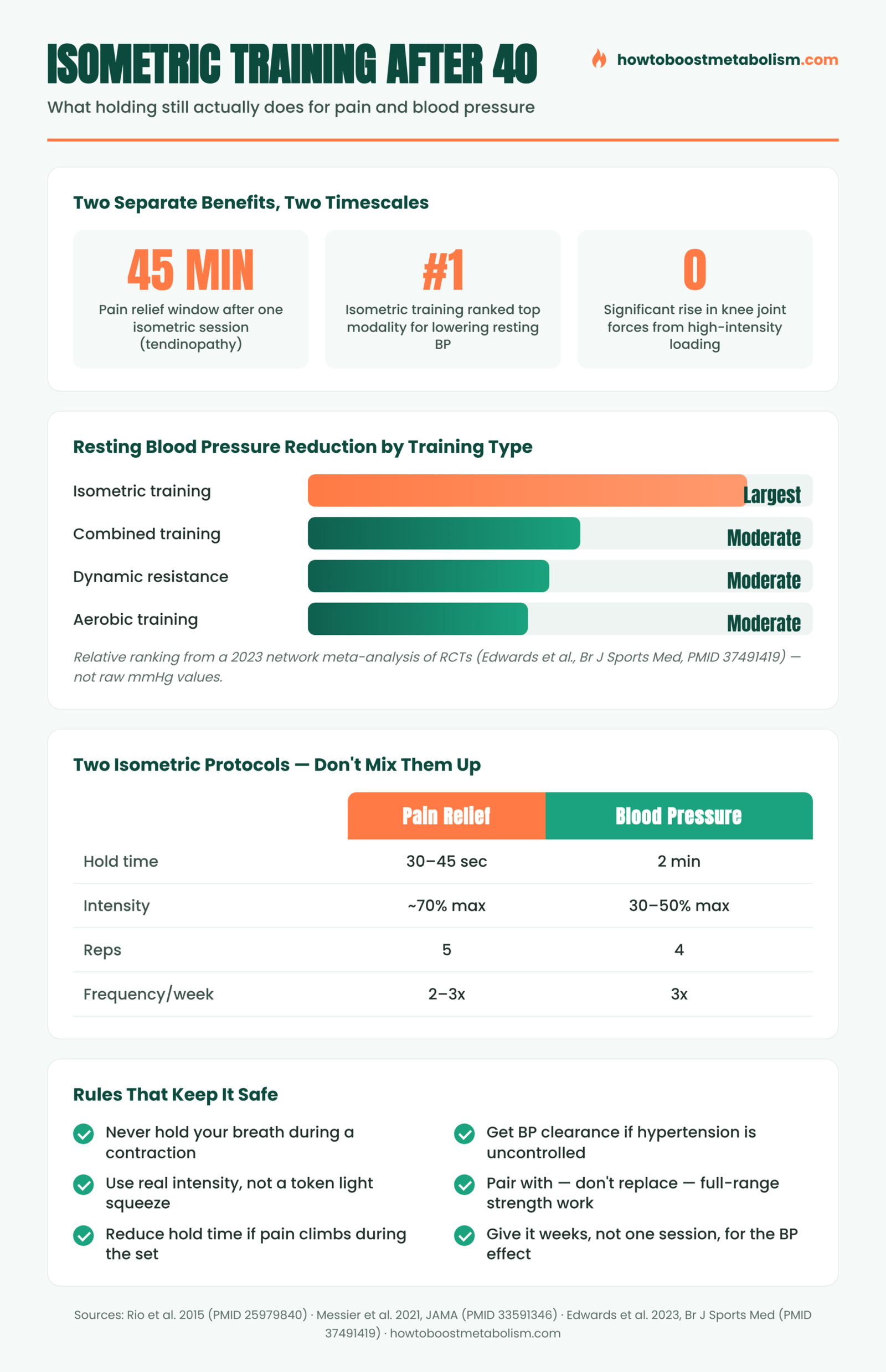
In 2015, a team led by Ebonie Rio published a small but influential study in the British Journal of Sports Medicine on athletes with patellar tendinopathy (jumper’s knee). They had participants hold a heavy isometric leg extension — five reps of 45 seconds at a high intensity — and measured pain before and immediately after. Pain dropped substantially, and the effect lasted up to 45 minutes in some cases, alongside reduced inhibition of the quadriceps muscle on testing (Rio et al., 2015, Br J Sports Med, PMID 25979840). That single finding reshaped how a lot of physiotherapists approach in-season tendon pain: instead of telling an athlete to stop all loading, they prescribe a brief isometric hold right before activity.
A follow-up randomized crossover trial in recreational athletes with patellar tendinopathy found isometric exercise meaningfully reduced pain compared with a rest condition, supporting the idea that this isn’t just a fluke of one small lab (Non-Grove et al., 2020, J Sci Med Sport, PMID 31735531). Separately, a 2019 reliability study found a single bout of isometric wall-squat holding produced measurable exercise-induced hypoalgesia — a temporary, whole-body drop in pain sensitivity — in healthy adults, not just injured tissue (Hoeger Bement et al., 2019, Pain Med, PMID 29788440), which lines up with the broader exercise-induced analgesia literature.
The Honest Caveat: It Doesn’t Always Work
Here’s where we won’t oversell it. A 2021 study compared athletes with mild, early-stage patellar tendinopathy to pain-free matched controls and found widespread mechanical hyperalgesia in the symptomatic group — but it did not find the expected exercise-induced analgesia effect after isometric loading (Rathleff et al., 2021, Am J Phys Med Rehabil, PMID 33350645). The honest summary from the current evidence: isometric holds often reduce tendon pain in the short term, especially in more established or more painful cases, but the effect isn’t guaranteed, isn’t fully understood mechanistically, and shouldn’t be the only tool you reach for. It’s a bridge to keep training through a flare-up, not a cure for the underlying tissue problem.
Free download
🔥 The Metabolism Starter Kit
3 honest guides: a 7-day reset plan, a foods cheat-sheet and 12 metabolism myths debunked. No spam — unsubscribe anytime.
Isometrics for Arthritic Knees: What the START Trial Showed
Tendon pain is one thing; a stiff, arthritic knee at 45 or 55 is a different and more common problem. The largest and most rigorous trial here is the START randomized clinical trial, published in JAMA in 2021, which put adults with knee osteoarthritis through a high-intensity strength training program (including sustained isometric-style loading phases) versus a low-intensity comparison group. The high-intensity group saw significantly less knee pain over time, and — contrary to a common fear — did not show worse knee joint compressive forces as a result (Messier et al., 2021, JAMA, PMID 33591346). That matters because the instinct for a painful joint is often to go lighter and more passive. The data points the other way: appropriately loaded strength work, isometrics included, tends to calm an arthritic joint down rather than aggravate it.
This fits a much older body of evidence on resistance training and older adults generally. A Cochrane review of progressive resistance strength training found consistent improvements in physical function for older adults across dozens of trials (Liu & Latham, 2009, Cochrane Database Syst Rev, PMID 19588334) — isometric work is one piece of that broader picture, not a replacement for it.
The Blood Pressure Finding Almost Nobody Expects
Here’s the genuinely surprising part. You’d assume isometric holds — which spike blood pressure acutely, sometimes dramatically, while you’re holding the contraction — would be the worst exercise choice for anyone managing blood pressure. The opposite turns out to be true for the chronic, resting effect. A large 2023 network meta-analysis in the British Journal of Sports Medicine, pooling randomized trials across aerobic training, dynamic resistance training, combined training, high-intensity interval training, and isometric training, ranked isometric exercise training as the single most effective modality for lowering resting blood pressure — ahead of traditional cardio (Edwards et al., 2023, Br J Sports Med, PMID 37491419).
The Acute Spike vs. the Chronic Adaptation
These two facts aren’t actually in conflict, they’re just describing different timescales. During a hard isometric hold, systolic pressure can rise sharply for the seconds you’re contracting — which is exactly why anyone with uncontrolled hypertension or a cardiovascular condition should get medical clearance before starting, and why breath-holding (the Valsalva maneuver) during a max-effort hold should be avoided in favor of continuous breathing. But measured weeks later, at rest, consistent isometric training appears to produce a larger drop in baseline blood pressure than other training types tested. For someone over 40 where blood pressure creep is common, that’s a second, almost incidental reason to include isometric work — on top of whatever it does for a cranky knee or tendon.
Why This Matters More After 40
Three things change with age that make isometric training specifically useful, rather than just convenient. First, joint and tendon issues become more common — knee osteoarthritis prevalence climbs steeply through the 40s and 50s, and tendinopathies (Achilles, patellar, rotator cuff) show up more often in recreational lifters in this age bracket. Second, isometric holds are comparatively joint-friendly: there’s no eccentric loading, no impact, and you can dial the intensity up or down from a fixed position, which makes them a lower-barrier entry point when a joint is already irritated. Third, resting blood pressure tends to drift upward with age, so a training tool that both protects a cranky joint and chips away at resting blood pressure is doing double duty for a 40+ lifter in a way it wouldn’t for a healthy 25-year-old with neither concern. It pairs naturally with the kind of planned recovery we covered in our guide to deload weeks after 40 — a lighter isometric-focused week is a reasonable way to stay in motion without adding fresh joint stress.
A Practical Isometric Protocol You Can Start This Week
Two different goals call for two different isometric protocols. Don’t mix them up.
For Tendon Pain Management (Rio-Style Protocol)
- Pick a knee extension machine, wall sit, or loaded isometric position for the painful joint.
- Perform 5 repetitions of a sustained hold at a challenging intensity (roughly 70% of a maximum effort is a reasonable, conservative starting point).
- Hold each rep for 30–45 seconds, resting 1–2 minutes between reps.
- Do this before activity that normally provokes pain, or as a standalone session 2–3 times per week.
- Pain should drop or stay flat during the session — if it climbs noticeably, reduce the intensity or hold time.
For Blood Pressure and General Joint Resilience
- Choose 2–4 isometric exercises hitting different muscle groups (e.g., wall sit, isometric mid-thigh pull or deadlift hold, plank, isometric chest press against a rack).
- Hold each for 2 minutes at a moderate intensity (roughly 30–50% of maximum), or use 4 × 2-minute holds with short rest, which mirrors protocols used in the blood-pressure literature.
- Train 3 times per week.
- Breathe continuously throughout — never hold your breath against a closed airway during the contraction.
- Expect resting blood pressure changes to show up over weeks of consistent training, not after one session.
| Isometric Training | At a Glance |
|---|---|
| Best-supported use | Short-term tendon pain relief (patellar, Achilles) |
| Emerging use | Resting blood pressure reduction over weeks |
| Typical hold time, pain protocol | 30–45 seconds × 5, high intensity |
| Typical hold time, BP protocol | 2 minutes × 4, moderate intensity |
| Does NOT replace | Progressive resistance training for muscle and bone |
| Caution | Uncontrolled hypertension, cardiovascular disease — get clearance first |
Common Mistakes With Isometric Training
- Holding your breath. The Valsalva maneuver on top of an already BP-raising contraction is a bad combination, especially for anyone with cardiovascular risk factors.
- Using it as your only training. Isometrics are additive, not a replacement for full-range resistance training — they don’t build the same range-of-motion strength or bone-loading stimulus.
- Expecting pain relief from a light, brief hold. The protocols that showed analgesic effects used a real intensity and a real duration — a token 10-second squeeze isn’t the same stimulus.
- Skipping medical clearance with uncontrolled blood pressure. The chronic benefit is real, but the acute spike during the hold is also real — talk to a doctor first if you have hypertension.
- Stopping the moment pain hits zero. A tendon that feels pain-free after an isometric hold still needs a structured, progressive loading plan — the hold is pain management, not rehabilitation on its own.
Who Should Be Cautious
Isometric training is generally low-risk, but a few groups should talk to a doctor before starting a dedicated program: anyone with uncontrolled or poorly managed high blood pressure, anyone with a history of cardiovascular events, and anyone with an acute joint injury where a clinician hasn’t yet confirmed that loading (even static loading) is appropriate. If you have a diagnosed tendinopathy, working with a physical therapist to dose the isometric protocol correctly will get you better results than guessing.
Where This Fits Into a Bigger Plan
Isometric holds are a targeted tool, not a full training philosophy — they sit alongside the progressive overload and training volume principles that actually build muscle and bone over time. If you want the rest of that picture without the guesswork, our free Starter Kit below gives you a simple framework to build around.
Free download: our Metabolism Starter Kit — a protein calculator, a 7-day meal framework, and a one-page supplement checklist, with zero hype.
Get the Free Starter Kit →Related: Isometric holds aren’t the only joint-friendly option — blood flow restriction training lets you build real muscle with much lighter loads, worth knowing if heavy compression on the joint is the real limiter.
Frequently Asked Questions
Does isometric training build muscle like regular lifting?
To some extent, yes — isometric training can increase strength at the specific joint angle trained, but the effect is narrower than full-range resistance training, which builds strength and size across a wider range of motion. Think of isometrics as a useful addition, not a substitute for your main lifting program.
How long does the pain relief from an isometric hold last?
In the original research on patellar tendinopathy, pain reduction lasted up to about 45 minutes after a single session, which is long enough to use it as a warm-up strategy before activity. It’s a temporary window, not a permanent fix, and effects vary between individuals and even between studies.
Is it safe to do isometric exercises if I have high blood pressure?
Talk to your doctor first. Isometric contractions cause a real, sometimes sharp rise in blood pressure during the hold itself, even though consistent training appears to lower resting blood pressure over weeks. If your blood pressure is uncontrolled, get clearance and monitoring before starting.
Can isometric training help an arthritic knee?
The START trial found that a high-intensity strength training program — including sustained loading — reduced knee pain in people with osteoarthritis without worsening joint forces, which runs counter to the old advice to simply rest an arthritic joint. Appropriately dosed loading tends to help, not hurt.
How often should I do isometric training per week?
Most of the protocols used in the research land around 2–3 sessions per week, whether the goal is tendon pain management or blood pressure reduction. More isn’t automatically better — consistency over weeks matters more than daily sessions.
This article is for educational purposes only and is not a substitute for professional medical advice. If you have a diagnosed joint condition, tendinopathy, high blood pressure, or cardiovascular disease, consult a qualified healthcare provider before starting isometric training. See our Medical Disclaimer for more.