NAC for Exercise Recovery: Does the Antioxidant Help?
This article may contain affiliate links. If you buy through them, we may earn a small commission at no extra cost to you. See our Affiliate Disclosure and Medical Disclaimer.
N-acetylcysteine — almost always shortened to NAC — has quietly become one of the more talked-about recovery supplements in strength training circles, pitched as a way to mop up the oxidative “rust” that builds up during hard training and push fatigue further away. It has real pharmacology behind it: NAC is a precursor to glutathione, the body’s master antioxidant, and it’s been used in hospitals for decades as a mucus thinner and an acetaminophen-overdose antidote. None of that tells you whether taking it before a workout actually helps you lift more or recover faster — and that’s a question with a genuinely more complicated answer than most product pages let on.
The honest summary up front: the fatigue-delaying effect of NAC is real and well documented — in isolated muscle tissue and in people with health conditions that deplete glutathione. In healthy, trained athletes doing real-world exercise, trial after trial has failed to find a performance benefit. And a separate, growing body of research on antioxidants in general raises an honest caution: they may blunt some of the very training adaptations you’re working for.
Further reading: ashwagandha vs l-theanine for cortisol and weight
Where the NAC-and-Fatigue Idea Actually Comes From
The underlying science is legitimate. Reactive oxygen species (ROS) — byproducts of the chemical reactions that power muscle contraction — build up during hard exercise, and a landmark review (Med Sci Sports Exerc, PMID 27285492) lays out decades of evidence that ROS accumulation directly contributes to muscle fatigue. The same review notes that antioxidant pretreatment can delay fatigue in controlled settings, which is the entire basis for NAC’s reputation. That’s not a myth — it’s a real, mechanistically grounded finding.
The catch is where that finding comes from: much of the strongest fatigue-delay data is from isolated muscle fiber preparations, animal studies, or clinical populations with elevated oxidative stress and low baseline glutathione — not from healthy, well-trained humans doing a normal gym or cardio session. That distinction matters enormously, because it’s exactly the gap where a lot of supplement research falls apart on its way from the lab bench to the gym floor.
Further reading: omega-3 and visceral belly fat
What Happens When You Actually Test NAC on Trained Athletes
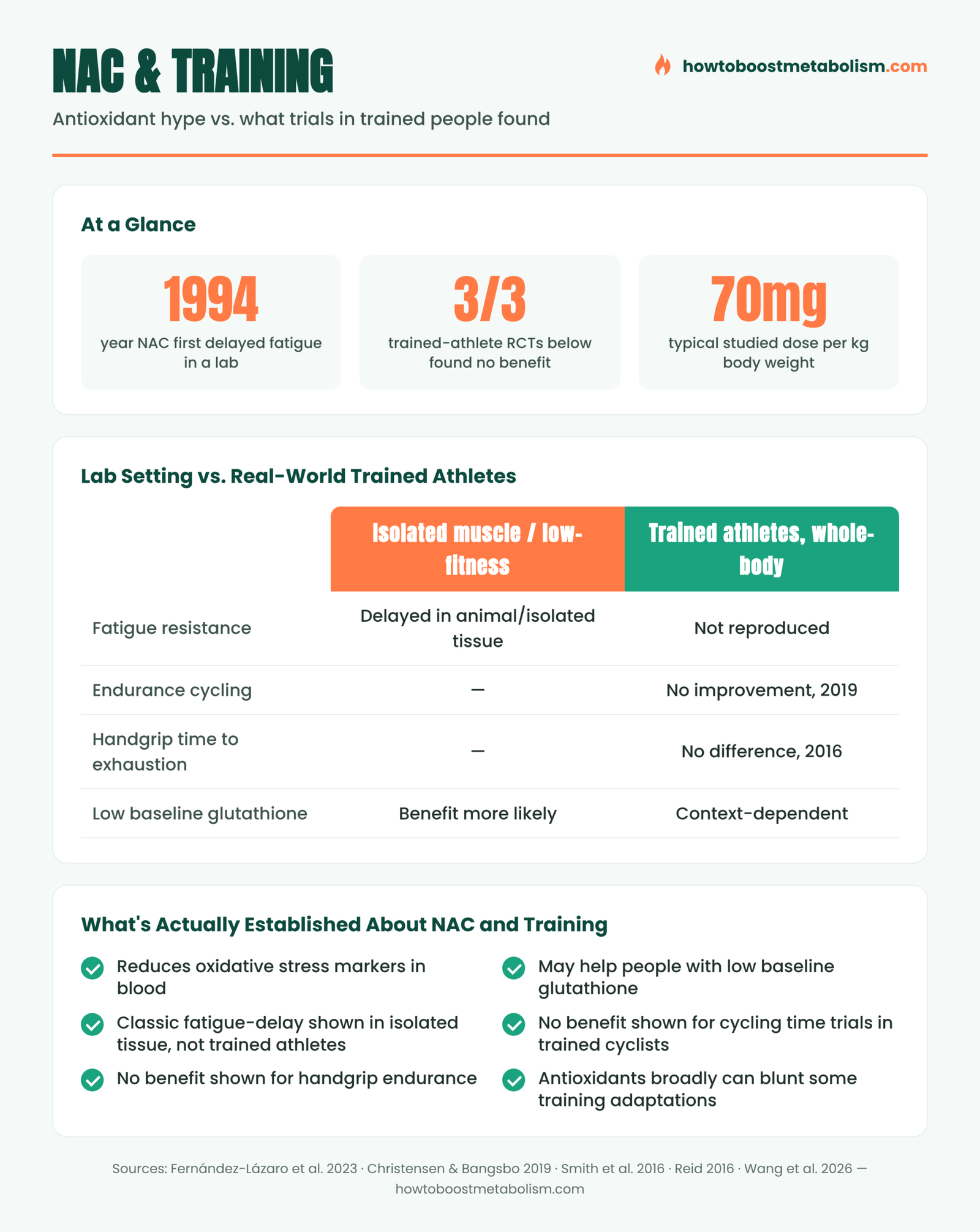
A 2019 crossover trial in well-trained cyclists (Eur J Appl Physiol, PMID 31030296) is a good example of that gap. Eleven cyclists with an average peak VO2 of 69 ml/min/kg — a genuinely elite aerobic capacity — completed two intense 4-minute time-trial efforts after taking either a placebo or 20 mg/kg of NAC. Power output was essentially identical between conditions in both trials (401 vs. 400 watts, and 401 vs. 400 watts). Plasma antioxidant capacity wasn’t even measurably different between groups, despite the supplementation.
A separate 2016 study (Physiol Rep, PMID 27044854) tested a much higher dose — 70 mg/kg — before a handgrip exercise test to exhaustion in healthy young men. Time to exhaustion was not significantly different between NAC and placebo (473 vs. 439 seconds), and NAC did not change blood flow or muscle oxygenation during the exercise, ruling out one of the proposed mechanisms for how it might help.
See also: taurine for metabolism and aging
A 2023 systematic review pulling together the controlled-trial evidence in adult men (Nutrients, PMID 37299425) reached a similarly measured conclusion: NAC can meaningfully shift blood biomarkers of oxidative stress, but the evidence for a reliable physical-performance benefit in otherwise healthy people is inconsistent at best.
The One Place NAC Looks More Promising: Low-Glutathione Populations
A 2026 review focused on aging (Front Nutr, PMID 42232577) frames this nuance well. It describes NAC’s effects as “context-dependent”: supplementation appears to improve glutathione availability, fatigue resistance, and exercise performance specifically in people with low baseline glutathione, while results stay inconsistent in healthy populations who already have adequate levels. The same review highlights early but genuinely interesting research on combining NAC with glycine (so-called “GlyNAC”) in older adults, with preliminary signals for improvements in oxidative stress, mitochondrial function, muscle strength, and insulin resistance — though it’s careful to call this “proof-of-concept” rather than settled science.
In other words: if you’re a healthy, well-fed, reasonably fit adult, the trials above are the ones that apply to you, and they’re not encouraging. If you’re older, under chronic physiological stress, or have a condition associated with glutathione depletion, the calculus may genuinely be different — but that’s a conversation for a physician, not a pre-workout label.
Related: VO2 Max and Longevity
Free download
🔥 The Metabolism Starter Kit
3 honest guides: a 7-day reset plan, a foods cheat-sheet and 12 metabolism myths debunked. No spam — unsubscribe anytime.
The More Important Question: Can NAC Backfire?
This is the part most marketing copy skips entirely, and it’s arguably more important than whether NAC helps in the short term. A growing line of research on antioxidant supplementation in general — not NAC specifically, but the same biochemical family — suggests that blunting oxidative stress during training can also blunt the training adaptations that stress is supposed to trigger.
A 2025 study (J Physiol, PMID 40433923) had young men perform three weeks of sprint interval training while taking either a placebo or a combination of vitamin C (1 g/day) and vitamin E (235 mg/day) — both well-studied antioxidants, though not NAC itself. Muscle biopsies showed that antioxidant supplementation blunted the protein-level training response, particularly in fast-twitch (type 2) muscle fibers — the exact fiber type that drives sprint power and hypertrophy. That’s a different compound than NAC, but the same underlying mechanism — suppressing oxidative signaling — is what NAC is specifically marketed to do, which makes this a reasonable caution to apply to the whole category rather than a reason to single out vitamin C and E.
| Population / Study | What Was Found | PMID |
|---|---|---|
| Elite cyclists, 4-min time trial | No difference in power output | 31030296 |
| Handgrip exercise to exhaustion | No difference in time to exhaustion | 27044854 |
| Healthy adult men, pooled trials | Inconsistent performance benefit | 37299425 |
| Low-glutathione / aging populations | More promising, still early | 42232577 |
| Antioxidants (vit. C/E) + sprint training | Blunted muscle protein adaptation | 40433923 |
NAC Isn’t Alone — The Same Pattern Shows Up Across Recovery Supplements
If this honest, mixed verdict on NAC feels unsatisfying, it’s worth knowing the same pattern — a plausible mechanism, some encouraging early signals, and inconsistent results once you look at strength/power outcomes specifically — shows up repeatedly across the broader category of “antioxidant and recovery” supplements, not just NAC.
A 2026 narrative review of tart cherry juice (Phys Act Nutr, PMID 41956499) — probably the most popular natural alternative to NAC for exercise recovery — reached a strikingly similar conclusion: the proposed anti-inflammatory and antioxidant mechanisms “did not consistently translate into functional benefits,” with favorable signals more frequent for soreness and perceived recovery than for actual strength or power outcomes, and several controlled trials reporting flatly null effects.
A 2026 review of beetroot juice (Nutrients, PMID 41515267) — another nitric-oxide-boosting supplement with some mechanistic overlap with citrulline — found more coherent evidence for cardiovascular outcomes like blood pressure and endothelial function than for neuromuscular performance, which the review describes as “less uniform.” The throughline across all three supplements is the same: mechanisms that look clean in a lab don’t automatically produce reliable strength or power gains in trained humans doing real training.
Dosing, Safety, and the Bigger Picture
Studied doses of NAC for exercise purposes have ranged widely — from roughly 20 mg/kg to 70 mg/kg of body weight, typically as a single pre-exercise dose in the research covered here, versus the 600-1,800 mg/day range more commonly used in the clinical and general-health NAC literature. None of the exercise-performance doses tested produced a measurable benefit in trained athletes, which makes “take a bit more” an unsupported workaround rather than a reasonable adjustment.
NAC has a long track record of safety at clinically used doses — it’s been administered intravenously in hospitals for acetaminophen overdose for decades — but gastrointestinal discomfort is a reasonably common side effect at the higher doses used in some exercise trials, and it can interact with nitroglycerin and certain other medications. Anyone on prescription medication should check with a pharmacist or physician before adding any supplement, NAC included, rather than relying on a workout forum’s dosing advice.
So Should You Take NAC Before or After Training?
For a healthy adult without a diagnosed glutathione deficiency, the honest, evidence-based answer is: probably not for performance or recovery around strength training, and possibly counterproductive if taken close enough to a hard session to blunt the adaptive signal you’re training for. That’s a noticeably more cautious conclusion than most “best recovery supplements” lists reach, but it’s what the controlled trials in trained populations actually show.
If you’re specifically dealing with a clinical reason to consider NAC — a respiratory condition, doctor-recommended glutathione support, or something unrelated to training performance — that’s a different conversation to have with a physician, and nothing here is meant to weigh in on that clinical use case.
What Actually Helps With Training Fatigue and Recovery
If the goal is genuinely managing fatigue and recovering faster between sessions, the supplements and strategies with a stronger overall evidence base are worth prioritizing first. Our look at beta-alanine for strength training after 40 covers one of the more consistently studied pre-workout ingredients, and our deep dive on zinc and magnesium timing for sleep and recovery looks at a combination with a more established, if still modest, evidence base for recovery specifically. Sleep, total protein intake, and training volume that matches your recovery capacity continue to outperform any single recovery supplement in the research literature.
If you’re over 40 and specifically worried about oxidative stress and muscle aging, our honest look at sarcopenic obesity — losing muscle while gaining fat covers the physiology this NAC research connects to, including why resistance training itself remains the single most evidence-backed intervention for that process, with or without antioxidant supplementation on top of it.
Bottom Line
NAC is a legitimate molecule with real, well-documented biochemistry — it’s not a scam ingredient in the way some fat-burner products are. The disconnect is specifically between the lab-bench evidence for fatigue delay (strong, but mostly in isolated tissue or glutathione-depleted populations) and the real-world evidence in trained, healthy athletes (consistently unimpressive, and possibly counterproductive for training adaptation if taken too close to a hard session). That’s a more specific and more useful verdict than either “NAC works” or “NAC is a scam” — and it’s the one the actual controlled trials support.
Free download: our Metabolism Starter Kit — a protein calculator, a 7-day meal framework, and a one-page supplement checklist, with zero hype.
Get the Free Starter Kit →Chasing recovery with antioxidants is a sign the training load may be the real issue. For adults over 40, a program that keeps volume and intensity moderate — Old School New Body is the one we recommend for beginners and returning lifters — usually does more for recovery than any supplement. One honest caveat: ignore the age-related statistics on its sales page — they aren’t sourced — and judge the program by its structure, not the copy.
A program designed so you don’t need to chase recovery:
Check Availability →Affiliate link — we may earn a commission at no extra cost to you. Disclosure
Frequently Asked Questions
Does NAC actually reduce muscle fatigue during exercise?
The underlying mechanism is real — reactive oxygen species contribute to fatigue, and antioxidants can delay it in isolated muscle tissue. But controlled trials in trained, healthy athletes — including elite cyclists and a handgrip-to-exhaustion test — have not found a measurable performance benefit from NAC supplementation.
Can NAC hurt my training progress?
Possibly, if taken in a way that blunts the oxidative signaling your muscles use to trigger adaptation. A 2025 study found that antioxidant supplementation (vitamin C and E, a related but different compound) blunted the muscle protein response to sprint training, particularly in fast-twitch fibers. This is a reasonable caution to extend to NAC, though it hasn’t been tested with NAC specifically in that exact protocol.
Who might actually benefit from NAC around exercise?
The clearest signal in the research is for people with low baseline glutathione — a marker more common in older adults or those under chronic physiological stress — not healthy, well-fed, already-active adults. A 2026 review on NAC combined with glycine (GlyNAC) in aging populations found promising early, though still preliminary, results.
What’s a typical NAC dose used in exercise research?
Studies have used a wide range, from roughly 20 mg/kg to 70 mg/kg of body weight, usually taken before exercise. Neither dose produced a measurable performance benefit in the trained-athlete trials covered in this article.
Is NAC the same as other antioxidant supplements like vitamin C or glutathione?
No — NAC is a specific amino acid derivative and a direct precursor to glutathione, while vitamin C and vitamin E are structurally unrelated antioxidants. They’re often grouped together in this kind of research because they share a broad mechanism (reducing oxidative stress), not because they’re the same compound.