
Collagen Peptides for Joint & Tendon Health After 40
This article may contain affiliate links. If you buy through them, we may earn a small commission at no extra cost to you. See our Affiliate Disclosure and Medical Disclaimer.
If you’ve started lifting again after 40 and your knees, elbows, or Achilles tendons are the thing slowing you down — not your muscles — you’ve probably seen collagen peptides pitched as the fix. Tendons, ligaments, and cartilage are mostly collagen, so the logic sounds reasonable: eat more of the raw material, make more of the tissue. The actual research is more specific than that pitch, and includes at least one well-powered trial that found no benefit at all. Here’s what seven controlled studies actually show.
The Mechanism: Collagen Synthesis Really Does Respond to Supplementation
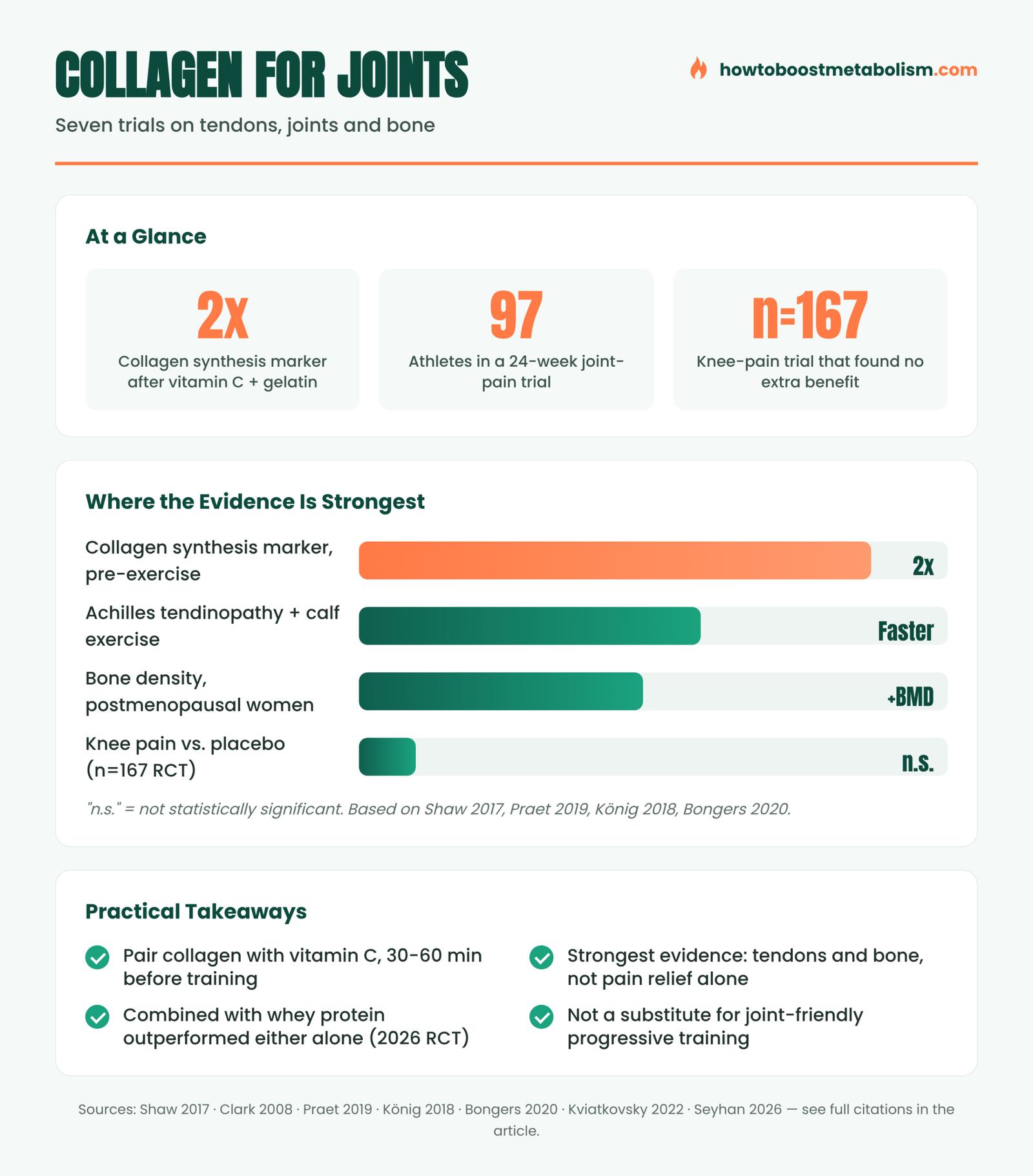
The foundational study here is a clever one (Shaw et al., 2017, American Journal of Clinical Nutrition). Eight healthy men took either a placebo or vitamin-C-enriched gelatin (5 g or 15 g) one hour before six minutes of rope-skipping — a drill chosen specifically to mechanically stimulate connective tissue. Blood drawn an hour after the 15 g dose showed roughly double the amino-terminal propeptide of type I collagen (a direct marker of new collagen being synthesized) compared with placebo. The researchers also took that post-supplement blood serum and used it to treat engineered ligament tissue in the lab, which showed increased collagen content and improved mechanical properties. This is good mechanistic evidence that the gelatin-plus-vitamin-C combination, taken shortly before loading the tissue, measurably increases collagen production — the biological step everything else depends on.
See also: Isometric Training for Joint Pain After 40
Joint Pain in Athletes: A Real-World 24-Week Trial
The largest and longest trial on actual joint pain is a 24-week, randomized, placebo-controlled study (Clark et al., 2008, Current Medical Research and Opinion) in 147 college varsity and club athletes with activity-related joint pain but no diagnosed joint disease. Ninety-seven subjects completed the full protocol. The group taking 10 g/day of collagen hydrolysate reported significantly greater reductions in joint pain at rest, while walking, standing, carrying objects, and lifting, compared with the placebo group. The effect was more pronounced in the subgroup with knee-specific pain. It’s an industry-funded trial (a common limitation in this research area), but it’s also one of the few studies run specifically in physically active people without existing joint disease — the exact population asking about this supplement.
See also: rucking after 40
Free download
🔥 The Metabolism Starter Kit
3 honest guides: a 7-day reset plan, a foods cheat-sheet and 12 metabolism myths debunked. No spam — unsubscribe anytime.
Achilles Tendinopathy: Collagen Plus Exercise Beat Exercise Alone (In This Pilot)
A small crossover pilot study in Nutrients (Praet et al., 2019) tested specific collagen peptides combined with a calf-strengthening program in 20 patients with chronic Achilles tendinopathy. The group that started on collagen peptides (before crossing over to placebo) showed significantly greater improvement on a validated tendon function and pain questionnaire (VISA-A) after three months than the group that started on placebo. Both groups eventually improved once they received the active supplement, suggesting the collagen peptides accelerated the clinical benefit of the structured exercise program rather than replacing it. This matches the general pattern in tendon research: collagen peptides appear to work with mechanical loading, not instead of it.
Bone Density in Postmenopausal Women: A Strong, Longer-Term Signal
Tendons aren’t the only connective tissue made largely of collagen — bone matrix is too. A 12-month, 131-woman randomized trial (König et al., 2018, Nutrients) gave postmenopausal women with age-related bone loss either 5 g/day of specific collagen peptides or placebo. The collagen group showed a significant increase in bone mineral density at both the spine and femoral neck, along with a favorable shift in bone-formation and bone-breakdown markers, while the placebo group’s bone density declined slightly over the same period, as expected with normal aging. This is one of the longer, better-controlled trials in the collagen literature, and bone density is a hard, DEXA-measured outcome rather than a self-reported one.
The Honest Counterpoint: A Well-Powered Trial Found Nothing for Knee Pain
Here’s where it would be dishonest to stop at the positive studies. A 12-week randomized trial in Applied Physiology, Nutrition, and Metabolism (Bongers et al., 2020) gave 10 g/day of collagen peptides to 167 physically active adults (median age 63) with self-reported knee pain — a much larger sample than most trials in this space. Knee pain, measured by a visual analog scale and two validated questionnaires, improved in both the collagen and placebo groups by a similar amount. Inflammatory, cartilage, and bone biomarkers also showed no difference between groups. The researchers’ conclusion was direct: 12 weeks of collagen peptide supplementation did not reduce knee pain beyond what placebo achieved in this population. This trial is a useful reality check — collagen’s benefits for connective tissue synthesis and bone density don’t automatically translate into less day-to-day joint pain for everyone.
A Balanced 2022 Review, and a Fresh 2026 Trial Combining Collagen With Protein
A 2022 review in Current Opinion in Clinical Nutrition and Metabolic Care (Kviatkovsky et al., 2022) summarized the field as genuinely promising but still maturing: collagen peptide supplementation, especially paired with resistance training, showed improvements in pain, function, and even body composition and strength in the recent literature it reviewed, likely through small “bioactive peptides” released during digestion rather than the collagen simply being used as raw building material. The review called for more research into exactly which peptides matter and why.
A 2026 randomized trial adds a useful wrinkle (Seyhan et al., 2026, BMC Sports Science, Medicine and Rehabilitation). Forty resistance-trained men did 8 weeks of supervised training while taking whey protein, collagen, both combined, or placebo. The combined whey-plus-collagen group had the largest gains in muscle mass, lumbar spine bone density, and 1RM squat and bench press strength — outperforming either supplement alone. Collagen alone still beat placebo on bone density and showed a small muscle-mass gain, but whey protein’s larger anabolic effect combined with collagen’s bone and connective-tissue signal for the best overall result. This fits the broader pattern: collagen looks like a complement to protein and training, not a replacement for either.
| Study | Population / Design | Finding |
| Shaw 2017 | 8 men, mechanistic RCT | 2x collagen synthesis marker with vitamin C + gelatin |
| Clark 2008 | 97 athletes, 24-wk RCT | Significant reduction in joint pain vs. placebo |
| Praet 2019 | 20 patients, pilot crossover | Collagen + exercise improved Achilles function faster |
| König 2018 | 131 postmenopausal women, 12-mo RCT | Increased spine & femoral neck bone density |
| Bongers 2020 | 167 adults, 12-wk RCT | No extra benefit for self-reported knee pain |
| Seyhan 2026 | 40 resistance-trained men, 8-wk RCT | Whey + collagen beat either alone for muscle/BMD |
What This Means If You’re Starting Strength Training After 40
The pattern across these seven studies is consistent: collagen peptides have solid mechanistic and clinical support for building connective tissue (tendons, bone) when paired with the mechanical loading that tells your body to use it, and for reducing joint discomfort in physically active people without existing joint disease. The evidence is much weaker, and in at least one strong trial, nonexistent, as a general pain reliever for people with established knee pain unrelated to a training stimulus.
Practically, that means collagen is best thought of as a small supporting piece for someone easing into or restarting strength training after 40 — taken with vitamin C shortly before training, alongside a program that progressively and sensibly loads your joints rather than skipping that part entirely. A joint-friendly, structured approach to building strength matters more than any supplement choice.
If stiff joints have made you hesitant to get back into lifting, Old School New Body‘s F4X method is built around shorter, lower-impact strength sessions designed with older trainees in mind — the kind of structured loading the collagen research above assumes you’re actually doing.
Check Availability →Affiliate link — we may earn a commission at no extra cost to you. Disclosure
Collagen Type Matters More Than Most Labels Suggest
One detail that gets lost in most collagen marketing: not all collagen is the same, and the trials reviewed above mostly used “specific collagen peptides” (hydrolyzed and, in some cases, fraction-targeted to particular tissue types) rather than generic bovine or marine gelatin scooped from a tub. The Shaw 2017 mechanistic study specifically used gelatin enriched with vitamin C, which is a cofactor required for your body to actually form new collagen cross-links — without adequate vitamin C in the diet, supplemental collagen peptides have less raw material to work with regardless of dose. The König 2018 bone trial and the Praet 2019 tendon trial both used proprietary “specific collagen peptide” formulations developed for those particular tissue targets, which may partly explain why results vary across cheaper, generic collagen products that haven’t been tested the same way.
This also helps explain the Bongers 2020 null result: a well-powered trial testing a 12-week, 10 g/day generic collagen peptide protocol specifically for already-established knee pain, in a population that wasn’t necessarily doing anything to mechanically load that tissue during the trial. Collagen synthesis appears to require a loading stimulus to actually translate into a usable, functional benefit — which is consistent with the Praet tendinopathy trial design, where collagen was always paired with a structured calf-strengthening program, never tested as a stand-alone painkiller.
Who Is This Actually For?
Based on the full set of evidence, collagen peptides make the most sense for a fairly specific person: someone over 40 who is resuming or starting progressive strength training, dealing with the kind of generalized joint stiffness or mild tendon discomfort that comes with reintroducing load to tissue that’s been undertrained, and who is already eating enough protein and training sensibly. It makes much less sense as a stand-alone treatment for an existing, diagnosed joint condition — that’s a conversation for a doctor or physical therapist, not a supplement aisle. And it makes little sense as a substitute for simply building training volume gradually, since every positive trial in this review paired collagen with some form of mechanical loading, never with rest alone.
Dosing and Safety
Trials showing benefit used 5–15 g/day of collagen peptides or gelatin, often combined with vitamin C and taken roughly 30–60 minutes before the targeted activity — a timing detail that matters, since the mechanistic study found peak collagen-synthesis markers about an hour after dosing. Collagen peptides are generally well tolerated, with mild digestive upset being the most common side effect reported. This article is educational and isn’t medical advice — see our medical disclaimer linked above.
Free download: our Metabolism Starter Kit — a protein calculator, a 7-day meal framework, and a one-page supplement checklist, with zero hype.
Get the Free Starter Kit →The Bottom Line
Collagen peptides aren’t a universal joint-pain cure — a well-powered 2020 trial found no benefit for self-reported knee pain beyond placebo. But for tendon loading, bone density, and joint discomfort tied to physical activity, the evidence is genuinely encouraging, especially when collagen is taken with vitamin C before training and paired with adequate protein and a sensible, progressive strength program. Treat it as a complement to good training, not a substitute for it.
Related reading: eccentric training and tendon health after 40, tennis elbow in lifters, finger pulley injury prevention and rehab, and our Old School New Body review.
Frequently Asked Questions
Does collagen actually help with joint pain?
It depends on the type of pain. In a 24-week trial of 97 active athletes with activity-related joint pain, collagen hydrolysate significantly reduced pain versus placebo. But in a larger, 12-week trial of 167 adults with self-reported knee pain, collagen showed no extra benefit over placebo.
How much collagen should I take, and when?
Studies showing benefit typically used 5-15 g/day, often paired with vitamin C and taken about 30-60 minutes before exercise, which lines up with when collagen synthesis markers peak after dosing.
Is collagen better than whey protein for muscle and joints?
A 2026 randomized trial found that combining whey protein with collagen outperformed either supplement alone for muscle mass, bone density, and strength gains — collagen appears to complement protein rather than replace it.
Does collagen help tendons specifically?
A pilot study in Achilles tendinopathy patients found that collagen peptides combined with a calf-strengthening program improved tendon function faster than the exercise program with placebo, though both groups improved eventually.
Can collagen help with bone density after menopause?
A 12-month randomized trial in 131 postmenopausal women found a significant increase in spine and femoral neck bone density with 5 g/day of specific collagen peptides, along with favorable shifts in bone turnover markers.