Omega-3 and Visceral Belly Fat: What Research Shows
This article may contain affiliate links. If you buy through them, we may earn a small commission at no extra cost to you. See our Affiliate Disclosure and Medical Disclaimer.
Type “omega-3 visceral fat” into Google and you’ll find dozens of articles implying that a few fish oil capsules will melt the fat around your organs. That’s not quite what the research says — but what it actually says is more interesting, and more useful, than the hype.
We went through the human randomized controlled trials that actually measured omega-3’s effect on visceral fat — not just “weight” or “belly circumference,” but the metabolically active fat wrapped around your liver, intestines, and other organs. Here’s the honest picture, plus where fish oil fits into a real fat-loss plan.
What Visceral Fat Actually Is (and Why It Matters More Than Subcutaneous Fat)
Not all belly fat behaves the same way. Subcutaneous fat sits just under the skin and is mostly cosmetic. Visceral fat packs in around your liver, pancreas, and intestines, and it’s biologically active — it secretes inflammatory signaling molecules (cytokines like TNF-alpha and IL-6) that interfere with insulin signaling throughout the body. That’s the mechanistic link between a visceral-fat-heavy body shape and higher risk of type 2 diabetes and cardiovascular disease, independent of total body weight.
This matters for the omega-3 question specifically: a supplement could, in theory, help in two very different ways — by shrinking the actual volume of visceral fat, or by making the visceral fat you already have less inflammatory and less metabolically disruptive. Those are different outcomes, and the trials mostly only support the second one.
What the Randomized Trials Actually Measured
The adipose tissue biopsy trial
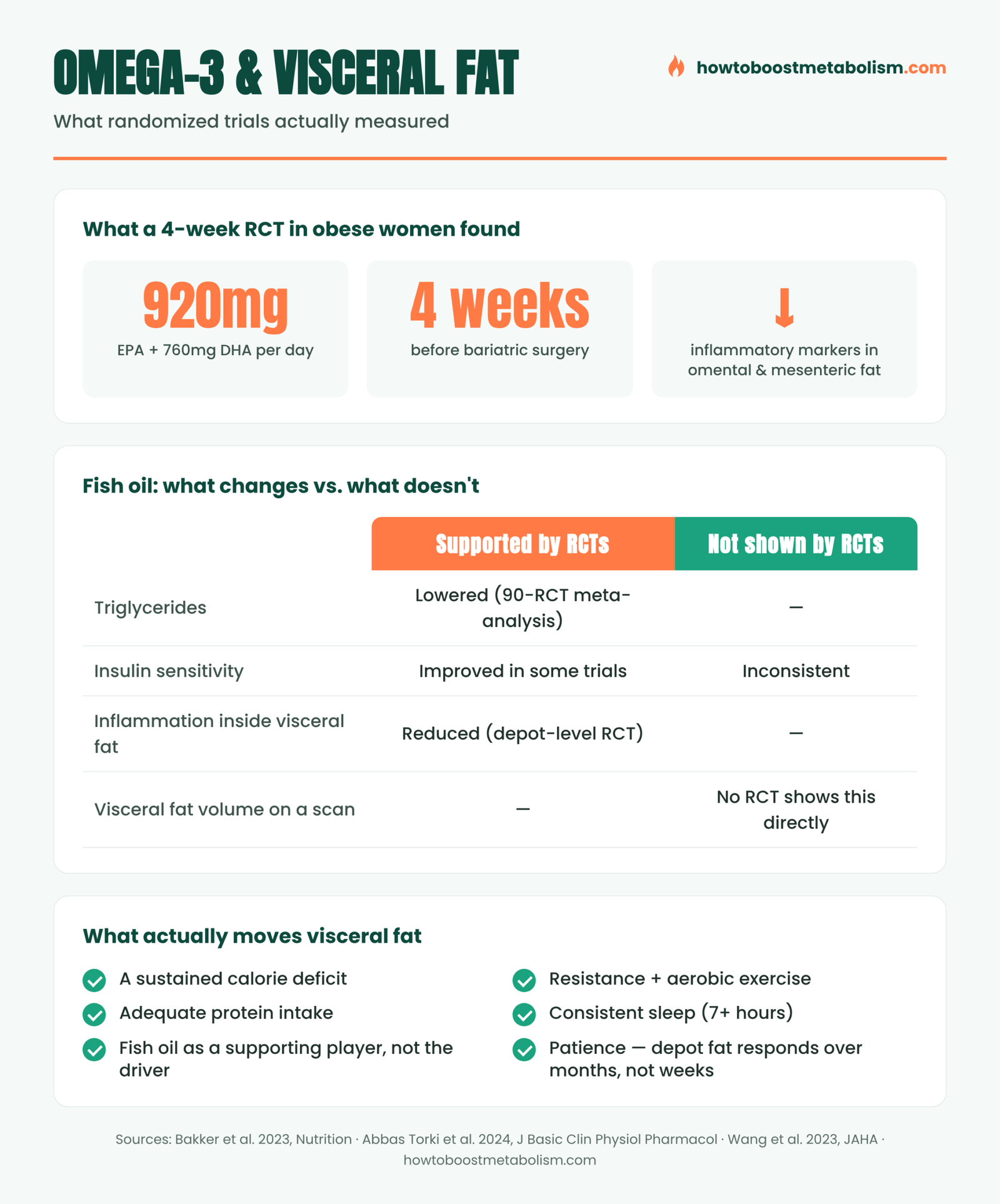
A 2023 randomized trial published in Nutrition (Bakker et al., 2023) gave morbidly obese women scheduled for bariatric surgery either a 2-week low-calorie diet or a 4-week omega-3-enriched diet (920 mg EPA + 760 mg DHA daily) before surgery. Because the women were already heading into surgery, the researchers could do something most nutrition studies can’t: they took actual biopsies of omental and mesenteric fat — the visceral depots that wrap around the gut — and measured inflammatory markers directly inside that tissue.
The omega-3 group showed reduced expression of several inflammatory markers specifically inside the visceral fat depots, compared with the low-calorie-diet-only group. That’s a genuinely useful finding: it means omega-3s can change how visceral fat behaves at the tissue level, in a relatively short window. What it does not show is that the fat depots got smaller — the trial wasn’t designed to measure volume change, and 4 weeks is a short window for that anyway.
The clinical population trial
A separate 2024 randomized trial in Journal of Basic and Clinical Physiology and Pharmacology (Abbas Torki et al., 2024) looked at omega-3 supplementation’s effect on muscle mass, fat mass, and visceral fat specifically in hemodialysis patients — a population with its own distinct metabolic profile. It’s a useful data point for the broader literature, but the results in dialysis patients don’t necessarily generalize to a healthy or overweight-but-otherwise-healthy adult trying to lose belly fat, so we’re citing it as supporting evidence of a biological effect rather than as a reason to expect the same magnitude of change in a general audience.
The metabolic marker evidence
Where omega-3 has firmer backing is on the blood markers that travel alongside visceral fat. A large meta-analysis of 90 randomized trials (Wang et al., 2023, JAHA) found omega-3 supplementation reliably lowers triglycerides, and a meta-analysis of 11 RCTs (Akinkuolie et al., 2011) found a modest improvement in insulin sensitivity. Both triglycerides and insulin resistance track closely with visceral fat — so omega-3 appears to improve the metabolic consequences of carrying visceral fat, even in studies that didn’t directly image the fat itself.
| Outcome | Evidence quality | What it means |
| Inflammation inside visceral fat tissue | Direct biopsy RCT (4 weeks) | Omega-3 changes tissue behavior, not just blood markers |
| Triglycerides | Strong (90-RCT meta-analysis) | Reliably lowered |
| Insulin sensitivity | Moderate (11-RCT meta-analysis) | Modest improvement in some populations |
| Visceral fat volume (CT/MRI) | Not directly demonstrated | No RCT we found shows fish oil shrinking visceral fat volume on imaging |
Free download
🔥 The Metabolism Starter Kit
3 honest guides: a 7-day reset plan, a foods cheat-sheet and 12 metabolism myths debunked. No spam — unsubscribe anytime.
Why This Gets Oversimplified Online
Most “fish oil for belly fat” content online cites one or two of these studies and skips straight to the conclusion that omega-3 “targets stubborn belly fat,” because that sentence sells supplements better than the honest version. The actual chain of evidence is: omega-3 reliably improves blood lipid markers → omega-3 appears to reduce inflammation measured directly inside visceral fat tissue in at least one short biopsy trial → no trial has shown it directly shrinking visceral fat volume on a scan. Each link in that chain is real, but the distance between “improves inflammation markers” and “melts belly fat” is exactly the gap that marketing copy quietly papers over.
It’s also worth asking why visceral fat specifically is hard to study with a supplement intervention: accurately measuring visceral fat volume requires a CT or MRI scan, which is expensive and involves radiation exposure (for CT) that researchers are reluctant to use repeatedly on healthy volunteers just to track a supplement trial. That’s a big part of why most nutrition research on visceral fat either uses surrogate markers (waist circumference, blood lipids) or, as in the Bakker trial above, piggybacks on patients who are already undergoing surgery for an unrelated reason. Until more imaging-based RCTs exist, “omega-3 directly reduces visceral fat volume” remains an untested claim, not a debunked one — the honest position is that we don’t yet have the direct evidence either way.
Could Omega-3 Supplements Make Things Worse?
For most healthy adults, no — the safety profile of fish oil at studied doses (1–3 g/day combined EPA+DHA) is well established, with the main side effects being mild (fishy aftertaste, occasional GI upset). The exceptions worth knowing: omega-3 supplements have a mild blood-thinning effect, so anyone on anticoagulant medication or with a bleeding disorder should check with their doctor before adding a high-dose supplement, and doses above roughly 3g/day combined EPA+DHA have been associated with a small increased risk of atrial fibrillation in some analyses, which is a reason not to simply assume “more is better.”
Getting Omega-3 From Food Instead
If you’d rather not add another pill to your routine, fatty fish delivers comparable EPA and DHA when eaten regularly. A 100g serving of salmon provides roughly 1.5–2.5g of combined EPA+DHA depending on the cut and whether it’s farmed or wild; mackerel and sardines run similarly high. Eating fatty fish 2–3 times per week gets most people into the same weekly EPA+DHA range used in the trials above, with the added benefit of protein and other micronutrients that a supplement doesn’t provide. Supplementation makes the most sense as a fallback for people who don’t eat fish regularly, not as a replacement for it.
Infographic: Omega-3 and Visceral Fat — The Real Data
So Should You Bother With Fish Oil for Belly Fat?
Yes, but recalibrate what you’re expecting it to do. Omega-3 supplementation is not a visceral-fat-burning agent — nothing in the human trial literature supports that framing. What it reasonably appears to do is make the visceral fat you have less inflammatory, and improve two of the metabolic markers (triglycerides, insulin sensitivity) most closely tied to visceral fat’s health risk. That’s worth something even if the tape measure doesn’t move because of it.
The things that actually shrink visceral fat volume, according to the broader body of research, are unglamorous: a sustained calorie deficit, resistance training, and enough aerobic activity to matter — which is why our Zone 2 cardio breakdown and our guide to losing belly fat after 40 are better starting points than any supplement aisle.
Choosing an omega-3 supplement
If you want to add fish oil on top of those fundamentals, look for a third-party-tested product that lists actual EPA and DHA content per serving (not just “fish oil 1000mg,” which can be mostly filler oil), and aim for a combined EPA+DHA dose in the range used in the trials above — roughly 1.5–2 g/day of combined EPA+DHA.
Free download: our Metabolism Starter Kit — a protein calculator, a 7-day meal framework, and a one-page supplement checklist, with zero hype.
Get the Free Starter Kit →Frequently Asked Questions
Does fish oil burn visceral fat?
No human randomized trial has directly shown fish oil reducing visceral fat volume on a CT or MRI scan. What RCTs do show is that omega-3 supplementation reduces inflammatory markers inside visceral fat tissue and improves related metabolic markers like triglycerides.
How much omega-3 do I need for visceral fat benefits?
Trials showing effects on inflammation and metabolic markers typically used combined EPA+DHA doses of roughly 1.5–2 g per day, taken for several weeks to months.
Is visceral fat the same as belly fat?
No. Belly fat includes both subcutaneous fat (under the skin) and visceral fat (around the organs). Visceral fat is the metabolically active, higher-risk type, and it isn’t something you can tell apart from subcutaneous fat just by looking in the mirror.
What actually reduces visceral fat?
The strongest evidence points to a sustained calorie deficit combined with regular exercise — both resistance training and aerobic activity — plus adequate sleep. Supplements, including omega-3, play a supporting role at best.
Can I get enough omega-3 from food instead of supplements?
Yes — fatty fish like salmon, mackerel, and sardines eaten 2–3 times a week can provide comparable EPA and DHA intake to supplement doses used in research, and whole-food sources come with additional nutrients.
This article is for informational purposes and is not medical advice. Talk to your doctor before starting any new supplement, especially if you take blood thinners or have a medical condition. See our Medical Disclaimer.