Taurine for Metabolism and Aging: What 2026 Science Shows
This article may contain affiliate links. If you buy through them, we may earn a small commission at no extra cost to you. See our Affiliate Disclosure and Medical Disclaimer.
In 2023, a single study in the journal Science turned taurine — a cheap amino acid you’ve probably seen listed on an energy-drink label — into one of the most talked-about longevity supplements on the internet. The headlines said taurine levels fall with age and that restoring them extended lifespan in animals. What usually got left out: the study was done in worms, mice, and monkeys, and the first dedicated human follow-up study found no such link at all. So what does taurine actually do for metabolism and aging in people? We dug into the human trial data — not just the viral headline.
Where the Taurine-Aging Story Actually Came From
The 2023 paper that started it all measured circulating taurine across species and found levels decline with age in mice, monkeys, and humans. When researchers restored taurine through supplementation in mice and monkeys, they saw improved health span — reduced cellular senescence, better mitochondrial function, less DNA damage, and in mice, a longer lifespan. In humans, lower circulating taurine correlated with several age-related diseases, and acute endurance exercise raised taurine levels (Singh et al., 2023, Science, PMID 37289866). The authors themselves were careful to say human trials were “warranted” — meaning the human proof didn’t exist yet. That nuance mostly didn’t survive the headline-writing process.
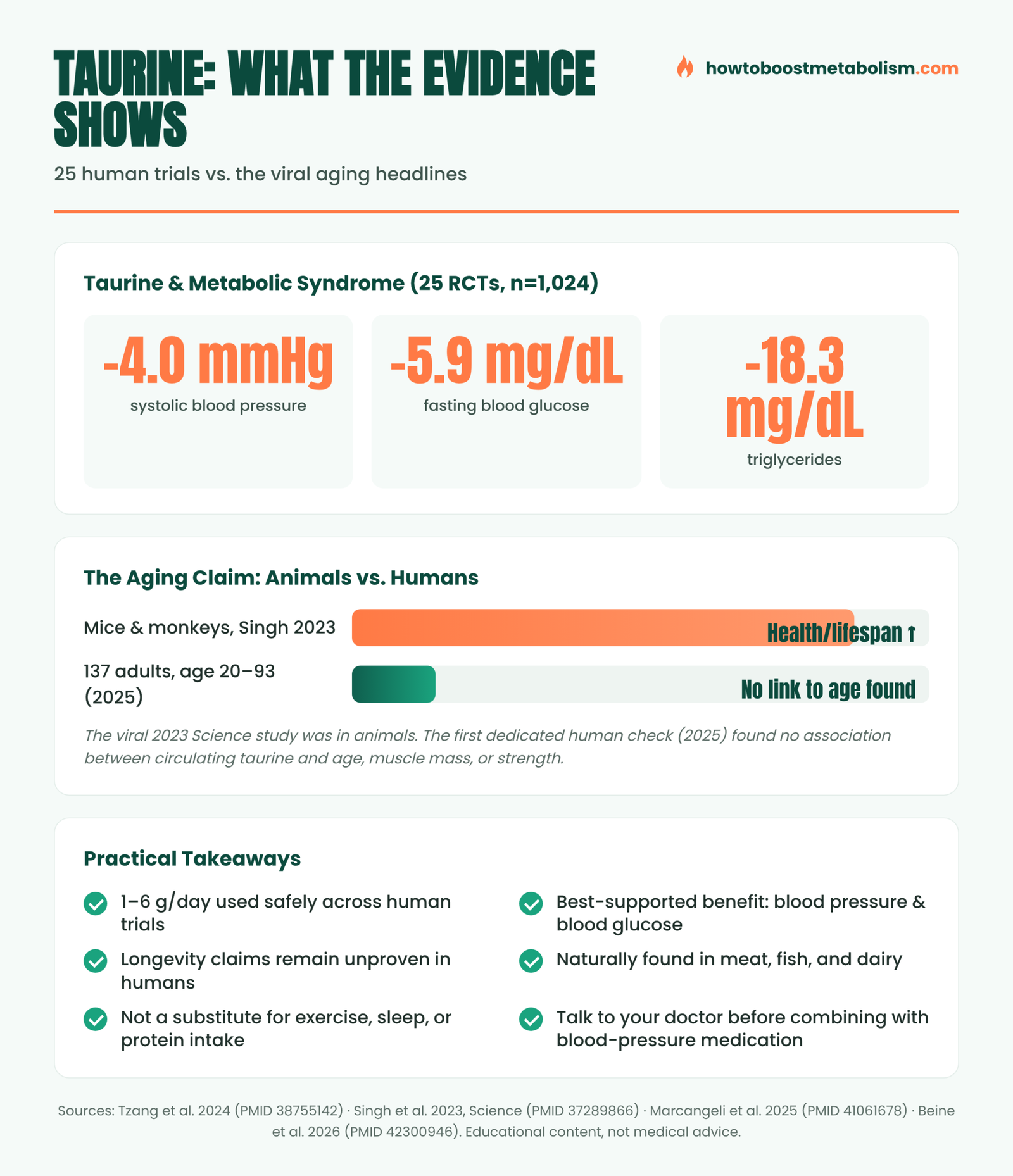
Two years later, a 2025 study in Aging Cell went looking for that human proof directly. Researchers measured circulating taurine in 137 men aged 20 to 93, split between physically active and inactive groups, and checked it against age, muscle mass, strength, physical performance, and mitochondrial function. They found no association between taurine levels and any of those outcomes — directly challenging the idea that taurine decline drives aging in humans (Marcangeli et al., 2025, PMID 41061678). A 2026 mechanistic review in Food & Function summarized the state of the science similarly: taurine clearly does interesting things at the cellular level — antioxidant defense, anti-inflammatory signaling, mitochondrial support — but “physiological synthesis and dietary intake appear sufficient to maintain basal health” for most people, with supplementation mainly adding value in specific contexts rather than as a universal anti-aging fix (Beine et al., 2026, PMID 42300946).
What Taurine Is Actually Well-Proven to Do
Set the longevity headline aside, and taurine has a genuinely solid, if less exciting, case for metabolic health. A 2024 meta-analysis in Nutrition & Diabetes pooled 25 randomized controlled trials covering 1,024 participants, with daily doses from 0.5 to 6 g over periods of 5 to 365 days. Compared with placebo, taurine supplementation produced statistically significant reductions in systolic blood pressure (−4.0 mmHg), diastolic blood pressure (−1.5 mmHg), fasting blood glucose (−5.9 mg/dL), and triglycerides (−18.3 mg/dL) — with a dose-dependent relationship for both blood pressure and glucose, and no significant adverse effects reported (Tzang et al., 2024, PMID 38755142). That is a real, reproducible signal across more than 1,000 people — a far stronger evidence base than the handful of animal studies behind the viral longevity claim.
A smaller, earlier randomized trial in people with type 2 diabetes found similar directional benefits: taurine combined with a calorie-controlled diet improved several metabolic parameters and endothelial (blood vessel) markers compared with diet alone (PMC9308194). None of this is dramatic on its own, but it is consistent, replicated across multiple trials, and measured in actual metabolic markers rather than inferred from headline-chasing animal data.
Free download
🔥 The Metabolism Starter Kit
3 honest guides: a 7-day reset plan, a foods cheat-sheet and 12 metabolism myths debunked. No spam — unsubscribe anytime.
So Is Taurine Worth Taking?
If your goal is longevity in the “turn back the clock” sense that went viral in 2023, the honest answer is: the best current human evidence doesn’t support that specific claim. If your goal is supporting healthy blood pressure and blood glucose as part of an overall metabolic-health routine, taurine has a reasonably solid, dose-dependent case behind it at 1–6 g per day — the same range used safely across the 25 trials in the 2024 meta-analysis. It’s not a replacement for diet, exercise, sleep, or any medication you’re already on, and the people most likely to be genuinely low in taurine are strict vegans and vegetarians, since taurine is concentrated in meat, fish, and dairy and the body’s own synthesis is limited.
| Claim | Human evidence strength | What the data actually shows |
| Extends lifespan / reverses aging | Weak | Shown in mice/monkeys only; first direct human check found no link (PMID 41061678) |
| Lowers blood pressure | Moderate–strong | −4.0 mmHg systolic across 25 RCTs, n=1,024 (PMID 38755142) |
| Improves blood glucose | Moderate–strong | −5.9 mg/dL fasting glucose, dose-dependent (PMID 38755142) |
| Lowers triglycerides | Moderate | −18.3 mg/dL across the same meta-analysis |
Where Taurine Actually Comes From
Taurine isn’t an essential amino acid in the strict sense — your liver can synthesize some of it from cysteine and methionine — but dietary intake matters because endogenous production in humans is relatively limited. Meat, poultry, seafood (especially shellfish like scallops and octopus), and dairy are the richest natural sources, typically providing somewhere in the range of 10–400 mg per serving depending on the food and cut. Plant foods contain essentially none. This is why the research community keeps flagging strict vegans and vegetarians as the population most likely to benefit from supplementation specifically, rather than the general population across the board.
How Taurine Compares to Other “Anti-Aging” Supplements
Taurine isn’t the only ingredient riding a wave of longevity headlines — NAD+ precursors, resveratrol, and various “senolytic” compounds have each had their own viral moment. The pattern across most of them is strikingly similar to taurine’s story: promising cellular or animal data, an enthusiastic headline, and human trial evidence that’s either thin, mixed, or still pending when you actually go looking for it. Taurine stands out a little from that pack specifically because it already has a decent-sized human evidence base — just for blood pressure and metabolic markers, not for the longevity claim it became famous for. That’s a more useful way to think about it: not “does taurine work,” but “which specific claim about taurine is actually backed by people, not mice.”
Taurine Isn’t a Muscle or Training Program — Here’s What Is
Nothing in the taurine research suggests it builds muscle, improves strength, or replaces resistance training — the Aging Cell study specifically found no relationship between taurine and muscle mass or strength at all. If maintaining muscle and functional strength through your 40s, 50s, and beyond is the actual goal, a structured strength-training approach matters far more than any single supplement. For readers who want a complete, affordable program built specifically for that age range, Old School New Body by Steve and Becky Holman lays out their F4X training method for adults over 40. One honest caveat before you look at it: the program’s own sales page cites dramatic statistics about aging and muscle loss that are not backed by independently verifiable sources — treat those specific numbers as marketing, not science, and judge the program on its training method instead.
See the F4X training method Old School New Body uses for building strength after 40.
Learn More →Affiliate link — we may earn a commission at no extra cost to you. Disclosure
Free download: our Metabolism Starter Kit — a protein calculator, a 7-day meal framework, and a one-page supplement checklist, with zero hype.
Get the Free Starter Kit →For more on separating real metabolism science from hype, see our evidence-ranked guide to the best metabolism supplements of 2026, and if you’re specifically focused on insulin and blood sugar, our guide to insulin resistance and metabolism covers seven other proven approaches.
Frequently Asked Questions
Does taurine really slow down aging?
The evidence for that specific claim is weak in humans. The 2023 study that popularized the idea was done in worms, mice, and monkeys; the first dedicated human study in 2025, covering 137 adults aged 20 to 93, found no association between taurine levels and age, muscle mass, strength, or mitochondrial function (PMID 41061678).
What does taurine actually do for metabolism?
The strongest human evidence — a 2024 meta-analysis of 25 randomized trials and 1,024 people — shows taurine supplementation can modestly lower systolic and diastolic blood pressure, fasting blood glucose, and triglycerides, in a dose-dependent way (PMID 38755142).
How much taurine should I take per day?
Human trials in the meta-analysis used doses from 0.5 g to 6 g per day, with no significant adverse effects reported compared to placebo. Most consumer products provide 500 mg to 1,000 mg per capsule, commonly taken once or twice daily.
Is taurine safe to take long-term?
The 2024 meta-analysis covered trial durations from 5 to 365 days without significant adverse effects, which is reassuring, but long-term data beyond a year is still limited. As with any supplement, check with your doctor if you take blood pressure medication, since taurine can lower blood pressure itself.
Do I need taurine if I eat meat and fish regularly?
Probably less than someone who doesn’t. Taurine is concentrated in animal products — meat, fish, and dairy — and the body’s own synthesis is limited, so strict vegans and vegetarians are the group most likely to have meaningfully lower taurine intake and status.