Body Recomposition After 40: Build Muscle, Lose Fat?
This article may contain affiliate links. If you buy through them, we may earn a small commission at no extra cost to you. See our Affiliate Disclosure and Medical Disclaimer.
“Build muscle and burn fat at the same time” is one of the most-repeated promises in the fitness industry, and also one of the claims people are most often told to ignore as marketing nonsense. After 40, when metabolism and recovery both feel slower and the stakes of wasted effort feel higher, it’s a fair question to ask with real skepticism: is simultaneous body recomposition actually possible, or is it a myth sold to sell supplements and programs?
The honest answer, backed by a notably well-designed 2026 randomized trial and a decade of supporting research before it, is that it’s genuinely possible under specific, non-magical conditions — but it’s slower, more modest, and more dependent on protein intake and training consistency than most marketing copy lets on.
You may also find this useful: Protein Timing: Does Spreading It Out Build More Muscle?
What ‘Body Recomposition’ Actually Means
Body recomposition refers to gaining lean mass (mostly muscle) and losing fat mass at the same time, rather than the traditional “bulk then cut” model where you deliberately gain weight (muscle plus some fat) in one phase and then lose weight (fat plus some muscle) in another. For decades, mainstream exercise science treated simultaneous recomposition as nearly impossible outside of complete beginners or people returning to training after a long break, because building muscle was assumed to require a calorie surplus while losing fat required a deficit — two seemingly opposite energy states.
Further reading: strength training on Ozempic
That assumption has been chipped away at steadily by research over the past decade, and a 2026 trial gives the clearest demonstration yet.
The 2026 Trial: Two Different Calorie Levels, Same Result Direction
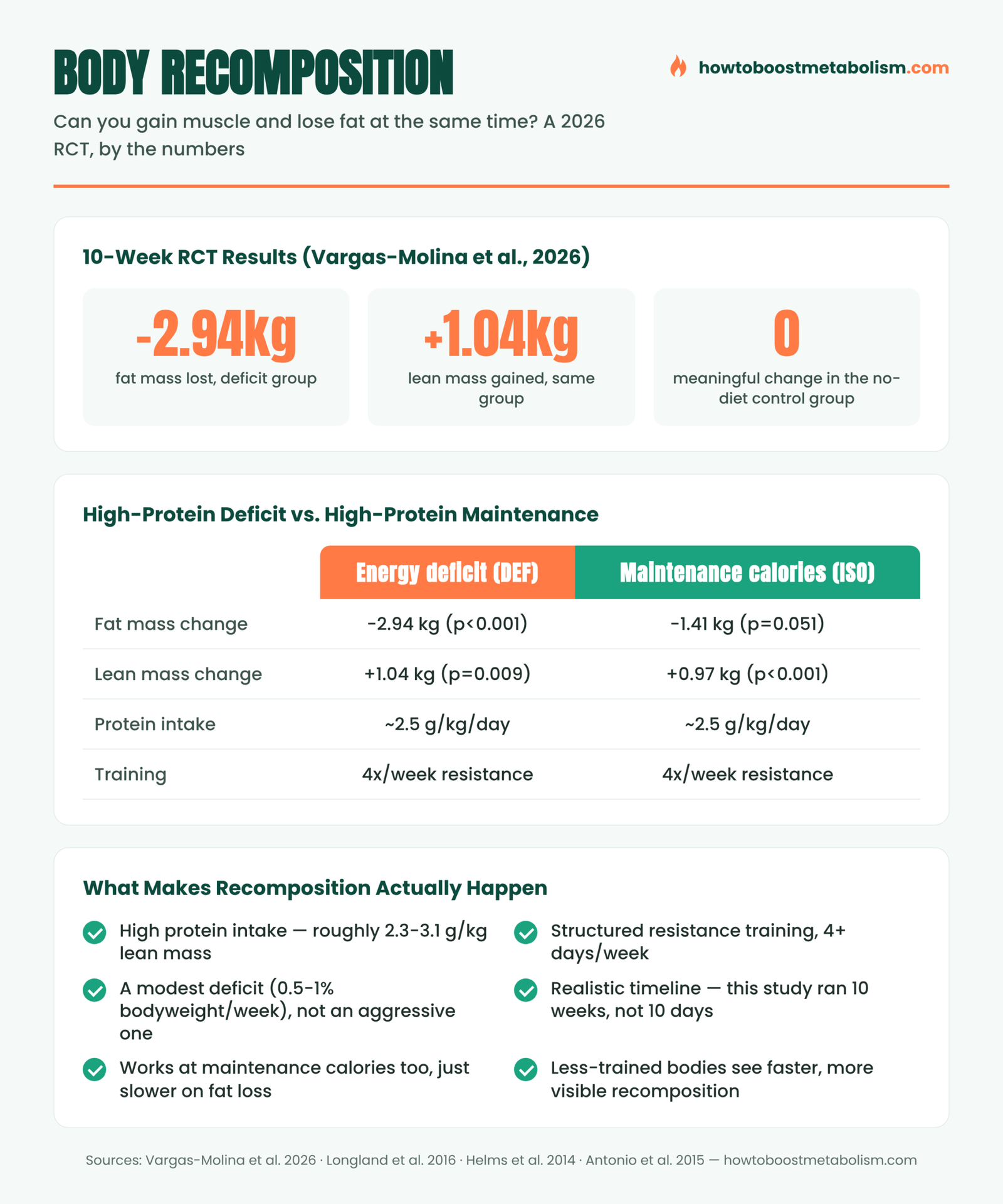
A study published in the European Journal of Applied Physiology (Vargas-Molina et al., 2026, PMID 41940947) randomized 30 resistance-trained adults into three groups for 10 weeks: a high-protein energy-deficit diet (DEF), a high-protein isocaloric (maintenance-calorie) diet (ISO), or a no-diet control that simply continued training as usual. Both diet groups consumed the same elevated protein intake — about 2.5 g per kilogram of body weight per day — while differing only in total calories. All groups did structured resistance training four days a week, and body composition was measured with DEXA scanning, a gold-standard method, at the start and end.
The results were genuinely striking. The deficit group lost 2.94 kg of fat mass (p < 0.001) while simultaneously gaining 1.04 kg of lean mass (p = 0.009). The maintenance-calorie group lost less fat (1.41 kg, a result that just missed statistical significance) but gained a very similar amount of lean mass (0.97 kg, p < 0.001). The control group — same training, no dietary structure or high protein target — showed no meaningful change in either direction. The researchers' own conclusion was direct: elevated protein intake appears to let people simultaneously lose fat and gain lean mass under both energy conditions, a finding they describe as challenging the traditional bulk-or-cut energy-balance model.
Free download
🔥 The Metabolism Starter Kit
3 honest guides: a 7-day reset plan, a foods cheat-sheet and 12 metabolism myths debunked. No spam — unsubscribe anytime.
This Isn’t a New or Isolated Finding
The 2026 trial builds on real precedent. A frequently cited 2016 study in the American Journal of Clinical Nutrition (Longland et al., PMID 26817506) put young men on a substantial 40% energy deficit combined with six days a week of resistance and high-intensity interval training, and compared a lower-protein diet (1.2 g/kg/day) to a higher-protein diet (2.4 g/kg/day). Over four weeks, the higher-protein group gained 1.2 kg of lean mass while losing 4.8 kg of fat mass — genuine simultaneous recomposition — while the lower-protein group barely gained lean mass (0.1 kg) despite losing a comparable amount of fat (3.5 kg).
A separate 2015 trial in already resistance-trained men and women (Antonio et al., J Int Soc Sports Nutr, PMID 26500462) found that a high-protein diet (3.4 g/kg/day) combined with heavy resistance training produced a significantly greater drop in fat mass and body fat percentage than a normal-protein diet, even without a deliberate calorie deficit being enforced — the extra protein itself appeared to shift body composition favorably.
And a widely referenced 2014 review of natural bodybuilding contest preparation (Helms et al., J Int Soc Sports Nutr, PMID 24864135) recommends keeping weight loss to roughly 0.5-1% of bodyweight per week specifically to maximize muscle retention during a deficit, alongside 2.3-3.1 g/kg of lean body mass in daily protein. That’s a far more modest, patient pace than most “shred fast” marketing suggests — and it’s consistent with why the slower, more moderate deficit group in the 2026 trial saw results at all.
| Study | Key Finding | PMID |
|---|---|---|
| Trained adults, 10-wk deficit, 2.5g/kg protein | -2.94kg fat, +1.04kg lean (both significant) | 41940947 |
| Young men, 40% deficit, 2.4g/kg protein | +1.2kg lean, -4.8kg fat vs. low-protein group | 26817506 |
| Trained adults, 3.4g/kg protein, no enforced deficit | Greater fat loss than normal-protein group | 26500462 |
| Natural bodybuilding contest prep, review | 0.5-1%/wk loss rate maximizes muscle retention | 24864135 |
Why Aggressive Deficits Backfire — Straight From the Official Position Stand
A newly issued position stand from the International Society of Sports Nutrition (Aragon et al., 2026, J Int Soc Sports Nutr, PMID 42867412) — the same organization behind several of the high-protein trials above — puts the deficit-size question in clear, official terms. Among its fifteen formal position points: very-low-energy diets (under 800 kcal/day) and low-energy diets (800-1,200 kcal/day) produce faster short-term weight loss but carry no long-term advantage over more moderate calorie-controlled approaches, and “may increase lean mass loss,” though adequate protein and resistance training can mitigate that risk.
The same position stand is specific about protein ranges in a way that lines up almost exactly with the recomposition trials above: 1.6-2.2 g/kg of bodyweight combined with resistance training “may optimize muscle anabolism,” while higher intakes of 1.9-3.2 g/kg “can maximize lean mass retention” specifically in lean, already resistance-trained individuals under a calorie deficit. It also states plainly that resistance training and sufficient protein intake are “indispensable mitigators of lean mass loss” in any sustained deficit, regardless of which specific diet style is used to create that deficit.
On the metabolic side, the position stand acknowledges that the body does fight back against sustained deficits through adaptive thermogenesis — a drop in resting energy expenditure beyond what reduced body size alone explains — but it’s explicit that this adaptation “is not an inevitable response” and tends to substantially ease once weight stabilizes. That’s a useful, calibrated middle ground between two common extremes: the myth that dieting permanently “breaks” your metabolism, and the opposite myth that calories in, calories out is the whole story with no biological pushback at all.
Why This Matters More, Not Less, After 40
If you’ve read our piece on sarcopenic obesity — losing muscle while gaining fat after 40, you already know the stakes: the natural drift after 40 runs in exactly the wrong direction for recomposition, toward quietly losing muscle while fat accumulates, often on the same unchanged bodyweight. That makes deliberate, protein-driven recomposition less of a vanity project and more of a direct countermeasure to a real physiological trend. It’s also consistent with what we covered in how much muscle you can realistically build after 50 — slower, but genuinely achievable with the right inputs.
None of the studies above were run exclusively in people over 40, and training status matters: less-trained bodies, which includes most people returning to lifting in their 40s and beyond after years away, tend to see faster, more visible recomposition than already highly trained lifters with less room left to adapt. That’s good news for most readers here, not a caveat against trying.
How to Actually Apply This
- Prioritize protein at roughly 1.6-2.4 g/kg of bodyweight per day (the studies above used the higher end of this range, 2.4-3.4 g/kg, and saw strong results).
- Keep structured resistance training at the center — every study that found recomposition included 4+ days a week of resistance training, not cardio alone.
- If you do run a deficit, keep it moderate — roughly 0.5-1% of bodyweight per week — rather than aggressive. The 2026 trial’s deficit group still saw muscle gain because the deficit wasn’t extreme.
- Don’t expect dramatic weekly scale changes. The clearest wins in this research happened over 10 weeks or more, not 10 days.
- If you are exploring structured intermittent-fasting approaches as part of your protein and calorie strategy, our review of the Anabolic Fasting program looks at one such option — see the note below on how to read its specific marketing claims.
Common Mistakes That Quietly Block Recomposition
Most people who try recomposition and feel like it “isn’t working for them” are usually making one of a few specific, fixable mistakes rather than running into a biological wall. Under-eating protein is the most common one — hitting roughly 1.6 g/kg (a reasonable general target) instead of the 2.4-3.4 g/kg range that actually produced recomposition in the trials above is a meaningfully different diet, not a rounding error. Treating cardio as a substitute for resistance training is another: every study that found simultaneous fat loss and muscle gain included structured resistance training as the primary exercise stimulus, not an occasional add-on to steady-state cardio.
Chasing an aggressive deficit because it feels more “serious” is a third common mistake, and it’s the one the research pushes back on most directly — the 2026 trial’s deficit group used a moderate, sustainable energy restriction, not a crash diet, and still produced meaningful fat loss alongside muscle gain. Finally, judging progress week to week by the bathroom scale alone tends to mask real recomposition, since gaining a kilogram of muscle while losing a kilogram of fat can leave the scale essentially unchanged despite a genuinely different, more favorable body composition underneath.
A Note on Programs That Promise This Exact Result
Because simultaneous muscle gain and fat loss is now backed by real randomized trial data, it’s also become a popular selling point — including for Brad Pilon’s Anabolic Fasting program, which pairs structured fasting windows with resistance training and markets itself around building muscle while burning fat. It’s worth being precise about what that means: the research above shows recomposition is genuinely achievable with the right protein intake and training, not that any specific fasting protocol makes it happen automatically or faster than the high-protein approaches tested in these trials. Read a claim like “build muscle and lose fat simultaneously” on a sales page as marketing framing of a real phenomenon, not as a guaranteed outcome of that particular product.
Curious about a structured fasting-plus-training approach built around this exact goal? Anabolic Fasting lays out a specific protocol — read the claims on its page with the context above in mind.
Learn More →Affiliate link — we may earn a commission at no extra cost to you. Disclosure
Free download: our Metabolism Starter Kit — a protein calculator, a 7-day meal framework, and a one-page supplement checklist, with zero hype.
Get the Free Starter Kit →Frequently Asked Questions
Is body recomposition actually possible, or is it a myth?
It’s genuinely possible, not a myth — a 2026 randomized controlled trial found resistance-trained adults simultaneously lost fat mass and gained lean mass over 10 weeks, in both an energy-deficit group and a maintenance-calorie group, as long as protein intake was high (about 2.5 g/kg/day).
Do I need a calorie deficit to build muscle and lose fat at the same time?
Not necessarily. The 2026 trial found that a high-protein diet at maintenance calories also produced simultaneous fat loss and lean mass gain, just with somewhat less fat loss than the deficit group. A moderate deficit tends to accelerate fat loss without blocking muscle gain, as long as protein stays high and the deficit isn’t extreme.
How much protein do I need for body recomposition?
The strongest results in the research above came from protein intakes of roughly 2.4 to 3.4 grams per kilogram of bodyweight per day — notably higher than general health guidelines, and specifically paired with resistance training in every study that found a recomposition effect.
How long does body recomposition take?
The featured 2026 trial ran 10 weeks and showed significant changes in that window; a separate 2016 trial saw results in just 4 weeks under a larger deficit. Realistic expectations are measured in months, not days, and results tend to be more visible for people newer to structured training.
Is body recomposition easier or harder after 40?
The underlying physiology (protein + resistance training driving simultaneous fat loss and muscle gain) doesn’t stop working after 40, but the natural drift without intervention tends to run the opposite direction — toward muscle loss and fat gain. That makes a deliberate recomposition approach more valuable after 40, not less realistic.