Vitamin D and Muscle Strength After 40: The Real Numbers
This article may contain affiliate links. If you buy through them, we may earn a small commission at no extra cost to you. See our Affiliate Disclosure and Medical Disclaimer.
Vitamin D has one of the more confusing reputations in the supplement world. Search for it and you’ll find claims ranging from “essential for preventing age-related muscle loss” to “most people don’t need to supplement at all.” Both framings are pulling from real research — they’re just describing different people. The honest answer, once you separate the studies by who was actually tested, is more useful than either extreme: vitamin D supplementation has a real, measurable effect on muscle strength and fall risk in specific populations, and close to no detectable effect in others. This article walks through what the meta-analyses actually found, and — since “boost metabolism” searches skew toward the 40-plus crowd — who in that age range should actually pay attention.
Why Vitamin D Is On Everyone’s Radar for Muscle
Vitamin D isn’t just a bone nutrient. Skeletal muscle cells have vitamin D receptors, and the hormone (it behaves more like a hormone than a classic vitamin once converted in the body) is involved in muscle fiber proliferation and differentiation. A 2019 narrative review by Remelli and colleagues lays out the biological case: older adults are disproportionately likely to be deficient, due to lower dietary intake and reduced skin synthesis from sunlight, and that deficiency has been proposed as a contributor to sarcopenia — the age-related, progressive loss of muscle mass and strength that raises the risk of falls, hospitalization, and disability. The review is explicit, though, that despite a plausible mechanism, the actual clinical trial results on supplementation have been “still controversial” (https://pubmed.ncbi.nlm.nih.gov/31766576/).
While you’re sorting out supplements, a protein and resistance-training foundation does more for muscle than any single nutrient — our free Starter Kit covers both.
Get the Free Starter Kit →Affiliate link — we may earn a commission at no extra cost to you. Disclosure
What Happens When You Supplement — The Honest Numbers
Two separate meta-analyses have pooled randomized controlled trials of vitamin D supplementation specifically in postmenopausal women, looking at grip strength (a standard, well-validated proxy for overall muscle strength) and mobility.
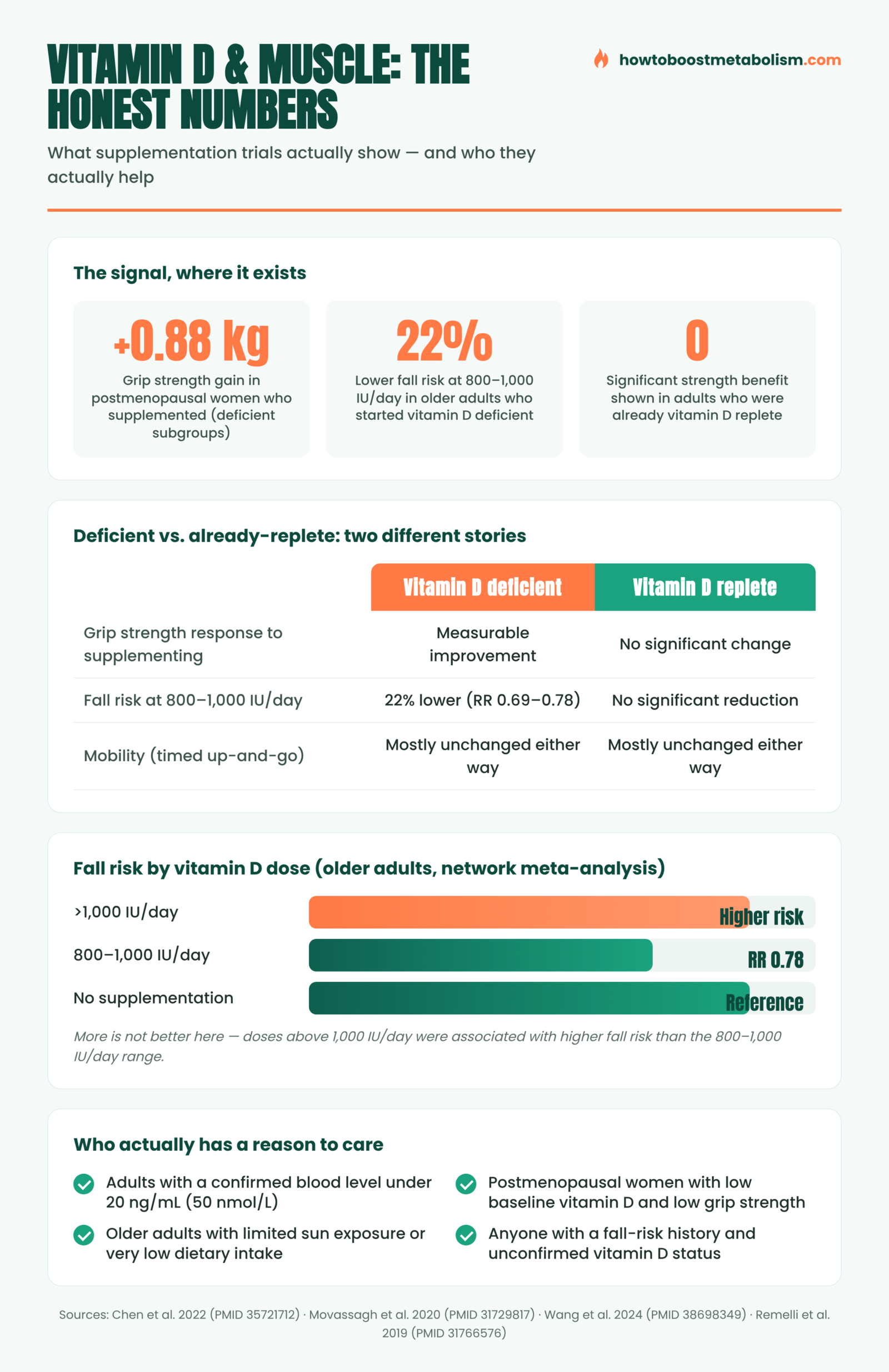
The larger and more recent of the two, a 2022 systematic review covering 13 trials, found that vitamin D supplementation produced a statistically significant 0.876 kg improvement in handgrip strength compared to control. But the effect wasn’t uniform — subgroup analysis showed the benefit was concentrated in women over age 60, in those not also taking calcium, and specifically in those whose baseline vitamin D level was already above 30 ng/mL at the time of testing, a detail that complicates a simple “deficient people benefit most” story and underscores how heterogeneous these trials are. Mobility, measured by a timed up-and-go test, showed no significant improvement either way (https://pubmed.ncbi.nlm.nih.gov/35721712/).
An earlier 2020 meta-analysis of 29 studies in the same population found a smaller, non-significant trend toward improved grip strength overall (a 0.656 kg difference that didn’t clear statistical significance), but — consistent with the idea that benefit concentrates in specific groups — subgroup analysis found a significant improvement among women taking more than 1,000 IU per day, for at least 3 months, who started with baseline vitamin D under 30 ng/mL. Mobility again showed no significant change (https://pubmed.ncbi.nlm.nih.gov/31729817/).
Reading both together: there’s a real signal, but it’s not “take vitamin D, get stronger.” It’s closer to “take vitamin D if you’re actually low on it, for long enough, at an adequate dose, and you might see a small grip-strength improvement” — while people who are already vitamin D-replete shouldn’t expect supplementing further to do much for their muscles.
Free download
🔥 The Metabolism Starter Kit
3 honest guides: a 7-day reset plan, a foods cheat-sheet and 12 metabolism myths debunked. No spam — unsubscribe anytime.
Falls: Where Vitamin D’s Case Is Strongest — But Dose Matters
The strongest, most consistent evidence for vitamin D in an aging population isn’t about muscle size or grip strength directly — it’s about fall prevention, which matters because falls are one of the leading causes of injury-related disability in older adults. A 2024 systematic review and network meta-analysis pooled 35 randomized trials and nearly 59,000 participants comparing vitamin D, calcium, and combined supplementation for fall prevention.
The results were dose-specific in a way that matters: 800–1,000 IU per day reduced fall risk by 22% compared to placebo (RR 0.78), and this benefit was concentrated in older adults who started with low vitamin D levels (at or below 50 nmol/L) — it did not show a significant benefit in people whose levels were already above that threshold. Critically, daily dosing worked; intermittent (occasional, high-dose) dosing did not, and doses above 1,000 IU per day were actually associated with a higher fall risk than the 800–1,000 IU/day range — a “more is better” assumption that this data directly contradicts (https://pubmed.ncbi.nlm.nih.gov/38698349/).
| Situation | What the trial data actually shows |
|---|---|
| Vitamin D deficient (≤50 nmol/L) | Measurable grip-strength and fall-risk benefit, at an adequate daily dose |
| Vitamin D replete (>50 nmol/L) | No significant additional benefit shown from supplementing further |
| Dosing above 1,000 IU/day | No added benefit over 800–1,000 IU/day — and higher fall risk in trial data |
| Intermittent, high-dose regimens | Did not show the fall-prevention benefit that daily dosing did |
Who Actually Needs to Worry About This
Based on the pattern across these trials, the people with an actual reason to check their vitamin D status and consider supplementing are fairly specific:
- Adults with a confirmed blood 25(OH)D level under 20 ng/mL (50 nmol/L) — this requires an actual blood test, not a guess.
- Postmenopausal women, particularly over 60, with low baseline vitamin D and noticeably reduced grip strength or a recent fall.
- Older adults with limited sun exposure — northern latitudes, winter months, indoor lifestyles, or consistently covered skin.
- Anyone with a history of falls and unconfirmed vitamin D status, given how consistent the fall-prevention signal is specifically in that group.
If none of that applies — if you get regular sun exposure, eat vitamin D-containing foods (fatty fish, fortified dairy, egg yolks), and have no reason to suspect deficiency — the research doesn’t support expecting extra benefit from supplementing on top of already-adequate levels.
Where the Marketing Oversells It
A lot of “boost your metabolism” and “stop age-related muscle loss” content treats vitamin D as a near-universal muscle fix. The actual trial data doesn’t support that framing. The benefit is real but narrow: it shows up reliably in people who are deficient, barely shows up (and sometimes doesn’t show up at all) in people who already have adequate levels, and more isn’t better past a fairly modest daily dose. Vitamin D is also not a substitute for the two interventions with by far the largest, most consistent effect on age-related strength and muscle loss: progressive resistance training and adequate dietary protein. Treat it as a plausible piece of the puzzle for people who are actually low, not a headline intervention on its own.
Food Sources, and Why Deficiency Is So Common Anyway
Part of why vitamin D deficiency is so widespread, even in places with plenty of sunshine, is that very few foods naturally contain meaningful amounts of it. Fatty fish like salmon, mackerel, and sardines are the strongest natural dietary sources; egg yolks and beef liver contribute smaller amounts; and most of the vitamin D in a typical Western diet comes from fortified foods — milk, some plant milks, and some breakfast cereals — rather than from naturally rich sources. That’s a thinner nutritional safety net than for a nutrient like protein, which shows up in dozens of common foods.
Skin synthesis from sun exposure was historically the main source for most of human history, but it comes with real caveats that explain why deficiency climbs with age: synthesis efficiency drops as skin thins with age, it’s blocked almost entirely by sunscreen (appropriately, given skin cancer risk), it’s negligible through window glass, and it swings dramatically by season and latitude — someone in the northern half of the United States can produce essentially none of it during winter months, regardless of time spent outdoors. Put plainly: you cannot reliably eyeball your own vitamin D status from “I eat reasonably well” or “I get outside a lot.” A blood test remains the only dependable way to know.
How Vitamin D Compares to Other Muscle-Related Nutrients
It’s worth placing vitamin D’s effect size in context against other nutrients this site has covered. HMB shows a modest, real benefit specifically in older or deconditioned adults but essentially nothing extra for healthy trained lifters. Zinc corrects metabolic markers in people who are actually deficient but doesn’t move body composition in adequately-nourished people. Vitamin D follows the same overall pattern: a real, population-specific effect, not a universal one. None of these nutrients come close to the effect size of resistance training itself or of hitting an adequate daily protein target — they’re better understood as removing a deficiency-related ceiling than as an active driver of strength gains on their own.
A Simple Way to Find Out If This Applies to You
- Ask for a 25(OH)D blood test at your next physical — this is the only reliable way to know if you’re actually deficient rather than guessing from symptoms.
- If you’re below 20 ng/mL, talk to your healthcare provider about an appropriate daily dose — the trial data above points to roughly 800–1,000 IU/day as the best-supported range for most older adults, not higher.
- If you’re already above 30 ng/mL, the evidence doesn’t suggest pushing your levels higher will add further strength or fall-prevention benefit.
- Re-test after a few months of consistent daily supplementation rather than assuming it’s working — and keep resistance training and protein intake as the foundation regardless of what your vitamin D level turns out to be.
Frequently Asked Questions
Frequently Asked Questions
Does vitamin D build muscle the way protein or training does?
No. The trial evidence shows a modest strength and fall-risk benefit specifically in people who were vitamin D deficient to begin with — it isn’t a muscle-building intervention on the scale of resistance training or adequate protein intake, which have far larger, more consistent effects.
How much vitamin D should I take?
This article isn’t medical advice, but the best-supported range across the fall-prevention trial data discussed above is roughly 800–1,000 IU per day, taken daily rather than in occasional high doses. Talk to your healthcare provider about your specific levels and needs before starting any supplement.
Can too much vitamin D be a problem?
The fall-prevention network meta-analysis found that daily doses above 1,000 IU/day were associated with a higher fall risk than the 800–1,000 IU/day range — a reminder that more isn’t automatically better, and very high doses carry their own established risks (including hypercalcemia) that a doctor should guide you on.
I already get a lot of sun. Do I still need to check my levels?
Sun exposure, latitude, season, skin tone, and age all affect how much vitamin D your skin actually synthesizes, so “I get a lot of sun” doesn’t guarantee adequate levels. A blood test is the only way to know for sure, and it’s the only way to tell whether supplementing is likely to do anything for you.
Is vitamin D deficiency actually common after 40?
It becomes more common with age due to reduced dietary intake and lower skin synthesis efficiency, which is exactly why researchers have focused fall-prevention and muscle-strength trials on older adult populations — but “common in older adults generally” doesn’t mean universal, which is why testing beats assuming.
Related reading: vitamin D is one nutrient in a bigger picture — see what the research actually shows on HMB and muscle loss after 40, whether zinc deficiency affects your metabolism, how creatine loading actually works, and how the LIFTMOR trial changed the conversation on strength training for bone density after menopause.
This article is for educational purposes and is not medical advice. Vitamin D supplementation, especially at higher doses, should be discussed with a qualified healthcare provider, particularly if you have kidney disease, take calcium supplements, or are on other medications. See our full Medical Disclaimer.