Ashwagandha vs L-Theanine for Cortisol and Weight (2026)
This article may contain affiliate links. If you buy through them, we may earn a small commission at no extra cost to you. See our Affiliate Disclosure and Medical Disclaimer.
“Cortisol belly” is one of the most-searched weight topics of 2026, and ashwagandha and L-theanine are the two supplements most often recommended for it in the same breath — sometimes even sold together in “cortisol support” blends. They get lumped together because both are marketed as calming, anti-stress ingredients. But they come from different plant families, work on different timelines, and — more importantly for this site — have very different amounts of actual trial evidence connecting them to weight or stress-eating. Here’s what separates them when you look past the marketing.
What Each One Actually Is
Ashwagandha (Withania somnifera) is an adaptogenic herb used in Ayurvedic medicine for centuries; most modern research uses a standardized root extract such as KSM-66. L-theanine is an amino acid found naturally in green and black tea, commonly taken as an isolated supplement (frequently paired with caffeine, since it’s thought to smooth out caffeine’s jitteriness). Both are described as reducing stress, but “reducing stress” in a research sense can mean very different things — a slower, weeks-long shift in baseline cortisol versus a fast, same-day dampening of a stress response.
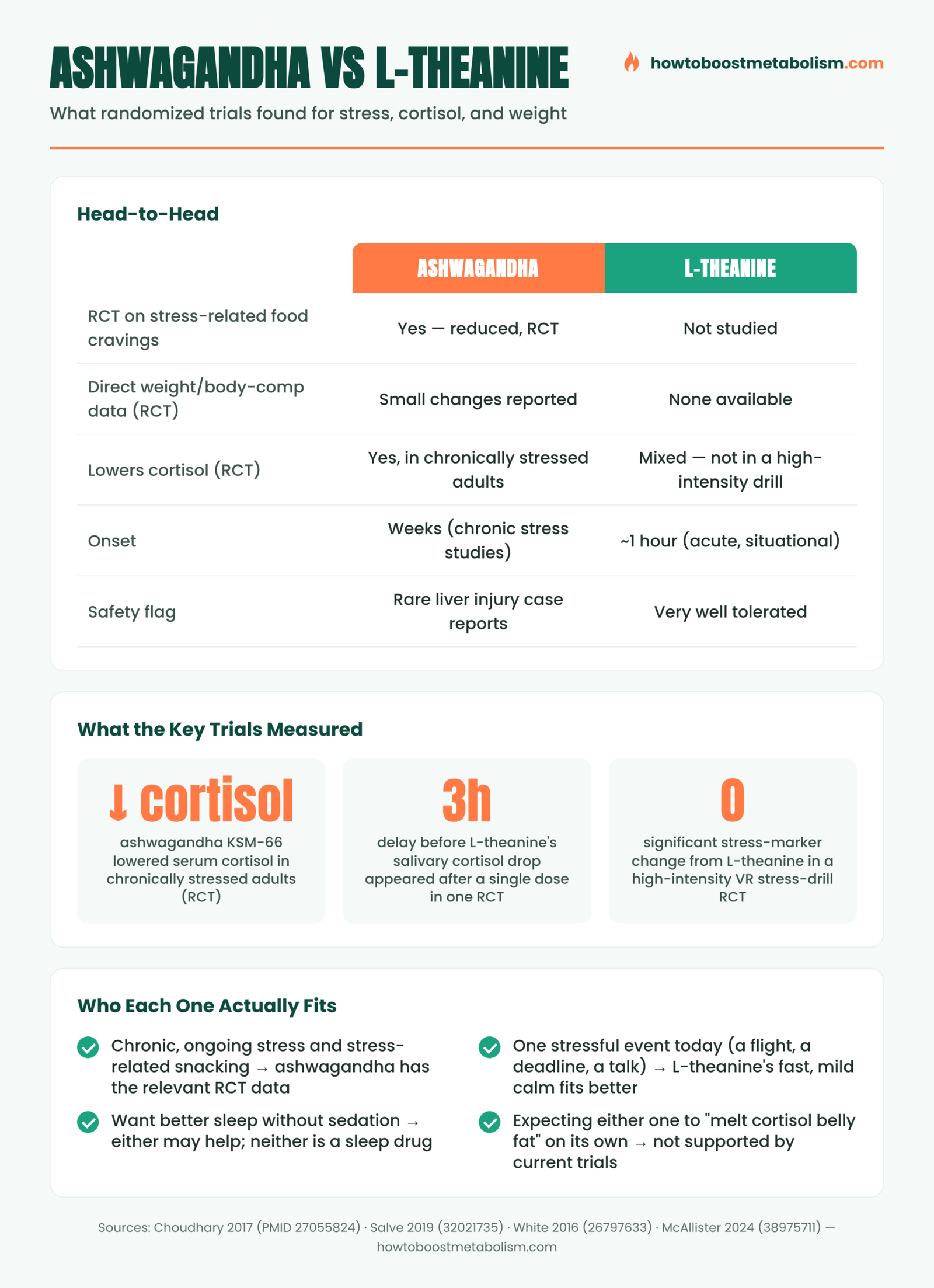
Ashwagandha: The One With Actual Weight-Related Trial Data
Ashwagandha has the more direct evidence tying it to the specific mechanism people are hoping for — stress eating. A randomized, double-blind, placebo-controlled trial using KSM-66 ashwagandha root extract in adults under chronic stress found reductions in both perceived stress and food cravings compared with placebo, alongside measured decreases in serum cortisol and improvements in body weight-related measures over the study period. A separate randomized trial (Cureus, 2019) using the same standardized extract reported lower cortisol and improved sleep quality in stressed adults. This is a meaningfully different kind of evidence than most “cortisol” supplements have behind them — it’s not just “lowers a stress hormone in a lab test,” it’s tied to the actual behavior (cravings, eating) that connects stress to weight gain in the first place.
The caveat matters, though: ashwagandha isn’t risk-free. Case report reviews have documented rare instances of cholestatic liver injury associated with ashwagandha use, and it’s not appropriate for people with autoimmune conditions, thyroid disorders on certain medications, or during pregnancy without medical guidance. “More evidence than most” is not the same as “no downside.”
At a Glance: Where the Evidence Actually Points
| Question | Ashwagandha | L-Theanine |
|---|---|---|
| RCT showing reduced stress-related food cravings? | Yes | Not studied directly |
| RCT showing lower cortisol? | Yes, in chronically stressed adults | Mixed — yes in one calm-lab RCT, no in a high-stress drill RCT |
| Direct weight or body composition data? | Reported in at least one RCT | None available |
| Typical time to notice an effect | Weeks, built on chronic dosing | About 1 hour, single dose |
| Main safety concern | Rare reports of liver injury; thyroid/autoimmune caution | Very well tolerated; little to no known risk at typical doses |
Mechanistically, ashwagandha’s active compounds — a group of steroidal lactones called withanolides — are thought to modulate the hypothalamic-pituitary-adrenal (HPA) axis, the signaling loop that governs how much cortisol the adrenal glands release in response to a perceived stressor. That’s a plausible biological route to the cortisol reductions seen in trials, though the exact withanolide-to-effect pathway in humans is still being worked out, and extract standardization (how much withanolide content a given “ashwagandha” product actually delivers) varies meaningfully between brands — part of why using a standardized extract like KSM-66, the one most trials have tested, matters more than it would for a simpler nutrient.
Free download
🔥 The Metabolism Starter Kit
3 honest guides: a 7-day reset plan, a foods cheat-sheet and 12 metabolism myths debunked. No spam — unsubscribe anytime.
L-Theanine: Fast, Mild, and Genuinely Under-Studied for Weight
L-theanine’s evidence base looks different — it’s well studied for subjective calm and acute stress response, but essentially untested for weight, appetite, or stress-eating specifically. A 2016 randomized, double-blind, crossover trial found that an L-theanine drink significantly reduced subjective stress response to a cognitive stressor within an hour, with a reduced salivary cortisol response showing up three hours after dosing. But a more demanding 2024 trial — using a virtual-reality active-shooter training drill as the stressor, a considerably more intense challenge than a desk-based cognitive test — found that neither L-theanine (200 mg) nor L-tyrosine measurably changed stress biomarkers, even though the drill itself clearly spiked them. The honest read: L-theanine’s calming effect looks real for everyday, moderate stress, but it hasn’t been shown to hold up under more intense stress, and nobody has run the trial connecting it to actual weight or eating behavior the way ashwagandha researchers have.
That’s not a reason to dismiss L-theanine — it remains one of the best-tolerated, lowest-risk calming supplements available, commonly used alongside caffeine specifically because it blunts jitteriness without blunting alertness. It’s just not the ingredient with weight-specific trial data behind it.
The Biology: Why Chronic vs. Acute Stress Matters Here
The difference in evidence between these two supplements tracks a real biological distinction. Cortisol follows a daily rhythm and spikes temporarily in response to any stressor — that acute spike is normal and not itself harmful. The concern linked to weight gain is chronically elevated baseline cortisol, which is associated with increased appetite, preferential craving for high-sugar, high-fat “comfort” foods, and a tendency toward visceral (abdominal) fat storage specifically. Adaptogens like ashwagandha are studied mainly for their effect on this chronic baseline over weeks of use, which is why the relevant trials run for 8 weeks or longer. L-theanine’s research, by contrast, is almost entirely about blunting a single acute stress response in the hour or two after dosing — a genuinely useful but different target than baseline cortisol.
This also explains why it’s premature to expect either supplement to meaningfully shrink “cortisol belly” on its own. Visceral fat accumulation driven by chronic stress develops over months or years; even a supplement with a real cortisol-lowering effect would need to be paired with the slower, larger levers — consistent sleep, resistance training, adequate protein, and an overall calorie deficit if fat loss is the goal — to actually move that specific fat depot. Neither trial cited above measured waist circumference or visceral fat directly over a long enough period to make that claim.
Practical Takeaways
- For chronic, day-after-day stress and stress-snacking, ashwagandha (standardized KSM-66, ~600 mg/day) has the more relevant trial evidence — but give it several weeks; it’s not a same-day fix.
- For an acute, one-off stressful day — a flight, a big presentation, a stressful appointment — L-theanine’s fast onset (about an hour) and strong safety record make it a reasonable, low-risk choice, even without weight-specific data.
- Neither replaces sleep, protein, or movement as cortisol-lowering strategies — both are adjuncts, not substitutes.
- Skip ashwagandha if you have a thyroid condition, autoimmune disease, or liver concerns without talking to a doctor first, given the rare liver-injury case reports.
- “Cortisol belly” itself is a real physiological concept but an overused marketing term — chronically elevated cortisol is linked to abdominal fat storage, but no supplement on either side of this comparison has been shown to directly reduce visceral fat on its own.
Free download: our Metabolism Starter Kit — a protein calculator, a 7-day meal framework, and a one-page supplement checklist, with zero hype.
Get the Free Starter Kit →The Bottom Line
Ashwagandha and L-theanine both get marketed under the same “lower your cortisol, lose the stress belly” pitch, but they’re not interchangeable. Ashwagandha has randomized trial evidence connecting it to reduced cortisol, reduced stress-related food cravings, and reported changes in body weight measures in chronically stressed adults — the closest thing to direct evidence either ingredient has for this specific use case. L-theanine has solid evidence for fast, situational calm, and an excellent safety profile, but no trial has yet tested it against weight or eating behavior the way ashwagandha has been tested. If the goal is specifically stress-driven eating, the current evidence favors ashwagandha; if the goal is calming down for one specific stressful day, L-theanine’s speed and safety make it the more practical pick.
Frequently Asked Questions
Can ashwagandha or L-theanine reduce belly fat directly?
No supplement in this comparison has trial evidence showing it directly reduces visceral or belly fat. Ashwagandha has RCT evidence for reduced stress-related food cravings and cortisol, which may indirectly support weight management, but that’s different from directly burning abdominal fat.
Which works faster, ashwagandha or L-theanine?
L-theanine acts faster — effects on subjective stress have been measured within about an hour of a single dose in at least one RCT. Ashwagandha’s cortisol and craving effects were measured in trials using weeks of consistent daily dosing, not a single dose.
Is it safe to take ashwagandha and L-theanine together?
There’s no specific research on combining them, but they work through different mechanisms and neither is a sedative in the typical sense, so a doctor-approved combination is plausible. Anyone with thyroid disease, autoimmune conditions, or liver concerns should check with a doctor before adding ashwagandha specifically.
Does L-theanine have any downsides?
L-theanine is generally very well tolerated with few reported side effects at typical doses (100-400 mg). Its main limitation for this specific use case is a lack of direct research on weight, appetite, or stress-eating outcomes, not a safety concern.
What dose of ashwagandha was used in the research?
Most of the relevant randomized trials used a standardized KSM-66 root extract at around 600 mg per day, taken consistently over several weeks — not a single occasional dose.
Related Reading
For dosing specifics and safety notes, see our full KSM-66 ashwagandha review. If TikTok’s “cortisol cocktail” trend brought you here, see our fact-check on the cortisol cocktail trend, and for the sleep side of the stress-weight connection, see sleep and metabolism.