Citrulline Malate for Strength Training: Does It Work?
This article may contain affiliate links. If you buy through them, we may earn a small commission at no extra cost to you. See our Affiliate Disclosure and Medical Disclaimer.
Walk down the pre-workout aisle, or scroll a supplement label, and you’ll almost certainly see citrulline malate near the top of the ingredient list, usually right next to creatine, caffeine, and beta-alanine. It’s marketed as a pump enhancer, a fatigue delayer, and a recovery aid, all in one scoop. It’s also one of the more heavily studied sports supplements on the market, which is actually good news: instead of guessing, we can look at what a decade of controlled trials — and several 2020s meta-analyses — say about whether it does anything for someone lifting weights.
The honest short answer: citrulline malate has a real, measurable, but small effect on high-rep, short-rest strength training, a more consistent effect on how hard exercise feels, and essentially no effect on maximal strength. Here’s how the evidence breaks down, outcome by outcome.
Related: does creatine help your brain after 40?
What Citrulline Malate Is Supposed to Do
Citrulline malate (CM) is a combination of the amino acid L-citrulline and malic acid. The theory is straightforward: citrulline is converted to arginine in the kidneys, arginine is a precursor for nitric oxide, and nitric oxide widens blood vessels. Wider blood vessels, in theory, mean more blood flow, more oxygen and nutrient delivery to working muscle, and faster clearance of metabolic byproducts like ammonia and lactate. The malate half is thought to support the Krebs cycle, the pathway muscle cells use to regenerate ATP for energy. Put those together and you get the marketing pitch: better pumps, more reps, less soreness, faster recovery.
That mechanism isn’t make-believe — the physiology is real and reasonably well understood. The open question has always been whether an 8-gram dose of a pre-workout supplement moves those dials enough to matter in a gym, not in a test tube.
See also: BFR Training After 40
The Study That Started the Hype
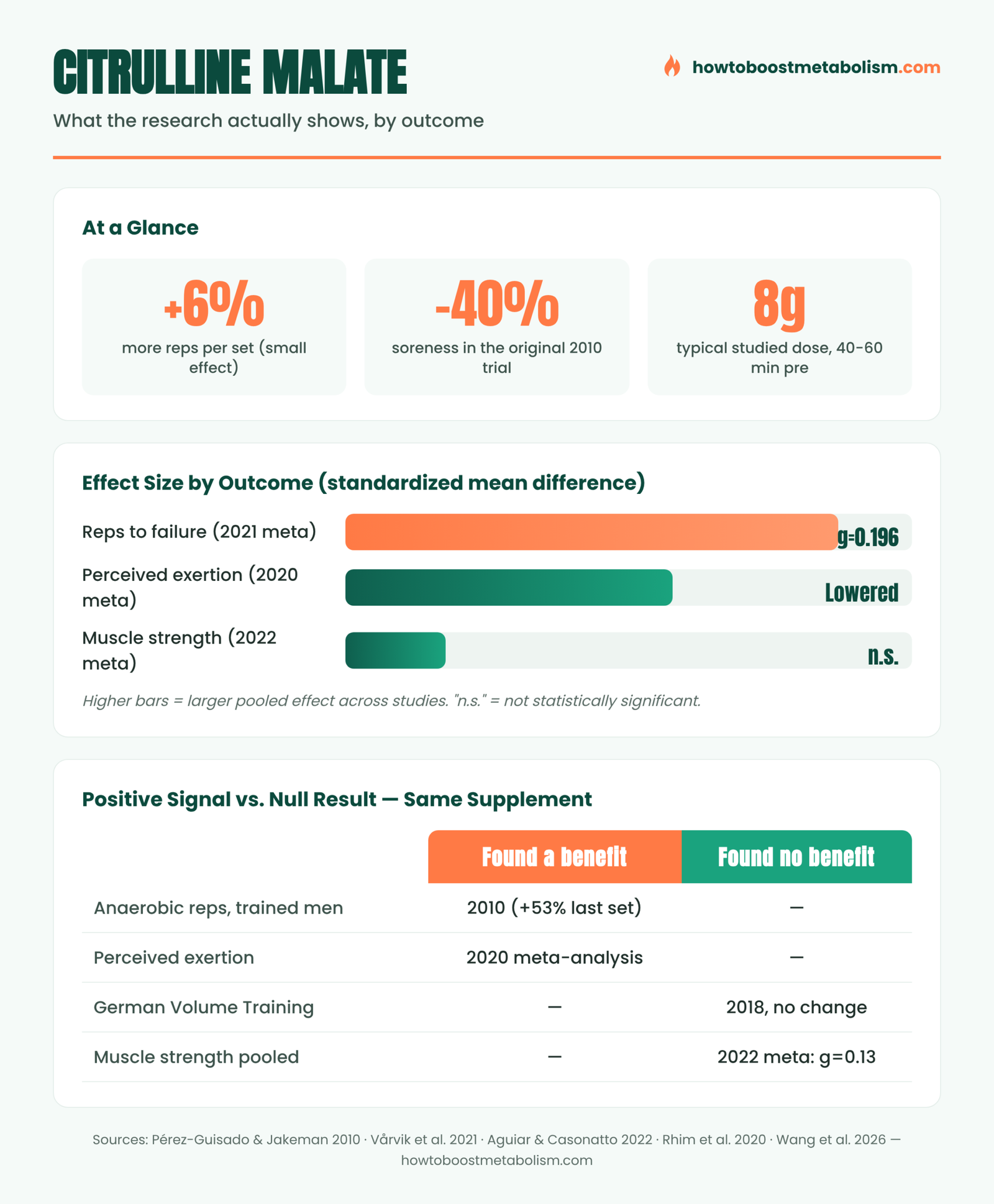
The citrulline malate story in strength training really begins with a 2010 study by Pérez-Guisado and Jakeman (J Strength Cond Res, PMID 20386132). Forty-one trained men did two bench press sessions — eight sets of as many reps as possible at 80% of their one-rep max — once with 8 g of citrulline malate and once with a placebo, in a randomized, double-blind crossover design. The results were striking: participants performed about 53% more total repetitions in the citrulline trial by the fourth set, and muscle soreness 24 and 48 hours later was roughly 40% lower.
That’s a genuinely large effect, and it’s the number most product pages still quote today, more than fifteen years later. The problem is that it’s a single small trial, and single trials — even good ones — don’t replicate perfectly. The real test of whether an effect is real is what happens when independent labs try to reproduce it.
You may also find this useful: does HMB really prevent muscle loss after 40?
Free download
🔥 The Metabolism Starter Kit
3 honest guides: a 7-day reset plan, a foods cheat-sheet and 12 metabolism myths debunked. No spam — unsubscribe anytime.
What Happened When Other Labs Tried to Replicate It
Several follow-up studies tried, and the picture got considerably messier. A 2018 trial out of Sheffield Hallam University (J Int Soc Sports Nutr, PMID 30097067) had recreationally active men and women perform German Volume Training — 10 sets of 10 reps — with and without 8 g of CM. There was no significant difference in repetitions completed, and no difference in isometric, concentric, or eccentric peak force. Muscle soreness over the following 72 hours was actually higher in the citrulline group, not lower. A separate 2017 trial in untrained young men (Nutrients, PMID 29057836) likewise found that CM did not improve muscle recovery after a single resistance exercise session.
So by the late 2010s, the literature had one strong positive result and at least two clean null results on very similar protocols. That’s exactly the situation meta-analysis is designed for: pooling every available trial to get a more reliable estimate than any single study can provide.
What the Meta-Analyses Actually Found
Three separate meta-analyses published between 2020 and 2022 converge on a similar, nuanced answer, and a 2026 update adds the most comprehensive look yet.
You may also find this useful: supersets vs. straight sets
Repetitions to Failure: A Small but Real Effect
A 2021 meta-analysis (Int J Sport Nutr Exerc Metab, PMID 34010809) pooled eight studies and 137 participants, mostly strength-trained men and women. Supplementing with 6-8 g of CM roughly 40-60 minutes before training increased total repetitions to failure by about 6.4% on average, a small but statistically significant effect (standardized mean difference = 0.196, p = .022). The effect was slightly larger and closer to significance for lower-body exercises (8.1%) than upper-body exercises (5.7%, not statistically significant on its own).
Perceived Exertion and Soreness: The Most Consistent Benefit
A 2020 systematic review and meta-analysis (J Sport Health Sci, PMID 33308806) pooled 13 studies and 206 participants and found that citrulline supplementation significantly reduced rating of perceived exertion (RPE) and muscle soreness at 24 and 48 hours post-exercise, though not at 72 hours, and did not significantly lower blood lactate. In plain terms: the workout may genuinely feel somewhat easier and less painful afterward, even when the raw performance numbers don’t move dramatically.
Muscle Strength: No Significant Effect
A 2022 meta-analysis focused specifically on resistance-trained adults (J Diet Suppl, PMID 34176406) pooled four randomized controlled trials and found no overall effect of citrulline malate on muscle strength outcomes (SMD = 0.13, 95% CI -0.21 to 0.46) — the confidence interval straddled zero for both upper- and lower-body lifts. If your goal is purely how much weight you can lift for a low-rep max effort, this body of evidence doesn’t support citrulline malate helping.
You may also find this useful: taurine for metabolism and aging
The 2026 Update: Small, Real, but Modest
The most comprehensive analysis to date (Nutrients, 2026, PMID 42356270) used a three-level meta-analytic model across 30 randomized trials, 138 effect sizes, and 644 participants — the largest pooled sample yet. It found a small but statistically significant overall improvement in exercise performance (g = 0.16, p = .01), with wide prediction intervals and limited statistical power, and no significant pooled effect on perceived exertion. Evidence looked more consistent for acute (single-dose) protocols than for chronic daily supplementation, with exploratory subgroup signals favoring aerobic endurance and short anaerobic efforts over straight resistance training.
| Outcome | What the Evidence Shows | PMID |
|---|---|---|
| Rep performance (high-rep, short rest) | Small, real benefit (~6% more reps) | 34010809 |
| Perceived exertion / soreness | Consistent, moderate benefit | 33308806 |
| Maximal strength (1RM-style effort) | No significant effect | 34176406 |
| Overall exercise performance (2026 pooled) | Small but real (g=0.16) | 42356270 |
Beyond the Gym: Citrulline, Blood Pressure, and Vascular Aging
Most of the strength-training research above treats citrulline purely as a performance supplement, but its original mechanism — boosting nitric oxide and widening blood vessels — has a second, arguably more interesting application for anyone over 40: vascular health. This is a separate research thread from the strength-training literature above, and it’s worth understanding on its own terms rather than as a reason to expect bigger lifting gains.
A 2026 double-blind, placebo-controlled trial (Nutr Res, PMID 42142423) gave 66 adults averaging 63 years old either 3,000 mg of L-citrulline or a placebo for 12 weeks. The effect depended heavily on starting blood pressure: participants with high-normal (prehypertensive) blood pressure saw a significant improvement in flow-mediated dilation — a direct measure of how well blood vessels widen in response to increased blood flow — while citrulline made little difference for those who already had normal blood pressure. That’s a meaningfully different framing than a pre-workout pump claim: the benefit, where it exists, looks concentrated in people whose vascular function has already started to decline.
A 2026 systematic review focused specifically on postmenopausal women (BMC Womens Health, PMID 41588439) pooled 12 randomized trials and 360 participants aged 50-75 and found that most studies reporting blood pressure outcomes showed reductions in systolic blood pressure, with some improvement in flow-mediated dilation as well. Muscle-function benefits, notably, only showed up in the two studies that combined citrulline with actual resistance training — supplementation alone, without training, wasn’t enough. Across all 12 trials, citrulline supplementation was not linked to any adverse effects, and metabolic markers like glucose, insulin, and lipids didn’t move consistently either way.
A 2025 review (Front Nutr, PMID 42005822) frames this nicely as a “muscle-vasculature crosstalk” story specific to aging: it argues that citrulline’s vascular effects and leucine’s muscle-building effects work through genuinely different pathways, and that pairing either or both with structured exercise produces better outcomes for muscle mass, vascular reactivity, and physical performance than any single piece alone — consistent with the postmenopausal review’s finding that citrulline needed resistance training attached to move muscle outcomes at all.
The practical takeaway for a 40-plus reader is fairly specific: if your main interest is squeezing out an extra rep or two in the gym, the strength-training evidence above sets realistic expectations. If you’re more interested in vascular health as you age — particularly if your blood pressure already runs on the higher side of normal — the vascular research is a separate, somewhat more encouraging thread, though it’s not a substitute for medical management of blood pressure and shouldn’t be treated as one.
So Who Should Actually Consider It?
Put the honest picture together and citrulline malate looks like a legitimate but modest tool, not a game-changer. It’s most likely to help if your training involves higher reps and shorter rest periods — think bodybuilding-style hypertrophy work, circuits, or metabolic finishers — where delaying the point of fatigue by a rep or two per set, set after set, adds up over a session. It’s less likely to move the needle for pure low-rep strength or power work, where the limiting factor is neural drive and fiber-level force production rather than metabolic fatigue.
The soreness and perceived-exertion benefit is arguably the most reliable finding in the whole body of research, and it’s also the easiest to notice yourself: if a session genuinely feels a bit more manageable and you’re a little less wrecked the next day, that’s consistent with what multiple trials have found, even if it doesn’t show up as more weight on the bar.
Dosing and Practical Notes
- Most positive studies used 6-8 g of citrulline malate (not plain L-citrulline, which is dosed differently) taken 40-60 minutes before training.
- The 2018 German Volume Training trial that found higher soreness with CM used the same 8 g dose, which is a reminder that even a well-dosed supplement doesn’t guarantee a benefit for every protocol or person.
- Side effects are minimal; the main one reported in trials is mild stomach discomfort in some users.
- Citrulline malate is not the same as creatine, and the two work through completely different mechanisms — some lifters stack both, since the research on each is evaluated independently.
How This Compares to Other Pre-Workout Ingredients
If you’ve already read our honest look at beta-alanine for strength training after 40, the pattern will feel familiar: a supplement with a plausible mechanism, a genuinely large original study, and a more modest, outcome-specific effect once independent meta-analyses pool the full evidence base. That’s not a knock on either ingredient — it’s simply what rigorous science looks like when it catches up with marketing claims. For a nutrient most lifters already have questions about, our piece on whether a creatine loading phase is actually necessary covers the one supplement in this category with the strongest overall evidence base.
And if soreness management is your main interest here, our deeper explainer on what muscle soreness (DOMS) actually means puts citrulline’s soreness-reduction data in the context of everything else that genuinely helps — and the popular remedies that, per the current evidence, mostly don’t.
Free download: our Metabolism Starter Kit — a protein calculator, a 7-day meal framework, and a one-page supplement checklist, with zero hype.
Get the Free Starter Kit →Citrulline is a workout-day detail; the thing that decides whether you build muscle while leaning out is how training and eating are organized around each other. Anabolic Fasting is one structured answer to that, combining lifting with intermittent fasting. Its “build muscle and burn fat at the same time” pitch is marketing language, not a guarantee; treat it as a structured program, not a promise.
The bigger structure a pre-workout supplement fits inside:
Learn More →Affiliate link — we may earn a commission at no extra cost to you. Disclosure
Frequently Asked Questions
Does citrulline malate actually increase strength?
Not meaningfully for maximal strength. A 2022 meta-analysis of resistance-trained adults found no significant effect on muscle strength outcomes. It does have a small, statistically significant effect on repetitions to failure in higher-rep, shorter-rest training, which is a different outcome than one-rep max strength.
How much citrulline malate should I take and when?
Most of the studies showing a benefit used 6-8 grams of citrulline malate (the combined compound, not plain L-citrulline) taken 40 to 60 minutes before training.
Does citrulline malate reduce muscle soreness?
The evidence here is more consistent than for strength or reps: a 2020 meta-analysis of 13 studies found citrulline significantly reduced perceived exertion and soreness at 24 and 48 hours post-exercise. That said, one 2018 trial found the opposite — higher soreness with citrulline — so results aren’t universal.
Is citrulline malate the same as L-citrulline?
No. Citrulline malate combines L-citrulline with malic acid, and studies typically dose it differently (grams of the combined compound) than plain L-citrulline supplements, which are usually dosed by the citrulline content alone. Comparing dosages across the two without accounting for this is a common mistake.
Is citrulline malate worth buying?
If your training is higher-rep and metabolically demanding, the research supports a small, real benefit for rep performance and a more consistent reduction in how hard sessions feel. If you’re chasing a bigger one-rep max, the current evidence doesn’t show it will help with that specific goal.