Sarcopenic Obesity: Losing Muscle and Gaining Fat After 40
This article may contain affiliate links. If you buy through them, we may earn a small commission at no extra cost to you. See our Affiliate Disclosure and Medical Disclaimer.
Here’s a scenario that confuses a lot of people over 40: your weight on the scale barely changes year to year, maybe it even looks fine on paper, but your clothes fit differently, your arms look softer, and a jar lid that used to be easy now takes real effort. That’s not just “getting older” in some vague sense — there’s a specific, named clinical condition that describes exactly this, and it has a real research base behind both the problem and what helps.
It’s called sarcopenic obesity, and it’s the condition of losing muscle mass and strength (sarcopenia) while simultaneously carrying excess body fat (obesity) — often at the same time the number on the scale stays roughly put, which is exactly why it goes unnoticed for years.
Further reading: Does Muscle Weigh More Than Fat?
What Sarcopenic Obesity Actually Is
In 2022, the European Society for Clinical Nutrition and Metabolism (ESPEN) and the European Association for the Study of Obesity (EASO) published a joint consensus statement specifically to standardize how this condition is defined and diagnosed, because for years researchers were using inconsistent criteria (PMID 35227529). The consensus frames sarcopenic obesity as the coexistence of excess adiposity and reduced skeletal muscle mass and/or function — not simply “fat” or “skinny-fat” as casual terms, but a defined syndrome with its own screening and diagnostic pathway, typically involving body composition measurement (not just BMI or the scale) plus a functional test like grip strength or walking speed.
See also: grip strength: the longevity marker you can train
A comprehensive 2018 review in Nature Reviews Endocrinology, by researchers John Batsis and Dennis Villareal, lays out why this happens physiologically: declining sex hormones, chronic low-grade inflammation, reduced physical activity, and changes in how the body partitions calories between muscle and fat tissue all compound with age, and having excess fat tissue actually accelerates muscle loss rather than simply coexisting alongside it (PMID 30065268). Fat tissue isn’t a passive bystander — it’s metabolically active and contributes to the inflammatory environment that degrades muscle over time.
How Common Is It, Really?
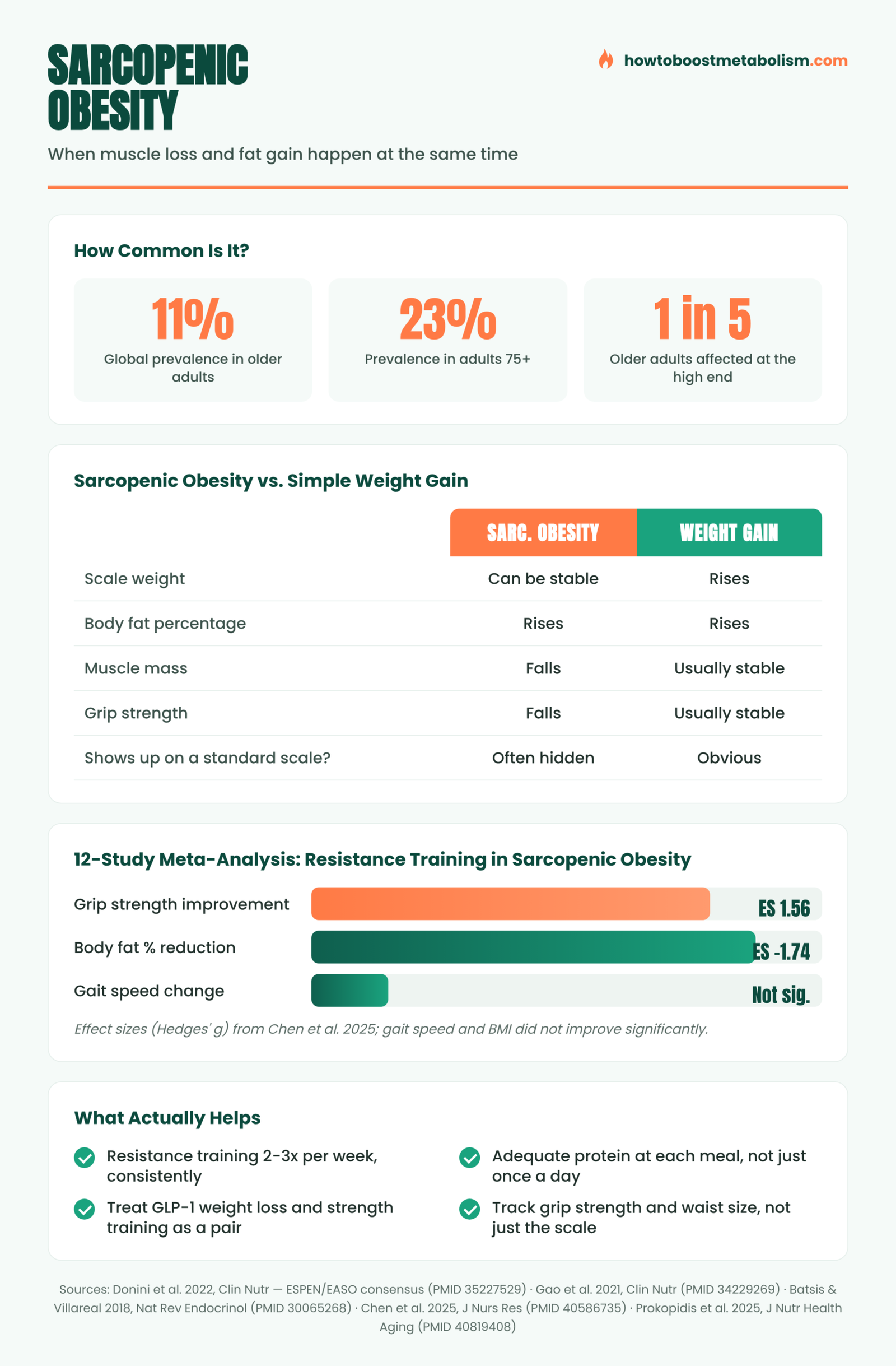
A 2021 systematic review and meta-analysis in Clinical Nutrition, pooling 50 studies, estimated the global prevalence of sarcopenic obesity in older adults at 11% overall (PMID 34229269). That number climbed meaningfully in specific subgroups: 23% among adults 75 and older, 16% among hospitalized patients, and around 19-21% in North and South American populations specifically. The prevalence didn’t differ significantly by sex, and importantly, it didn’t depend much on which obesity-diagnosis method was used (body fat percentage, BMI, or waist circumference) — the muscle-loss side of the equation was the more variable factor.
See also: what is “metabolic age” and can you actually lower it?
Translate that into plain terms: more than one in ten older adults worldwide fits the criteria, and in the oldest groups it’s closer to one in four. This isn’t a rare or exotic diagnosis — it’s a common, under-recognized pattern that standard weight-focused checkups routinely miss.
Free download
🔥 The Metabolism Starter Kit
3 honest guides: a 7-day reset plan, a foods cheat-sheet and 12 metabolism myths debunked. No spam — unsubscribe anytime.
Why the Scale Hides This Condition
| What you measure | Sarcopenic obesity | Simple weight gain |
|---|---|---|
| Scale weight | Can stay stable for years | Trends upward |
| Body fat percentage | Rises | Rises |
| Lean muscle mass | Falls | Usually holds steady |
| Grip strength / functional strength | Falls | Usually holds steady |
| What a routine checkup catches | Often nothing — weight and BMI look unremarkable | Flagged by weight trend |
This is the core reason the condition flies under the radar. If you’re simultaneously losing a few pounds of muscle and gaining a few pounds of fat, the scale can report the exact same number for years while your actual body composition — and your functional strength — quietly deteriorates. A grip strength reading compared to age-matched norms or a body composition scan will catch this long before the bathroom scale does.
GLP-1 Medications Add a New Wrinkle
This condition has become newly relevant for a specific, fast-growing group: people using GLP-1 receptor agonists like semaglutide or tirzepatide for weight loss. A 2025 analysis in the Journal of Nutrition, Health & Aging, by researcher Konstantinos Prokopidis and colleagues, lays out the concern directly: these medications achieve real weight loss — typically 15-25% of body weight over 12-24 months — but a meaningful share of what’s lost is lean muscle mass, not just fat (PMID 40819408). The paper also flags that up to two-thirds of users discontinue treatment within a year, often due to cost or side effects, and that stopping frequently leads to weight regain — mostly as fat, since the muscle lost during the drug-assisted weight loss doesn’t automatically come back. That combination — real muscle loss during treatment, plus fat-dominant regain after stopping — is exactly the recipe for sarcopenic obesity, which the paper notes already affects an estimated 10-20% of older adults even without GLP-1 use. If you’re using one of these medications, the research on preventing muscle loss on GLP-1 drugs and a structured strength training plan built specifically around that goal are worth reading in full, not treated as optional extras.
What the Research Says Actually Helps
The encouraging part: sarcopenic obesity responds to intervention, and resistance training is the most consistently effective tool studied so far. A 2025 systematic review and meta-analysis in the Journal of Nursing Research, pooling 12 randomized controlled trials, found that resistance exercise produced a significant improvement in grip strength (effect size 1.56) and a significant reduction in body fat percentage (effect size -1.74) compared to control groups (PMID 40586735). Gait speed and BMI, notably, did not improve significantly — a useful, honest reminder that resistance training changes body composition and functional strength more reliably than it changes a scale-based number.
A 2025 randomized clinical trial out of Beijing Sport University put this into a real-world protocol: 25 older women with possible sarcopenic obesity were split into a 36-week personalized resistance training group (3 sessions per week, 40 minutes each, progressing from low to moderate intensity) versus a control group (PMID 40993553). The training group showed significant improvements in body fat percentage, appendicular skeletal muscle mass index, hand grip strength, walking speed, and functional mobility tests compared to control — essentially reversing several of the defining markers of the condition over the course of the study.
Simple Signs Worth Paying Attention To
You don’t need a DEXA scan to get a reasonable read on this. A few practical signals, used together, give you a much better picture than the scale alone: grip strength that feels noticeably weaker than it used to (a jar lid, a heavy grocery bag, a stuck door), visible loss of muscle definition in the arms or legs even if your waistline hasn’t changed much, a waist measurement that’s crept up while your weight has stayed flat, and simply finding everyday tasks — stairs, carrying things, getting up from the floor — harder than they were five years ago despite a similar bodyweight. None of these alone is a diagnosis, but together they’re a reasonable prompt to look at body composition, not just weight, the next time you see a clinician.
Why Women Face a Particular Version of This After Menopause
The hormonal shift around menopause accelerates both sides of this equation at once: declining estrogen is associated with both faster muscle loss and a shift toward storing more fat around the midsection, which is part of why strength training during and after menopause does double duty — it’s one of the few interventions that directly addresses both the muscle side and, through its effect on bone density, a related age-related risk that tends to cluster with sarcopenic obesity in the research.
Protein Still Does Most of the Heavy Lifting
Resistance training provides the stimulus, but it needs raw material to work with. The research on spreading protein intake evenly across meals rather than loading it all at dinner, and on a slow-digesting protein dose before bed, both point to the same underlying principle that matters even more when you’re specifically trying to hold onto muscle while also managing body fat: consistent protein availability throughout the day and night gives your muscle-building machinery more opportunities to actually use the training stimulus you’re providing.
A Practical Framework
- Resistance train 2-3 times per week, consistently — the research protocols that worked were sustained programs lasting months, not a few weeks of effort.
- Prioritize protein at every meal, not just once a day — this pairs with the muscle-preservation mechanism and matters even more if you’re also in a calorie deficit.
- Track grip strength or a simple functional test over time, not just scale weight — it’s the measurement that actually reflects what’s happening to your muscle.
- If you’re on a GLP-1 medication, build the strength training in from day one, rather than waiting to see how much muscle you’ve lost.
- Don’t assume a stable weight means nothing is changing — body composition can shift significantly while the number on the scale sits still.
If part of your plan involves a structured approach to managing calorie intake alongside your training — rather than resistance training alone — it’s worth knowing what’s actually being sold. Programs built around alternating fasting and feeding windows combined with a specific training structure, like the one reviewed in our Anabolic Fasting review, market themselves around building muscle and losing fat at the same time. That framing is marketing language, not a guarantee backed by the sarcopenic-obesity trials above — the actual evidence for improving this specific condition points to resistance training and adequate protein as the proven levers, with a structured nutrition approach as a potential support for the fat-loss side of the equation, not a replacement for either.
If you’re looking for a structured program that pairs a fasting-based nutrition framework with a training plan built around a similar “build muscle, lose fat” goal, Anabolic Fasting is one option in the ClickBank marketplace worth a look — judged on its own terms, not as a cure for sarcopenic obesity.
Check Availability →Affiliate link — we may earn a commission at no extra cost to you. Disclosure
Free download: our Metabolism Starter Kit — a protein calculator, a 7-day meal framework, and a one-page supplement checklist, with zero hype.
Get the Free Starter Kit →Frequently Asked Questions
What is sarcopenic obesity, in plain terms?
It’s the combination of losing muscle mass and strength (sarcopenia) while carrying excess body fat (obesity) at the same time — often while your scale weight stays roughly stable, which is why it’s commonly missed (PMID 35227529).
How common is sarcopenic obesity?
A 2021 meta-analysis of 50 studies estimated global prevalence at about 11% in older adults overall, rising to 23% in adults 75 and older (PMID 34229269).
Can you have sarcopenic obesity even if your weight hasn’t changed?
Yes — that’s actually the typical presentation. Muscle loss and fat gain can roughly offset each other on the scale while body composition and functional strength change significantly underneath.
Does resistance training actually help sarcopenic obesity?
Yes. A 2025 meta-analysis of 12 randomized controlled trials found resistance training produced a significant improvement in grip strength and a significant reduction in body fat percentage, though gait speed and BMI did not improve significantly (PMID 40586735).
Are GLP-1 weight loss drugs linked to sarcopenic obesity risk?
There’s a documented concern. GLP-1 medications cause real weight loss that includes a meaningful share of lean muscle, and the weight regain that often follows discontinuation tends to be fat-dominant — a pattern researchers have flagged as raising sarcopenic obesity risk, particularly with repeated cycles of treatment and discontinuation (PMID 40819408).
What’s the single best test to check for sarcopenic obesity at home?
No single home test replaces a clinical body composition assessment, but tracking grip strength against age-matched norms, watching your waist measurement alongside your weight, and noticing whether everyday strength tasks feel harder than they used to are reasonable, free starting signals worth discussing with a clinician if they’re trending the wrong way.