GLP-1 Muscle Loss: How to Protect Your Metabolism (2026)
This article may contain affiliate links. If you buy through them, we may earn a small commission at no extra cost to you. See our Affiliate Disclosure and Medical Disclaimer.
If you’ve started a GLP-1 medication like semaglutide (Ozempic, Wegovy) or tirzepatide (Zepbound, Mounjaro), the scale is almost certainly moving in the direction you want. What most people aren’t told clearly enough: a meaningful chunk of that drop can be muscle, not fat — and muscle is exactly the tissue that keeps your resting metabolism from sliding backward once the weight comes off. This guide walks through what the actual 2026 clinical data says about GLP-1 and lean mass, why it happens, and the specific, evidence-based moves that blunt it.
How Much Muscle Do GLP-1 Drugs Really Cost You?
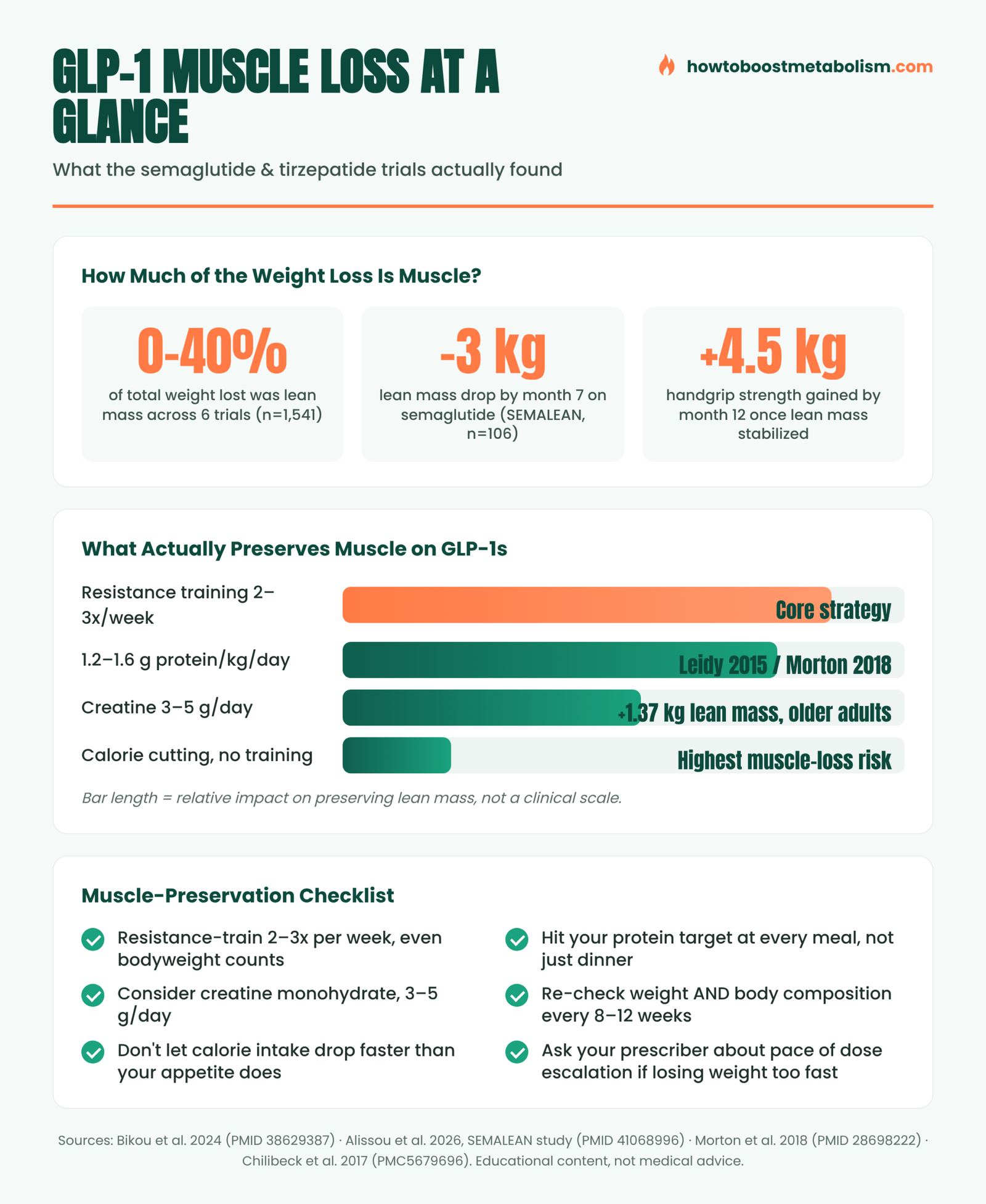
A 2024 systematic review in Expert Opinion on Pharmacotherapy pooled six trials covering 1,541 adults on semaglutide and found that while most of the weight loss came from fat, lean mass reductions ranged from almost 0% to as much as 40% of total weight lost, with the biggest absolute lean-mass losses showing up in the largest trials (Bikou et al., 2024, PMID 38629387). That is a wide range, and it matters: losing 10 lbs that is 10% muscle is a very different outcome than losing 10 lbs that is 35% muscle.
A more recent 2026 prospective study — the SEMALEAN trial, tracking 106 adults with obesity on semaglutide 2.4 mg over 12 months — put real numbers on the timeline. Lean mass dropped by about 3 kg at month 7, then stabilized. By month 12, handgrip strength had actually improved by 4.5 kg on average, and the prevalence of sarcopenic obesity in the group fell (Alissou et al., 2026, PMID 41068996). The takeaway: the biggest risk window is the first several months of rapid weight loss, and muscle function can recover afterward — if you give your body the raw materials and the training stimulus to rebuild.
This isn’t a fringe concern. It’s significant enough that a randomized controlled trial is now specifically testing whether resistance exercise plus protein supplementation can protect lean mass during semaglutide and tirzepatide therapy — the LEAN-PREP study, published as a protocol in BMJ Open in 2026 (PMID 42020128). The clinical research world has already moved past “is this a problem” to “what’s the best way to fix it.”
Why GLP-1 Drugs Put Muscle at Risk in the First Place
GLP-1 receptor agonists work mainly by sharply reducing appetite and slowing gastric emptying. That’s the whole mechanism — and it’s also the problem for muscle. When total food intake drops fast, protein intake usually drops with it, often below the amount your muscles need to repair and maintain themselves. Add in the fact that rapid weight loss of any kind (diet-only, surgery, or medication) tends to pull a disproportionate share from lean tissue when protein and resistance training aren’t part of the picture, and you get the pattern seen across the trials above.
In plain terms: it is not that semaglutide or tirzepatide “attacks” muscle directly. It’s that most people on these drugs eat a lot less of everything, including protein, while doing the same amount (or less) of the resistance training that normally signals your body to keep muscle around.
Free download
🔥 The Metabolism Starter Kit
3 honest guides: a 7-day reset plan, a foods cheat-sheet and 12 metabolism myths debunked. No spam — unsubscribe anytime.
The Two Levers That Actually Move the Needle
1. Protein: Hit the Number, Every Day, Not Just Occasionally
A 49-study review on protein and resistance training found that muscle-protein-synthesis benefits plateau around 1.6 g of protein per kilogram of bodyweight per day (Morton et al., 2018, PMID 28698222) — noticeably higher than the general population’s RDA. Separately, higher protein intake is one of the most consistently reproduced factors in preserving lean mass during intentional weight loss, partly by supporting satiety and blunting the loss of fat-free mass (Leidy et al., 2015, PMID 25926512). On a GLP-1 drug, where total food volume is already down, that target is genuinely hard to hit from food alone — appetite is the whole point of the medication. This is exactly the gap a clean protein supplement is built to close without adding real hunger.
2. Resistance Training: The Signal Protein Alone Can’t Send
Protein gives your muscles the building blocks. Resistance training is what tells your body to actually use them to maintain or build tissue instead of letting it go. You don’t need a gym membership — two to three short sessions a week using bodyweight moves, resistance bands, or dumbbells is enough to change the signal, and it’s the single intervention every muscle-preservation protocol in this space (including the ongoing LEAN-PREP trial) is built around.
3. Creatine: A Small, Well-Studied Assist
Creatine monohydrate is one of the most thoroughly tested supplements in sports nutrition, and the International Society of Sports Nutrition’s position stand confirms it is safe at standard doses for healthy adults (Kreider et al., 2017, PMID 28615996). In older adults combining creatine with resistance training, a meta-analysis found an average gain of 1.37 kg of lean mass compared with training alone (Chilibeck et al., 2017, PMC5679696) — precisely the population and the mechanism that matters most when you’re actively losing weight and trying not to lose muscle alongside it.
A Simple Weekly Framework
| What to track | Target |
|---|---|
| Daily protein | 1.2–1.6 g per kg bodyweight, spread across 3–4 meals/shakes |
| Resistance training | 2–3 sessions/week, full-body, 20–40 minutes |
| Creatine (optional) | 3–5 g/day, any time, with or without food |
| Check-ins | Weigh-ins weekly; body composition or tape measurements every 8–12 weeks |
| Rate of loss | Aim for 0.5–1% of bodyweight per week where your prescriber agrees it’s appropriate |
Free download: our Metabolism Starter Kit — a protein calculator, a 7-day meal framework, and a one-page supplement checklist, with zero hype.
Get the Free Starter Kit →Signs You Might Be Losing Muscle, Not Just Fat
The scale can’t tell the difference between fat and muscle, so it’s worth watching for other signals. Feeling noticeably weaker on the same resistance-training loads you handled a month ago, struggling more with stairs or carrying groceries, a visibly softer or less defined look despite losing weight, and a resting heart rate or energy level that feels “off” compared to how fast you’re losing weight can all point to lean-mass loss outpacing fat loss. None of these are diagnostic on their own, but together they’re a reasonable cue to add more protein and resistance training before assuming everything is fine just because the number on the scale is dropping.
A more precise way to track this, if it’s available to you, is a body-composition scan — a DXA scan, a BodPod, or even a reasonably consistent smart scale used under the same conditions each time (same time of day, similar hydration). The SEMALEAN study used DXA scans at baseline, 7, and 12 months specifically because body weight alone wasn’t a reliable enough signal to track what was actually happening to lean tissue.
Does This Apply to Tirzepatide and Liraglutide Too?
Most of the detailed body-composition data so far comes from semaglutide trials simply because it reached the market first and has been studied longest at scale. But the underlying mechanism — sharply reduced food intake leading to disproportionate lean-mass loss without enough protein and resistance training — isn’t specific to one molecule. Tirzepatide trials, including MRI substudies of the SURPASS-3 program, have reported similar body-composition shifts, and the same muscle-preservation principles apply regardless of which specific GLP-1 or dual GLP-1/GIP agonist you’re on: the drug changes how much you eat, not what your muscles need to stay functional.
What This Isn’t
This article is not medical advice, and it is not a suggestion to stop or slow a prescribed medication without talking to the clinician who prescribed it. If you’re losing weight unusually fast, feeling persistently weak, or noticing your strength dropping rather than your fatigue simply changing, that’s a conversation for your prescriber — dose, pace, and nutrition support can often be adjusted together.
If you want the bigger picture on supporting your metabolism without medication, see our guide on 7 ways to boost GLP-1 naturally, and if protein sourcing is the piece you’re still deciding on, our whey vs. plant protein comparison breaks down the practical differences.
Related: For the specific foods and daily protein framework that pair with this, see our GLP-1 food list for preventing muscle loss.
Related: Diet alone won’t protect your muscle on GLP-1 medication — see our practical strength training plan for Ozempic and Wegovy users.
Resistance training is the main lever for protecting muscle while on a GLP-1. Old School New Body is a follow-along program built around short, F4X-style strength sessions for adults over 35 — a simple way to add structured strength work. Talk to your doctor before starting a new exercise program while on medication.
Learn More →Affiliate link — we may earn a commission at no extra cost to you. Disclosure
Frequently Asked Questions
Does Ozempic or Zepbound directly cause muscle loss?
Not directly. The drugs reduce appetite and food intake sharply; when protein intake and resistance training don’t keep pace with the weight loss, a larger share of what’s lost ends up being lean mass. Trials show this effect ranges widely — from negligible to a meaningful share of total weight lost — depending on the person and what they’re doing alongside the medication (PMID 38629387).
How much protein do I need while on a GLP-1 drug?
Research on protein and resistance training suggests benefits plateau around 1.6 g of protein per kilogram of bodyweight per day (PMID 28698222). That’s higher than most people eat normally, and harder to reach when appetite is suppressed, which is why many people on GLP-1 drugs lean on a protein shake to close the gap without adding bulk to meals.
Is creatine safe to take with Ozempic or Wegovy?
There’s no known pharmacological interaction between creatine monohydrate and GLP-1 receptor agonists, and creatine is one of the most extensively safety-tested supplements available (PMID 28615996). As always, mention any supplement you’re adding to your prescribing clinician, especially if you have kidney disease.
Does the muscle loss reverse once I stop losing weight?
The SEMALEAN study found lean mass losses largely stabilized after the initial months, and handgrip strength had actually improved by month 12 (PMID 41068996) — but that pattern was seen in people who were still active and eating adequate protein, not a guaranteed outcome for everyone.
Do I need to do cardio instead of weights to protect muscle?
Cardio is good for cardiovascular health and calorie balance, but it isn’t the signal that preserves lean tissue during weight loss. Resistance training — lifting, bands, or bodyweight work against load — is the specific stimulus every study and protocol in this area is built around.