What Is “Metabolic Age” and Can You Actually Lower It?
This article may contain affiliate links. If you buy through them, we may earn a small commission at no extra cost to you. See our Affiliate Disclosure and Medical Disclaimer.
You step on a smart scale, it syncs to an app, and alongside your weight it tells you your “metabolic age” is 47 — thirteen years older than you actually are. It’s a genuinely unsettling number to see first thing in the morning, and it’s designed to be: it’s one of the more effective pieces of gamified health marketing built into consumer scales over the last decade. The honest version of what that number means is less alarming, more useful, and worth understanding before you buy anything to try to “fix” it.
What metabolic age is actually calculated from
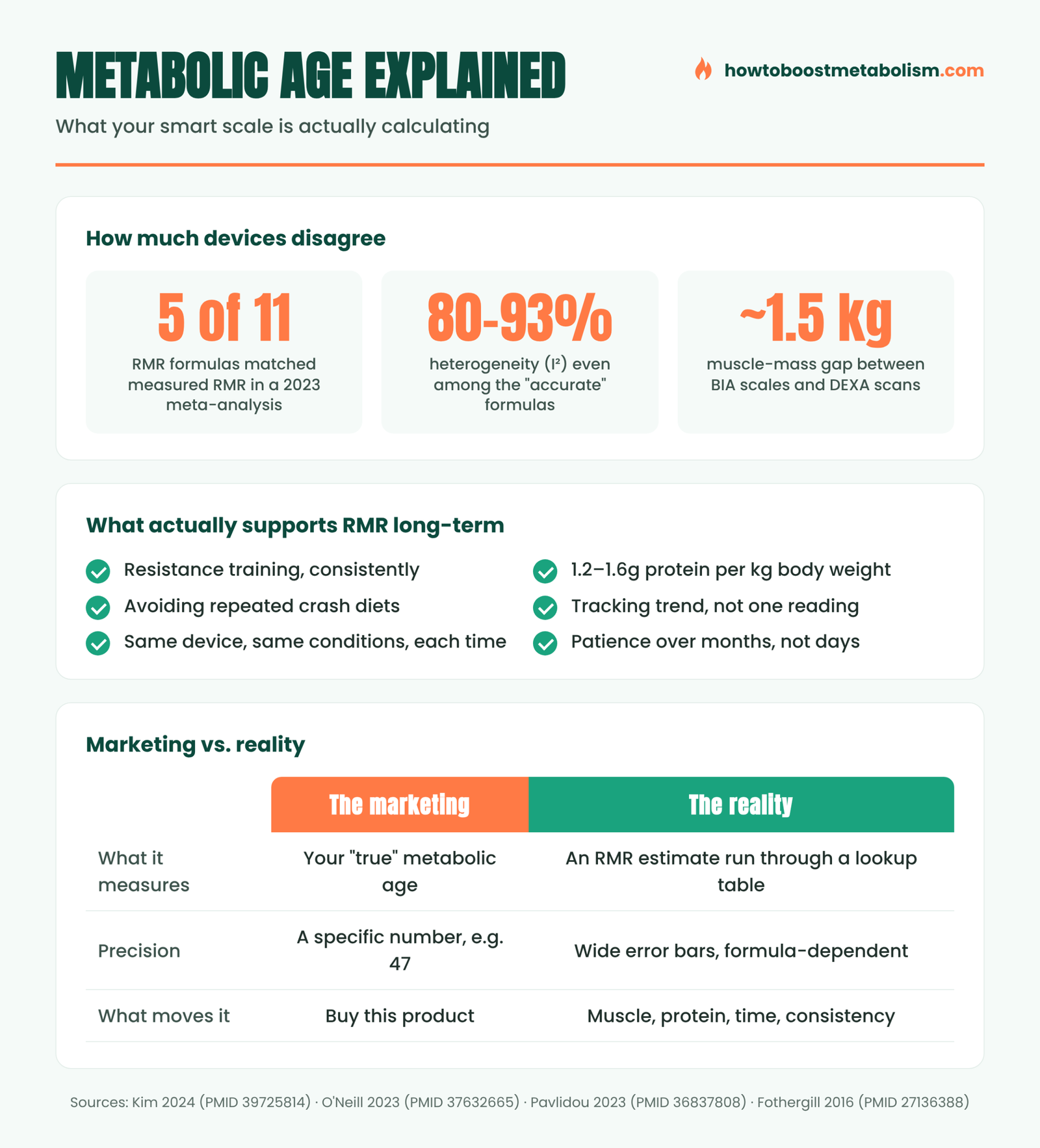
“Metabolic age” is not measured directly — nothing about your body is scanned for an “age.” It’s a two-step estimate. First, the device calculates your resting metabolic rate (RMR), the number of calories your body burns at complete rest, using a prediction equation that typically factors in your weight, height, sex, and sometimes an estimate of body composition from bioelectrical impedance (BIA) — the weak electrical current you feel nothing from when you stand on certain scales. Second, the app compares your calculated RMR to an averaged reference table of RMR by age group, and reports whichever age in that table matches your number most closely. If your RMR comes out lower than the average for your real age, the app reports you as metabolically “older”; if it’s higher, you’re reported as “younger.”
That’s the whole mechanism. There is no blood test, no hormone panel, no cellular aging marker involved — it’s an estimate of an estimate, repackaged as a single, emotionally loaded number.
Why two devices can disagree by 10+ years on the same person
Both steps in that calculation carry real, documented error. On the body-composition side, a study comparing BIA against dual-energy X-ray absorptiometry (DEXA) scans — a far more direct imaging method — in older adults found consistent gaps between the two: BIA estimated appendicular muscle mass at about 19.7 kg in men versus 18.1 kg by DEXA, and 13.7 kg versus roughly 12.6 kg in women, differences large enough that the researchers had to build device-specific correction equations just to make the numbers comparable (Kim et al., 2024, Aging Clinical and Experimental Research, PMID 39725814, PMC11701648). A scale’s BIA reading also shifts with hydration, recent food, and time of day, none of which have anything to do with how “metabolically old” you are.
On the RMR-formula side, a 2023 meta-analysis tested 11 widely used RMR prediction equations against measured RMR (via indirect calorimetry, the actual gold-standard method) across 29 studies and 1,430 people. Only five equations — including the century-old original Harris-Benedict and two Cunningham versions — produced estimates that didn’t differ significantly from measured RMR on average, while commonly used formulas including Mifflin-St Jeor, Owen, and the FAO/WHO/UNU equation significantly over- or under-estimated it. Even among the formulas that worked “on average,” individual accuracy varied enormously — heterogeneity (I² statistics) ran from 80–93% for most of them, meaning the formula that’s accurate for the group is often well off for any specific person (O’Neill, Corish & Horner, 2023, Sports Medicine, PMID 37632665). A 2023 paper proposing a revised Harris-Benedict equation made a similar point from the other direction — enough systematic error existed in the original to justify re-deriving it from 722 new subjects (Pavlidou et al., 2023, Metabolites, PMID 36837808). Stack an imprecise body-composition reading into an imprecise RMR formula, and a double-digit-year swing between two consumer devices is not surprising — it’s close to expected.
Free download
🔥 The Metabolism Starter Kit
3 honest guides: a 7-day reset plan, a foods cheat-sheet and 12 metabolism myths debunked. No spam — unsubscribe anytime.
The one part of “metabolic age” that is real
None of this means resting metabolic rate itself is fake or unimportant — only that the specific number your scale reports has a wide error bar. The underlying biology the marketing is pointing at is genuine: muscle tissue burns more energy at rest than fat tissue, gram for gram, so two people at the same weight and height can have meaningfully different RMR depending on how much lean mass they’re carrying. That’s the real mechanism behind “building muscle raises your metabolism” — it’s just usually marketed with a much more precise-sounding number attached than the science actually supports.
It’s also worth knowing that RMR isn’t fixed — it responds to how you treat your body over time, in both directions. The long-term follow-up of contestants from a major weight-loss TV show found their RMR was still suppressed by about 500 calories per day six years after the show ended, well beyond what their body weight alone would predict — a phenomenon called metabolic adaptation, driven in large part by chronic under-eating and the muscle loss that often comes with aggressive dieting (Fothergill et al., 2016, Obesity, PMID 27136388, PMC4989512). In other words: crash dieting is one of the more reliable ways to push your actual metabolic age in the wrong direction, regardless of what any scale says about it.
What actually moves the needle — if you want to try
- Resistance training, consistently. Building and maintaining muscle is the most evidence-backed way to support RMR over months and years, not days.
- Enough protein to support that muscle. Most research on preserving and building lean mass during weight management points to roughly 1.2–1.6 g of protein per kg of body weight per day.
- Avoiding repeated aggressive crash diets, which the research above links to RMR suppression well beyond what weight loss alone would cause.
- Treating the number as a trend, not a verdict. Measuring on the same device, same time of day, similar hydration, and watching the direction over 2–3 months tells you more than any single reading.
Free download: our Metabolism Starter Kit — a protein calculator, a 7-day meal framework, and a one-page supplement checklist, with zero hype.
Get the Free Starter Kit →For the mechanics of what actually determines your calorie burn day to day, see our plain-language breakdown of BMR, RMR, and TDEE explained. If low-level daily movement rather than formal exercise is more your focus, our guide to NEAT and non-exercise movement covers a genuinely underrated lever. And for a full, evidence-ranked view of supplements that can support metabolic health, see our best metabolism supplements guide for 2026.
If you’re specifically over 40 and looking for a structured way to rebuild muscle rather than piecing together a routine on your own, Old School New Body’s F4X program is built around strength training for that age group — note that some of the statistics on its sales page about age-related muscle loss are not sourced to published research and shouldn’t be taken as established fact, but the authors and the strength-training premise itself are real. See the program →
Related: Your metabolic age and your overall strength reserve are closely linked — we covered the data on grip strength as a longevity marker.
Frequently Asked Questions
Is metabolic age a real medical measurement?
No — “metabolic age” is not a diagnosis or a recognized clinical biomarker. It is a consumer-facing way of presenting a resting metabolic rate (RMR) estimate: the scale or app calculates your RMR with a prediction equation, then reports the age at which the average person in its reference database has that same RMR. It is a repackaged estimate built on top of another estimate, which is why two different devices can give the same person two very different “metabolic ages” on the same day.
Why do smart scales and fitness trackers give such different metabolic age numbers?
Most consumer devices estimate body composition using bioelectrical impedance analysis (BIA), which sends a weak electrical current through the body and infers fat and muscle mass from how fast it travels. BIA readings shift with hydration, recent food and exercise, and the specific equation a brand uses, and research comparing BIA against DEXA scans (a more direct imaging method) has found real, consistent gaps in muscle mass estimates between the two — which cascades directly into a different metabolic age result.
Does a lower metabolic age number actually mean you’re healthier?
Not reliably on its own. Because the number is built from an RMR prediction equation, and a meta-analysis of these equations found several widely used ones significantly over- or under-estimate measured RMR even in healthy adults, a “good” metabolic age reading can reflect which formula a device uses as much as it reflects your actual physiology. The things known to genuinely support metabolic health — more muscle mass, regular resistance training, adequate protein, and good sleep — are worth pursuing regardless of what the number on the scale says.
What actually lowers your resting metabolic rate in a way that matters?
Muscle tissue is more metabolically active at rest than fat tissue, so building and maintaining lean mass through resistance training, combined with enough protein to support it, is the most evidence-backed lever for raising your actual resting metabolic rate over time — which is what a “lower metabolic age” is meant to represent in the first place. Crash dieting does the opposite: it tends to lower measured RMR beyond what weight loss alone would predict, an effect called metabolic adaptation.
Should I worry if my metabolic age reading is much higher than my real age?
A single high reading from a home scale is not a reason to panic — these devices have real margin of error, and hydration status alone can shift a BIA-based estimate meaningfully in either direction on a given day. It’s more useful as a rough trend over months on the same device under similar conditions (same time of day, similar hydration) than as a precise one-time verdict, and it should never substitute for an actual conversation with a doctor if you have specific health concerns.
This article is for general information and is not a substitute for medical advice. See our Medical Disclaimer.