

Lactobacillus Gasseri for Belly Fat: Does the Science Hold Up?
This article may contain affiliate links. If you buy through them, we may earn a small commission at no extra cost to you. See our Affiliate Disclosure and Medical Disclaimer.
Probiotic marketing for “belly fat” usually leans on a vague appeal to gut health in general. Lactobacillus gasseri is one of the few strains that actually has a specific, published human trial behind the belly-fat claim — which makes it worth looking at seriously instead of dismissing it with every other gut-health supplement. The question is what that trial actually showed, how big the effect really was, and whether it holds up against newer, broader research on probiotics and body fat.
At a Glance
| Question | What the research shows |
|---|---|
| Did a specific L. gasseri strain reduce visceral fat in a human RCT? | Yes — strain SBT2055, ~8% reduction over 12 weeks |
| Was the effect durable after stopping? | No — it faded within about 4 weeks of discontinuation |
| Does the mechanism have animal-study support? | Yes — reduced inflammation in fat tissue in mouse studies |
| Do broader probiotic/synbiotic meta-analyses confirm a fat-loss effect? | Mixed — a 2026 meta-analysis found effects that didn’t survive sensitivity testing |
The Core Study: Kadooka et al., 2013
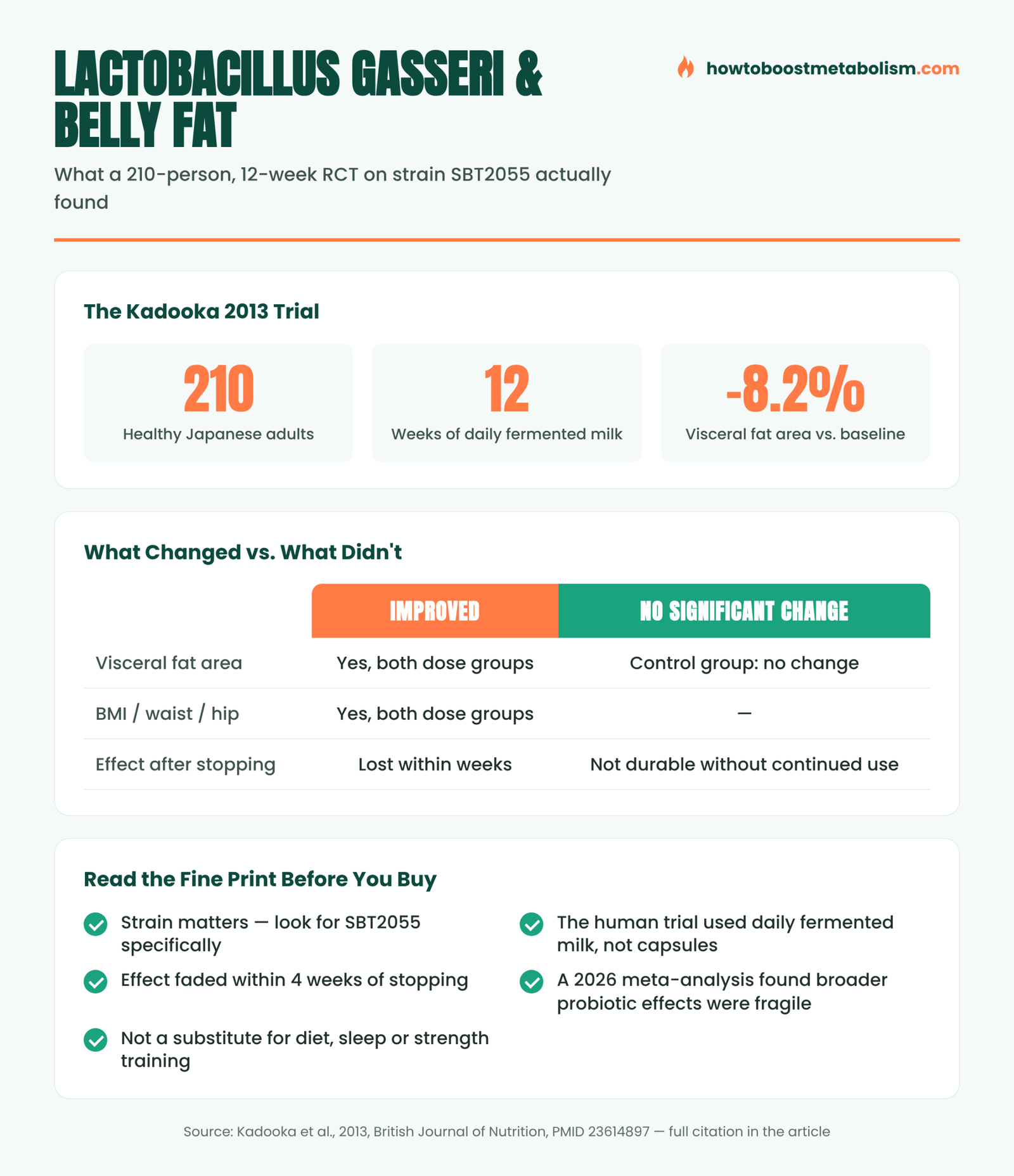
The most-cited human evidence comes from a multi-center, double-blind, randomized controlled trial in 210 healthy Japanese adults who specifically had large visceral fat areas (80–188 cm², measured by CT scan). Participants drank 200g per day of fermented milk containing one of two doses of Lactobacillus gasseri strain SBT2055 (LG2055), or a plain control, for 12 weeks. At the end of the trial, visceral fat area had dropped by an average of 8.5% in the higher-dose group and 8.2% in the lower-dose group compared to baseline — both statistically significant. BMI, waist circumference, hip circumference and total body fat mass also decreased significantly in both LG2055 groups. The control group showed no significant change in any of these measures (Kadooka et al., 2013, British Journal of Nutrition).
That’s a real, specific, statistically significant result in a reasonably large trial — which is more than most “gut health for belly fat” claims can point to. But three details in the same study are just as important as the headline number, and most marketing copy leaves them out entirely.
- The effect size was modest: roughly 8% of visceral fat area, not a dramatic transformation
- It was tested using daily fermented milk at a specific CFU dose, not an arbitrary capsule
- Critically, when participants stopped drinking it, the effect faded within about four weeks — this is maintenance, not a one-time fix
Free download
🔥 The Metabolism Starter Kit
3 honest guides: a 7-day reset plan, a foods cheat-sheet and 12 metabolism myths debunked. No spam — unsubscribe anytime.
Does the Mechanism Make Sense?
Animal research backs up a plausible mechanism. In diet-induced obese mice, the same strain reduced pro-inflammatory gene expression specifically in visceral adipose tissue and reduced liver fat content after 24 weeks of feeding, alongside lower body weight and fat mass — consistent with an anti-inflammatory effect in fat tissue rather than some kind of direct “fat-burning” action (Miyoshi et al., 2014, European Journal of Nutrition — mouse study, not human data).
That’s a reasonable biological story — chronic low-grade inflammation in visceral fat is part of how metabolic dysfunction develops, and a strain that calms that down could plausibly help. It’s still important to flag that this specific mechanistic detail comes from mice, not people; the human evidence for the actual outcome (visceral fat area) is what the Kadooka trial above provides.
What a Broader 2026 Meta-Analysis Adds — and a Caution
Zooming out from this one strain, a 2026 systematic review and meta-analysis pooled 10 randomized trials (633 participants total) testing probiotics and synbiotics generally for body weight management in overweight or obese adults. It found no significant effect on body weight or lean body mass, a significant reduction in BMI, and a small but significant effect on fat mass/body fat percentage. Here’s the important caveat: when the researchers removed a single study with a baseline imbalance in their sensitivity analysis, the BMI effect dropped to borderline significance and the fat-mass effect lost significance entirely. The authors explicitly described their own findings as “preliminary” and “not robust to single-study exclusion” (Ko et al., 2026, Physical Activity and Nutrition, PMC13358612).
That doesn’t contradict the Kadooka result on L. gasseri specifically — that trial is one of the stronger single studies in this space precisely because of its size, its specific strain, and its CT-scan measurement of visceral fat rather than a cruder proxy. But it’s a useful reality check on probiotics-for-fat-loss as a category: the effect, where it exists, tends to be modest and fragile rather than dramatic and robust.
One honest caveat on supplementing: the Kadooka trial used fermented milk at specific CFU doses, not a capsule, so you’re extrapolating strain-level evidence to a different delivery format and dose. That’s a reasonable bet given the mechanism data, but it’s not the exact thing that was tested.
The Bottom Line
Lactobacillus gasseri, specifically strain SBT2055, has one of the better human evidence bases of any probiotic for visceral fat — a real randomized trial, a meaningful sample size, objective CT-scan measurement, and a plausible biological mechanism. It is not a dramatic fat-loss tool: the effect is roughly 8%, it requires ongoing use to maintain, and the broader category of probiotics for weight management has fragile evidence once you zoom out. Treat it as a modest, evidence-backed addition to a diet and exercise approach — not a replacement for one.
For the fundamentals that have stronger, more consistent evidence, see our guides on losing belly fat after 40 and why you might not be losing belly fat despite diet and exercise. If insulin resistance is part of your picture, our guide on insulin resistance and metabolism covers the bigger mechanisms at play, and our evidence-ranked metabolism supplements guide shows how this strain compares to other options.
Free download: our Metabolism Starter Kit — a protein calculator, a 7-day meal framework, and a one-page supplement checklist, with zero hype.
Get the Free Starter Kit →Frequently Asked Questions
Does Lactobacillus gasseri really reduce belly fat?
One well-designed 210-person randomized controlled trial found about an 8% reduction in visceral fat area over 12 weeks using strain SBT2055 specifically, measured by CT scan. It’s a real, modest effect in one solid study, not a dramatic transformation.
Do I need the exact SBT2055 strain, or does any Lactobacillus gasseri work?
The human trial used strain SBT2055 specifically, so that’s the strain with direct evidence behind it. Other L. gasseri strains may behave differently — strain-specific effects are common with probiotics, so check the label.
How long do I need to take it to see results?
The trial measured results at 12 weeks of daily use. Just as importantly, the benefit faded within about four weeks after participants stopped — this works more like an ongoing habit than a one-time course.
Is probiotic supplementation for weight loss backed by strong evidence overall?
The evidence is mixed and generally modest. A 2026 meta-analysis of 10 trials found a small effect on fat mass that lost statistical significance once a single outlier study was removed in sensitivity analysis — the authors called their own findings preliminary. L. gasseri SBT2055 has one of the stronger individual studies in the category, but it’s not a guaranteed effect.
Can I just eat yogurt with probiotics instead of supplementing?
The original trial used fermented milk at a specific, measured CFU dose of a specific strain — most commercial yogurt doesn’t disclose strain or CFU count, so you can’t be sure you’re getting an equivalent dose. A labeled supplement or fermented product that names the strain is a more reliable way to match what was actually studied.