Strength Training for Menopause: The Real Bone Data
This article may contain affiliate links. If you buy through them, we may earn a small commission at no extra cost to you. See our Affiliate Disclosure and Medical Disclaimer.
For decades, the standard advice for women with low bone density after menopause was to avoid heavy lifting — the fear being that loading a fragile skeleton with serious weight would cause fractures, not prevent them. One of the most-cited trials in bone health research directly tested that assumption with real postmenopausal women doing genuinely heavy resistance training, and the results reshaped how exercise physiologists talk about bone health in midlife. Here’s what it actually found, what it didn’t, and how it connects to the broader metabolic picture of menopause.
Why Menopause Changes the Bone Equation
Estrogen plays a direct role in regulating bone remodeling — the constant cycle of old bone tissue being broken down and new bone being built. When estrogen drops sharply during the menopause transition, bone breakdown tends to outpace bone formation, and many women experience their most rapid lifetime rate of bone loss in the years immediately around and after menopause. This is the biological backdrop for why osteopenia (reduced bone density) and osteoporosis (more severe bone loss with higher fracture risk) become dramatically more common after menopause than before it. It’s also tightly linked to the metabolic shifts covered in our guide to boosting metabolism after 50 and through menopause — bone, muscle, and metabolic health move together during this transition, not independently.
The LIFTMOR Trial: Heavy Lifting, Not Light Exercise
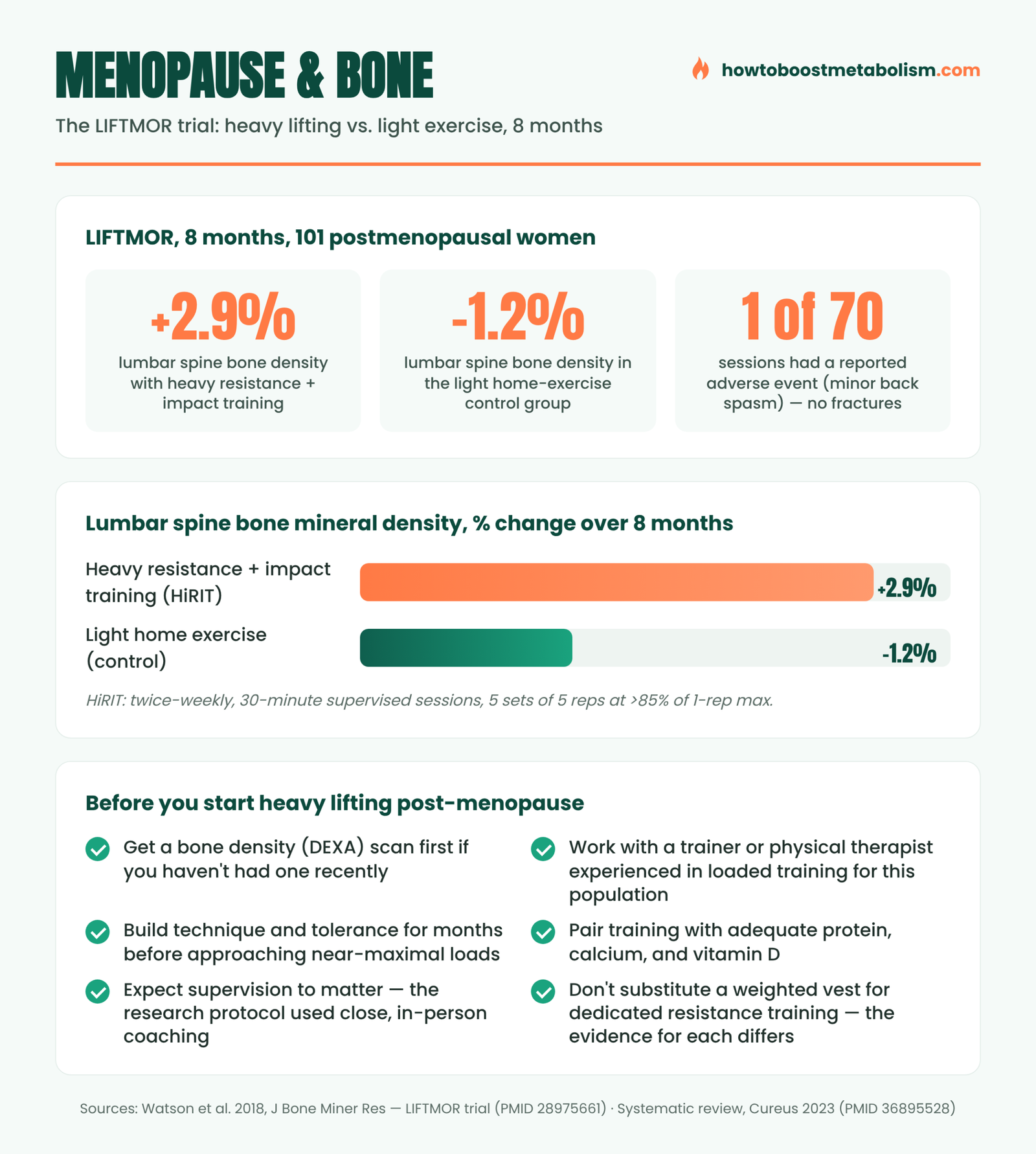
The key study here is the LIFTMOR randomized controlled trial, published in the Journal of Bone and Mineral Research by a team at Griffith University in Australia. The researchers recruited 101 postmenopausal women (average age 65) who already had low bone mass — the exact population conventional wisdom said to protect from heavy loading, not expose to it. Half were randomized to eight months of High-intensity Resistance and Impact Training (HiRIT): twice-weekly, 30-minute, closely supervised sessions built around five sets of five repetitions at more than 85% of each woman’s one-repetition maximum — genuinely heavy weight, not light toning exercises. The other half did a home-based, low-intensity exercise program, which served as the comparison group.
The results directly contradicted the old caution. The heavy-training group gained 2.9% in lumbar spine bone density on average, while the light-exercise comparison group lost 1.2% over the same eight months — a meaningful gap in opposite directions, not just a difference in degree. At the femoral neck (part of the hip), the heavy-training group essentially held steady (+0.3%) while the comparison group continued losing ground (-1.9%). The heavy-training group also saw thicker cortical bone at the femoral neck, slightly increased height (a proxy for less spinal compression), and improved scores on every functional test the researchers measured, including the timed up-and-go and sit-to-stand tests used to assess fall and frailty risk.
Just as important as the bone numbers: safety. Across roughly 70 supervised sessions per participant in the heavy-training group, researchers recorded exactly one adverse event — a minor lower-back spasm — and zero fractures. Compliance was high in both groups (92% in the heavy-training arm, 85% in the home-exercise arm). The trial’s own stated purpose was to test whether the perceived high fracture risk of heavy loading in osteoporotic women was justified, and under closely supervised conditions, it found the opposite: the heavier, more demanding program was both more effective and not meaningfully more dangerous than a gentle home program.
Free download
🔥 The Metabolism Starter Kit
3 honest guides: a 7-day reset plan, a foods cheat-sheet and 12 metabolism myths debunked. No spam — unsubscribe anytime.
This Isn’t the Same as the Weighted-Vest Research
It’s worth being precise here, because “load your skeleton to protect your bones” gets applied to very different interventions that don’t produce the same results. A separate, large 2025 randomized trial in JAMA Network Open found that wearing a weighted vest for several hours a day during intentional weight loss did not meaningfully protect hip bone density in older adults — see our full breakdown in the rucking and bone density guide. The difference between that null result and LIFTMOR’s strong positive result isn’t a contradiction; it’s a dose-response story. LIFTMOR used near-maximal resistance loads (over 85% of 1-rep max) under close supervision, specifically designed to deliver the high-magnitude, high-rate mechanical strain that bone actually needs to respond. A vest worn passively during an ordinary day delivers a much smaller, lower-rate mechanical signal. The research consistently points to intensity and loading rate, not just “any extra weight,” as the active ingredient for bone.
A Systematic Review Backs the Pattern
A 2023 systematic review in Cureus looked across multiple trials of high-intensity and high-impact exercise in postmenopausal women and found a consistent pattern: programs that combined meaningful resistance loads with impact elements (like the jumping component built into LIFTMOR) tended to show the clearest bone density benefits, more so than low-intensity or purely aerobic programs. That’s a helpful confirmation that LIFTMOR’s result wasn’t a one-off fluke, though it’s also a reminder that most of this evidence base is still built from a relatively small number of trials, and individual results vary based on starting bone density, medication use, and overall health status.
Why This Result Surprised Exercise Physiologists
For context on why LIFTMOR made waves: clinical guidance for decades leaned toward low-impact, lower-intensity exercise for anyone with diagnosed osteopenia or osteoporosis, largely out of caution rather than strong contrary evidence. The underlying bone biology actually argued the opposite — bone tissue responds to mechanical strain in a dose-dependent way, and the highest-magnitude, highest-rate loading (think jumping and near-maximal lifting, not gentle resistance bands) produces the strongest osteogenic signal. The caution came from a reasonable fear that applying that kind of load to already-fragile bone would cause the exact fractures everyone was trying to prevent. LIFTMOR is notable precisely because it tested that fear directly, in the population it applied to most, under conditions designed to catch problems early (close supervision, gradual build-up, trained staff), and found the fear wasn’t well-supported when the program was run carefully.
That nuance — “carefully supervised heavy training was safe and effective” rather than “heavy training is always safe” — is the detail that tends to get lost when this trial gets summarized in a headline. The researchers didn’t hand participants a barbell and a magazine article; they ran closely monitored sessions with trained staff for eight months. Reproducing the result at home with no guidance and no progression plan is a meaningfully different proposition than what the trial actually tested.
Beyond Bone: The Metabolic Case for Lifting Through Menopause
Bone density is only one piece of why resistance training matters during and after the menopause transition. Estrogen decline is also associated with a shift toward more visceral fat storage and a tendency to lose lean muscle mass more readily, both of which affect resting metabolic rate and insulin sensitivity. Building and maintaining muscle through resistance training is one of the most direct levers available to counteract that shift — muscle tissue is metabolically active and plays a meaningful role in glucose disposal. This is part of why the same broad recommendation — structured, progressive resistance training, not just cardio — shows up across our guides to building muscle after 50 and progressive overload after 40. The bone benefit documented in LIFTMOR and the metabolic benefit of preserved lean mass are two expressions of the same underlying mechanical and hormonal story, not separate recommendations that happen to overlap.
What This Looks Like in Practice
| Element | What the trial actually did |
|---|---|
| Load used | >85% of 1-rep max — genuinely heavy, not light toning weights |
| Frequency | Twice weekly in the trial — not daily |
| Session length | About 30 minutes, including warm-up |
| Supervision | Closely supervised by trained staff throughout the 8-month trial |
| Who it was tested on | Postmenopausal women, average age 65, with existing low bone mass |
| Reported harm | 1 minor back spasm across roughly 3,500 supervised training sessions; no fractures |
Getting Started Without Getting Hurt
- Get a baseline DEXA bone density scan if you haven’t had one, especially if you’re postmenopausal or have risk factors for osteoporosis — this tells you and your provider what you’re actually working with.
- Don’t go straight to 85% of your 1-rep max on day one. The trial’s participants built up to that intensity gradually and were supervised throughout — recreate that progression and that oversight, not just the end-stage loading.
- Work with a trainer, physical therapist, or coach who has specific experience programming resistance training for osteopenia or osteoporosis, not just general fitness experience.
- Prioritize technique on foundational lifts (squat pattern, hip hinge, loaded carries) before chasing heavier numbers — form breakdown under near-maximal load is where injury risk actually comes from.
- Support the training stimulus with adequate protein, calcium, and vitamin D — mechanical loading and nutrition work together, not separately, as covered in our protein requirements guide.
- If you’re earlier in the menopause transition rather than several years past it, our guide to managing metabolism through perimenopause covers the broader hormonal picture alongside this bone-specific data.
The Bottom Line
The old advice to avoid heavy lifting after menopause because of fracture risk doesn’t hold up against the strongest available trial on the question. Under proper supervision and gradual progression, genuinely heavy resistance and impact training outperformed light exercise for bone density at both the spine and hip, improved physical function across the board, and did so with an excellent safety record. The caveat that matters is implementation, not the underlying premise: get assessed, progress gradually, and get coached — don’t skip straight to maximal loads without the structure that made the trial’s results safe in the first place.
If you’d rather follow a structured, progressive strength program than design your own loading progression from scratch, Old School New Body lays out a step-by-step resistance training method (F4X) aimed specifically at adults rebuilding strength later in life. Its marketing leans on some aging statistics we can’t independently verify, so treat those specific numbers skeptically — but the underlying structured-progression approach is a reasonable way to build the kind of consistent, progressive loading habit that trials like LIFTMOR suggest actually matters for bone.
See the Program →Affiliate link — we may earn a commission at no extra cost to you. Disclosure
Free download: our Metabolism Starter Kit — a protein calculator, a 7-day meal framework, and a one-page supplement checklist, with zero hype.
Get the Free Starter Kit →Related: Bone density isn’t the only outcome vitamin D gets credit for — see the honest numbers on vitamin D and muscle strength after 40.
Frequently Asked Questions
Is heavy lifting actually safe for women with osteoporosis?
In the LIFTMOR trial, 101 postmenopausal women with low bone mass did eight months of closely supervised resistance training at over 85% of their one-rep max, with only one minor adverse event (a back spasm) and no fractures. Safety in that trial depended heavily on gradual progression and close supervision — it’s not a reason to start lifting maximally without guidance or a baseline assessment.
How much does strength training actually improve bone density after menopause?
In the LIFTMOR trial, heavy resistance and impact training increased lumbar spine bone density by 2.9% over 8 months, while a light home-exercise comparison group lost 1.2% over the same period. Results vary by individual, baseline bone density, and program intensity.
Does a weighted vest work as well as heavy resistance training for bone density?
No — a separate 2025 randomized trial found that wearing a weighted vest during weight loss did not significantly protect hip bone density in older adults, unlike the strong effect seen with near-maximal resistance training in the LIFTMOR trial. Intensity and loading rate appear to matter more than simply adding weight passively.
How often do I need to lift heavy to protect my bones after menopause?
The LIFTMOR protocol used just two 30-minute sessions per week, not daily training — suggesting frequency doesn’t need to be extreme if the intensity and supervision are adequate.
Do I need a trainer to start this kind of program?
It’s strongly advisable, at least initially. The LIFTMOR trial’s safety record was achieved under close, in-person supervision with gradual progression to near-maximal loads — not by lifting heavy without guidance. A trainer or physical therapist experienced with osteoporosis populations can help you progress safely.