Protein Timing: Does Spreading It Out Build More Muscle?
This article may contain affiliate links. If you buy through them, we may earn a small commission at no extra cost to you. See our Affiliate Disclosure and Medical Disclaimer.
Most people in the U.S. eat the opposite of what sports nutrition researchers recommend: a small, carb-heavy breakfast, a moderate lunch, and the bulk of their protein for the day at dinner. The question that keeps coming up in fitness circles is whether that pattern is actually holding back muscle growth — and whether forcing yourself to spread protein evenly across three or four meals makes a measurable difference. The honest answer, once you look past the single most-cited study, is more nuanced than either “it’s everything” or “it doesn’t matter at all.”
The Study Everyone Cites: Even Beats Skewed, in the Lab
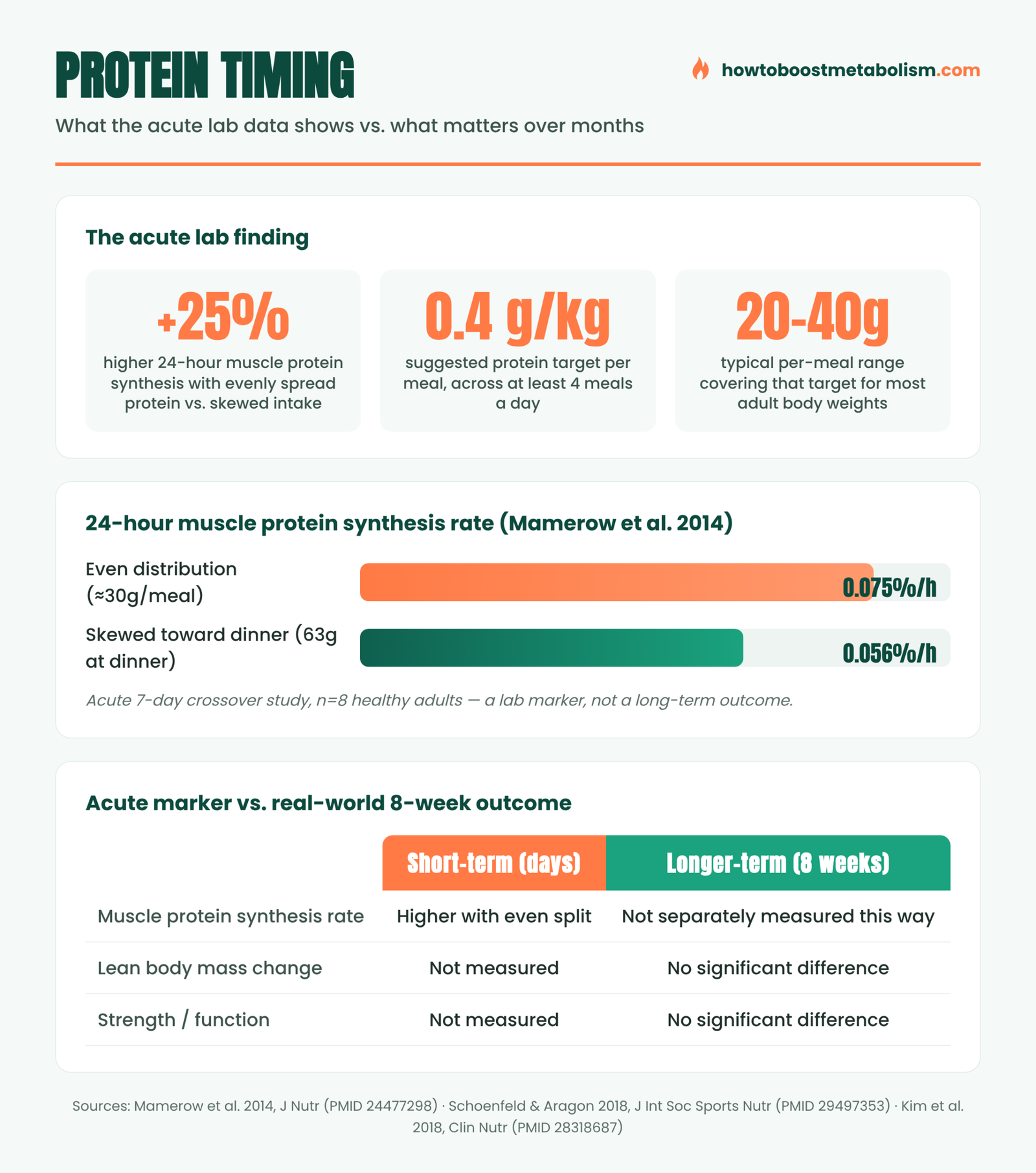
The foundational paper here is a 2014 crossover trial in the Journal of Nutrition led by researchers at the University of Texas Medical Branch and the University of Illinois. Eight healthy adults ate two different diets, each for seven days, with a 30-day break in between: one where protein was spread evenly across breakfast, lunch, and dinner (about 30g at each meal), and one where it was skewed the way a typical American diet is — about 11g at breakfast, 16g at lunch, and 63g at dinner. Both diets had the same total daily protein and calories. Using blood and muscle biopsy samples with a tracer amino acid, the researchers measured 24-hour muscle protein synthesis directly, not estimated it. The even-distribution diet produced a muscle protein synthesis rate 25% higher than the skewed diet (0.075%/hour vs. 0.056%/hour), and the difference held up after a full week of eating that way, not just on day one.
That’s a real, statistically significant, mechanistically interesting result. It’s also a very small study (eight people) measuring a biological marker over a handful of days — not muscle mass, not strength, not a year of training outcomes. It tells you that your body’s machinery responds differently to an evenly spread protein intake. It does not, by itself, tell you how much visible difference that makes to the muscle on your frame after a year of training.
How Much Protein Can One Meal Actually Use?
A widely cited 2018 review in the Journal of the International Society of Sports Nutrition, by researchers Brad Schoenfeld and Alan Aragon, tackled the related question of whether there’s a ceiling on how much protein a single meal can use for muscle-building. Their read of the acute research: doses above roughly 20–25g of fast-digesting protein eaten alone do get used, but a growing share gets oxidized for energy rather than built into tissue — especially without other food alongside it. Based on that evidence, they land on a practical recommendation: aim for about 0.4 g of protein per kilogram of body weight at each meal, spread across a minimum of four meals, to comfortably hit a daily target of 1.6 g/kg. For someone eating the higher end of the researched range (2.2 g/kg/day), that works out to roughly 0.55 g/kg per meal. In plain numbers, that’s roughly 25–40g of protein per meal for most adults — not the common gym-bro rule of “you can only absorb 30g at once,” which oversimplifies a more flexible system.
Free download
🔥 The Metabolism Starter Kit
3 honest guides: a 7-day reset plan, a foods cheat-sheet and 12 metabolism myths debunked. No spam — unsubscribe anytime.
The Honest Complication: Longer Trials Don’t Show the Same Gap
Here is the part of the story that rarely makes it into Instagram captions. A 2018 randomized trial in Clinical Nutrition followed 14 older adults for a full 8 weeks — not 7 days — comparing an even protein distribution against an uneven one, with total daily protein matched at 1.1 g/kg/day in both groups. The result: no significant difference between groups in lean body mass, muscle strength, physical function, or whole-body protein kinetics. The same lead group had found a similar null result in an earlier acute metabolic study. In other words, when you extend the comparison from days to weeks and from a lab marker to actual body composition and strength, the clear acute advantage for even distribution becomes much harder to detect.
Taken together, the most defensible summary is this: evenly distributing protein across meals appears to produce a measurably higher muscle protein synthesis rate in short, tightly controlled lab conditions. Whether that translates into meaningfully more muscle or strength over months of real-world eating and training is not yet well established, and at least one trial found it didn’t. If you’re already hitting an adequate total daily protein intake and training consistently, obsessing over the exact gram count at each meal is very likely a second-order detail — worth doing if it’s easy, not worth stressing over if it isn’t.
Why the Acute Study and the Longer Trial Disagree
It’s worth sitting with why a well-designed 7-day study and a well-designed 8-week study can point in different directions, because this pattern shows up constantly in nutrition science and it’s rarely explained well. Muscle protein synthesis measured over 24 hours is a snapshot of a dynamic process — it tells you how your body is handling amino acids right now, under the specific diet you just ate. Lean body mass and strength, measured after 8 weeks, are the cumulative result of dozens of these daily snapshots plus training stimulus, recovery, sleep, and total energy balance all stacked on top of each other. A 25% difference in a single biological marker, averaged over many days and filtered through all those other variables, can easily shrink to something too small for a 14-person trial to detect with statistical confidence. That doesn’t mean the marker is meaningless — it means the practical, real-world effect size is probably much smaller than the lab number makes it sound, and may only show up clearly in people training very intensely, eating very precisely, or over a much longer timeframe than 8 weeks.
There’s also a sample-size problem worth being upfront about: the original 2014 study had eight participants, and the 8-week follow-up trial had fourteen. Neither is a large study. That’s completely normal for this type of intensive lab research — tracer studies and controlled feeding trials are expensive and labor-intensive, so sample sizes tend to be small across the whole field, not just in these two papers. But it’s a good reason not to treat either result as the final word, and a good reason this article is built around “here’s the range of what’s been found” rather than a single confident number.
Does Age Change the Calculation?
One plausible reason researchers keep revisiting this question in older adults specifically is a phenomenon sometimes called “anabolic resistance” — the idea that aging muscle may need a larger per-meal protein dose to trigger the same level of muscle protein synthesis that a smaller dose triggers in a younger adult. If that’s true, it would make hitting an adequate per-meal threshold (rather than just a daily total) more important as you get into your 50s, 60s, and beyond, simply because a meal that was “enough” at 30 might fall short of the per-meal threshold at 65. This is part of why several of the key distribution trials have specifically recruited older adults rather than college-age subjects — it’s the population most likely to actually benefit from being deliberate about this, even though the 8-week trial above didn’t find a clear advantage for even distribution specifically. The more consistent recommendation across the research, regardless of age, is to make sure each meal clears a reasonable protein floor — see our guide on how much protein you actually need per day for age-adjusted targets — rather than fixating on whether the spacing between meals is perfectly even.
What This Means for Your Actual Meals
| Factor | Priority | Why |
|---|---|---|
| Total daily protein | Highest-leverage factor — hit this number first | Most-researched driver of muscle gain over time |
| Protein at breakfast | Moderate leverage — closes the biggest common gap | Most Americans under-eat protein at this meal |
| Exact grams per meal | Low leverage once total and spread are reasonable | 0.4 g/kg/meal is a useful target, not a hard rule |
| Perfectly even spacing every 3–4 hours | Lowest leverage for most people | Convenience and adherence usually matter more |
A Practical, Non-Obsessive Approach
- Start by hitting your total daily protein target — this is the factor with the strongest overall evidence base for building and preserving muscle.
- If your breakfast is currently low in protein (cereal, toast, coffee), that’s the easiest, highest-leverage fix — add eggs, Greek yogurt, or a protein shake rather than overhauling your whole day.
- Aim for roughly 25–40g of protein at your main meals as a loose target, not a number to hit exactly every single time.
- Don’t panic about one heavy-protein dinner occasionally outweighing a lighter breakfast — the research showing a downside used a much more extreme and consistent skew than most people actually eat.
- If you train in a fasted state in the morning, having protein reasonably close to your workout (before or after) is a reasonable habit, but the exact minute-by-minute window matters far less than total daily intake. Our high-protein breakfast guide has practical starting points.
The Bottom Line, Without the Hype
If you had to walk away with one sentence: total daily protein intake is the well-established foundation, even distribution across meals is a plausible but unproven refinement on top of it, and neither one works without a training stimulus that actually demands more muscle. Treat the 25% muscle protein synthesis number as a genuinely interesting physiological finding worth acting on when it’s easy — adding protein to a protein-light breakfast, for instance — rather than as a reason to weigh out exact grams at every meal or feel guilty about an unevenly distributed day here and there.
Where This Connects to Strength Training
Protein distribution doesn’t operate in a vacuum — it matters most in combination with a training stimulus that actually calls for more muscle protein synthesis in the first place. If you’re not doing progressive resistance training, fine-tuning meal timing is unlikely to move the needle much at all. Our guides on progressive overload after 40 and what muscle soreness actually signals cover the training side of this equation, and our breakdown of whether a creatine loading phase is necessary covers a related, frequently over-complicated supplement question with the same pattern: a real lab effect, and a much smaller practical one.
Free download: our Metabolism Starter Kit — a protein calculator, a 7-day meal framework, and a one-page supplement checklist, with zero hype.
Get the Free Starter Kit →Old School New Body is a follow-along program built around short, F4X-style strength sessions for adults over 35 — useful if you’d rather follow a ready-made plan than design your own split. The protein habits above still do most of the work; the program covers the training side.
Learn More →Affiliate link — we may earn a commission at no extra cost to you. Disclosure
Frequently Asked Questions
Does it really matter if I eat most of my protein at dinner?
A small 2014 lab study found that spreading protein evenly across meals produced 25% higher 24-hour muscle protein synthesis than loading most of it at dinner. But an 8-week randomized trial in older adults found no significant difference in actual lean body mass or strength between even and uneven distribution when total daily protein was matched. Total daily intake appears to matter more than exact timing.
How much protein should I eat per meal to build muscle?
A commonly cited sports nutrition review recommends roughly 0.4 g of protein per kilogram of body weight per meal, spread across at least four meals, to comfortably reach 1.6 g/kg per day. For most adults that works out to roughly 25–40g of protein per meal.
Is there a maximum amount of protein my body can use in one meal?
There isn’t a hard biological ceiling, but research suggests that additional protein beyond roughly 20–25g eaten alone increasingly gets used for energy rather than muscle-building, especially without other food. Combining protein with other macronutrients slows digestion and may allow more of it to be used over a longer window.
Should I eat protein immediately after my workout?
Having protein reasonably close to training (before or after) is a sensible habit, but current evidence suggests the so-called “anabolic window” is much wider than the old 30-minute rule implied. Total daily protein intake matters more than hitting a precise post-workout minute.
Is protein timing more important for older adults?
Some researchers have hypothesized that older adults may benefit more from evenly distributed, higher-per-meal protein because of reduced sensitivity to amino acids (sometimes called “anabolic resistance”), but a direct 8-week trial in older adults did not find a significant advantage for even distribution over uneven. Total protein adequacy remains the best-supported recommendation.