Zone 2 Cardio for Fat Loss: What 2026 Research Shows
This article may contain affiliate links. If you buy through them, we may earn a small commission at no extra cost to you. See our Affiliate Disclosure and Medical Disclaimer.
“Zone 2” went from a term used mostly by endurance coaches and exercise physiologists to one of the most searched fitness phrases of the decade — popularized by longevity-focused doctors, elite coaches, and a wave of wearable apps that now label your heart rate zones automatically. The pitch is appealing: an easy, conversational-pace cardio session that supposedly trains your body to burn fat more efficiently and builds a stronger aerobic engine for everything else you do. Some of that is well supported. Some of it is marketing running ahead of the data. Here’s an honest look at what the current research actually shows, how to find your own Zone 2 without expensive lab testing, and how it fits into a broader metabolism and fat-loss strategy.
What Is Zone 2 Cardio, Really?
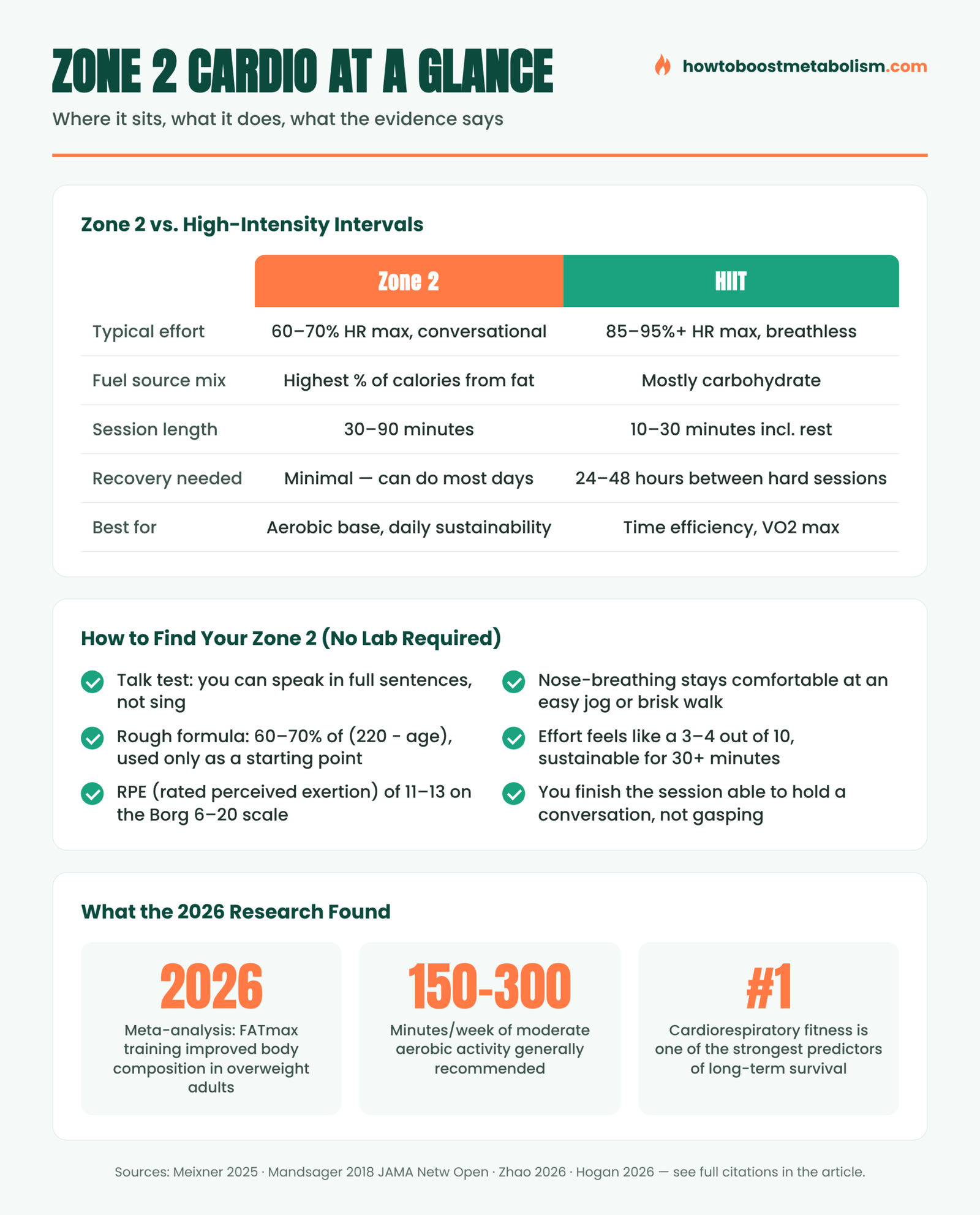
Zone 2 refers to the second of five commonly used heart-rate training zones, sitting at roughly 60–70% of your maximum heart rate. Physiologically, it’s meant to approximate the intensity at which your body relies most heavily on fat as a fuel source, roughly overlapping with what exercise scientists call “FATmax” — the exercise intensity at which fat oxidation is highest in absolute terms. Below this intensity you’re burning relatively little total energy; above it, your body shifts increasingly toward burning carbohydrate for fuel.
In practice, Zone 2 feels easy. You should be able to hold a full conversation. If you’re gasping for air between sentences, you’ve drifted into Zone 3 or higher — which isn’t bad, it’s just not Zone 2 anymore.
The Science: What 2026 Research Shows (and Doesn’t)
The idea that low-intensity aerobic training improves fat metabolism and long-term health isn’t new — it’s the backbone of classic endurance coaching. What’s newer is a wave of 2025–2026 research re-examining exactly how precise and useful the “Zone 2” concept really is in practice.
A 2025 study in Translational Sports Medicine tested 50 trained cyclists and compared several common methods used to define an individual’s Zone 2 boundary. The researchers found meaningful disagreement both between methods and from day to day within the same person, concluding that commonly used formulas and fixed heart-rate percentages don’t always reflect what’s actually happening in an individual’s metabolism (Meixner et al., 2025). In plain terms: your “Zone 2” is personal, and a generic percentage-of-max-heart-rate chart is a starting point, not gospel.
A related 2026 systematic review in Medicine & Science in Sports & Exercise examined how well “FATmax” (the intensity of peak fat burning) lines up with the lactate and ventilatory thresholds exercise scientists usually use to define Zone 2 boundaries. The agreement between these markers was inconsistent across studies, reinforcing that there’s no single universal percentage that nails Zone 2 for everyone (Hogan et al., 2026).
That doesn’t mean the training itself is useless — far from it. A 2026 systematic review and meta-analysis of randomized controlled trials in Diabetes, Metabolic Syndrome and Obesity looked specifically at FATmax-intensity exercise in people who were overweight or living with obesity, and found it improved body composition and several cardiovascular health markers compared with control conditions (Zhao et al., 2026). And more broadly, cardiorespiratory fitness — the kind Zone 2 training is designed to build — is one of the most consistent predictors of long-term survival in the medical literature. A large retrospective cohort study of patients undergoing exercise treadmill testing found that higher fitness levels were associated with progressively lower all-cause mortality, with no observed upper limit to the benefit, even at very high fitness levels (Mandsager et al., 2018).
Put together, the honest summary is this: the precise “magic zone” is harder to pin down than most infographics suggest, and it’s genuinely individual. But the broader habit — consistent, easy-to-moderate aerobic exercise — is one of the better-supported things you can do for long-term metabolic and cardiovascular health.
Free download
🔥 The Metabolism Starter Kit
3 honest guides: a 7-day reset plan, a foods cheat-sheet and 12 metabolism myths debunked. No spam — unsubscribe anytime.
How to Find Your Zone 2 (No Lab Required)
Most people don’t have access to a metabolic cart or a lactate analyzer, and given how much individual variation the 2025–2026 research found, a lab test isn’t strictly necessary to get useful results. Three practical ways to find your zone:
- The talk test. You should be able to speak in full sentences without gasping, but singing should feel uncomfortable. If you can easily sing along to a song, you’re probably below Zone 2 (Zone 1). If you can only get out a few words, you’re above it.
- A starting-point formula. Estimate max heart rate as roughly 220 minus your age, then target 60–70% of that number. A 45-year-old would estimate a max of about 175 bpm, putting Zone 2 around 105–123 bpm. Treat this as a rough starting point, not a precise target — the 2025 research above found this kind of formula can meaningfully over- or underestimate an individual’s real physiological zone.
- Perceived effort. On a 1–10 scale, Zone 2 should feel like a 3–4: easy, sustainable, the kind of pace you could keep for an hour if you had to.
How Much Zone 2 Do You Need?
There’s no single clinical trial that pins down an exact weekly dose specific to “Zone 2” as a label. General physical activity guidelines recommend 150–300 minutes a week of moderate-intensity aerobic activity for most adults, and Zone 2 training is a comfortable way to accumulate a large share of that volume without the recovery demands of harder sessions. A realistic starting structure for most people:
| Week | Sessions | Duration | Notes |
|---|---|---|---|
| 1–2 | 2–3 | 20–30 min | Build the habit; walking or easy cycling both count |
| 3–4 | 3 | 30–45 min | Add one slightly longer session on a rest day |
| 5+ | 3–4 | 45–60 min | Maintain; combine with 1–2 strength sessions per week |
Because Zone 2 is low-impact on your recovery, it can usually be layered around strength training rather than competing with it. See our guide on balancing cardio and strength training if you’re trying to fit both into a realistic weekly schedule, and our explainer on how BMR, RMR and TDEE actually work if you want to understand how this fits into your total daily calorie burn.
Zone 2 vs. HIIT: Which Is Better for Fat Loss?
This isn’t really an either/or question. HIIT burns more total calories per minute and produces a larger post-exercise oxygen debt, while Zone 2 burns a higher percentage of calories from fat per minute and is far easier to recover from and repeat often. For pure fat-loss math, total weekly energy expenditure and your overall calorie balance matter more than which specific zone you trained in. We cover the trade-offs in detail in our HIIT vs. cardio for metabolism comparison — most well-designed programs for fat loss use some of both.
Fueling and Hydration for Longer Zone 2 Sessions
Zone 2 sessions under 60 minutes generally don’t require special fueling or electrolyte strategies for most people — water is enough. Once sessions regularly stretch past 60–90 minutes, especially in heat, replacing sodium and other electrolytes lost in sweat becomes more relevant, and in rare cases of very high fluid intake without adequate sodium, overdoing plain water can contribute to exercise-associated hyponatremia, a genuinely dangerous condition seen in endurance athletes (Klingert et al., 2022). This doesn’t apply to most people doing 30–45 minute sessions a few times a week, but if you’re building toward longer endurance work, it’s worth planning ahead.
Aerobic training like Zone 2 cardio also places ongoing demand on your cardiovascular system, which is part of why omega-3 fatty acids come up often in endurance-training nutrition discussions — they’re one of the more consistently studied nutrients for supporting healthy triglyceride levels (Wang et al., 2023).
Common Mistakes
- Training too hard. The single most common Zone 2 mistake is drifting into Zone 3 without realizing it — if you can’t hold a conversation, slow down.
- Expecting it to replace strength training. Zone 2 builds aerobic capacity; it doesn’t build or preserve muscle the way resistance training does.
- Chasing a “perfect” number. Given how much individual variation the 2025–2026 research found, obsessing over an exact heart rate is less useful than consistency.
- Doing it exclusively. A mix of easy aerobic work, some harder intervals, and strength training generally outperforms any single modality done alone.
What We Don’t Recommend
Be skeptical of any claim that Zone 2 cardio alone will “reset your metabolism” or produce dramatic fat loss without attention to diet. The research above supports real, meaningful benefits to cardiovascular fitness and fat oxidation capacity — it does not support treating Zone 2 as a stand-alone weight-loss method. If a program promises specific pounds lost from cardio zone training alone, treat that as marketing, not physiology.
Free download: our Metabolism Starter Kit — a protein calculator, a 7-day meal framework, and a one-page supplement checklist, with zero hype.
Get the Free Starter Kit →Related: If you’re experimenting with fat sources for fat oxidation, see how MCT oil compares with coconut oil in the actual trials.
Related: For more on omega-3’s real (and overstated) role in fat loss, see our breakdown of what the research shows about omega-3 and visceral fat.
Related: Curious how your zone 2 habit shows up on paper? We dug into what VO2 max actually predicts about long-term health, and how strength training affects it too.
Related: Worried that regular cardio is working against your strength training? We dug into the research on the so-called interference effect — the answer depends more on your cardio choice than you’d think.
Zone 2 works best alongside some strength work to protect muscle. Old School New Body is a follow-along program built around short, F4X-style strength sessions for adults over 35 — an easy way to add resistance training without long gym sessions.
Learn More →Affiliate link — we may earn a commission at no extra cost to you. Disclosure
Frequently Asked Questions
What heart rate is Zone 2 cardio?
For most healthy adults, Zone 2 sits roughly between 60% and 70% of heart rate max, though individual variability is large. A 2025 study of 50 cyclists found that common formulas for estimating this zone often disagree with each other and with a person’s actual physiological markers, so a simple talk-test or a lab-based lactate or ventilatory test is more reliable than a formula alone (Meixner et al., 2025).
How many minutes of Zone 2 cardio per week should I do?
There’s no single research-backed number specific to Zone 2, but most coaches and the general cardiorespiratory fitness literature point toward 150–300 minutes a week of easy-to-moderate aerobic work, often split into 3–5 sessions of 30–60 minutes. Building up gradually matters more than hitting an exact target in week one.
Does Zone 2 cardio burn more fat than HIIT?
Zone 2 training sits close to the exercise intensity where the body burns the highest percentage of fat as fuel (often called “FATmax”), but HIIT burns more total calories per minute. A 2026 meta-analysis of randomized trials found FATmax-intensity exercise improved body composition and cardiovascular markers in people who are overweight or living with obesity (Zhao et al., 2026). For most people, the two approaches are complementary rather than competing — see our comparison of HIIT vs. steady-state cardio for the full picture.
Can beginners do Zone 2 training?
Yes — Zone 2 is, by definition, an easy-to-moderate effort, which makes it one of the more beginner-friendly and joint-friendly forms of cardio. Starting with brisk walking or light cycling and using the talk test (see below) is a safe way to find the right effort level without a lab test.
Is Zone 2 cardio a waste of time if I just want to lose weight?
No, but it isn’t magic either. Zone 2 sessions build aerobic capacity and may support fat oxidation at rest and during exercise, which is genuinely useful for long-term metabolic health (Mandsager et al., 2018). Weight loss itself still comes down to a sustained calorie deficit — Zone 2 is one tool among several, not a replacement for nutrition.
This article is for informational purposes only and is not medical advice. Talk to your doctor before starting a new exercise program, especially if you have a heart condition or other health concerns. See our full medical disclaimer.