MCT Oil vs Coconut Oil: What 2026 Research Shows
This article may contain affiliate links. If you buy through them, we may earn a small commission at no extra cost to you. See our Affiliate Disclosure and Medical Disclaimer.
Walk into any health-food aisle in the U.S. and you’ll find MCT oil and coconut oil sitting a few feet apart, often with nearly identical marketing: “boosts metabolism,” “burns fat,” “keto-friendly energy.” Some brands use the terms almost interchangeably. That’s a problem, because the two oils are not the same thing, and the research on each has reached different — sometimes contradictory — conclusions. Below is what randomized trials actually found when scientists put both oils to the test, not what the label on the bottle implies.
MCT Oil and Coconut Oil Are Not the Same Product
“MCT” stands for medium-chain triglycerides — fat molecules with 6 to 12 carbon atoms, mainly caprylic acid (C8) and capric acid (C10). Because they’re shorter than long-chain fats, MCTs are absorbed differently: they go largely straight to the liver via the portal vein instead of the lymphatic system, where they’re used quickly for energy or converted to ketones, rather than stored.
Coconut oil does contain MCTs, but it’s mostly lauric acid (C12), which behaves more like a long-chain fatty acid metabolically despite the “medium-chain” label some marketing uses for it. Depending on the source, coconut oil is roughly 14-17% true C8/C10 MCTs — the rest is lauric acid and other long-chain saturated fats. Bottled “MCT oil” products, by contrast, are concentrated, extracted C8 and/or C10 — often 100% of the fat content. That difference in composition is why the two oils don’t perform the same way in clinical trials.
Satiety: MCT Oil Wins, Clearly
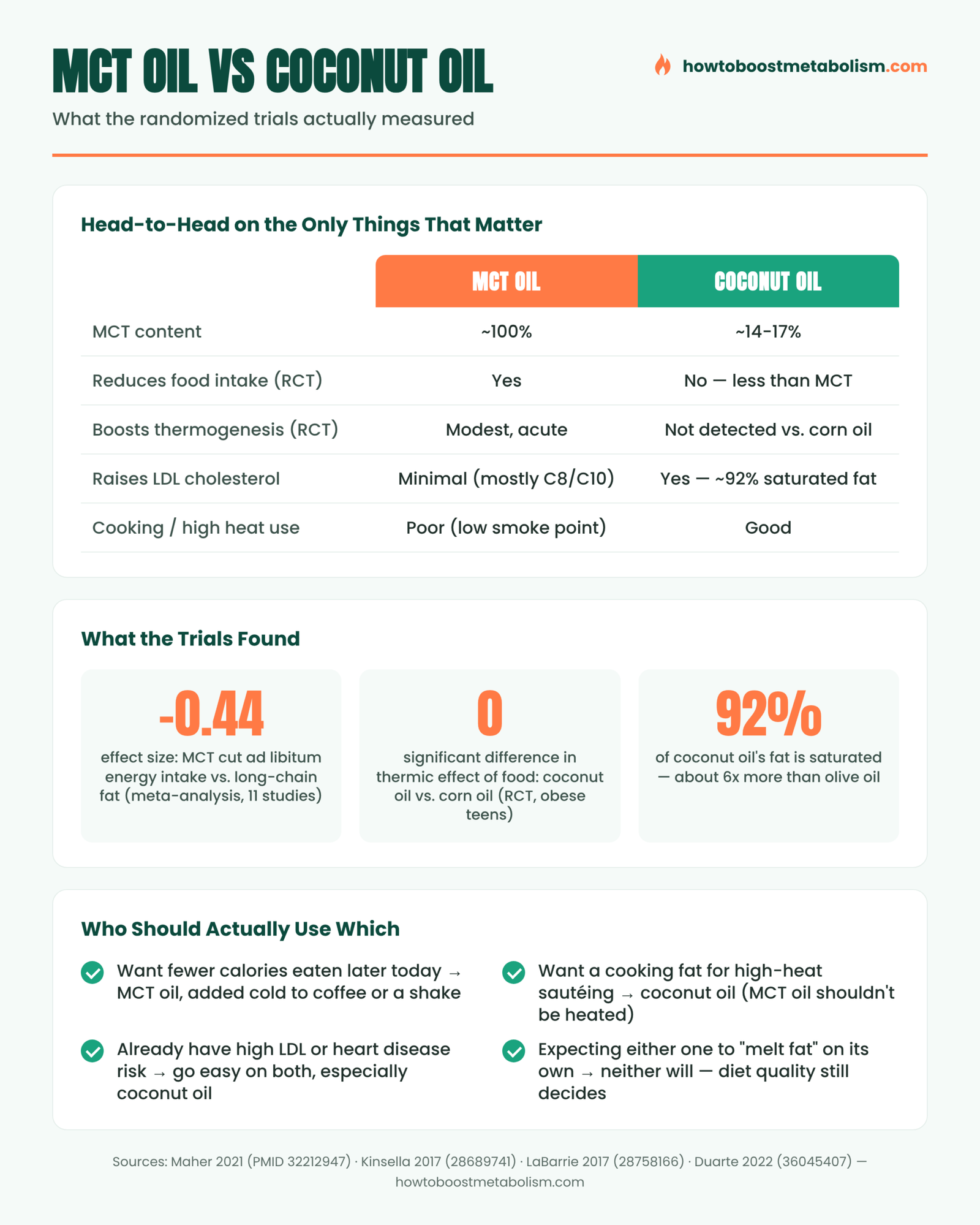
The strongest, most consistent evidence favors MCT oil over long-chain fats (including coconut oil) for appetite control. A 2021 systematic review and meta-analysis pooling 17 studies and 291 participants found that MCT ingestion produced a statistically significant, moderate reduction in later energy intake compared with long-chain triglycerides, both after a single dose and with repeated use under lab conditions (pooled effect size -0.444, 95% CI -0.808 to -0.080). Interestingly, this happened without a corresponding change in subjective hunger ratings or appetite hormones — people simply ate less at the next meal, even though they didn’t report feeling less hungry.
Coconut oil doesn’t get the same benefit. A 2017 randomized, double-blind, crossover trial compared MCT oil, coconut oil, and a control vegetable oil in a breakfast smoothie, then measured food intake at an ad libitum lunch three hours later. MCT oil reduced food intake compared with both coconut oil and the control; coconut oil performed no better than ordinary vegetable oil. The coconut oil was also rated less palatable than the MCT oil. The researchers’ conclusion was blunt: coconut oil “cannot be promoted as having similar effects to MCT oil on food intake and satiety.”
Free download
🔥 The Metabolism Starter Kit
3 honest guides: a 7-day reset plan, a foods cheat-sheet and 12 metabolism myths debunked. No spam — unsubscribe anytime.
Thermogenesis: The “Fat-Burning” Claim Doesn’t Hold Up for Coconut Oil
Some MCT research has shown a modest, acute increase in energy expenditure (diet-induced thermogenesis) after ingestion, which is part of where the “MCT boosts metabolism” claim originated. Coconut oil marketing often borrows this claim wholesale — but when it’s actually tested, it doesn’t show up. A randomized crossover trial in obese adolescents compared a coconut oil-enriched test meal with a corn oil meal and measured the thermic effect of food over six hours using indirect calorimetry. There was no significant difference between the two oils in thermogenesis, satiety, glucose, or insulin response. The authors noted this was the only study of its kind at the time and called for more research — but as it stands, the claim that coconut oil meaningfully “revs up” metabolism isn’t supported by the one trial designed to test it directly.
At a Glance: What Each Oil Is Actually Backed to Do
| Measure | MCT Oil | Coconut Oil |
|---|---|---|
| Reduces food intake at next meal (RCT) | Yes — moderate effect | No — not different from control oil |
| Increases thermogenesis (RCT) | Modest evidence, acute | Not detected vs. corn oil |
| Typical MCT (C8/C10) content | ~100% | ~14–17% |
| Effect on LDL cholesterol | Minimal at normal doses | Can raise LDL — ~92% saturated fat |
| Best practical use | Cold, added to coffee/shakes/dressings | Cooking fat, baking, high-heat sautéing |
What About Coconut Oil’s Effect on Cholesterol and Weight?
This is where the honest answer gets less flattering for coconut oil. A 2022 systematic review and meta-analysis of seven randomized controlled trials (515 participants, 4 weeks to 2 years of follow-up) found that coconut oil intake did not produce a clinically meaningful improvement in body weight, waist circumference, body fat percentage, LDL cholesterol, or triglycerides compared with other oils and fats. It did raise HDL (“good”) cholesterol slightly (+3.28 mg/dL on average) — but the review’s own authors concluded that public health advice should continue to favor other oils over coconut oil given the lack of clear cardiometabolic benefit and its very high saturated fat content (about 92%, roughly six times that of olive oil).
None of this means coconut oil is dangerous in ordinary cooking amounts as part of a varied diet — the point is narrower: the specific claim that coconut oil functions like a concentrated MCT supplement for weight or metabolism isn’t supported by the trials that have actually tested it head-to-head against MCT oil.
Why the Confusion Happened in the First Place
Part of the mix-up is linguistic. Coconut oil was marketed hard during the early 2010s keto boom specifically because it contains some MCTs, and early coverage often rounded that up to “coconut oil is an MCT oil.” Supplement brands then reinforced the overlap by selling coconut-oil-derived MCT products, which are real MCT oil (just sourced from coconuts rather than palm kernel oil) — but the finished product is chemically very different from the coconut oil sitting in a jar on the shelf, because the long-chain lauric acid has been fractionated out. The result: three different products (coconut oil, coconut-derived MCT oil, and palm-derived MCT oil) all get discussed under one umbrella term in casual conversation, and only the concentrated MCT versions carry the satiety and modest thermogenic evidence described above.
Does Either Oil Matter for a Ketogenic Diet Specifically?
Both oils show up constantly in keto diet content, and for a genuinely different reason than the metabolism claims: MCTs are converted to ketone bodies more readily and more rapidly than long-chain fats, which is why MCT oil is popular for people trying to raise blood ketone levels or ease the transition into ketosis. This is a real, measurable effect — but it’s a ketone-production effect, not evidence of fat loss or a faster metabolism on its own. Coconut oil can nudge ketone production too, just more slowly and less predictably given its lower true-MCT content. If ketone levels are the specific goal (for example, under medical supervision for a therapeutic ketogenic diet), that’s a separate conversation from the weight-management claims this article is evaluating.
Practical Takeaways
- If your goal is appetite control or a ketone/energy boost, use an actual MCT oil product (look for C8/C10 on the label), taken cold — stirred into coffee, a smoothie, or salad dressing. Don’t heat it; MCT oil has a low smoke point and heating it defeats the purpose.
- If your goal is a cooking fat, coconut oil’s higher smoke point makes it more practical for sautéing or baking — just don’t expect a metabolic bonus from it.
- Start MCT oil low — 1 teaspoon, building to 1–2 tablespoons a day. Going straight to large doses commonly causes GI distress (cramping, diarrhea) because of how rapidly MCTs are absorbed.
- Neither oil replaces the basics. The appetite effect from MCT oil is real but modest — it’s a small lever, not a substitute for protein intake, fiber, sleep, or overall calorie balance.
- Watch total saturated fat if you already have elevated LDL — both oils add to that total, coconut oil more so.
- Check the label on “MCT oil” products. Some blends include coconut oil or palm oil fractions beyond pure C8/C10 — read the ingredient list rather than assuming every bottle labeled “MCT oil” has an identical composition.
Free download: our Metabolism Starter Kit — a protein calculator, a 7-day meal framework, and a one-page supplement checklist, with zero hype.
Get the Free Starter Kit →The Bottom Line
MCT oil and coconut oil are often sold as the same thing wearing two labels. They aren’t. MCT oil — the real, concentrated C8/C10 kind — has a modest but repeatable effect on satiety and a smaller, less consistent effect on thermogenesis. Coconut oil, despite containing some MCTs, behaves in trials more like an ordinary saturated cooking fat: no significant satiety advantage, no detectable thermogenic boost against corn oil, and no clinically meaningful change in weight or lipids versus other fats, aside from a small HDL bump. If the goal is metabolic effect specifically, the evidence points to MCT oil, not coconut oil, as the one actually worth buying for that purpose.
Frequently Asked Questions
Is coconut oil a type of MCT oil?
Partially. Coconut oil contains some true medium-chain triglycerides (mainly C8 and C10), but they make up only about 14–17% of its fat. The majority is lauric acid (C12), which behaves metabolically more like a long-chain fat. Bottled MCT oil products are concentrated C8/C10 and don’t contain the long-chain saturated fats that make up most of coconut oil.
Can MCT oil help you lose weight?
The best evidence shows a moderate reduction in food intake at later meals, not direct fat loss. A 2021 meta-analysis of 17 studies found MCT reduced ad libitum energy intake compared with long-chain fat, but the effect is modest and works through eating less later, not through directly burning more calories.
Does coconut oil raise cholesterol?
It can. Coconut oil is about 92% saturated fat — roughly six times more than olive oil. A 2022 meta-analysis of randomized trials found no clinically meaningful improvement in LDL cholesterol or triglycerides from coconut oil versus other oils, with only a small increase in HDL.
Can I cook with MCT oil instead of coconut oil?
Not recommended for high heat. MCT oil has a low smoke point and is meant to be used cold or added to already-prepared food and beverages. Coconut oil is the more practical choice for sautéing, roasting, or baking.
How much MCT oil should I take per day?
Most research uses doses in the range of roughly 1–4 tablespoons (about 15–60 mL) per day, but starting with 1 teaspoon and increasing gradually over 1–2 weeks is the safer approach — larger starting doses commonly cause digestive upset.
Related Reading
For the broader picture of which supplements actually move the needle on metabolism, see our evidence-ranked guide to metabolism supplements. If appetite control is your main goal, our best fiber supplement guide covers a lower-cost option with a larger evidence base, and our Zone 2 cardio guide looks at fat oxidation from the exercise side.