Velocity-Based Training After 40: Does It Actually Help?
This article may contain affiliate links. If you buy through them, we may earn a small commission at no extra cost to you. See our Affiliate Disclosure and Medical Disclaimer.
If you’ve spent any time near a barbell in the past few years, you’ve probably seen someone clip a small sensor to the end of it, or prop up a phone on a tripod before a set. That’s velocity-based training (VBT) — using how fast the bar moves to decide how hard a set actually was, instead of just trusting the number on the plates. It’s been a staple in college and professional strength programs for over a decade. The question that matters for a 45-year-old lifting three times a week is simpler: does it actually make your training better, or is it just an expensive toy for people who already have a coach, a budget, and a spreadsheet habit?
Short answer: it’s a genuinely useful tool for a specific problem — but the research doesn’t support the idea that it builds more muscle or strength than good old percentage-based programming. What it’s actually good at is something lifters over 40 tend to need more than younger lifters: honest, day-to-day fatigue management.
Related: Best Rep Range for Muscle vs. Fat Loss
What velocity-based training actually measures
A barbell doesn’t move at the same speed on every rep, even at the same weight. On a fresh day, your first rep at 80% of your one-rep max might move at 0.5 meters per second. On a day when you slept badly, ate too little, or are still recovering from Tuesday’s session, that exact same weight might move at 0.4 m/s or slower — your central nervous system simply can’t produce force as fast. VBT uses a small linear position transducer, a sensor-based device, or increasingly just a phone camera app, to measure that speed on every rep. The core idea: bar speed is a real-time readout of how much fatigue is actually in the tank, which is information a percentage on paper can’t give you.
See also: cluster sets vs. traditional sets
In practice, this gets used two ways. The first is load selection — your current bar speed at a given weight is compared to a known speed-load profile to estimate what you could actually lift that day, which can swing meaningfully session to session for reasons that have nothing to do with how hard you trained the week before. The second, more common use, is as a stopping rule within a set: you decide ahead of time how much the bar is allowed to slow down — say, 20% slower than your fastest rep — and you stop the set the moment it crosses that line, regardless of how many reps you’d planned to do.
You may also find this useful: VO2 max and longevity
Does it actually build more strength than just using percentages?
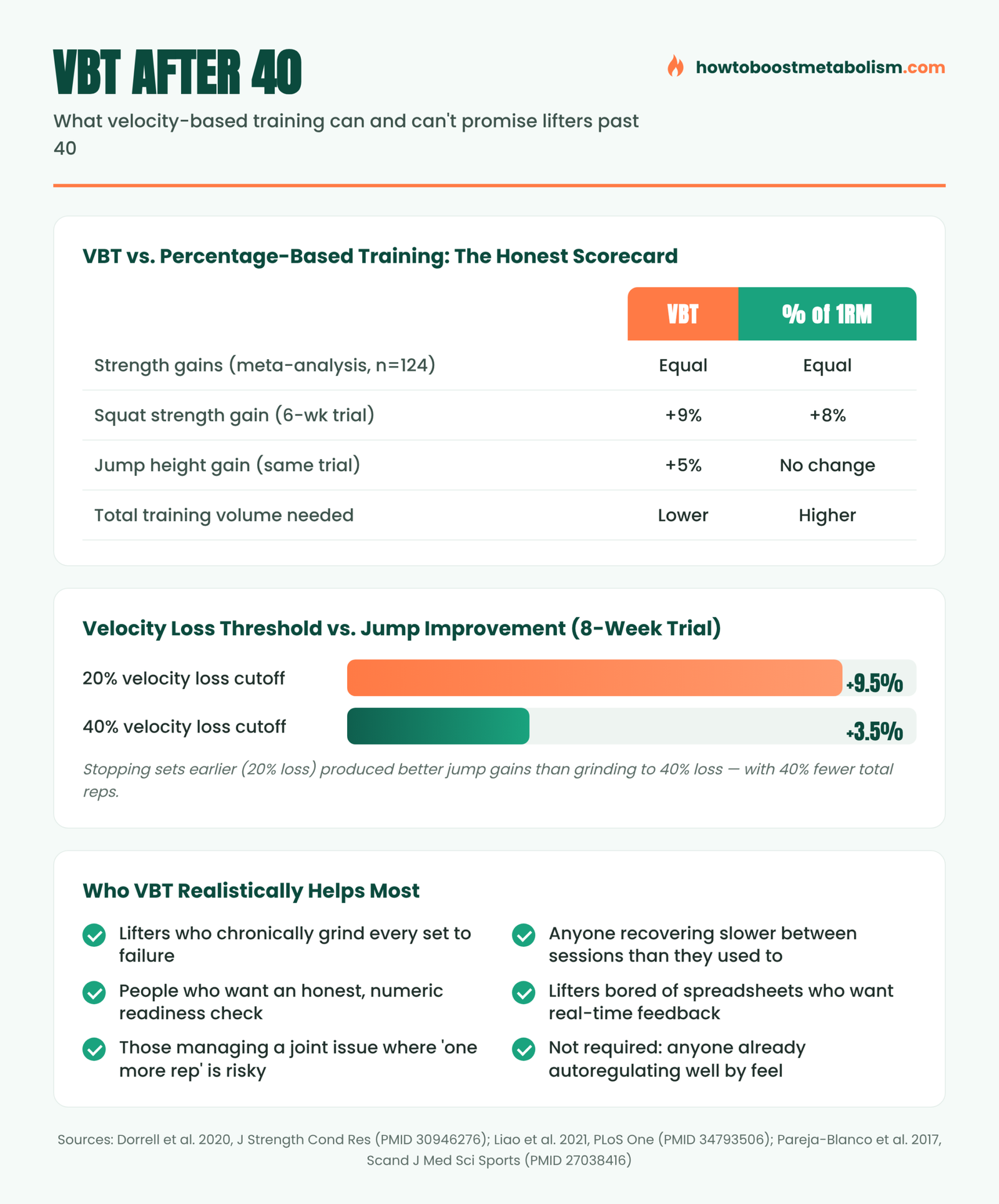
This is where the marketing around VBT tends to outrun the evidence. A 2021 systematic review and meta-analysis in PLoS One pooled six controlled trials comparing velocity-based training directly against traditional percentage-based training (Liao et al., 2021, PMID 34793506). Across back squat 1RM, jump height, sprint speed, and change-of-direction performance, the difference between the two methods was not statistically significant for any outcome. Both approaches worked. Neither reliably beat the other.
That doesn’t mean VBT is pointless — it means its advantage isn’t raw strength output. A smaller but frequently cited trial from the University of Lincoln (Dorrell et al., 2020, J Strength Cond Res, PMID 30946276) found something more interesting: a VBT group matched or slightly beat a percentage-based group on squat, bench, and overhead press strength gains, and uniquely improved jump height — while lifting a significantly lower total training volume to get there. In other words, the VBT group didn’t out-lift the other group; it got a similar result for less total work, mainly by stopping sets before they turned into grinding, fatigue-generating reps.
A larger 2022 meta-analysis pooling nine studies and 253 trained men did find VBT produced meaningful improvements in lower-body max strength, strength endurance, jump, and sprint performance versus no intervention or non-velocity training (Zhang et al., 2022, Int J Environ Res Public Health, PMID 35954603). The honest caveat, and it’s an important one for this audience: every participant in that pooled data was a trained male, most with at least a year of lifting experience, and none of the included trials specifically recruited lifters over 40. Nothing about the physiology suggests the effect wouldn’t transfer — but it hasn’t been directly tested in that population, so treat the strength numbers as a reasonable extrapolation, not a guarantee.
Free download
🔥 The Metabolism Starter Kit
3 honest guides: a 7-day reset plan, a foods cheat-sheet and 12 metabolism myths debunked. No spam — unsubscribe anytime.
The real advantage after 40: managing fatigue before it manages you
Here’s the piece of the research that’s actually most relevant to a lifter who doesn’t bounce back from a hard session the way they did at 25. A well-designed 2017 trial out of Spain had two groups train with the exact same squat program, differing only in how much bar-speed slowdown they allowed before ending a set — a 20% velocity loss cutoff versus a 40% cutoff (Pareja-Blanco et al., 2017, Scand J Med Sci Sports, PMID 27038416). The 20%-loss group ended sets earlier, performed about 40% fewer total reps across the 8-week program, and still matched the 40%-loss group’s squat strength gains — while getting noticeably better jump height improvements (9.5% vs. 3.5%) and smaller markers of muscle fatigue on biopsy.
That’s the actual case for VBT as a lifter gets older: it gives you an objective number for ‘this is turning into a grind, stop here’ instead of relying on willpower or guessing. A 2021 systematic review of elite-athlete VBT programs reached a similar practical conclusion — that allowing velocity losses in roughly the 10–20% range per set tends to produce good adaptations while limiting unnecessary fatigue, and that the real-time feedback itself (seeing your number on a screen) helps people actually stick to the plan instead of talking themselves into a few extra reps (Włodarczyk et al., 2021, Int J Environ Res Public Health, PMID 34069249). For someone managing a cranky lower back, a knee that doesn’t love high-rep squats anymore, or simply a work schedule that doesn’t allow three rest days before the next session, that kind of built-in brake is worth more than a theoretical strength edge.
At a glance: what the evidence actually supports
| Claim | What the research shows |
|---|---|
| Builds more raw strength than % of 1RM programming | Not shown — largest head-to-head meta-analysis found no significant difference |
| Can match strength results with less total volume | Yes — shown directly in a controlled 6-week trial |
| Helps limit excess fatigue and overreaching | Yes — this is its best-supported, most practical use |
| Tested specifically in lifters over 40 | No direct trials yet — evidence is extrapolated from trained younger adults |
| Requires expensive equipment to try | No — phone-based bar-speed apps exist; even an RPE-based proxy helps |
What you actually need to try this
You do not need a $300 linear position transducer to test whether this approach helps you. There are three realistic entry points, in order of cost:
- Free — the eyeball/phone-video method. Film your working sets from the side on your phone. If a rep visibly grinds, slows dramatically mid-rep, or your sticking point gets noticeably longer than your first rep of the set, that’s your velocity-loss signal. Crude, but free and better than nothing.
- Low cost — a velocity-tracking app. Several phone apps use the camera to estimate bar speed automatically and will flag when a rep crosses a velocity-loss threshold you set in advance. This is the most practical entry point for most home and commercial-gym lifters.
- Dedicated hardware. Clip-on linear position transducers are the most accurate option and what most of the research above was conducted with, but they’re a real purchase — reasonable for someone training seriously three-plus times a week, overkill for someone training twice a week for general health.
Common mistakes people make when they first try this
- Chasing a number instead of a result. Velocity loss is a tool for deciding when to stop a set, not a score to maximize. Fast bar speed on a weight that’s too light doesn’t build strength just because the number looks good.
- Picking an unrealistic cutoff. A 10% velocity-loss limit will end most sets after 2–3 reps on compound lifts — fine for peaking, frustrating and unnecessary for a general strength phase. 20% is a sensible default for most lifters most of the time.
- Ignoring that velocity varies lift to lift. A deadlift and a bench press don’t have the same speed profile at the same relative intensity — don’t apply one universal cutoff number across every exercise without separately establishing it.
- Expecting it to replace recovery basics. VBT can tell you that you’re fatigued. It can’t fix the sleep, protein intake, or stress load that’s causing the fatigue in the first place.
A simple way to add this to your current program
You don’t need to rebuild your whole program around this. The lowest-friction way to use it after 40: keep your current main lifts and rep ranges exactly as they are, but pick one compound lift per session — usually whichever one tends to feel the grindiest — and apply a 20% velocity-loss stopping rule to it for a month. Track, by feel or by app, when a set crosses that threshold, and end the set there even if your plan called for two more reps. Compare how you feel the next day versus your usual approach of hitting a fixed rep target regardless of bar speed. Most people who try this notice the difference in next-day soreness and joint comfort well before they notice any difference on the scale or the bar.
Related reading: if load autoregulation and training volume are new concepts for you, our guides to progressive overload after 40, training volume landmarks (MEV/MAV/MRV), when deload weeks actually help, and periodization styles for lifters past 40 all cover the surrounding pieces of this puzzle in more depth.
Free download: our Metabolism Starter Kit — a protein calculator, a 7-day meal framework, and a one-page supplement checklist, with zero hype.
Get the Free Starter Kit →Whether or not you track bar speed, the bigger lever after 40 is a program that respects recovery. Return to Prime is a training program for men over 40 that targets the recovery and hormonal systems that quietly decline with age.
Learn More →Affiliate link — we may earn a commission at no extra cost to you. Disclosure
Frequently Asked Questions
Do I need to buy a velocity-tracking device to benefit from this?
No. A phone-based velocity app or even careful visual judgment of bar speed on video can capture most of the practical benefit — using speed as a stopping signal rather than grinding every set to a fixed rep count. Dedicated hardware is more precise but not required to try the underlying principle.
Is velocity-based training actually proven to build more muscle than normal programming?
No — the best available head-to-head meta-analysis found no significant strength advantage over traditional percentage-based training. Its demonstrated advantage is achieving similar results with less total volume and better day-to-day fatigue management, not superior muscle or strength gains.
What velocity-loss cutoff should a lifter over 40 use?
Around 20% velocity loss per set is a reasonable, well-studied default for most strength work. Lower cutoffs (10%) are more conservative and appropriate when managing a joint issue or during a lighter phase; higher cutoffs allow more total volume for lifters specifically chasing hypertrophy.
Has this actually been tested in people over 40?
Not directly. The controlled trials behind these numbers were conducted in trained younger adults, mostly men in their 20s. The physiological logic for extending the fatigue-management benefits to older lifters is sound, but no published trial has specifically recruited a 40-plus sample.
Can velocity-based training replace tracking percentages altogether?
It can complement percentages rather than replace them. Most practical programs use percentages or RPE to pick a starting weight, then use velocity loss within the set as a readiness and stopping guide on top of that — the two approaches aren’t mutually exclusive.
This article is for educational purposes and is not medical advice. Consult a qualified healthcare provider before starting a new training program. See our Medical Disclaimer.