Overhead Press After 40: Protect Your Shoulders
This article may contain affiliate links. If you buy through them, we may earn a small commission at no extra cost to you. See our Affiliate Disclosure and Medical Disclaimer.
Affiliate Disclosure · Medical Disclaimer
Somewhere in your late 30s or 40s, overhead pressing starts to feel different. Maybe there’s a pinch at the top of the movement that wasn’t there a few years ago, or a friend told you pressing overhead ‘wrecks your shoulders’ past a certain age. The research tells a more specific, more useful story than a blanket warning: shoulder problems in lifters are real and measurable, but they’re tied to particular movement patterns and muscle imbalances — not to overhead pressing as a category. Done with the right exercise selection and some scapular groundwork, pressing overhead after 40 is not the shoulder-destroyer it’s sometimes made out to be.
How common is shoulder impingement in lifters, really?
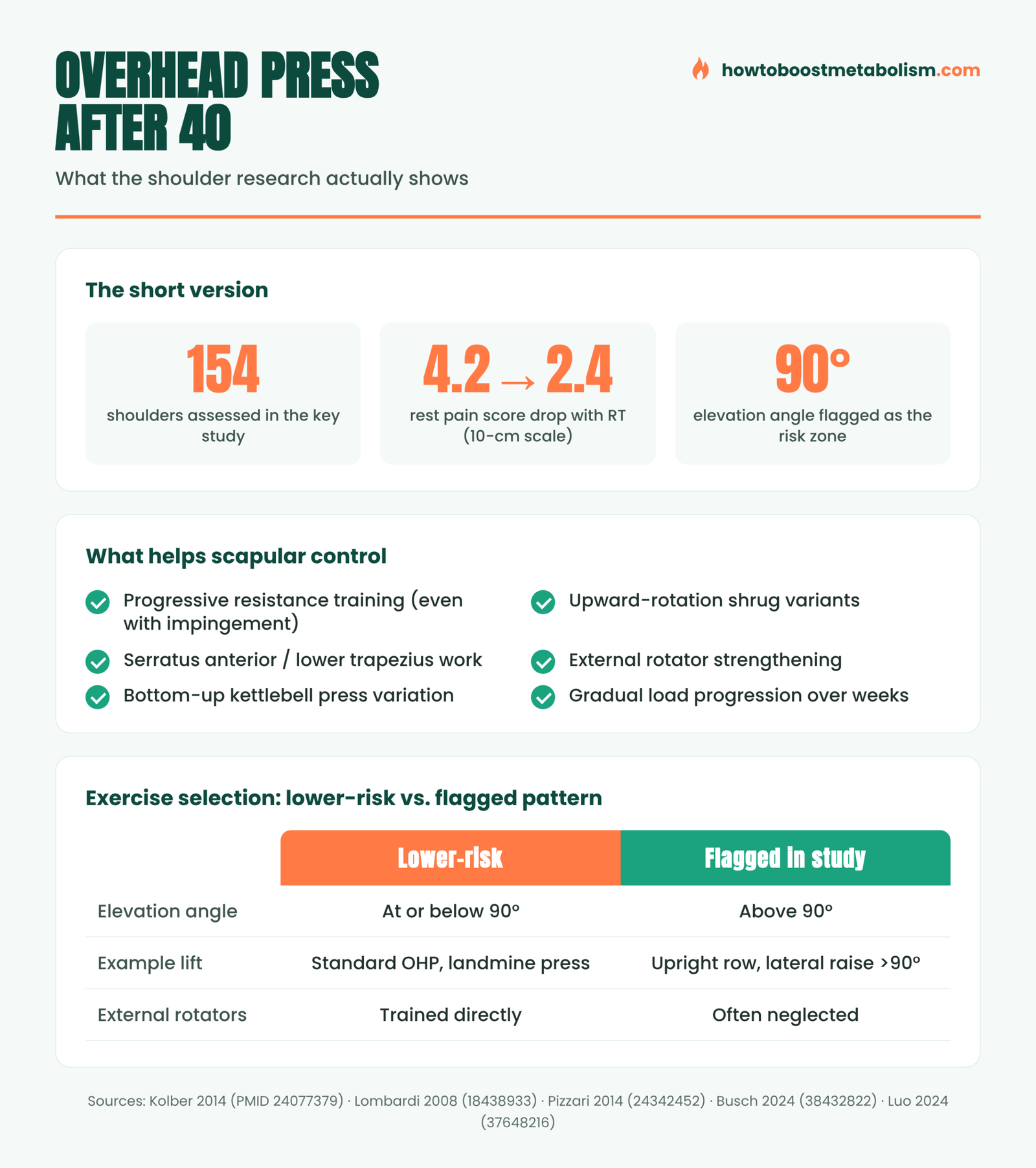
A case-controlled study in the Journal of Strength and Conditioning Research (Kolber et al., 2014) assessed 154 shoulders across 77 men — 46 who weight-trained at least twice a week and 31 non-lifting controls — using two validated clinical tests for subacromial impingement syndrome (SIS): the painful arc sign and the Hawkins-Kennedy test. The weight-training group showed significantly more combined-positive results on these tests than controls. But the more useful finding was about which specific exercises were associated with those signs: lateral deltoid raises and upright rows performed above 90 degrees of shoulder elevation were significantly associated with SIS characteristics, while strengthening the external rotators (the small rotator-cuff muscles that control the ball of the shoulder in its socket) was inversely associated — meaning people who trained them tended to show fewer signs of impingement. Overhead pressing itself wasn’t the variable singled out here; two specific high-elevation lateral movements were.
Does strengthening make an already-irritated shoulder worse?
This is the question that matters most if your shoulder already bothers you, and the answer from the trial evidence is reassuring. A randomized controlled trial in Arthritis & Rheumatism (Lombardi et al., 2008) put 60 patients already diagnosed with shoulder impingement syndrome (mean age roughly 55) through a twice-weekly, 2-month progressive resistance training program for the shoulder musculature, compared with a wait-and-see control group. The training group’s rest pain dropped from 4.2 to 2.4 on a 10-point scale (p < 0.001), pain during movement dropped from 7.4 to 5.2 (p < 0.001), and function scores improved significantly more than in the control group. In other words: progressive, structured resistance training was a treatment for existing shoulder impingement, not a risk factor to avoid while it heals. That single finding reframes a lot of the fear around pressing after 40 — the answer to shoulder pain is rarely 'never load it again.'
Free download
🔥 The Metabolism Starter Kit
3 honest guides: a 7-day reset plan, a foods cheat-sheet and 12 metabolism myths debunked. No spam — unsubscribe anytime.
The scapula is doing more work than people realize
A healthy overhead press depends on the shoulder blade rotating upward in sync with the arm raising — a coordination pattern that can break down with age, desk-bound posture, or simply neglecting the muscles responsible for it. Two of the main players are the lower trapezius and the serratus anterior, both of which help rotate and stabilize the scapula as the arm goes overhead. When these muscles underperform relative to the upper trapezius (the muscle most people default to using for any shoulder shrug or stabilization effort), the shoulder blade doesn’t rotate properly, and the space available for the rotator cuff tendons to glide through narrows — a mechanical setup for the same impingement signs identified above.
Shrug variations aren’t all equal
A study in Clinical Biomechanics (Pizzari et al., 2014) compared a standard shrug with an ‘upward rotation shrug’ performed at 30 degrees of shoulder abduction instead of 0. The modified version produced significantly higher activation of the upper trapezius, lower trapezius, and — in a healthy population — the serratus anterior and middle trapezius as well. A follow-up study in Human Movement Science (Lee et al., 2016), in people with diagnosed scapular downward rotation syndrome, found a ‘stabilization shrug’ variant produced the biggest increase in scapular upward rotation angle, while a ‘frontal shrug’ was best for raising raw upper trapezius activity. The practical thread across both studies: how you shrug — the arm angle and cueing — changes which muscles actually do the work, and the standard straight-up shrug most people default to isn’t necessarily the best version for scapular health.
Even your grip on the weight matters
An EMG study in the Journal of Bodywork and Movement Therapies (Busch et al., 2024) compared overhead presses performed with a dumbbell, a standard kettlebell grip, and a kettlebell held bottom-up (balanced upside-down above the fist) at equal loads. The bottom-up kettlebell grip produced significantly greater serratus anterior activation than either the standard kettlebell or the dumbbell, while the dumbbell produced more medial deltoid and lower trapezius activity than the kettlebell. No single implement won across every muscle — which is itself a useful finding. Rotating pressing implements, rather than pressing the same bar or dumbbell the same way every session, appears to spread the training stimulus across more of the muscles that stabilize the shoulder blade.
What a real rehab protocol for existing impingement looks like
A randomized trial in the Journal of Athletic Training (Luo et al., 2024) put 41 recreational overhead athletes with diagnosed shoulder impingement through a 30-minute training protocol built around three exercises strengthening the lower trapezius and serratus anterior, specifically designed not to let the upper trapezius dominate the movement. One group got electromyographic biofeedback and verbal cues to consciously activate the right muscles; the other didn’t. Both groups improved scapular upward rotation and muscle activation patterns, along with measurable changes in corticospinal excitability — essentially, the brain’s connection to those muscles got stronger. The biofeedback group saw an extra edge in lower trapezius activation. The practical lesson for a home or gym setting, without lab equipment: deliberately feeling for the lower-trap-and-serratus engagement during scapular exercises, rather than running through the reps on autopilot, likely matters.
At a glance: what the research supports
| Factor | Associated with more shoulder trouble | Associated with less / improvement |
|---|---|---|
| Elevation angle on lateral/pulling work | Above 90° (upright rows, lateral raises) | At or below 90° |
| External rotator training | Often skipped | Inversely linked to impingement signs |
| Progressive resistance training with existing impingement | — | Reduced pain, improved function in an RCT |
| Scapular shrug variant | Standard straight shrug (less effective) | Upward-rotation / stabilization shrug |
| Pressing implement variety | Same grip every session | Rotating dumbbell / KB / bottom-up KB |
A simple weekly add-on, not a new program
None of this research calls for throwing out your current program and replacing it with a shoulder rehab routine. It calls for a small, consistent addition. A reasonable version, based on the exercises used in the studies above, might look like: 2 sets of an upward-rotation or stabilization shrug variant (arm at roughly 30 degrees of abduction rather than straight down) for 12–15 reps, performed with a deliberate mental cue to feel the lower trap and serratus anterior working rather than the traps on top of the shoulder; a direct external-rotation exercise with a light band or cable for 2–3 sets of 12–15; and, once or twice a week, swapping your usual pressing implement for a bottom-up kettlebell press or a landmine press at submaximal loads to vary the stabilizer demand. None of this needs to replace your main pressing lift — it sits alongside it, typically at the end of an upper-body session, and takes under ten minutes.
Why age makes this more relevant, not less
None of the studies above were testing age directly as the variable of interest, but the populations they drew from skew toward exactly the lifters this matters most for: the shoulder impingement study’s patient group averaged in the mid-50s, and general shoulder-health literature consistently notes that scapular control, rotator cuff tendon quality, and the balance between the upper and lower portions of the trapezius tend to drift unfavorably with years of desk work, prior injuries, and training habits that favor the ‘mirror muscles’ — chest, front delts, upper traps — over the less visible stabilizers on the back of the shoulder blade. That drift doesn’t happen overnight, and it doesn’t happen to everyone, but by your 40s it has usually had two or three decades to compound. The fix isn’t dramatic; it’s the kind of unglamorous, consistent accessory work described above, done for months rather than days.
Putting it together: pressing overhead after 40
None of this amounts to ‘avoid overhead pressing.’ It amounts to a short list of adjustments worth making: keep an eye on how much upright-row and lateral-raise volume above shoulder height you’re doing, since that specific pattern — not pressing — is the one flagged in the research; don’t skip external rotator work, since it was the one strengthening habit inversely linked to impingement signs; add a scapular-focused shrug variant or two, cued deliberately rather than performed on autopilot; and if your shoulder already aches, know that the evidence favors structured, progressive strengthening over backing off entirely. Shoulder pain that’s sharp, constant, worsening, or accompanied by night pain or weakness still deserves an in-person evaluation — this isn’t a substitute for that — but for the common, nagging ache that shows up with age, the research points toward training through it intelligently rather than training around it forever.
One more honest caveat worth sitting with: most of the exercise-selection findings here come from a single case-controlled study, and most of the scapular-mechanics findings come from small EMG and biomechanics trials, not large multi-year outcome studies tracking who actually develops shoulder pain over a decade of training. That’s the nature of this corner of sports-medicine research — it’s mechanistic and short-term rather than longitudinal. The practical takeaways above are a reasonable, evidence-informed bet based on what’s currently available, not a guarantee, and they’re worth revisiting as better long-term research comes out.
Free download: our Metabolism Starter Kit — a protein calculator, a 7-day meal framework, and a one-page supplement checklist, with zero hype.
Get the Free Starter Kit →Related reading
For more on training around joints and tendons as they age, see our guides to dead hangs and grip/tendon health after 40, isometric training for joint pain after 40, and why unilateral training earns a place in a 40+ program.
Frequently Asked Questions
Should I stop overhead pressing if my shoulder hurts sometimes?
Not automatically. A randomized trial found that progressive resistance training actually reduced pain and improved function in people who already had diagnosed shoulder impingement syndrome, compared with a wait-and-see control group. Pain during pressing is a signal to adjust load, range, or exercise selection — not necessarily a reason to abandon pressing altogether. If pain is sharp, worsening, or accompanied by numbness or weakness, that’s a reason to get it assessed rather than push through.
Are upright rows and lateral raises really worse for the shoulder than pressing?
One case-controlled study found that upright rows and lateral deltoid raises performed above 90 degrees of shoulder elevation were specifically associated with signs of subacromial impingement in weight-training participants, while strengthening the external rotators was associated with fewer such signs. That’s a narrower finding than ‘pressing is bad’ — it points at specific high-elevation lateral movements, not overhead pressing as a category.
What’s a ‘bottom-up’ kettlebell press and is it worth doing?
It’s a kettlebell overhead press held with the bell balanced upside-down above your fist instead of resting against your forearm. An EMG study found this grip specifically increased activation of the serratus anterior, a key scapular-stabilizing muscle, more than a standard kettlebell or dumbbell press. It’s a useful accessory variation for building scapular control, not a required replacement for your main pressing lift.
What exercises actually help scapular control?
Research on shrug variations found that an ‘upward rotation shrug’ performed with the arm raised to about 30 degrees activates the upper and lower trapezius more than a standard shrug, and a ‘stabilization shrug’ variant produced the biggest increase in scapular upward rotation angle in people with scapular dyskinesis. Lower-trapezius and serratus-anterior focused exercises, done consistently, are the common thread across the rehab research.
How long before scapular-focused work actually changes anything?
In a controlled trial, a 30-minute scapula-focused training protocol performed by recreational overhead athletes with existing shoulder impingement produced measurable improvements in muscle activation patterns and scapular control within the study’s training period of several weeks — not a single session, but not a multi-year commitment either. Consistency over weeks, not perfection in any one workout, is what the research protocols have in common.