Rest Periods Between Sets After 40, Explained
This article may contain affiliate links. If you buy through them, we may earn a small commission at no extra cost to you. See our Affiliate Disclosure and Medical Disclaimer.
Scroll through enough fitness content and you’ll get a confident, specific-sounding rule: rest 90 seconds for muscle, 3 minutes for strength, period. It’s tidy, it’s quotable, and it’s based on real research — but mostly research done in young, already-trained men. Once you’re past 40, with different recovery capacity, different joint tolerance, and often less time per session, the honest answer gets more interesting: the research doesn’t point to one universal number, and in at least one direct test, older lifters responded the opposite way from the textbook recommendation.
What “Rest Interval” Actually Changes
The pause between sets isn’t dead time — it determines how much weight you can lift on the next set, how many total reps you accumulate across a workout, and how much metabolic and hormonal stress the session produces. Shorter rest means more fatigue carried into each subsequent set, which can either stimulate more muscle growth (via metabolic stress) or simply mean you lift less weight for fewer reps — and which of those two things wins out is exactly what the research has tried to pin down.
See also: tennis elbow in lifters
Why Rest Interval Even Matters: Two Competing Theories
For years, the standard explanation for “short rest builds more muscle” was hormonal: shorter rest between sets produces a bigger spike in growth hormone and testosterone immediately after training, and those hormones were assumed to drive extra muscle growth. That theory has mostly fallen apart under closer scrutiny — the acute post-workout hormone spike turns out to correlate poorly with actual long-term hypertrophy, and some of the best hypertrophy outcomes in the literature have come from longer-rest protocols that produce a smaller hormonal spike, not a bigger one.
Further reading: Best Rep Range for Muscle vs. Fat Loss
The more current explanation centers on total training volume and mechanical tension instead. Longer rest means less residual fatigue carried into each set, which means you can lift heavier loads and complete more total quality repetitions across a session — more mechanical work done close to your actual capacity, set after set. Short rest, by contrast, lets you finish a workout faster but often at the cost of lifting lighter loads or stopping reps short as fatigue compounds across sets. Both pathways can build muscle; they just trade off session length against per-set quality in different ways, which is a big part of why the research doesn’t converge on one single “best” number across every population and goal.
Free download
🔥 The Metabolism Starter Kit
3 honest guides: a 7-day reset plan, a foods cheat-sheet and 12 metabolism myths debunked. No spam — unsubscribe anytime.
The Baseline Finding: Longer Rest Wins for Strength and Size — in Young Trained Men
The most frequently cited study here (Schoenfeld et al., 2016, Journal of Strength and Conditioning Research) put 21 young, resistance-trained men through 8 weeks of identical total-body training, with the only difference being 1-minute rest (SHORT) versus 3-minute rest (LONG) between sets. The result was unambiguous for this population: 1-rep-max squat and bench press strength increased significantly more in the LONG group, and muscle thickness in the front of the thigh also grew more with LONG rest, with a similar trend in the triceps. Local muscular endurance improved equally in both groups. This study is a big part of why “rest longer for size and strength” became the default advice.
Related: BFR training after 40
Systematic reviews mostly back this up, with caveats. One review of inter-set rest and hypertrophy (Grgic et al., 2017, European Journal of Sport Science) concluded that both short and long rest intervals can build muscle, but that the newer, more sensitive studies in trained lifters suggest a possible edge for longer rest — while flagging that there still aren’t enough directly comparable studies to call this settled. A companion review focused specifically on strength (Grgic et al., 2018, Sports Medicine) found that short rest intervals (under 60 seconds) can still produce real strength gains, but that rest periods over 2 minutes appear necessary to fully maximize strength in already-trained lifters — while untrained beginners did just fine with 60–120 seconds. A third review focused purely on the mechanistic evidence (Henselmans & Schoenfeld, 2014, Sports Medicine) reached a similarly measured conclusion: the long-term hypertrophy data, while limited in quantity, generally doesn’t support the older assumption that short, metabolically stressful rest periods are automatically superior for building muscle.
Related: deload weeks after 40
Then Older Lifters Got Tested Separately — and the Picture Shifted
Here’s where the generic advice runs into a real limitation: almost none of the above studies enrolled anyone over 40. When researchers have tested rest intervals specifically in older adults, the results haven’t simply mirrored the young-trained-men data.
Older Men: Shorter Rest Won an 8-Week Head-to-Head
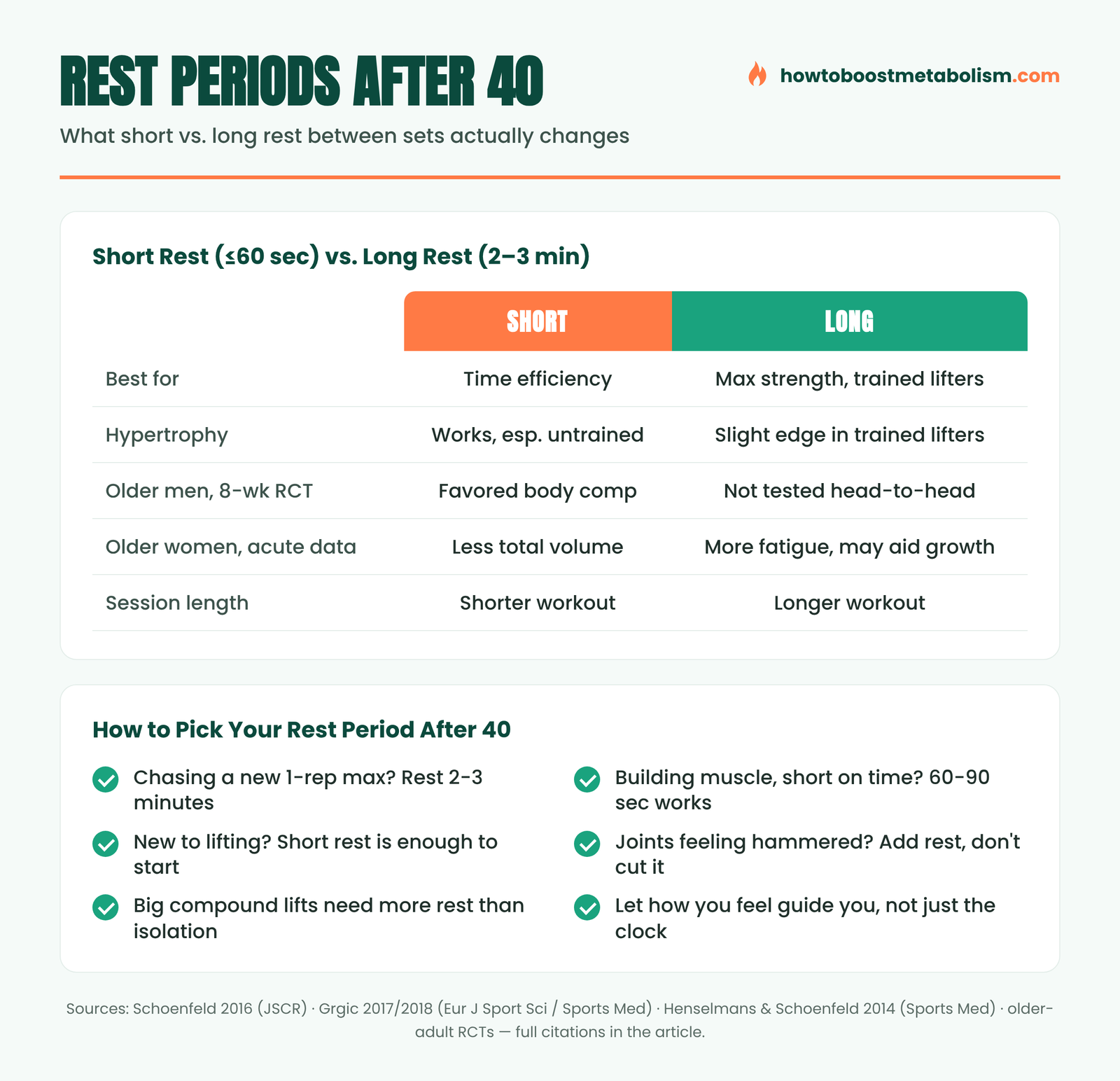
In a study of older men (published in the European Journal of Applied Physiology, 2015), an 8-week strength-training phase comparing short rest intervals against extended rest intervals found the short-rest group came out ahead — significantly greater increases in lean body mass, bench press 1RM, leg press 1RM, lat pulldown strength, and stair-climbing power, compared with the long-rest group. The authors’ own conclusion was direct: shortened rest intervals produced greater enhancements in body composition and muscular performance in older men than the same program with extended rest — the opposite direction from what the Schoenfeld trial found in young trained men.
Older Women: Longer Rest Reduced Fatigue — With a Caveat on What That Predicts
A separate study in trained older women (Jambassi Filho et al., 2020, Journal of Strength and Conditioning Research) compared 1-minute versus 3-minute rest across three sets taken to failure. The 3-minute condition allowed significantly more total training volume and time under tension, and produced noticeably greater acute strength loss immediately after the session — a sign of harder, more complete sets. The researchers’ interpretation was that this higher per-session workload from longer rest “may” support greater long-term strength and hypertrophy gains in older women, though — importantly — this particular study measured only the acute, single-session response, not actual changes over weeks of training, so it’s a reasonable inference rather than a proven outcome.
See also: Does Cardio Cancel Out Your Strength Gains?
Put those two findings side by side and the honest conclusion is that age clearly changes something about the short-vs-long-rest equation, but not in one consistent direction across every study, every sex, and every outcome measured. That’s a genuinely unsettled area of the research — not a case where a tidy number is being hidden from you.
So What Should You Actually Do?
Rather than hunting for one universal number, it’s more useful to rest according to what you’re actually training for on a given day:
Related: linear vs. undulating periodization for lifters over 40
- Training for maximum strength or a true 1-rep max on big compound lifts (squat, deadlift, bench, overhead press): rest 2–3 minutes. The strength evidence, including in the specific older-adult studies above, consistently favors more complete recovery between heavy efforts.
- Training primarily for muscle size and you’re short on time: 60–90 seconds is a reasonable, evidence-supported default, especially if you’re newer to structured lifting.
- New to resistance training in general: don’t overthink this. Short-to-moderate rest (60–120 seconds) is sufficient to build both strength and muscle while you’re in the early, fast-progress phase.
- Joints feeling beat up, or recovering from a layoff: err toward more rest, not less — rushing the clock to “get a better pump” isn’t worth sacrificing form on the next set.
- Isolation exercises (curls, lateral raises, leg extensions) can generally use shorter rest than heavy compound lifts regardless of your training goal — the fatigue they produce is more localized and recovers faster.
One more practical point the research doesn’t often spell out: your own sense of readiness is a legitimate input, not just “the clock.” If you’re still breathing hard and your grip or bar speed feels noticeably off at the official rest-period cutoff, taking another 30–60 seconds costs you very little and likely protects the quality of the next set.
It’s also worth separating two different kinds of fatigue that longer rest helps manage differently after 40: muscular fatigue (can your muscles produce force right now) and systemic fatigue (how your joints, connective tissue, and nervous system feel across the whole session, and the next day). The controlled trials above mostly track the first kind, because it’s easier to measure in a lab. The second kind is harder to study but matters just as much in practice — if you consistently feel beat up the day after training at a given rest interval, that’s useful information even without a published study backing it, and it’s reasonable to add rest until that feeling resolves.
| Goal | Suggested Rest | What the Evidence Shows |
|---|---|---|
| Max strength / 1RM work | 2–3 minutes | Favored in young trained men and in both older-adult studies above |
| Muscle size, time-efficient | 60–90 seconds | Comparable hypertrophy to longer rest in several trials; faster session |
| Beginners (any age) | 60–120 seconds | Sufficient for strength gains per systematic review data |
| Isolation / accessory work | 45–75 seconds | Localized fatigue recovers faster than big compound lifts |
A Simple Template to Try This Week
If you’d rather have a concrete starting point than keep juggling rules, here’s a reasonable full-body template that respects the goal-based guidance above: begin with your heaviest compound lift of the day (squat, deadlift, bench, or overhead press variant) for 3–4 sets, resting 2–3 minutes between sets. Move to one or two secondary compound movements (rows, lunges, incline press) for 3 sets, resting 90–120 seconds. Finish with 2–3 isolation or accessory exercises (curls, lateral raises, calf raises, core work) for 2–3 sets, resting 45–75 seconds. This structure naturally front-loads your best recovery toward the lifts where it matters most for strength, while keeping total session length manageable by shortening rest once the stakes per set are lower.
Further reading: Muscle Soreness (DOMS): What It Actually Signals
A Note on Structure, Not Just Timing
Rest interval is one dial among several — training volume, load, and exercise selection all interact with it. If you’re trying to figure out how many total sets per week make sense for your schedule and recovery, our guide to training volume landmarks (MEV, MAV, MRV) covers that piece directly. If time efficiency is the real constraint driving your rest-period question, it’s also worth comparing supersets versus straight sets and cluster sets versus traditional sets — both are structured ways to manage fatigue and session length without simply guessing at a rest number.
Free download: our Metabolism Starter Kit — a protein calculator, a 7-day meal framework, and a one-page supplement checklist, with zero hype.
Get the Free Starter Kit →Interestingly, the one study above in older men favored short rest periods — and short rest (around 30-40 seconds) is the core of Old School New Body‘s F4X method, which uses moderate weights and brief sets specifically for people over 40. If you want a program built on that principle, it’s a direct match. One honest caveat: ignore the age-related statistics on its sales page — they aren’t sourced — and judge the program by its structure, not the copy.
A program built on exactly the short-rest approach the older-adult data favored:
Check Availability →Affiliate link — we may earn a commission at no extra cost to you. Disclosure
Frequently Asked Questions
How long should you rest between sets after 40?
There’s no single universal number, but a practical default is 2–3 minutes for heavy strength work on big compound lifts, and 60–90 seconds for muscle-building work when you’re short on time. The research in older adults specifically is mixed — one trial in older men found shorter rest produced better body-composition and strength results, while a study in older women found longer rest reduced acute fatigue and may support better long-term gains — so matching rest to your specific goal matters more than chasing one fixed rule.
See also: Does Lifting Slower Build More Muscle?
Is short rest between sets bad for people over 40?
Not based on the available evidence. One controlled 8-week trial in older men found shortened rest intervals actually produced greater gains in lean mass, strength, and stair-climbing power than extended rest. Short rest is not inherently harmful at this age — it’s a legitimate option, particularly for muscle-building goals or time-limited sessions.
Does resting longer between sets build more muscle?
In young, already-trained men, one well-controlled study found longer rest (3 minutes) produced greater muscle thickness gains than short rest (1 minute). But systematic reviews note that both short and long rest intervals can produce real hypertrophy, and the advantage for long rest is most consistent in trained lifters rather than beginners — and wasn’t the pattern seen in the one available older-men trial.
Should rest periods be different for strength training versus bodybuilding-style training?
Generally yes. The strength-focused evidence favors longer rest (2–3 minutes, or more for very heavy near-maximal lifts) to allow fuller recovery between high-effort attempts. For muscle-size-focused training, shorter rest (60–90 seconds) produces comparable results in several trials while cutting total workout time — useful if your sessions need to fit a tighter schedule.
Do rest periods matter less for isolation exercises like bicep curls?
Somewhat, yes. Isolation exercises create more localized fatigue that tends to recover faster than the full-body fatigue from heavy compound lifts like squats or deadlifts, so shorter rest (45–75 seconds) is generally reasonable there even on days when you’re using longer rest for your main compound lifts.