
Barbell vs. Dumbbell Training After 40
This article may contain affiliate links. If you buy through them, we may earn a small commission at no extra cost to you. See our Affiliate Disclosure and Medical Disclaimer.
It’s one of the oldest arguments in any gym: barbell purists insist nothing builds real strength like a loaded bar, while dumbbell advocates point to better range of motion, less strain on finicky joints, and the ability to train without a spotter. After 40, the question gets more practical and less tribal — you’re weighing real trade-offs around joint comfort, available equipment, and how much time you actually have, not just chasing the biggest number on a lift. Here’s what the research on muscle activation, strength outcomes, and training stability actually shows, and how to use it to choose rather than just pick a side.
What a Barbell Gives You That a Dumbbell Doesn’t
The simplest, least controversial advantage of a barbell is load. You can put far more absolute weight on a barbell than you can manage with a pair of dumbbells, both because the bar distributes load symmetrically and because dumbbells become awkward to handle, rack, and stabilize well before you hit the loads a strong lifter can barbell-squat or deadlift. If your primary goal is moving the heaviest possible weight — training for a true 1-rep max, or simply enjoying the specific feeling of progressive heavy loading — the barbell remains the standard tool for a reason.
Related: Overhead Press After 40
EMG research backs up a modest activation edge for barbell pressing in some comparisons. One study (Saeterbakken et al., published in the Journal of Sports Science & Medicine) compared the barbell bench press against dumbbell flyes and found higher overall muscle activation in the pectoralis major, anterior deltoids, and triceps for the barbell version across most of the lift’s range — though it’s worth being precise here: that study compared a barbell press to dumbbell flyes specifically, a different movement pattern, not a dumbbell press. The flye’s horizontal arm path did show a real advantage of its own, with 57–86% higher biceps brachii activation than the barbell press — useful in specific training contexts, even if it doesn’t match the barbell’s chest and triceps numbers.
See also: The No-Equipment Home Workout That Boosts Metabolism After 40
What Changes When You Compare Barbell, Dumbbell, and Machine Directly
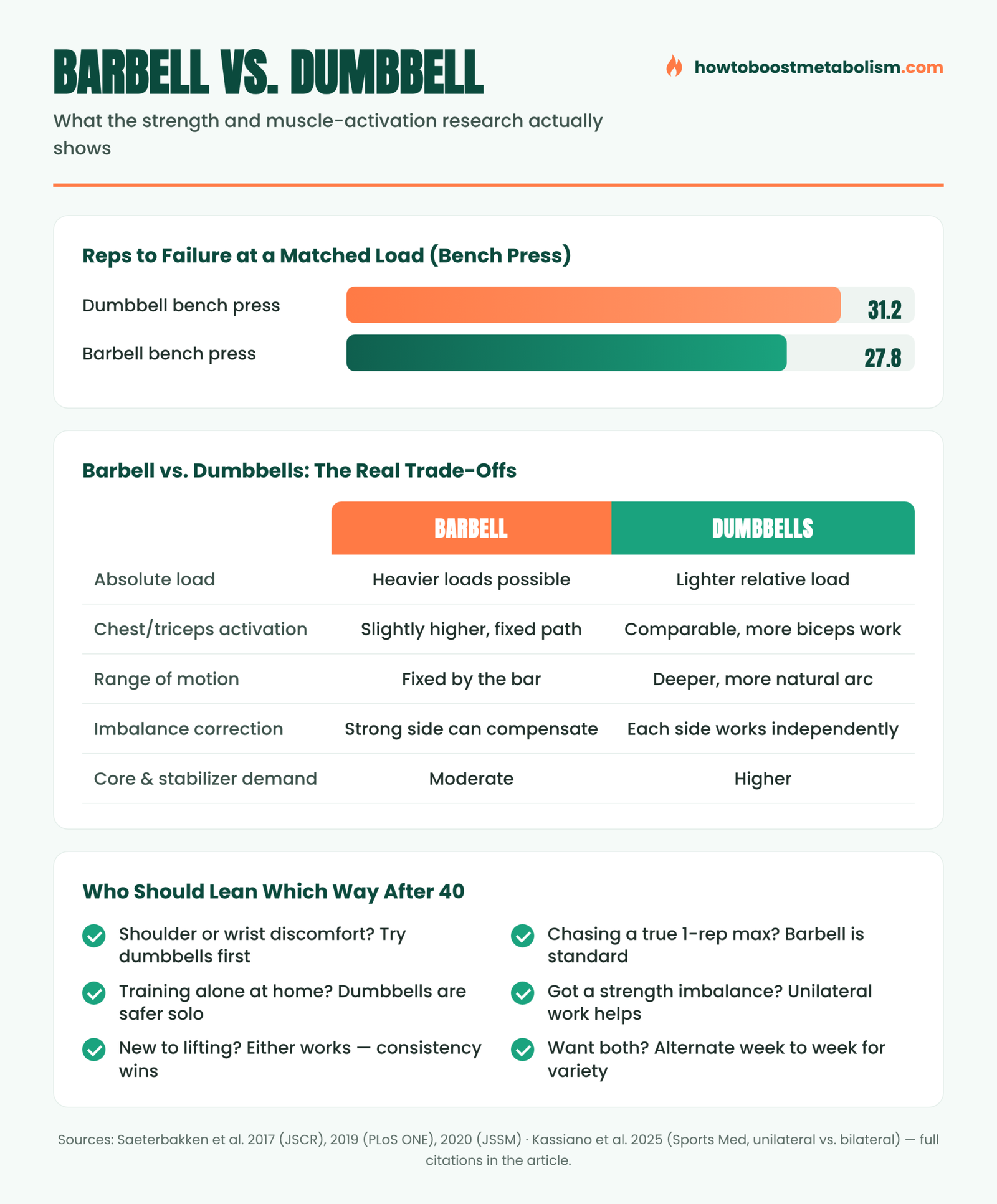
A more directly relevant study (Saeterbakken et al., 2017, Journal of Strength and Conditioning Research) tested dumbbell, barbell, and Smith-machine bench press back to back in the same trained lifters, measuring both total repetitions and muscle activation. The dumbbell bench press allowed significantly more total repetitions to failure than the barbell version (31.2 vs. 27.8 reps at a matched relative load) — likely because the lighter absolute load per hand, even at the same percentage of effort, lets the smaller stabilizing muscles hold on longer. Muscle activation also differed by modality: the dumbbell version produced significantly greater pectoralis major activation than the barbell version, and the Smith machine produced greater anterior deltoid activation than either free-weight option. The practical message here isn’t “one tool wins” — it’s that each modality shifts the activation pattern slightly, and all three remain legitimate training options.
See also: best rep range for muscle vs. fat loss
Free download
🔥 The Metabolism Starter Kit
3 honest guides: a 7-day reset plan, a foods cheat-sheet and 12 metabolism myths debunked. No spam — unsubscribe anytime.
Does the Extra Stability Demand of Dumbbells Actually Build More Muscle?
This is the theory behind a lot of “dumbbells are better because they force more stabilization” claims — and it’s only partly supported. A controlled study comparing training groups across different stability demands (Saeterbakken et al., 2019, PLoS ONE) had participants train for 10 weeks using free weights, a wobble board (highest instability), or a Smith machine (most stable), and found similar improvements in muscle thickness, rate of force development, and maximal voluntary contraction across all three conditions. The high-stability (Smith machine) group actually showed greater strength improvement in the specific trained exercise than the other two. In other words, extra instability didn’t translate into extra muscle growth in this trial — it mainly demanded more skill and balance, which is a different kind of benefit than bigger muscles.
Further reading: BFR training after 40
Related work on core muscle activation (Saeterbakken et al., Journal of Strength and Conditioning Research) found free-weight squats and Smith-machine squats produced similar core muscle activation to each other, both higher than a leg press — supporting the idea that it’s “free weights vs. a fixed machine” that matters most for core engagement, more than “barbell vs. dumbbell” specifically, since both are free-weight tools.
The Unilateral Advantage: Where Dumbbells Have a Genuine, Different Job
The strongest, most distinct case for dumbbells after 40 isn’t about muscle growth at all — it’s about training each side of your body independently, which a barbell structurally cannot do. A recent systematic review and meta-analysis (Sports Medicine, 2025) pooled nine studies comparing unilateral (one-limb-at-a-time) and bilateral (both-limbs-together) resistance training and found no significant difference in muscle hypertrophy between the two approaches. But strength gains followed a clear principle of specificity: bilateral training produced a bigger improvement in bilateral strength, while unilateral training produced a bigger improvement in unilateral strength. If you’ve ever noticed one side feels noticeably weaker, more fatigued, or less coordinated than the other — common after 40, especially after an old injury on one side — dumbbell work addresses that directly in a way a barbell generally doesn’t, because each arm or leg has to manage its own load rather than letting the stronger side quietly take over.
You may also find this useful: grip strength: the longevity marker you can train
Beyond Pressing: Squats, Rows, and Lunges
Most of the controlled research above focuses on pressing movements, simply because the bench press is the easiest lift to standardize across a barbell, dumbbell, and machine version in a lab. The same general pattern holds up reasonably well for lower-body and pulling work, though: a barbell back squat lets you load more total weight than a pair of dumbbells ever will, which matters if your priority is maximum lower-body strength. A dumbbell goblet squat or dumbbell lunge, on the other hand, is easier to learn with good form, puts less compressive load through the spine for a given level of leg fatigue, and — like dumbbell pressing — trains each leg to carry and stabilize its own share of the load. Rows follow a similar split: a barbell row lets you move serious total weight with both arms together, while a one-arm dumbbell row lets you dial in effort and range of motion independently on a side that might be weaker, tighter, or recovering from an old injury.
What About Joint Comfort? The Honest Limitation in the Research
This is the claim you’ll see most often in casual gym advice — “dumbbells are easier on your shoulders and wrists” — and it deserves an honest caveat: there isn’t a large body of controlled research directly measuring joint pain outcomes between barbell and dumbbell training specifically in lifters over 40. What does support the idea is biomechanical: a barbell forces both hands into one fixed, straight bar path and one fixed grip width, while dumbbells let your wrists, elbows, and shoulders travel in their own natural arc and rotate independently. For anyone with a shoulder that doesn’t love a fixed barbell bench path, or a wrist that complains about a locked-in grip, that freedom of movement is a genuinely useful practical option to try — it’s a reasonable, biomechanically grounded recommendation, just not one backed by the same kind of head-to-head injury-outcome trial as the strength and activation findings above.
Further reading: Supersets vs. Straight Sets
| If You… | Lean Toward | Why |
|---|---|---|
| Want the heaviest possible loads / true 1RM testing | Barbell | Higher absolute load capacity, standard for max-strength testing |
| Have shoulder, wrist, or elbow discomfort on fixed-bar lifts | Dumbbells | Natural, independent joint path — biomechanically reasonable, even without a dedicated injury trial |
| Have a noticeable left/right strength imbalance | Dumbbells | Unilateral training builds unilateral strength more directly (meta-analysis) |
| Train alone without a spotter | Dumbbells | Can bail out of a failed rep more safely than a stuck barbell |
| Want maximum chest activation per set in pressing | Dumbbells, slightly | Significantly greater pectoralis major EMG vs. barbell in direct comparison |
A Practical Way to Use Both
You don’t actually have to choose one tool for life. A sensible approach after 40 is to keep your heaviest, most structurally demanding compound lifts — squat, deadlift, overhead press — on a barbell when you have access to one and your joints tolerate it well, since that’s where the load-capacity advantage matters most. Then use dumbbells for pressing variations when a shoulder is cranky, for rows and lunges where unilateral loading is genuinely useful, and as your primary tool entirely if you’re training at home with limited equipment or without a training partner.
If you’re newer to structured strength training, or returning to it after a long break — which describes a lot of people starting to lift seriously for the first time after 40 — a complete, already-sequenced program removes the guesswork of building this kind of balance yourself from scratch. The research above is useful for understanding why a program is built a certain way, but it doesn’t replace the value of simply following a structured plan consistently rather than redesigning your training every week based on the latest comparison study you read.
Old School New Body’s F4X method was built specifically around efficient, joint-conscious training for beginners and lifters returning to the gym after 40 — using a format that leans on dumbbells and bodyweight work precisely because they’re more forgiving on cranky joints while you rebuild a base of strength.
Check Availability →Affiliate link — we may earn a commission at no extra cost to you. Disclosure
If equipment access or stability is the real question behind your barbell-vs-dumbbell decision, our guide to resistance bands vs. free weights covers a related trade-off, and unilateral training after 40 goes deeper into the one-side-at-a-time question raised above. For a full breakdown of the program referenced here, see our honest Old School New Body review.
Free download: our Metabolism Starter Kit — a protein calculator, a 7-day meal framework, and a one-page supplement checklist, with zero hype.
Get the Free Starter Kit →Related: Footwear is another variable worth getting right for your squat setup. We break down the biomechanics research in do weightlifting shoes help squat depth after 40.
Frequently Asked Questions
Is barbell training better than dumbbell training for building muscle?
Not clearly, based on the available head-to-head research. Direct comparisons of barbell, dumbbell, and machine pressing find different muscle-activation patterns rather than one modality being consistently superior — dumbbells produced more pectoralis major activation and allowed more total reps in one study, while barbells showed a modest overall activation edge over dumbbell flyes in another. Both can build real muscle.
Are dumbbells easier on the joints than barbells?
This is widely believed and biomechanically reasonable — dumbbells allow a more natural, independent range of motion for each arm or leg instead of locking both hands to one fixed bar path — but there isn’t a large body of controlled research directly measuring joint-pain outcomes between the two specifically. If a fixed barbell path bothers a shoulder or wrist, trying dumbbells is a sensible, low-risk experiment.
Do dumbbells build more core strength than a barbell?
Research on stability demands suggests free-weight exercises (both barbell and dumbbell) tend to produce similar core muscle activation to each other, and both tend to activate the core more than a fixed machine like a leg press. The bigger core-activation factor appears to be “free weight vs. fixed machine” rather than “barbell vs. dumbbell” specifically.
Should I use dumbbells if I have a strength imbalance between my left and right side?
Likely yes for at least part of your training. A 2025 systematic review and meta-analysis found unilateral (one-limb) training produces greater gains in unilateral strength specifically, following the principle of training specificity, while bilateral training better improves bilateral (two-limb) strength. Since dumbbells allow true independent-limb training, they’re a direct tool for addressing a known imbalance.
Can beginners over 40 start with dumbbells instead of a barbell?
Yes. Dumbbells are a complete, legitimate way to build strength and muscle, particularly useful for beginners because they’re easier to learn, don’t require a spotter, and allow you to bail out of a failed rep safely. A barbell becomes more valuable once you’re specifically chasing maximum absolute loads or testing a true 1-rep max, which usually isn’t the priority in the first months of training.