
Tennis Elbow in Lifters: What Actually Works
This article may contain affiliate links. If you buy through them, we may earn a small commission at no extra cost to you. See our Affiliate Disclosure and Medical Disclaimer.
Affiliate Disclosure · Medical Disclaimer
You don’t have to play tennis to get tennis elbow. In a gym, it usually shows up after weeks of heavy grip work, farmer’s carries, dumbbell rows, or one too many high-rep curl sessions — a dull, then sharp, ache on the outside of the elbow that flares every time you grip a barbell or shake someone’s hand. The medical name is lateral epicondylalgia (also written lateral epicondylitis), and it is one of the most common overuse injuries in people who train their arms and grip hard and often. The good news: it has been studied in dozens of randomized trials, and the evidence points toward a fairly clear, if slow, path back to pain-free lifting.
What’s actually going on in the elbow
The muscles that extend your wrist and fingers — the ones that fight gravity every time you hold a loaded barbell, a pull-up bar, or a suitcase carry — all originate from a small bony bump on the outside of the elbow called the lateral epicondyle. Lateral epicondylalgia is a breakdown of that tendon origin, most often involving the extensor carpi radialis brevis (ECRB) tendon specifically. Despite the old name ‘tennis elbow,’ it isn’t really inflammation in the classic sense — it’s a tendon that has been loaded faster than it can adapt, developing disorganized collagen and small areas of degeneration. That distinction matters because it’s part of why anti-inflammatory approaches alone tend to underperform compared with loading-based rehab.
Why lifters get it
- Heavy or high-volume grip work — farmer’s carries, dead hangs, thick-bar holds
- Rowing and pulling movements with a lot of wrist extension under load
- High-rep wrist curls, reverse curls, or forearm-focused accessory work added too quickly
- A sudden jump in climbing, grip-sport, or racquet-sport training volume
- Poor grip variety — always using the same grip width and wrist angle on pulling lifts
The eccentric-exercise evidence
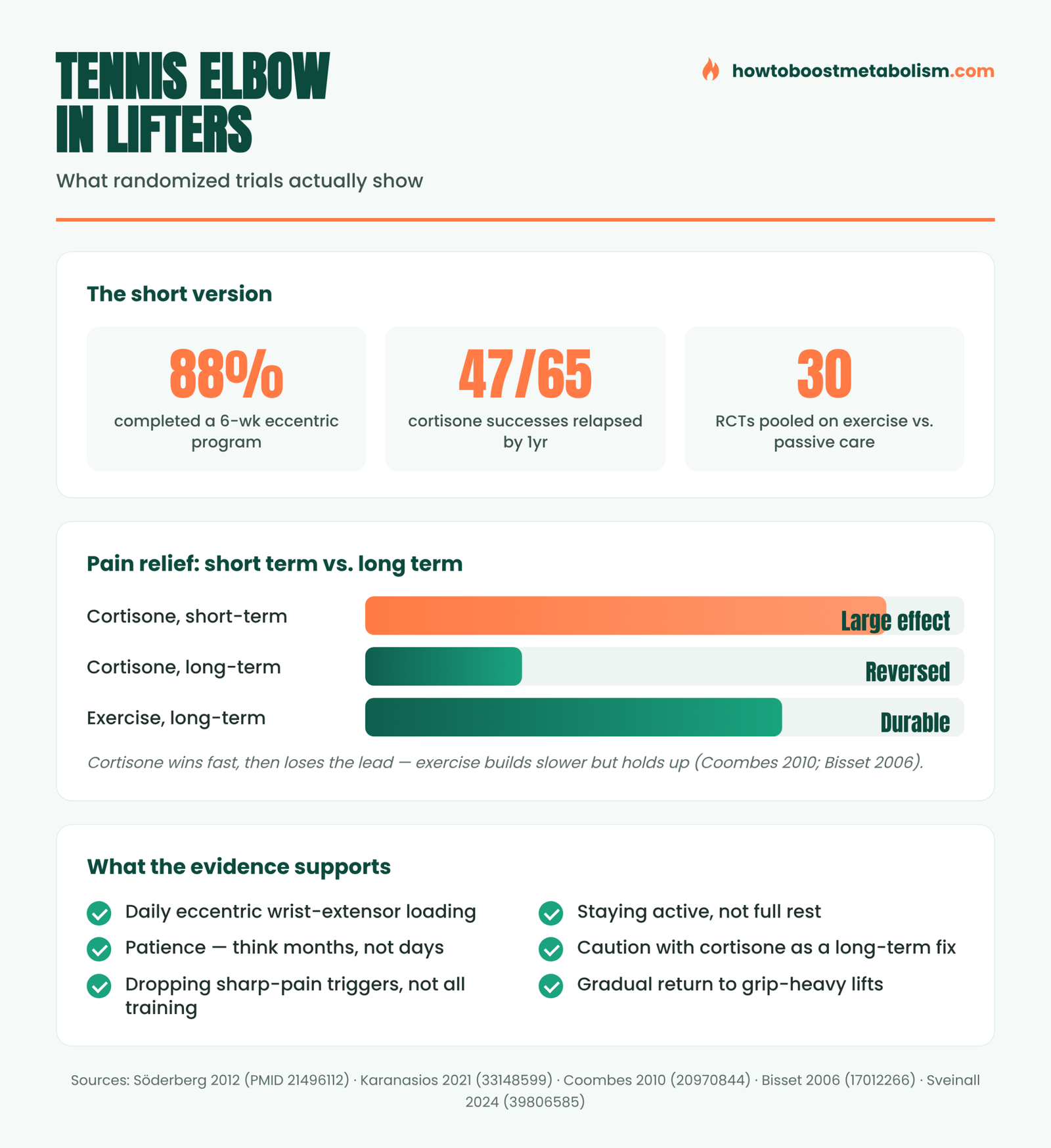
The single best-studied intervention for lateral epicondylalgia is eccentric loading of the wrist extensors. In a randomized-controlled trial published in the Scandinavian Journal of Medicine & Science in Sports (Söderberg et al., 2012), 42 people with long-term lateral epicondylalgia were split into a 6-week home eccentric-exercise group and a forearm-band-only control group. By the end of the 6 weeks, the exercise group had significantly higher pain-free grip strength and wrist-extensor strength, and fewer of them still met the clinical criteria for epicondylalgia. Notably, the effect wasn’t visible yet at the 3-week mid-point — it took the full 6 weeks of daily work to show up, and global pain ratings didn’t improve significantly even though strength did. That’s a useful, honest detail: eccentric training rebuilds tendon capacity measurably before it necessarily makes the ache go away.
Free download
🔥 The Metabolism Starter Kit
3 honest guides: a 7-day reset plan, a foods cheat-sheet and 12 metabolism myths debunked. No spam — unsubscribe anytime.
Does exercise actually beat other treatments?
A 2021 systematic review and meta-analysis in the British Journal of Sports Medicine (Karanasios et al., 2021) pooled 30 randomized trials and 2,123 participants comparing exercise with passive treatments for lateral elbow tendinopathy. Exercise outperformed corticosteroid injections on nearly every outcome at every time point except short-term pain — including pain-free grip strength at short, mid, and long-term follow-up. But the authors were upfront that the certainty of evidence was low to very low, and that the effect sizes, while statistically real, were small. In plain terms: exercise is the better long-term bet based on the available trials, but it isn’t a miracle fix, and results vary a lot between studies because programs differ so much in load, frequency, and duration.
The cortisone trap: fast relief, worse long-term odds
This is the part most people never hear before they get an injection. A landmark systematic review in The Lancet (Coombes et al., 2010), covering 41 trials and 2,672 participants, found that corticosteroid injections produced a large reduction in pain for lateral epicondylalgia in the short term (4 weeks) — but that advantage reversed by the intermediate term (26 weeks) and stayed reversed at the long term (52 weeks), with no treatment actually outperforming injections at those later points on average.
A separate randomized trial in the BMJ (Bisset et al., 2006) put a sharper number on it: corticosteroid injection beat physiotherapy and a wait-and-see approach at 6 weeks, but 47 of the 65 initial successes in the injection group had relapsed by the time researchers checked back at 52 weeks — a far higher recurrence rate than either physiotherapy or simply waiting it out. The authors’ own conclusion was that the short-term benefit of cortisone is ‘paradoxically reversed,’ and that it should be used cautiously. That doesn’t make injections useless — if you need to be pain-free for a specific event in the next two weeks, it’s a legitimate short-term tool — but it’s not a substitute for rehab, and the data suggest it may even set you up for a harder relapse.
Is it really tennis elbow?
Before you commit to months of rehab, it’s worth ruling out a few look-alikes. Radial tunnel syndrome — compression of a nerve branch running near the same spot — can mimic lateral epicondylalgia but tends to ache lower down the forearm and worsen with forearm rotation rather than wrist extension alone. Elbow osteoarthritis and loose bodies in the joint can also cause lateral elbow pain, especially in lifters who are also older or have a history of elbow trauma. The hallmark signs that point toward classic lateral epicondylalgia are pain localized directly over the bony bump on the outside of the elbow, pain reproduced by resisted wrist extension or gripping, and tenderness you can press on and reliably recreate. If your pain doesn’t fit that pattern, or if you notice numbness, tingling, or weakness beyond grip strength, that’s a reason to see a physical therapist or sports medicine physician rather than self-treating.
Why the forearm tendon behaves differently
It’s tempting to borrow rehab protocols wholesale from bigger tendons — the Achilles, the patellar tendon — since they’re the most heavily studied. But the wrist extensor tendons at the elbow are smaller, see constant low-level loading throughout the day (typing, carrying bags, turning a doorknob), and rarely get full rest the way a knee tendon might between workouts. That constant background load is probably part of why the heavy slow resistance approach that works well for knee and Achilles tendinopathy backfired in the 2024 feasibility trial above: the elbow tendon was already working overtime outside the gym, and adding heavy, slow loading on top of that tipped it into more pain rather than adaptation. It’s also why many clinicians now start lateral epicondylalgia rehab with lighter, higher-frequency loading — closer to the Söderberg protocol — before progressing to heavier work, rather than jumping straight to maximal loads.
A reality check on heavy slow resistance training
Heavy slow resistance (HSR) training has become a popular tendinopathy protocol for problems like jumper’s knee and Achilles tendinopathy, so it’s tempting to assume it transfers directly to tennis elbow. A 2024 feasibility trial in BMJ Open (Sveinall et al., 2024) tested exactly that, randomizing patients with lateral epicondylalgia to HSR training, shockwave therapy, or advice. The honest result: only 6 of 19 participants (32%) actually complied with the HSR protocol, mainly because it aggravated their pain. The researchers concluded HSR training in its tested form ‘was not suitable’ for a chunk of tennis elbow patients — a useful reminder that a strategy that works beautifully for knee or Achilles tendons doesn’t automatically transfer to the smaller, more irritable tendons around the elbow. Lighter, more gradual eccentric loading — like the Söderberg protocol above — has a better track record here.
At a glance: treatment options for lateral epicondylalgia
| Approach | Short-term (0–6 wks) | Long-term (3–12 mo) | What the trials say |
|---|---|---|---|
| Daily eccentric exercise | Slow to build | Strong, durable | Best-supported option; needs 6+ weeks of consistency |
| Corticosteroid injection | Large pain relief | High relapse rate | Useful short-term bridge, not a long-term fix |
| Heavy slow resistance (HSR) | Often aggravates pain | Unclear — low adherence | May be too aggressive early on for this tendon |
| Physiotherapy (manual + exercise) | Better than wait-and-see | Comparable to cortisone, less relapse | Solid, well-tolerated middle ground |
A simple, evidence-informed starting point
None of this is a substitute for an in-person assessment, especially if pain is severe, worsening, or involves numbness or tingling. But based on the trial evidence above, a reasonable starting framework for a lifter with early lateral epicondylalgia looks like this:
- Identify and temporarily lighten (don’t necessarily eliminate) the specific lifts that reproduce sharp pain — often heavy curls, thick-bar carries, or high-rep rowing
- Add a daily eccentric wrist-extensor exercise: holding a light dumbbell, slowly lower the wrist from extended to flexed over 3–5 seconds, using the other hand to reset it back up — 3 sets of 10–15, most days of the week
- Keep training everything that doesn’t provoke sharp pain — lower body, pressing, and non-aggravating pulling patterns
- Reassess pain-free grip strength weekly rather than day-to-day pain, since strength tends to improve before pain fully resolves
- Give the plan at least 6 full weeks before judging it, and expect 3–6 months for a complete return to heavy grip-dependent lifts
Free download: our Metabolism Starter Kit — a protein calculator, a 7-day meal framework, and a one-page supplement checklist, with zero hype.
Get the Free Starter Kit →How this connects to the rest of your training
If grip and tendon health is becoming a recurring theme in your training after 40, it is worth reading our honest look at dead hangs and the real evidence on grip and tendon health, our guide to why grip strength is tracked as a longevity marker, and our breakdown of loaded carries and farmer’s walks after 40 — all three sit right in the same forearm-and-tendon territory that tennis elbow comes from.
Frequently Asked Questions
Is tennis elbow the same thing as golfer’s elbow?
No. Tennis elbow (lateral epicondylalgia) affects the tendons on the outside of the elbow that attach to the wrist extensor muscles, usually from gripping, pulling, or repetitive wrist extension. Golfer’s elbow (medial epicondylalgia) is the mirror-image problem on the inside of the elbow, tied to the wrist flexors. Lifters can get either, but the lateral version is far more common in people who do heavy grip work, carries, rows, and curls.
Do I need to stop lifting completely until it heals?
Usually not. Complete rest tends to make tendon pain come back as soon as you resume training, because the tendon never adapts to load. The randomized-trial evidence instead supports relative rest from the specific movements that provoke sharp pain, combined with a structured loading program for the wrist extensors, while keeping everything else in your program running.
Should I get a cortisone injection?
Think carefully before you do. A large systematic review of 41 randomized trials found corticosteroid injections for lateral epicondylalgia clearly beat other treatments on pain in the first few weeks, but that advantage reversed at 3 and 6 months, with one trial reporting that 47 of 65 initial successes had relapsed by the long-term follow-up. If you need fast relief for a specific event, an injection is a legitimate option — just go in knowing the longer-term picture favors exercise.
How long does it actually take to recover?
Plan in months, not days. In the trials above, meaningful improvements in pain-free grip strength showed up by 3 to 6 weeks of daily eccentric work, but full resolution and a full return to heavy pulling and carrying commonly takes 3 to 6 months. Lateral epicondylalgia is a slow-healing tendon problem, and rushing the comeback is the most common reason it becomes a recurring issue.
What should I actually do in the gym this week?
Drop or lighten any exercise that reproduces sharp elbow pain — usually heavy curls, thick-bar carries, or high-rep rowing — without stopping training entirely. Add a short daily eccentric wrist-extensor exercise (below), keep training everything else that doesn’t hurt, and reintroduce grip-heavy lifts gradually as pain-free grip strength improves over several weeks.