

MEV, MAV, MRV: How Many Sets Do You Need?
This article may contain affiliate links. If you buy through them, we may earn a small commission at no extra cost to you. See our Affiliate Disclosure and Medical Disclaimer.
If you’ve spent any time in a gym forum or a fitness app’s “program builder,” you’ve probably run into the acronyms MEV, MAV, and MRV. They sound like they belong on a spreadsheet, not in a workout — and that’s roughly right. They come from the world of competitive bodybuilding periodization, popularized by coaches like Mike Israetel, and they’re a genuinely useful way to think about how many sets per week you need for a given muscle group. The problem is that most explanations either oversimplify them into a fixed number (“do 10–12 sets, always”) or bury the actually useful part under jargon. This article does the opposite: what the terms mean, what the dose-response research says about weekly set volume, and — since this site skews toward readers training after 40 — how the picture changes once recovery capacity isn’t what it was at 25.
Prefer not to calculate your own volume landmarks every few weeks? A structured 12-week program already schedules the progression for you.
Learn More →Affiliate link — we may earn a commission at no extra cost to you. Disclosure
What MEV, MAV, and MRV Actually Mean
All three terms describe a range of weekly training sets for a single muscle group, not a single magic number. They sit on a continuum:
- MV (maintenance volume) — the bare minimum weekly sets needed to keep the muscle and strength you already have, without building more.
- MEV (minimum effective volume) — the smallest amount of weekly training that still produces measurable, continued progress. Below this, you’re essentially maintaining, not improving.
- MAV (maximum adaptive volume) — the volume range that produces the best rate of progress for your current recovery capacity. This is where most structured hypertrophy programs try to park you.
- MRV (maximum recoverable volume) — the most volume you can do in a week and still recover from it before the next session. Beyond this, performance and recovery start trending backward.
None of these are fixed physiological constants. They move depending on your training age, your sleep, your stress, your diet, and — relevant here — your actual age. A useful way to think about it: MEV, MAV, and MRV aren’t numbers you look up, they’re a framework for noticing when you’re undertraining, appropriately training, or digging a hole you can’t recover from.
Where These Terms Come From — and Where They Don’t
It’s worth being upfront: the acronyms themselves are coaching shorthand, not terms you’ll find in a peer-reviewed paper’s methods section. That doesn’t make them useless — it means the honest way to use them is to anchor them to the actual dose-response literature on weekly set volume, which does exist and is fairly consistent, rather than to any single influencer’s exact numbers.
Free download
🔥 The Metabolism Starter Kit
3 honest guides: a 7-day reset plan, a foods cheat-sheet and 12 metabolism myths debunked. No spam — unsubscribe anytime.
What the Dose-Response Research Actually Shows
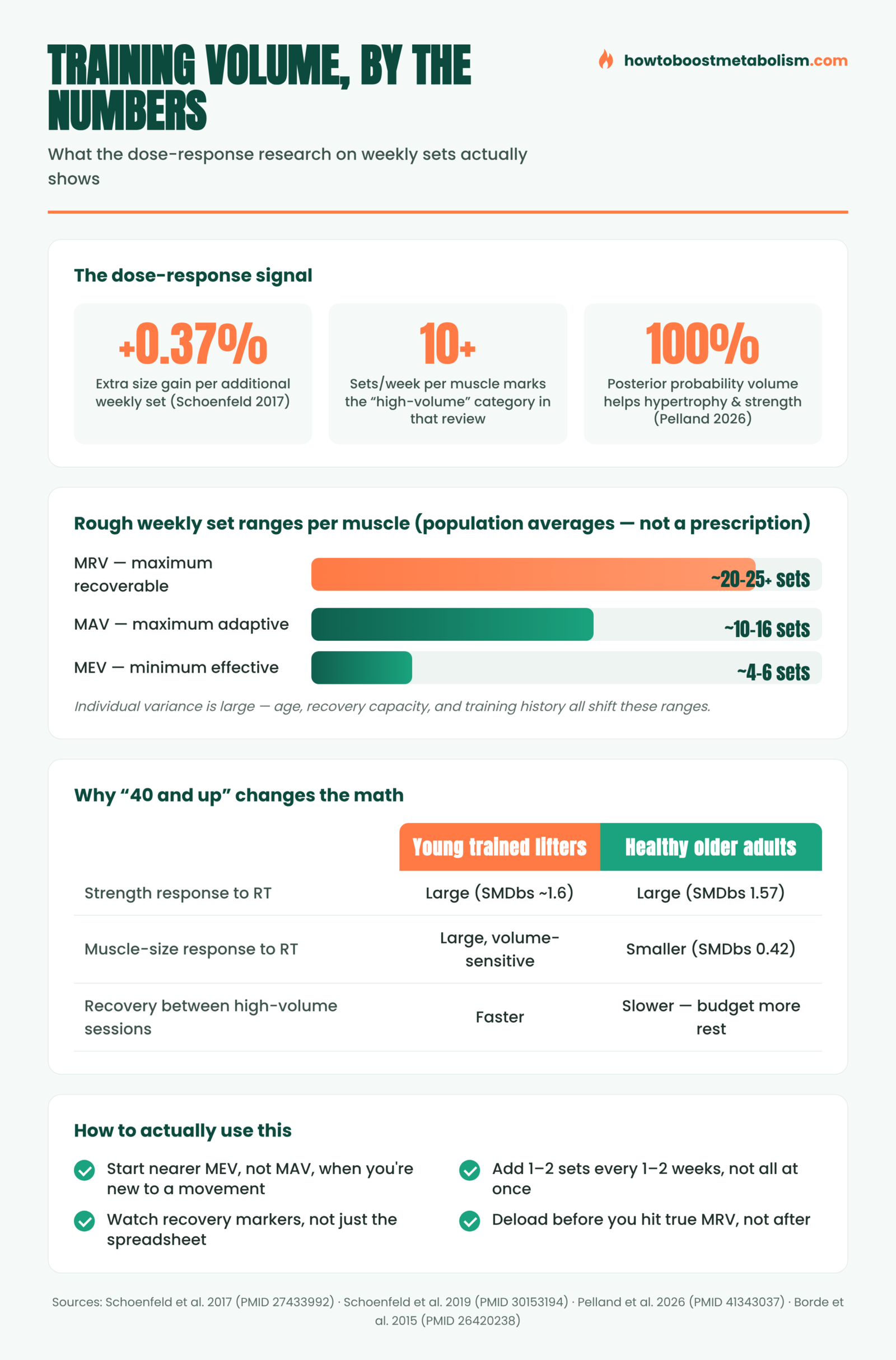
The foundational paper here is a 2017 systematic review and meta-regression by Schoenfeld, Ogborn, and Krieger, pooling 34 treatment groups across 15 studies. Each additional weekly set per muscle was associated with a further 0.37% gain in muscle size, and when the data was split into weekly-set categories — fewer than 5, 5–9, and 10 or more sets per muscle per week — the higher-volume group showed a meaningfully larger size increase than the lower-volume group (a 3.9 percentage-point difference in effect) (https://pubmed.ncbi.nlm.nih.gov/27433992/).
A follow-up controlled trial from the same lead author in 2019 tested this directly in resistance-trained men: one group did 1 set per exercise per session, another did 3, and another did 5, all three times a week for 8 weeks. Strength gains ended up similar across all three groups — more volume didn’t make people meaningfully stronger here — but muscle size gains at the elbow flexors, elbow extensors, and both thigh sites were significantly larger in the higher-volume groups. That’s a useful nuance: volume and strength don’t scale together the way volume and size often do (https://pubmed.ncbi.nlm.nih.gov/30153194/).
The newest entry is a 2026 meta-regression by Pelland and colleagues, which re-ran this question with a cleverer method — splitting sets into “direct” and “indirect” contributions depending on how specific they were to the muscle being measured — across 67 studies and over 2,000 participants. The headline finding: the probability that more weekly volume improves both size and strength was effectively 100%, but both relationships show diminishing returns, and that flattening curve is far more pronounced for strength than for size. In other words, past a certain point, more sets keep buying you a little more muscle but almost nothing extra in the way of strength (https://pubmed.ncbi.nlm.nih.gov/41343037/).
Put together, these three papers are the actual evidence behind the MEV→MAV→MRV curve: volume helps, up to a point, with real individual variation in exactly where that point sits.
| Landmark | Typical weekly range | What it means in practice |
|---|---|---|
| MEV (minimum effective) | ~4–6 sets/week/muscle | Enough to maintain and make slow progress |
| MAV (maximum adaptive) | ~10–16 sets/week/muscle | Where most hypertrophy-focused lifters park |
| MRV (maximum recoverable) | ~20–25+ sets/week/muscle | Upper ceiling before recovery breaks down |
These ranges are population averages pulled from the pooled research above, not a personal prescription — a beginner, a detrained 50-year-old, and an advanced lifter with a decade of training history can have genuinely different numbers.
Why the Math Shifts After 40
A 2015 systematic review by Borde, Hortobágyi, and Granacher looked specifically at dose-response relationships in healthy older adults (mean age 65+), pooling 25 randomized controlled trials. Resistance training produced large improvements in strength (a pooled effect size of 1.57) but much smaller improvements in muscle size (effect size 0.42) — a noticeably bigger gap between strength gains and size gains than you typically see in younger trained populations (https://pubmed.ncbi.nlm.nih.gov/26420238/).
The practical takeaway isn’t that strength training stops working after 40 — it clearly doesn’t, and the strength gains in that review were substantial. It’s that the relationship between sets, size, and strength isn’t identical to what a 25-year-old competitive bodybuilder experiences. Expect strength to respond strongly to moderate volume; expect visible size gains to take more patience and more total training time at a given volume. It also means recovery becomes the binding constraint sooner: pushing toward MRV without matching sleep, protein, and recovery days is a faster route to a stall after 40 than it was at 25.
A Practical Weekly Template
If you’re not interested in tracking landmarks precisely, a reasonable default most lifters over 40 can run for months without burning out:
- Weeks 1–2: Start near MEV — roughly 4–6 sets per muscle per week, especially for any movement pattern you haven’t trained in a while.
- Weeks 3–8: Add 1–2 sets per muscle every week or two, moving toward the MAV range (roughly 10–16 sets), as long as recovery between sessions stays normal.
- Week 9 or when progress stalls: Hold at your current MAV for 1–2 weeks rather than pushing toward MRV — then take a deload week before trying to progress further.
- Repeat the cycle, reassessing your personal MEV/MAV/MRV every few months as training age increases.
Common Mistakes With Volume Landmarks
- Jumping straight to MRV because a program online says “20 sets a week builds muscle fastest.” It might — for someone with their recovery capacity, not necessarily yours.
- Counting junk volume: a set taken nowhere near effort (far from failure, sloppy form) doesn’t count the same as a set that actually challenged the muscle. The dose-response data above comes from sets performed with real effort.
- Never deloading, so volume creeps upward every week until recovery collapses and you lose a month to overuse soreness or a tweaked joint.
- Changing programs every few weeks, which resets your effective training age and keeps you perpetually near MEV instead of letting volume tolerance build over months.
Tracking Your Own Landmarks Without a Lab
You don’t need a sports-science lab to get a rough, personal read on where your own MEV, MAV, and MRV sit. A simple, low-tech method that tracks reasonably well with the research above:
- Pick one tracking metric per muscle group — usually total reps completed at a given load, or simply whether your top set’s weight or reps went up week over week.
- Hold volume steady for 2 weeks at your starting point and confirm performance is at least stable, not declining. That’s a sign you’re at or above your current MV.
- Add 1–2 sets per muscle every 1–2 weeks while performance keeps improving or holding steady — this is the MEV-to-MAV climb.
- Stop adding volume the moment performance stalls or soreness stops resolving within 48–72 hours — you’ve likely found your current MAV ceiling, with MRV somewhere just above it.
- Reassess every 8–12 weeks, since training age, sleep, stress, and body composition all shift these numbers over time.
This kind of self-tracking is exactly what the research above is formalizing: a graded, individualized response to volume that you can approximate with a notebook and some patience, without needing to guess at someone else’s exact numbers from a program you downloaded online.
Where a Structured Program Removes the Guesswork
Calculating your own MEV, MAV, and MRV from scratch — and adjusting them every few weeks — is exactly the kind of ongoing math a lot of people would rather not do forever. This is the appeal of a pre-built, periodized program that schedules the volume progression for you. Old School New Body, a program built by Steve and Becky Holman specifically for the 40-plus demographic, structures its sets and progression week to week so you’re not hand-calculating landmarks on a spreadsheet. One honest caveat: the program’s own sales page cites statistics about age-related muscle loss (for example, claims about how much faster the body supposedly ages per year, or what percentage of people over 35 lose muscle) that are marketing claims, not figures backed by the independent research cited in this article — evaluate the program on its actual structure and reviews, not on those numbers.
Free download: our Metabolism Starter Kit — a protein calculator, a 7-day meal framework, and a one-page supplement checklist, with zero hype.
Get the Free Starter Kit →Related: Set structure is a smaller lever than total volume, but it still matters for technique and fatigue — see our breakdown of cluster sets vs. traditional sets for the full picture.
Related: Once your weekly volume is dialed in, cueing can matter too — see what the evidence actually says about the mind-muscle connection.
Frequently Asked Questions
Frequently Asked Questions
Is there one correct number of sets per week for muscle growth?
No. The research shows a dose-response trend — more sets per week tend to produce more muscle growth, up to a point, with diminishing returns — but the exact MEV, MAV, and MRV for a given person depends on training age, recovery, and the specific muscle group. Treat the ~4–6 / ~10–16 / ~20–25+ ranges above as starting estimates, not fixed targets.
Does more volume always mean more strength gains?
Not necessarily. A controlled trial comparing 1, 3, and 5 sets per exercise found similar strength gains across all three groups, even though the higher-volume groups built more muscle size. Strength and size don’t always respond to volume the same way.
How do I know if I’m near my MRV?
Warning signs include performance dropping session to session despite adequate rest, soreness that lingers well past 72 hours, and motivation or sleep quality declining. At that point, a deload — cutting volume by roughly half for a week — is usually more productive than pushing further.
Do MEV, MAV, and MRV change with age?
The underlying research suggests the gap between strength gains and size gains widens in older adults, and recovery between high-volume sessions tends to take longer. That generally means a slower climb toward MAV and more caution about chasing MRV after 40, not a lower ceiling on what’s achievable.
Should beginners start at MEV or MAV?
Start closer to MEV. Beginners respond to relatively low volume because almost any consistent stimulus is new, and starting conservatively leaves room to add sets over months rather than maxing out volume tolerance in the first few weeks.
Related reading: if volume is one lever, structure is another — see how progressive overload actually works after 40, how full-body versus split routines change your weekly set distribution, how rep range interacts with total volume, and when a deload week is the right call before you hit true MRV.
This article is for educational purposes and is not medical advice. Talk to a qualified healthcare provider before starting a new training program, especially if you have an existing injury or health condition. See our full Medical Disclaimer.