Rucking After 40: What the Research Says About Fat Loss
This article may contain affiliate links. If you buy through them, we may earn a small commission at no extra cost to you. See our Affiliate Disclosure and Medical Disclaimer.
“Rucking” — walking with a weighted vest or loaded backpack — has gone from a military training staple to one of the most talked-about fitness trends for people over 40. The pitch is simple: strap on extra weight, walk the same route you always walk, and suddenly you’re burning more calories, building your legs and core, and supposedly protecting your bones against age-related loss. Some of that is genuinely backed by research. Some of it is marketing getting ahead of the data. We pulled the actual trials — not the influencer reels — to see which parts hold up.
What Rucking Actually Is
Rucking simply means walking at a normal or brisk pace while carrying external load, usually in a weighted vest or a rucksack packed with plates or sandbags. It sits in an interesting middle ground between pure cardio (walking, hiking) and resistance training: your cardiovascular system works harder than it would unloaded, while your posterior chain, core, and stabilizer muscles have to work continuously to control the extra mass. For people in their 40s, 50s, and beyond who find running hard on the knees but find plain walking “too easy” to feel like real exercise, it’s an appealing middle path.
The Metabolic Case: Does the Vest Actually Burn More Calories?
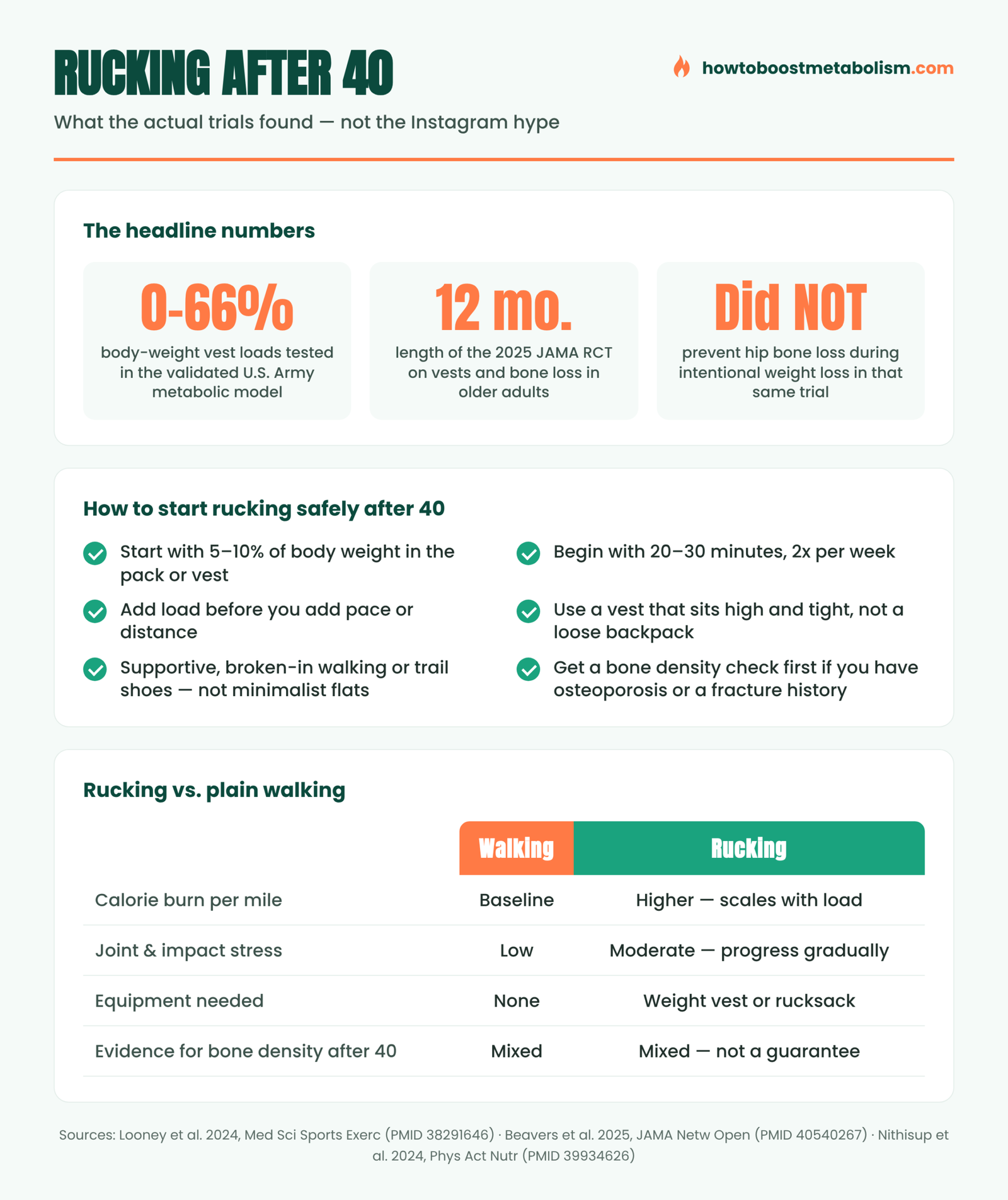
Yes — this part is on solid ground. Researchers from the U.S. Army Research Institute of Environmental Medicine published a validated model in 2024 (Med Sci Sports Exerc) specifically to predict the metabolic cost of walking with a weighted vest. Twenty adults walked on a treadmill at up to 11 different speeds while carrying vest loads ranging from 0% up to a striking 66% of body mass, with researchers measuring oxygen consumption directly (indirect calorimetry) at each combination. The takeaway for the rest of us: energy cost rises in a predictable, load-dependent way — the heavier the vest relative to your body weight, and the faster you walk, the more calories you burn per minute and per mile. That’s not a controversial finding; it’s basic exercise physiology, now mapped with unusually precise military-grade data.
What the study does not tell you is that a weighted vest is some kind of metabolic hack that outperforms other forms of exercise for fat loss. It simply makes walking — a very accessible, joint-friendly activity — burn meaningfully more energy per session than walking unloaded. For someone who already walks regularly, that’s a legitimate way to raise the ceiling without switching to running or adding gym time.
Free download
🔥 The Metabolism Starter Kit
3 honest guides: a 7-day reset plan, a foods cheat-sheet and 12 metabolism myths debunked. No spam — unsubscribe anytime.
The Bone Density Question: Where the Hype Gets Ahead of the Evidence
This is the claim you’ll see repeated constantly: “rucking builds bone density because it loads your skeleton.” The mechanical logic is real — bone responds to mechanical strain, which is exactly why weight-bearing exercise is recommended for bone health in the first place. But the specific claim that strapping on a vest meaningfully protects or rebuilds bone after 40 is weaker than the marketing suggests, and the best available trial on this says so directly.
In a 2025 randomized controlled trial published in JAMA Network Open, researchers at Wake Forest University followed 150 older adults with obesity through 12 months of intentional weight loss. One group lost weight with no added exercise, one group wore a weighted vest for about 7 hours a day (with the vest’s load increased to replace roughly 78% of the weight they lost), and one group did supervised progressive resistance training three times a week. The result: all three groups lost a similar amount of hip bone density (roughly 1.2% to 1.9%) over the year, and the weighted vest group was not statistically different from the no-exercise group. Progressive resistance training didn’t significantly outperform the vest either. The study’s own conclusion was blunt: “neither weighted vest use nor progressive resistance training was able to mitigate weight loss-associated bone loss at the hip.”
That’s an important, honest data point, and it’s the opposite of what most rucking content tells you. It doesn’t mean rucking is useless for bone health — it means a daily vest, worn passively during ordinary activity while actively losing weight, wasn’t enough to outrun the bone loss that intentional weight loss causes in older adults. The mechanical stimulus from a vest during walking is real but modest compared with the high-impact, near-maximal loading used in dedicated bone-focused resistance programs (more on that in our guide to strength training and bone density after menopause).
A smaller 2024 trial in Physical Activity and Nutrition offers a more encouraging — but much smaller and shorter — signal. Fifty-two women aged 60–79 did eight weeks of brisk walking and strengthening exercises; one group wore a weighted vest, and another wore the vest while also adding a modest 3 grams of extra protein per day. The vest-plus-protein group gained thoracic spine bone mineral content and lean mass, while the vest-only and control groups both lost ground on the same measures. It’s a promising hint that pairing load with adequate protein intake matters — but with only eight weeks of data and a small sample, it’s far from proof that rucking alone rebuilds bone.
Rucking vs. Plain Walking vs. Running: Where It Fits
| Walking | Rucking | Running | |
|---|---|---|---|
| Calorie burn | Baseline for your pace | Higher — scales with vest load | Highest per minute |
| Joint impact | Low | Low-to-moderate, loads the frame | Higher, repetitive impact |
| Learning curve | None | Low — just add load gradually | Moderate, pacing/form matter |
| Equipment cost | None | $40–$150 for a vest | Shoes only |
| Best for | Daily movement, recovery days | Adding intensity without running | Cardio capacity, speed |
Why Rucking Became Popular With the 40+ Crowd
Part of rucking’s appeal has nothing to do with the physiology papers above — it’s simply that it solves a real problem. Running at 45 can aggravate knees, hips, and backs that have accumulated decades of wear. Standard gym resistance training requires access to equipment, time, and often a learning curve for correct form. Walking alone is accessible but, for someone who already walks daily, can plateau in how much it challenges the body. A weighted vest is a low-cost, low-skill way to make an already-established habit harder without changing the activity itself. That’s a legitimate behavioral advantage even before you get to the metabolic data — adherence beats an optimal program nobody sticks with.
It also borrows credibility from military and tactical fitness culture, which has decades of practical experience with loaded marching, even if that experience was built around mission readiness rather than long-term joint health in a 50-year-old civilian. That borrowed credibility is part of why the claims around rucking often outrun the civilian, aging-focused research base — the training culture is older and more established than the specific clinical trials testing it in midlife and older adults.
Common Mistakes That Undercut the Benefits
- Loading up too fast. Jumping straight to 20–30% of body weight before your tendons, ligaments, and spine have adapted is the most common way people turn a useful habit into an overuse injury.
- Using a loose backpack instead of a fitted vest. A pack that swings or sits low shifts your center of gravity and loads your lower back and shoulders unevenly, compared with a vest that distributes weight close to your torso.
- Ignoring posture. Letting the load pull your shoulders forward and your head down increases strain on the neck and upper back over a long walk.
- Treating it as a bone-density guarantee. As the JAMA trial above shows, passively wearing a vest is not a proven substitute for dedicated, progressively heavier resistance training if bone density is your primary goal.
- Skipping protein. The one positive bone/muscle signal in the research above came from a group that combined vest-wearing with extra protein intake — the loading and the nutrition seem to work together, not in isolation.
How to Start Rucking Safely After 40
If you want to try it, the physiology above points to a sensible, conservative approach rather than the 45-pound-plate-carrier videos you’ll see online:
- Start with 5–10% of your body weight in the vest — for a 170 lb person, that’s roughly 9–17 lbs.
- Keep your first few sessions to 20–30 minutes at a normal walking pace; let your frame adapt before you push intensity.
- Progress load before pace. Add a few pounds every 1–2 weeks rather than walking faster with the same load.
- Choose a properly fitted weighted vest that sits high and tight against your torso — a loose backpack shifts weight and stresses your lower back and shoulders differently.
- Wear supportive, well-cushioned walking or trail shoes, not minimalist or worn-out footwear.
- If you have osteoporosis, a recent fracture, or significant knee or back issues, get cleared by a doctor or physical therapist first — loaded walking is not risk-free for a compromised spine or joints.
A reasonable long-term target for most healthy adults is 10–20% of body weight, built up over several months — not the extreme loads used in the military metabolic study, which were designed to stress-test a prediction model, not to recommend a training load for a 45-year-old office worker.
If You Want a Structured Program Instead of Guessing
Rucking is a useful add-on to your weekly movement, but it isn’t a substitute for a structured resistance training plan — which is exactly where the actual bone-density evidence is strongest (see the LIFTMOR trial breakdown in our menopause and bone density guide). If you’d rather follow a laid-out program than build your own routine from scratch, our beginner strength training guide is a free place to start.
Prefer a complete, done-for-you program built specifically for the 40+ body? Old School New Body lays out a structured strength routine (the F4X method) rather than asking you to figure out progression on your own. Its sales page leans on some dramatic aging statistics we can’t independently verify, so treat those claims skeptically — but the underlying strength-training structure is a reasonable, coach-free way to get consistent about resistance training if rucking alone isn’t cutting it.
See the Program →Affiliate link — we may earn a commission at no extra cost to you. Disclosure
Free download: our Metabolism Starter Kit — a protein calculator, a 7-day meal framework, and a one-page supplement checklist, with zero hype.
Get the Free Starter Kit →Frequently Asked Questions
Does rucking burn more calories than regular walking?
Yes. A 2024 validated metabolic model (Looney et al., Medicine & Science in Sports & Exercise) confirmed that adding vest load increases the energy cost of walking in a predictable, load- and speed-dependent way. The heavier the vest and the faster you walk, the more calories you burn per minute.
Does rucking actually improve bone density after 40?
The evidence is mixed and weaker than most rucking content suggests. A 2025 JAMA Network Open randomized trial found that a weighted vest worn during intentional weight loss did not prevent hip bone loss in older adults over 12 months — it performed no better than weight loss alone. A smaller, shorter trial found a benefit only when vest-wearing was combined with extra protein intake. Dedicated high-intensity resistance training has stronger bone-density evidence than passive vest-wearing.
How much weight should I put in a rucking vest if I’m over 40?
Most coaches and the available safety literature point to starting around 5–10% of body weight and progressing gradually, potentially toward 10–20% over months, rather than jumping to loads used in military or lab studies designed to test a prediction model rather than recommend a training dose.
Is rucking safe if I have osteoporosis or joint problems?
Not automatically. Loaded walking adds compressive stress to your spine, hips, and knees. If you have osteoporosis, a fracture history, or significant joint pain, talk to a doctor or physical therapist before adding external load to your walks.
Is rucking better than lifting weights for building muscle?
No — rucking is primarily a cardio-plus-postural-endurance activity, not a muscle-building stimulus in the way progressive resistance training is. It’s a reasonable complement to a strength program, not a replacement for one.