How Much Muscle Can You Build After 50? (Real Numbers)
This article may contain affiliate links. If you buy through them, we may earn a small commission at no extra cost to you. See our Affiliate Disclosure and Medical Disclaimer.
Search “how much muscle can you build after 50” and you’ll find everything from “none, your muscle-building years are over” to “20 pounds in 12 weeks” from someone selling a supplement. Neither is accurate. The real answer, backed by randomized controlled trials that specifically studied older adults — including people well into their 70s, 80s, and 90s — sits firmly in between: slower than your 20s, but genuinely real, measurable, and worth the effort.
The Short, Honest Answer
Yes, people over 50 build real muscle from resistance training — the question is just how fast, and under what conditions. Published rates for trained lifters in their 20s and 30s are often cited around 0.25–0.5% of body weight in lean mass per month under ideal conditions (good program, enough protein, a slight calorie surplus). After 50, most of the trial data suggests a realistically achievable range is roughly half that, especially in the first few months of a new program, and more for people who are furthest from their genetic potential (beginners see the fastest relative gains at any age). The exact number also depends heavily on training history: someone who lifted seriously in their 20s and 30s and is returning after a long break will typically regain lost muscle faster than a true first-time lifter builds it, thanks to a well-documented phenomenon often called “muscle memory.”
What Randomized Trials Actually Found
Even the “Very Elderly” Build Muscle
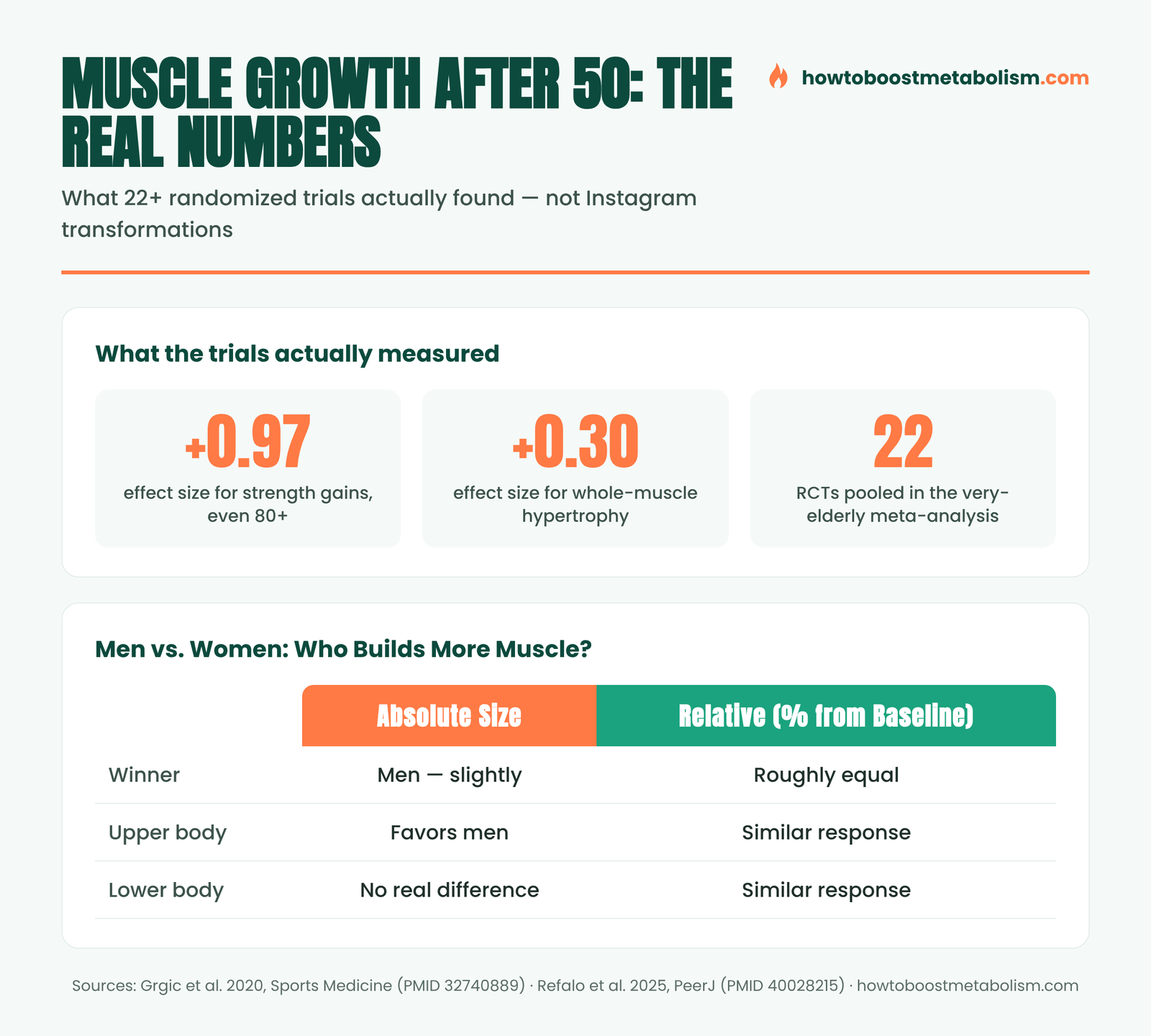
A 2020 systematic review and meta-analysis in Sports Medicine (PMID 32740889) pooled 22 randomized controlled trials specifically in adults 75 and older — a group most people assume is past the point of meaningful muscle growth. It found a significant effect of resistance training on both muscle strength (effect size 0.97) and whole-muscle hypertrophy (effect size 0.30), and the strength benefit held up even in the “oldest-old” subgroup of people 80 and older (effect size 1.28). Reported adverse events from the training programs were minimal. If people in their 80s and 90s can add measurable muscle size and real strength, the ceiling for someone in their 50s is considerably higher.
You Don’t Need a Huge Program to See Results
A 2025 network meta-analysis in Sports Medicine that pooled 151 randomized trials in adults 60+ (PMID 39405023) found that even a low training volume — a handful of sets per exercise per week — produced a meaningful improvement in lean body mass (standardized mean difference 0.25) and lower-body muscle hypertrophy (standardized mean difference 0.40). Moderate and higher training volumes pulled further ahead specifically for maximum strength, but the muscle-size response was already solid at a modest, sustainable dose. This matters because the biggest predictor of long-term muscle gain after 50 isn’t how hard any single program is — it’s whether you’re still doing it in a year.
Women Build Muscle Just as Effectively as Men (Relatively Speaking)
A common myth is that muscle-building after 50 is mainly a “men’s topic.” A 2025 Bayesian meta-analysis in PeerJ (PMID 40028215) comparing male and female responses to the same resistance-training programs found that absolute muscle size increases were slightly higher in men (driven mostly by upper-body differences), but relative increases — the percentage of muscle gained from each person’s own starting point — were essentially the same between sexes. In practical terms: a woman doing the same program as a man should expect a comparable proportional improvement in muscle size, even though the absolute number of pounds may look smaller on a frame that started smaller.
If You’re Also Carrying Extra Body Fat, the Programming Still Works
A 2023 scoping review in Frontiers in Nutrition (PMID 37234555) looked specifically at resistance-training protocols used in older adults with “sarcopenic obesity” — the combination of low muscle mass and excess body fat that becomes more common after 50. Across the 15 studies it reviewed, programs ran 8–24 weeks, used full-body routines with both single- and multi-joint exercises, and typically used 1–3 sets per movement. The takeaway for anyone worried that carrying extra weight disqualifies them from building muscle: it doesn’t. The same basic resistance-training framework that works for lean older adults is the one researchers use for this group too — muscle and fat are addressed with the same training stimulus, even if a calorie deficit for fat loss is layered on separately. For the metabolic side of that equation, see our breakdown of what “metabolic age” actually means and whether it is worth tracking.
Free download
🔥 The Metabolism Starter Kit
3 honest guides: a 7-day reset plan, a foods cheat-sheet and 12 metabolism myths debunked. No spam — unsubscribe anytime.
At a Glance: Realistic Expectations by Starting Point
| Who You Are | Realistic First 3–6 Months | What Drives It |
|---|---|---|
| Complete beginner, 50s–60s | Noticeable strength gains monthly; visible muscle changes by month 2–3 | “Newbie gains” — furthest from your ceiling |
| Returning after years off | Faster than a true beginner — “muscle memory” speeds re-growth | Previously trained muscle fibers, retained neural patterning |
| Already training consistently | Slower, incremental strength PRs; muscle size gains measured over months, not weeks | Closer to your natural adaptation ceiling |
| 70s, 80s and beyond | Real, meaningful strength and size gains — slower, but far from zero (PMID 32740889) | Still highly trainable; consistency matters more than intensity |
Why Results Feel Slower After 50 (Even When They’re Real)
- Anabolic resistance — muscle tissue in older adults needs a somewhat larger protein stimulus per meal to trigger the same rate of muscle protein synthesis as in younger adults.
- Hormonal shifts — lower testosterone and estrogen levels (especially post-menopause) modestly reduce the baseline rate of muscle building, though resistance training still works on top of this.
- Recovery capacity — connective tissue and the nervous system often need a day or two more between hard sessions on the same muscle group.
- Underestimating effort needed — many people over 50 unintentionally train with lighter loads than their body can safely handle, which caps the stimulus for growth.
How to Maximize What’s Actually Achievable
- Train with real intent. Working sets should feel genuinely challenging — 1–3 reps left in reserve, not a casual warm-up pace.
- Hit your protein target every day, not just on training days. Aim for roughly 1.2–1.6 g/kg of body weight, spread across 3–4 meals.
- Prioritize consistency over perfection. Two solid full-body sessions per week, done for a year, will out-build an ambitious 6-day split abandoned after six weeks.
- Track strength numbers, not just the mirror. Strength gains show up faster than visible size changes and are a reliable sign the program is working.
- Give it real time. Meaningful visible change is typically a 3–6 month story, not a 3–6 week one.
The Comparison Trap
One of the fastest ways to feel discouraged is comparing your own progress to a 25-year-old’s transformation photos, or to someone else’s genetics, training history, or hormone profile. The research above is encouraging precisely because it measures people against their own starting point, not against an unrelated younger population. A 10% strength improvement in three months is a meaningful physiological change at any age, even if it doesn’t look dramatic on social media. The people who keep training for years — and therefore keep accumulating gains — are almost always the ones who judged their own progress against their own baseline instead of someone else’s highlight reel.
If you want the specific mechanics of how to structure the training itself, we cover the week-by-week progression in our guide to progressive overload after 40, and if you are just getting started, see our beginner’s strength training guide first. And since building muscle is one of the few things that genuinely raises your resting energy needs, it is worth reading our honest answer to whether building muscle really boosts metabolism — the effect is real, but smaller than most marketing claims suggest.
Men and women both respond well to this kind of training, but the starting point often looks different. If you are a man specifically planning a program around your 50s, our dedicated guide for men over 50 walks through how to combine training, protein, and recovery for this decade specifically.
Fasting and resistance training aren’t opposites — done right, they can work together. Anabolic Fasting is Brad Pilon’s program combining a structured fasting protocol with resistance training, aimed at building muscle while managing fat. The “build muscle and burn fat simultaneously” claims on the sales page are marketing, not a guarantee — our full review breaks down what’s realistic and what isn’t.
Read Our Full Review →Affiliate link — we may earn a commission at no extra cost to you. Disclosure
For more on how sarcopenia (age-related muscle loss) is treated clinically, the training protocols researchers use are strikingly similar to what we recommend above — modest volume, consistent effort, and realistic timelines rather than crash programs.
Free download: our Metabolism Starter Kit — a protein calculator, a 7-day meal framework, and a one-page supplement checklist, with zero hype.
Get the Free Starter Kit →Related: How you move the weight matters less than you’d think for muscle growth — see what a 2025 meta-analysis found about rep tempo and time under tension.
Related: Building muscle after 50 and protecting bone density are closely linked goals. For the bone-specific evidence, see our breakdown of the LIFTMOR trial on strength training and bone density after menopause.
Related: Trying to decide how to structure your weekly training after 50? We compared full-body vs. split routines after 40 using the frequency research.
Related: Short on time but still trying to build muscle after 50? Here’s what the research says about supersets as a time-efficient alternative to straight sets.
Related: Worried that heavier lifting means getting “bulky”? Our look at the hormone science behind the bulky myth breaks down why that fear doesn’t hold up.
Frequently Asked Questions
Can you really build muscle after 50?
Yes. Randomized trials, including ones studying adults in their 70s, 80s, and 90s, consistently show measurable increases in both muscle strength and muscle size from resistance training. The rate is slower than in your 20s, but it is genuinely real at any age studied so far.
How long does it take to see visible muscle growth after 50?
Strength gains are often noticeable within 4–6 weeks of consistent training. Visible changes in muscle size typically take longer — most people report a noticeable difference around the 3-month mark, with more substantial changes by 6 months.
Do women build less muscle than men after 50?
In absolute terms, men tend to add slightly more total muscle mass, largely due to upper-body differences. In relative terms — the percentage gained from each person’s own starting point — research shows the response is essentially equivalent between sexes.
Is it too late to start strength training at 60 or 70?
No. A meta-analysis of 22 randomized trials in adults 75+ found significant strength and muscle-size improvements, including in the 80-and-older subgroup. Starting later means starting further from your ceiling, which often produces faster relative early progress, similar to any beginner.
How much protein do I need to build muscle after 50?
Most research in this age group points to roughly 1.2–1.6 grams of protein per kilogram of body weight per day, spread across 3–4 meals, to account for the reduced sensitivity to protein (anabolic resistance) that comes with age.
This article is for educational purposes and is not personalized medical or fitness advice. Talk to a doctor before starting a new resistance-training program, especially if you have an existing health condition, joint issue, or have been inactive for an extended period.