Omega-3 and Muscle Protein Synthesis After 40: The Data
This article may contain affiliate links. If you buy through them, we may earn a small commission at no extra cost to you. See our Affiliate Disclosure and Medical Disclaimer.
Fish oil gets recommended for almost everything — heart health, joints, mood, and increasingly, muscle. The pitch for muscle specifically goes like this: omega-3 fatty acids reduce inflammation and improve how your muscle cells respond to protein and insulin, so they should help preserve or even build muscle as you get older. It’s a reasonable hypothesis, and unlike a lot of supplement claims, it’s actually been tested directly in randomized trials — including one of the more elegant mechanistic studies in all of sports nutrition. The results, though, are genuinely split.
We reviewed six studies and meta-analyses, from a landmark 2011 clamp study to a large 2025 trial with nearly 1,500 participants, to find out what omega-3 fatty acids actually do for muscle protein synthesis and muscle mass after 40 — and where the evidence runs out.
You may also find this useful: Does Creatine Help Your Brain After 40?
The Landmark Study: Omega-3 Sensitizes Muscle to Protein and Insulin
The most-cited mechanistic study is an 8-week randomized controlled trial published in the American Journal of Clinical Nutrition (Smith et al., 2011). Sixteen healthy older adults took either omega-3 fatty acids or corn oil, and researchers directly measured the rate of muscle protein synthesis using stable isotope tracers — a far more precise method than measuring muscle size with a tape measure. Omega-3 supplementation had no effect on the basal (resting) rate of muscle protein synthesis. But during a hyperaminoacidemic-hyperinsulinemic clamp — essentially simulating what happens after a protein-rich meal — the omega-3 group showed a much larger jump in muscle protein synthesis (roughly 3.4 times greater) than the corn-oil group, along with greater activation of the mTOR and p70s6k anabolic signaling proteins. In plain terms: omega-3s didn’t boost muscle building at rest, but they appeared to make muscle more responsive when amino acids and insulin were present — the exact conditions that happen after you eat a meal with protein in it.
See also: does creatine cause weight gain?
The Follow-Up: Real Muscle Gains Over Six Months
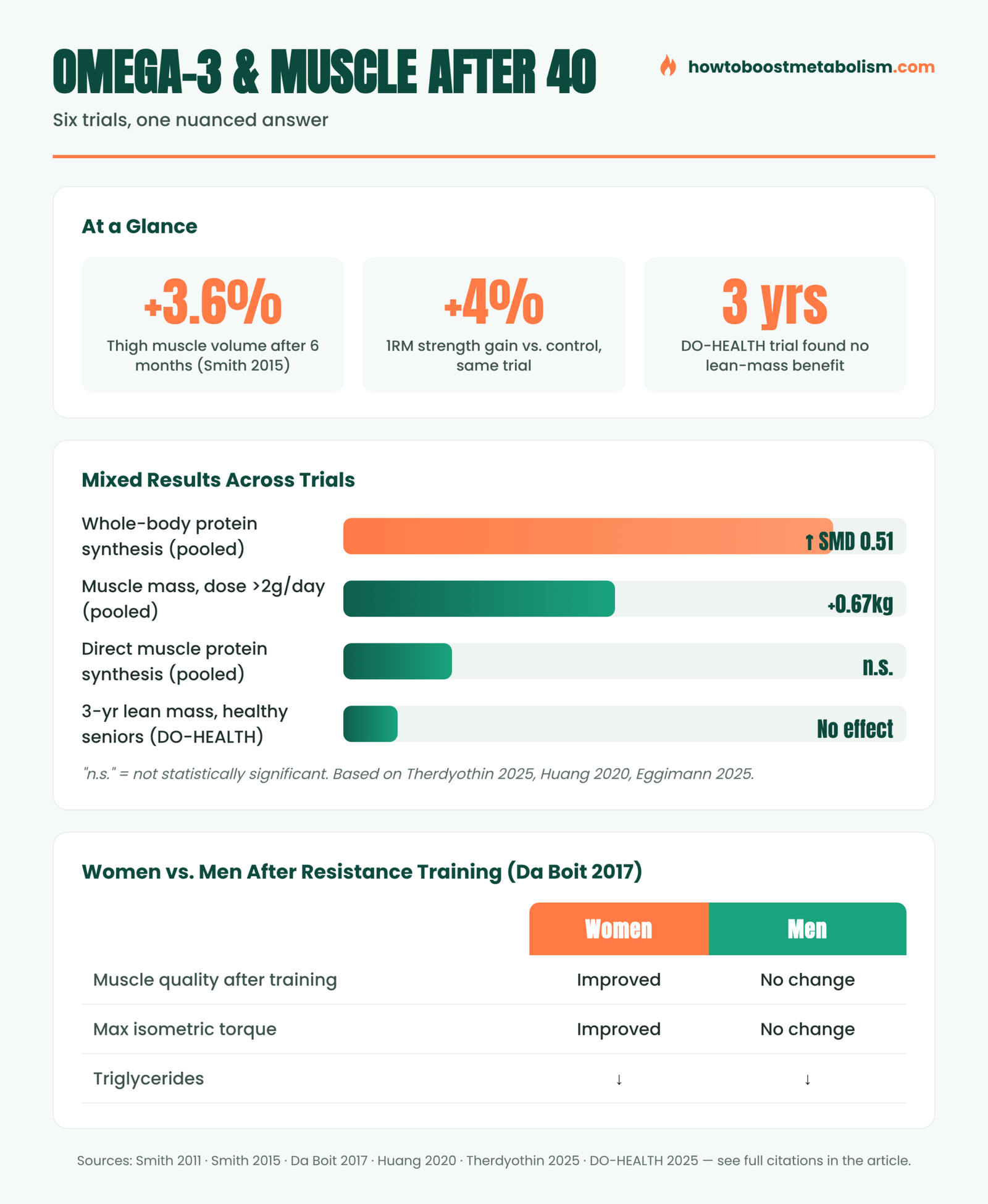
The same research group followed up with a longer, larger trial (Smith et al., 2015, also in the American Journal of Clinical Nutrition). Sixty healthy adults aged 60–85 took either n-3 PUFA (fish oil) or corn oil for six months. The omega-3 group ended up with 3.6% greater thigh muscle volume, 2.3 kg greater handgrip strength, and 4.0% greater one-rep-max strength compared with the control group — all without any structured resistance training program. This is the single strongest piece of evidence that omega-3 supplementation alone can meaningfully slow age-related muscle loss, and it’s a big part of why fish oil keeps coming up in sarcopenia research.
Free download
🔥 The Metabolism Starter Kit
3 honest guides: a 7-day reset plan, a foods cheat-sheet and 12 metabolism myths debunked. No spam — unsubscribe anytime.
Where It Gets Complicated: Resistance Training and Sex Differences
A 2017 randomized trial (Da Boit et al., 2017, same journal) tested whether 3 g/day of fish oil would amplify the muscle-building response to 18 weeks of actual resistance training in older men and women. The result was split by sex: women on omega-3 showed a significantly greater improvement in muscle quality and isometric torque after training compared with women on placebo. Men showed no such difference — resistance training worked the same with or without the omega-3. Both sexes saw a bigger drop in triglycerides with the fish oil, which is a separate, more well-established cardiovascular benefit. The takeaway: omega-3’s muscle-building boost on top of actual training may be real, but it isn’t universal, and sex appears to be one variable that matters.
See also: does HMB really prevent muscle loss after 40?
The Meta-Analyses: A More Cautious Average
No Effect on Direct Muscle Protein Synthesis, But a Whole-Body Signal
A 2025 systematic review and meta-analysis in Nutrition Reviews (Therdyothin et al., 2025) pooled eight randomized trials measuring muscle protein synthesis directly. Across six of those trials, omega-3 supplementation showed no significant effect on muscle protein synthesis rates specifically (standardized mean difference of just 0.03, essentially zero). But a smaller pool of three trials measuring whole-body protein synthesis did find a significant increase (SMD 0.51). In other words: when you zoom in on the muscle itself, the direct anabolic effect mostly disappears in the pooled data, even though the original 2011 clamp study and 2015 trial both showed positive results individually. Averages can hide real effects in subgroups — which is exactly what the Da Boit sex-difference finding suggests is happening here.
A Modest Dose-Dependent Benefit for Muscle Mass
A separate 2020 meta-analysis in Nutrients (Huang et al., 2020), pooling 10 trials in older adults, found a small but statistically significant average gain in muscle mass (0.33 kg) and improved “timed up and go” mobility performance with omega-3 supplementation. Critically, the benefit was concentrated in people taking more than 2 g/day for more than six months — lower doses and shorter trials showed less effect. This dose-and-duration pattern lines up with the Smith 2015 trial, which also ran six months.
See also: Protein Timing: Does Spreading It Out Build More Muscle?
A Large, Long Trial That Found Nothing
The most sobering data point comes from the DO-HEALTH trial, a 3-year randomized, placebo-controlled study in 2,157 healthy, active adults aged 70+ (Eggimann et al., 2025, Journal of the American Geriatrics Society). Among 1,495 participants who had their muscle mass tracked by DEXA scan, daily omega-3 supplementation — alone or combined with vitamin D and a home exercise program — produced no benefit on appendicular lean mass or sarcopenia risk over three years, compared with placebo. There was a small protective effect at the one-year mark that disappeared by year three. This was a healthy, already physically active population, which may partly explain why a supplement had little room to help.
So What Should You Actually Take From This?
Put together, the honest picture looks like this: omega-3 fatty acids plausibly improve how your muscle responds to the protein and insulin surge after meals (the 2011 clamp mechanism), and at least two trials have shown real-world muscle size and strength gains over 6 months without any added training. But that effect doesn’t show up consistently in pooled meta-analyses of direct muscle protein synthesis, it may be stronger in women than men when combined with resistance training, and a large, long-running trial in healthy, active seniors found no benefit at all over three years.
The most defensible position: omega-3 supplementation is not a muscle-building supplement you should expect dramatic results from, but there’s reasonable evidence it can help preserve muscle mass and strength — particularly at higher doses (above 2 g/day of combined EPA/DHA) sustained for 6+ months — especially if your diet is otherwise low in fatty fish. It is not a substitute for resistance training or adequate protein intake, both of which have far larger and more consistent effects on muscle retention after 40.
Related: Taurine for Metabolism and Aging
| Study | Design | Muscle Outcome |
| Smith 2011 | 8-wk RCT, clamp technique, n=16 | No basal effect; boosted anabolic response to a meal |
| Smith 2015 | 6-mo RCT, n=60, no training | +3.6% thigh volume, +4% 1RM strength vs. control |
| Da Boit 2017 | 18-wk RCT + resistance training, n=50 | Benefit in women only, not men |
| Therdyothin 2025 (meta-analysis) | 8 pooled RCTs | No effect on direct MPS; ↑ whole-body protein synthesis |
| Huang 2020 (meta-analysis) | 10 pooled RCTs | +0.33kg muscle mass, dose-dependent (>2g/day) |
| DO-HEALTH 2025 | 3-yr RCT, n=1,495 (DEXA) | No lean-mass benefit over 3 years |
A Different Question: Omega-3 and Belly Fat
Muscle protein synthesis is a separate question from whether fish oil helps you lose visceral fat — a claim we examined in detail, including why the evidence there is weaker than most marketing suggests, in our dedicated review of omega-3 and visceral belly fat. The two effects (muscle retention vs. fat loss) rely on different mechanisms and shouldn’t be assumed to travel together.
Why the Studies Disagree: A Few Honest Explanations
It’s tempting to pick the one or two studies that support whatever you already wanted to believe about fish oil. A more useful exercise is asking why six good studies on the same general question landed in different places. A few real variables stand out: dose (the positive Smith trials and the dose-dependent Huang meta-analysis both point to a floor somewhere around 2 g/day of combined EPA/DHA, well above many commercial softgels); duration (benefits that show up at 6 months don’t necessarily show up at 8 weeks, and DO-HEALTH ran a full 3 years without finding one); training status (Da Boit’s sex-specific effect only appeared in combination with actual resistance training, not supplementation alone); and baseline fish intake (someone who already eats salmon twice a week has less room to improve than someone who eats almost no omega-3-rich food).
DO-HEALTH’s null result deserves particular attention because of its size and rigor — 1,495 people tracked by DEXA scan over three full years is about as strong a dataset as this field has. But it’s also worth noting the population: healthy, community-dwelling, already physically active older adults who may have had relatively little muscle loss to prevent in the first place, and a fairly standard 1 g/day dose, below the 2+ g/day threshold the Huang meta-analysis flagged as mattering most. A null result in a population with little room to improve, at a dose below the apparent effective threshold, doesn’t necessarily contradict a positive result in a different population at a higher dose — it may simply be testing a different question.
Practical Takeaways for Lifters Over 40
If you’re deciding whether omega-3 supplementation belongs in your routine, a few practical points from this research are worth acting on rather than ignoring. First, dose matters more than brand: look for a supplement that actually delivers 2 g/day or more of combined EPA and DHA, since most of the positive trials used doses in that range or higher, not the 300-500 mg found in a typical single softgel. Second, give it time — six months, not six weeks, is the window where the clearer benefits showed up. Third, don’t expect it to replace resistance training or protein intake; in every study where it helped, it helped on top of, or as a sensitizer for, the muscle’s response to other anabolic signals, not as a stand-alone driver of growth.
Dosing and Safety
Trials showing benefit used doses in the 2–4 g/day range of combined EPA and DHA, sustained for at least 6 months — much higher than the roughly 250–500 mg found in a typical over-the-counter fish oil softgel, so check the label rather than assuming one capsule covers it. Fish oil can thin the blood slightly at high doses, which matters if you’re on blood thinners or scheduled for surgery, and it can cause mild digestive upset in some people. Getting EPA/DHA from fatty fish (salmon, sardines, mackerel) two or more times a week is a reasonable food-first alternative. This article is educational, not medical advice — see our medical disclaimer linked above.
Free download: our Metabolism Starter Kit — a protein calculator, a 7-day meal framework, and a one-page supplement checklist, with zero hype.
Get the Free Starter Kit →The Bottom Line
Omega-3 fatty acids are not a proven muscle-builder the way creatine or adequate protein are, but they’re also not nothing. The strongest individual trials show real muscle-size and strength benefits over 6 months, particularly in women and at higher doses, while the largest, longest trial in healthy seniors found no benefit at all. If you already eat fatty fish regularly and train consistently, don’t expect fish oil capsules to move the needle much further. If you don’t, and you’re over 40, there’s a reasonable case for a higher-dose fish oil supplement as one small piece of a muscle-retention strategy — just not the centerpiece of it.
Related reading: sarcopenic obesity: losing muscle and gaining fat after 40, body recomposition after 40, and vitamin D and muscle strength.
If you’re reading about muscle protein synthesis after 40, you’re probably trying to do the difficult thing: keep or add muscle while losing fat. Anabolic Fasting is built around that exact goal, pairing resistance training with short fasting periods. Its “build muscle and burn fat at the same time” pitch is marketing language, not a guarantee; treat it as a structured program, not a promise.
For the recomposition goal behind this research:
Learn More →Affiliate link — we may earn a commission at no extra cost to you. Disclosure
Frequently Asked Questions
Does fish oil help build muscle?
The evidence is mixed. Two trials found real gains in muscle size and strength over 6 months without added training, but a large 3-year trial in healthy seniors (DO-HEALTH) found no lean-mass benefit, and a 2025 meta-analysis found no pooled effect on direct muscle protein synthesis specifically.
How much omega-3 do I need for a muscle benefit?
Trials showing benefit generally used 2-4 grams per day of combined EPA and DHA for at least 6 months — notably higher than the amount in a standard drugstore fish oil softgel, so check the label.
Does omega-3 work better for women or men?
One randomized trial combining fish oil with 18 weeks of resistance training found a significant muscle-quality benefit in women but not in men, suggesting the response may not be uniform across sexes.
Is it better to get omega-3 from food or supplements?
Both were used across the studies reviewed here, and fatty fish (salmon, sardines, mackerel) two or more times a week is a reasonable food-first source of EPA and DHA if you’d rather not supplement.
Will omega-3 help me lose belly fat too?
That’s a separate question with weaker supporting evidence — see our dedicated review of omega-3 and visceral fat for the details, since the mechanisms for fat loss and muscle retention aren’t the same.