

Finger Pulley Injuries: Prevention and Recovery Guide
This article may contain affiliate links. If you buy through them, we may earn a small commission at no extra cost to you. See our Affiliate Disclosure and Medical Disclaimer.
A sudden pop or sharp pain at the base of a finger mid-crimp is one of the most common ways a climbing or hangboard session ends early. These are finger flexor pulley injuries, and they are, by a wide margin, the single most common overuse injury in rock climbers — accounting for up to roughly 20% of all climbing-related injuries, according to a 2026 clinical review in Current Sports Medicine Reports (Manjunathan & Liem, 2026, https://pubmed.ncbi.nlm.nih.gov/42241601/). If you climb, hang from bars regularly as part of a strength routine (see our guide on dead hangs after 40), or you simply want to understand what happened the last time something in your finger gave out, this is the evidence on grading, treating, and preventing these injuries.
The Anatomy: What Actually Tears
Each finger has a series of annular pulleys — fibrous rings, labeled A1 through A5 — that hold the flexor tendons close against the bones as you bend your fingers. Without them, the tendons would bow away from the bone every time you grip something, like a bowstring pulled off its proper line. The A2 and A4 pulleys sit at the highest risk of injury, especially under the kind of eccentric loading that happens in a full crimp grip — the hyperextended position of the fingertip joint that climbers use for small holds (Miro et al., 2021, Wilderness & Environmental Medicine, https://pubmed.ncbi.nlm.nih.gov/33966972/).
You may also find this useful: tennis elbow in lifters
This mechanism is also why these injuries are rare outside of climbing specifically: very few other activities load the finger flexor tendons the way a full crimp on a small edge does. It’s a sport-specific injury pattern, not a generic “overused your hands” problem — which is part of why generic hand-strengthening advice sometimes misses the actual risk factor.
See also: Do ‘Negatives’ Really Protect Your Tendons After 40?
Grading the Injury: Why It Matters for Your Recovery Timeline
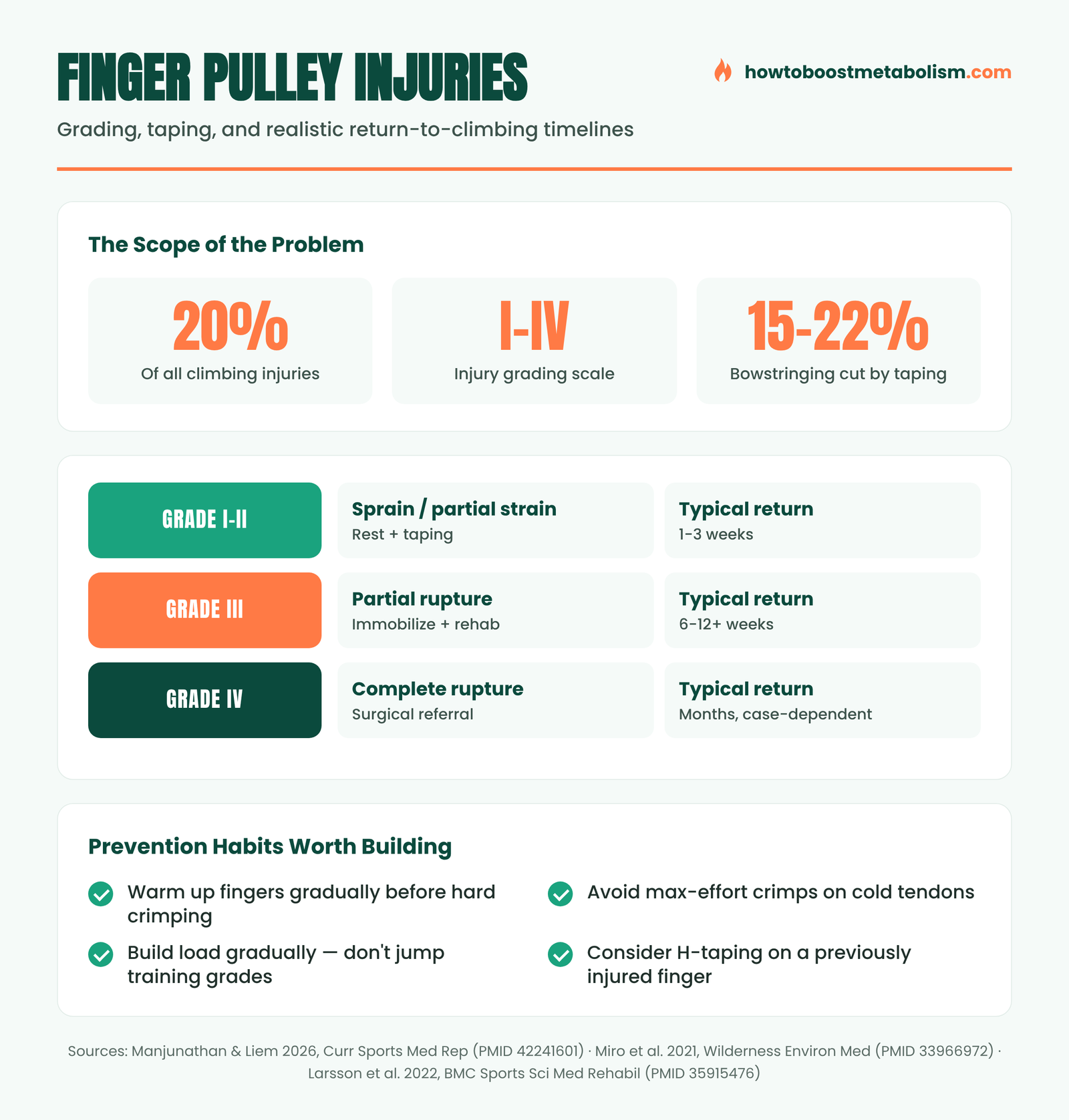
Not every pulley injury is the same, and treating a mild strain like a full rupture (or vice versa) either wastes recovery time or risks making things worse. The standard clinical system grades these injuries from I through IV, based on the degree of tissue damage:
| Grade | What’s Actually Torn | Typical Management |
|---|---|---|
| Grade I | Sprain / microtrauma, no structural tear | Rest, taping, gradual return — often 1-3 weeks |
| Grade II | Partial tear of a single pulley | Protected loading, taping — often several weeks |
| Grade III | Complete rupture of a single pulley, or partial rupture of multiple pulleys | Immobilization then structured rehab — commonly 6-12+ weeks |
| Grade IV | Complete rupture of multiple pulleys, often with bowstringing | Surgical referral is common; recovery measured in months |
That “typical management” column is deliberately described as commonly observed ranges, not a guarantee — actual recovery time depends on which specific pulley is involved, how early the injury is diagnosed, and individual healing response. A clinician, not a chart, should confirm your grade. Grade I through III injuries are generally managed conservatively with immobilization, taping, or a protective splint; grade IV injuries that don’t respond to conservative care are the ones where surgical repair becomes the standard option (Miro et al., 2021, https://pubmed.ncbi.nlm.nih.gov/33966972/).
On clinical exam, the hallmark finding is “bowstringing” — visible or palpable volar displacement of the flexor tendon away from the bone when the finger is actively flexed against resistance. Ultrasound is the recommended first-line imaging tool because it’s highly sensitive and specific and can be performed dynamically (i.e., while you actively grip), with MRI reserved as a backup if ultrasound findings are inconclusive.
Free download
🔥 The Metabolism Starter Kit
3 honest guides: a 7-day reset plan, a foods cheat-sheet and 12 metabolism myths debunked. No spam — unsubscribe anytime.
Does Taping Actually Work?
H-taping (and similar circumferential taping methods around the base of the finger) is close to universal in climbing gyms, but for a long time the actual evidence behind it was thin. A 2022 systematic review specifically set out to settle whether taping beats not taping (Larsson et al., 2022, BMC Sports Science, Medicine and Rehabilitation, https://pubmed.ncbi.nlm.nih.gov/35915476/). After screening 595 records, the team found eight studies and one case report meeting their criteria, covering 206 climbers, four non-climbers, and 23 pairs of cadaver hands.
The result is a genuinely useful nuance rather than a simple yes/no: evidence of low to moderate certainty suggests taping might reduce bowstringing of the finger flexor tendons by roughly 15-22%, which is a real mechanical effect, not nothing. But evidence of moderate certainty also showed that taping has no effect on maximum voluntary contraction (grip strength) or muscle activation in uninjured climbers — meaning taping an uninjured finger “for support” doesn’t make you measurably stronger or safer in terms of force output. Evidence on pain reduction, faster return-to-sport, and reduced rupture risk was all rated “very low” to “low” certainty — promising in theory, not yet proven in rigorous trials. No adverse effects of taping were reported across the included studies, which is reassuring even where the benefit evidence is thin.
The practical read: taping a previously injured pulley has a real, modest mechanical rationale (less bowstringing under load) and essentially no downside, so it’s reasonable to keep doing. Taping an uninjured finger purely as a strength or safety crutch has little evidence behind it — your technique and training load matter far more than the tape itself.
Rehab: What the Clinical Commentary Actually Recommends
Despite how common these injuries are, a 2023 clinical commentary pointed out a real gap in the literature: there has historically been very little clear guidance on exactly how to progress someone back to climbing after a pulley injury, beyond “rest it and see” (Ehiogu, Schöffl & Jones, 2023, Current Sports Medicine Reports, https://pubmed.ncbi.nlm.nih.gov/37800745/). Their proposed framework leans specifically on strength-and-conditioning principles rather than passive rest alone — the foundation of effective rehab, in their words, is the “judicious application of progressive loading” to rebuild the tissue’s structural and material properties, not just waiting for pain to subside before jumping straight back to hard crimping.
In practice, that means a rehab path that typically moves through: pain-free isometric holds in open-hand positions first, gradual reintroduction of half-crimp loading as tolerance improves, protected return to climbing on larger holds and lower-intensity routes, and only a later return to full-crimp, high-intensity climbing once grip capacity has actually been rebuilt — not simply once pain has subsided. We cover the general principle of progressive, pain-guided loading for connective tissue in more depth in our isometric training for joint health guide, which applies the same underlying logic to other joints and tendons.
A Finding That Complicates the Picture: Adaptation vs. Injury
One more nuance worth knowing if you climb at a high level for years: a study comparing experienced, high-level sport climbers to non-climbers found that the climbers had measurably longer tendon-bone distances (a marker associated with bowstringing) in the A2 and A4 pulleys of their ring fingers — even when asymptomatic and reporting no pain or dysfunction (Iruretagoiena et al., 2021, Wilderness & Environmental Medicine, https://pubmed.ncbi.nlm.nih.gov/34538713/). The study’s own title frames the open question honestly: “Injury or Adaptation?” Years of progressive loading may produce a degree of structural change that looks pathological on imaging but functions normally in context — a reminder that a single ultrasound finding, without symptoms, isn’t automatically a diagnosis requiring treatment.
Not Just for Climbers: Hangboard and Dead-Hang Training
Finger pulley injuries are described in the literature specifically as a rock-climbing injury pattern, but the same mechanism — a crimp-style grip under high tendon load — shows up any time someone does hangboard work or weighted dead hangs as a general strength exercise rather than for climbing itself. We flagged this risk directly in our guide to dead hangs after 40: an open-hand or half-crimp hang position places dramatically less shear load on the A2/A4 pulleys than a full crimp, and for anyone outside of dedicated climbing training, there’s little reason to use a full crimp position at all. If your goal is general grip and tendon conditioning rather than climbing performance specifically, open-hand or half-crimp hangs get you most of the tendon-loading benefit with meaningfully less of this particular injury risk.
Age is also a relevant variable that doesn’t get much attention in the climbing-specific literature: tendons and their surrounding structures generally tolerate rapid increases in load less forgivingly after 40 than in someone’s 20s, simply because baseline tendon turnover and recovery capacity change with age. That’s an argument for a more conservative progression curve, not for avoiding hangboard or grip work altogether — the long-term tendon-health benefits of progressive loading, covered in our isometric training guide, still apply.
Prevention: What Actually Reduces Risk
- Warm up your fingers specifically before hard crimping — easy hangs and open-hand grip work first, full crimps only once tissue is genuinely warm, not just “a few minutes in.”
- Avoid jumping straight to maximum-effort full-crimp loading on cold tendons or after a long layoff — this is one of the most commonly cited mechanisms in case reports.
- Progress hangboard and crimp-intensity training gradually over weeks, the same principle that governs tendon loading everywhere else in the body.
- Consider taping a finger with a known previous pulley injury before hard sessions — the mechanical bowstringing-reduction evidence, while not definitive, supports this as a low-risk habit.
- Don’t ignore a sharp, sudden pop followed by swelling or weakness — get it evaluated rather than “climbing through it,” since early accurate grading changes management.
- Build general forearm and grip conditioning year-round rather than only before a climbing trip or a hangboard challenge — tissue that’s accustomed to regular, moderate load tolerates an occasional hard session far better than tissue that goes from idle to maximal with no ramp-up.
At a Glance
| Finding | Source |
|---|---|
| Up to ~20% of climbing injuries involve a finger pulley | Manjunathan & Liem, 2026 (PMID 42241601) |
| A2 and A4 pulleys are at highest risk, especially under crimp loading | Miro et al., 2021 (PMID 33966972) |
| Taping may cut bowstringing ~15-22%, but doesn’t boost grip strength | Larsson et al., 2022 (PMID 35915476) |
| Rehab should follow progressive loading, not passive rest alone | Ehiogu, Schöffl & Jones, 2023 (PMID 37800745) |
| Some tendon changes in elite climbers may reflect adaptation, not injury | Iruretagoiena et al., 2021 (PMID 34538713) |
Free download: our Metabolism Starter Kit — a protein calculator, a 7-day meal framework, and a one-page supplement checklist, with zero hype.
Get the Free Starter Kit →Once a pulley injury has healed, the safest way back is a structured progression rather than jumping straight to max hangs. The Ultimate Pull-Up Program is a progressive plan for building grip and pulling strength safely, with regressions for beginners.
Learn More →Affiliate link — we may earn a commission at no extra cost to you. Disclosure
Related: The same injury-or-adaptation question shows up in other tendons too — we explored it more broadly in what an abnormal tendon finding on MRI or ultrasound actually means.
Frequently Asked Questions
How do I know what grade my finger pulley injury is?
Grading (I through IV) is based on clinical exam findings like bowstringing plus imaging, usually dynamic ultrasound as the first choice. This requires a clinician — self-diagnosing from symptoms alone risks under- or over-treating the injury.
Does taping a finger actually prevent pulley injuries?
The clearest evidence is for reducing bowstringing (by roughly 15-22%) in a previously injured finger, not for boosting grip strength or definitively preventing a first injury. It appears low-risk, but the strongest prevention tools are gradual load progression and proper warm-up.
How long does a finger pulley injury take to heal?
It depends heavily on grade. Grade I-II injuries are often managed in a few weeks; Grade III injuries commonly take 6-12+ weeks with structured rehab; Grade IV injuries, especially if surgically repaired, can take months. These are typical ranges, not guarantees — your clinician’s assessment should guide your specific timeline.
Can I keep climbing with a mild pulley strain?
Climbing through a sharp, unresolved pulley injury risks converting a lower-grade injury into a higher-grade one. Current clinical guidance favors confirming the grade first, then following a progressive, pain-guided return rather than continuing to load it at full intensity.
Is it normal for experienced climbers to have some tendon bowstringing with no pain?
Research has found measurable tendon-bone distance changes in asymptomatic, high-level climbers’ A2/A4 pulleys compared to non-climbers, which the researchers describe as a possible adaptation rather than injury. Without pain or dysfunction, this finding alone isn’t necessarily something to treat.
This article is for informational purposes and is not medical advice. A sudden pop, swelling, or loss of grip strength in a finger warrants evaluation by a hand specialist or sports medicine clinician. See our Medical Disclaimer.