Does Strength Training Make You Hungrier? The Science
This article may contain affiliate links. If you buy through them, we may earn a small commission at no extra cost to you. See our Affiliate Disclosure and Medical Disclaimer.
You finish a hard lifting session and either feel like you could eat an entire rotisserie chicken, or you can’t imagine eating anything for the next three hours. Both experiences get talked about online as if they’re universal truths about exercise and appetite, and both are backed by real physiology — just not the way most fitness content explains it. The honest answer is that resistance training’s effect on hunger depends heavily on how hard and how long you train, and the acute research actually points toward appetite suppression far more often than the “exercise makes you starving” narrative suggests.
The Hormones Actually Doing the Work
Appetite is regulated by a handful of circulating hormones, and two matter most here. Ghrelin, often called the “hunger hormone,” is produced mainly in the stomach and rises before meals to drive the urge to eat; its active, appetite-stimulating form is called acylated ghrelin. Leptin, produced by fat tissue, works in the opposite direction — it signals satiety and helps regulate longer-term energy balance. Exercise of various kinds has been shown to acutely move both, and the direction and size of that movement is what determines whether a given workout leaves you hungrier or less hungry afterward.
What a Normal Session Actually Does
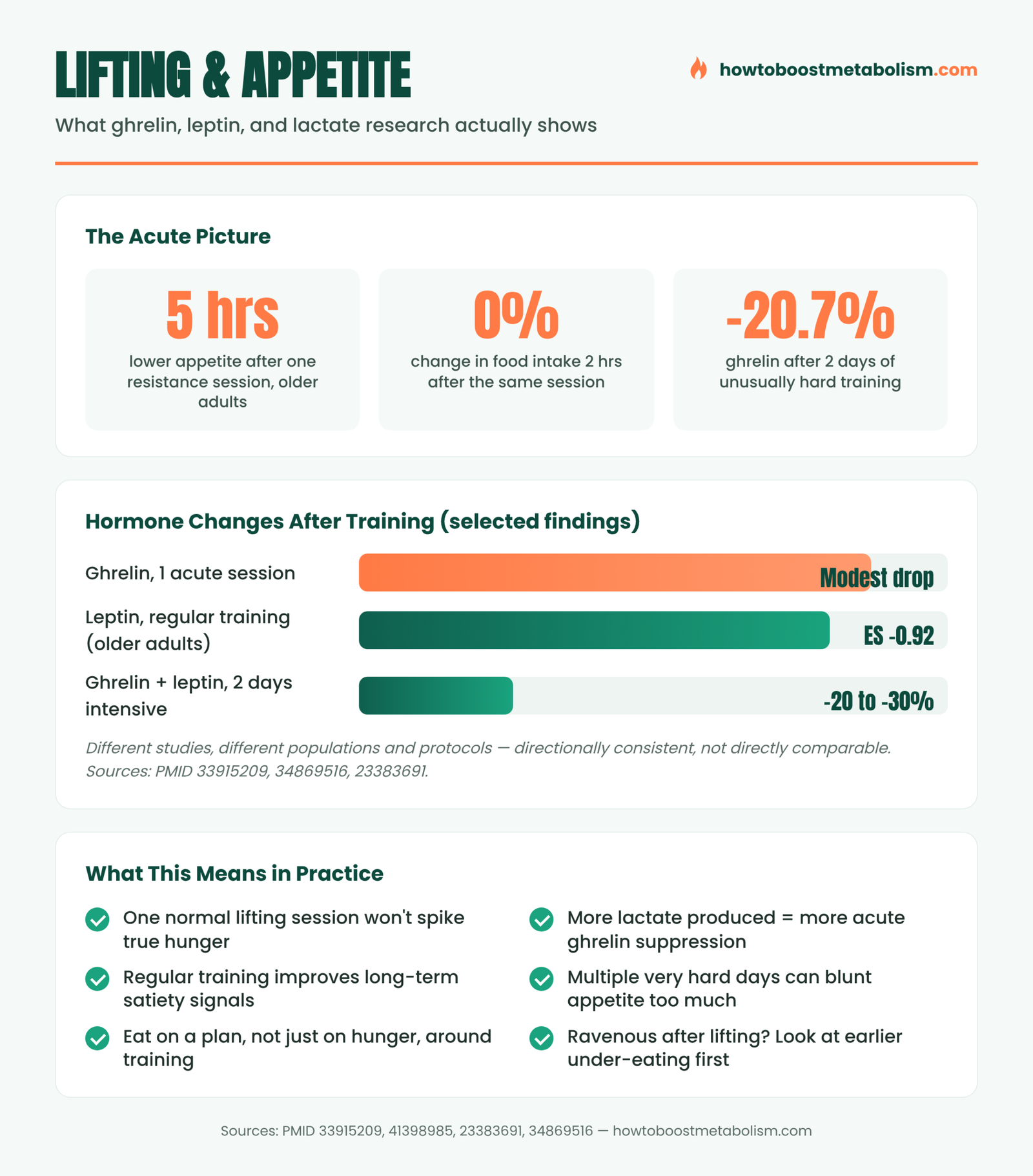
The most directly relevant study here, published in the journal Appetite in 2021, put twenty healthy older adults through a one-hour resistance exercise bout and compared it to a matched resting control condition (PMID 33915209). Researchers tracked subjective hunger ratings continuously for five hours and then offered participants an all-you-can-eat meal to measure actual energy intake. The result: hunger over the five-hour window was significantly lower after the lifting session than after rest, but the amount of food eaten at the meal two hours later didn’t differ at all between the two conditions. In the researchers’ own words, resistance exercise appeared to support muscle-building goals “without attenuating acute energy intake” — in plain terms, it modestly dialed down hunger signals without leading people to compensate by eating less. That’s close to the ideal outcome for anyone trying to build or preserve muscle: a workout that doesn’t quietly sabotage the eating side of the equation.
Free download
🔥 The Metabolism Starter Kit
3 honest guides: a 7-day reset plan, a foods cheat-sheet and 12 metabolism myths debunked. No spam — unsubscribe anytime.
Why Harder Sessions Suppress Hunger More — the Lactate Connection
If moderate resistance training modestly suppresses appetite, why does a brutal leg day sometimes leave you with zero interest in food for hours? A 2026 systematic review and individual-participant-data meta-analysis in Medicine & Science in Sports & Exercise pooled data from twelve studies (169 participants) testing whether exercise-induced lactate accumulation predicts changes in acylated ghrelin (PMID 41398985). It found a significant, negative relationship: the more lactate a bout of exercise produced, the more acylated ghrelin dropped afterward (β = -8.1, p < 0.001). Resistance training, especially higher-volume or shorter-rest sessions, is one of the more reliable ways to generate meaningful lactate — considerably more than a light walk, for instance. That gives a clean mechanistic explanation for something lifters have long reported anecdotally: the harder and more metabolically demanding the session, the less hungry you tend to feel immediately after, up to a point.
The Point Where Suppressed Appetite Stops Being a Good Sign
That “up to a point” matters. A smaller but informative 2013 study in Clinical Physiology and Functional Imaging put ten healthy men through resistance training twice a day for two consecutive days — deliberately inducing acute fatigue through excessive physical stress (PMID 23383691). By day three, plasma active ghrelin had dropped by 20.7% and leptin by 29.6%, alongside falling testosterone, insulin, and IGF-1. The researchers were explicit about how to interpret this: the hormone drops “might reflect excessive physical stress and may be early signs of accumulated fatigue,” not a benign appetite-suppressing bonus. That’s an important distinction. A single tough session modestly blunting hunger (as in the 2021 study above) looks healthy and sustainable. Appetite crashing hard after multiple consecutive days of unusually intense training looks more like an early overreaching signal — the same territory covered in more depth in our guide to overtraining signs and cortisol after 40.
| Scenario | What tends to happen | Source |
|---|---|---|
| One normal resistance session | Hunger modestly suppressed for ~5 hrs; food intake unchanged | PMID 33915209 |
| Higher-lactate, harder session | Larger acute drop in acylated ghrelin | PMID 41398985 |
| 2 days of unusually intensive training back-to-back | Ghrelin -20.7%, leptin -29.6%; flagged as fatigue sign | PMID 23383691 |
| Regular training over weeks/months, older adults | Lower fasting leptin and glucose; better satiety sensitivity | PMID 34869516 |
The Long-Term Picture Looks Different From the Acute One
Everything above describes what happens around a single session. The picture changes when you zoom out to weeks or months of consistent training. A 2021 systematic review and meta-analysis in Frontiers in Nutrition pooled 13 studies (443 participants, average age 68.9) testing exercise programs — five resistance training, three aerobic, six mixed — against control groups in older adults (PMID 34869516). Across the pooled data, the exercising groups showed statistically significant reductions in fasting glucose and, more notably, a large reduction in fasting leptin (effect size -0.92). Lower circulating leptin at rest, paired with maintained or improved sensitivity to it, is generally read as a sign of improved metabolic health and satiety regulation — not of being chronically under-fed. The researchers framed this as exercise promoting “satiety sensitivity” in older adults over time, which lines up with something trainers have observed for years: people who stick with resistance training for months often report their appetite and cravings becoming easier to manage, not harder.
What About Cardio, Compared to Lifting?
Most of the older, more alarmist “exercise makes you ravenous” research actually comes from endurance and aerobic exercise literature, not resistance training. Prolonged, lower-intensity steady-state cardio has a more mixed appetite record in the literature than resistance training does, partly because it produces far less lactate per unit of time and partly because it’s often performed for much longer durations, giving the body more time to register an energy deficit and signal for food. That’s one reason the lactate-ghrelin relationship identified in the 2026 meta-analysis is a useful piece of the puzzle (PMID 41398985): it helps explain why a 45-minute moderate jog and a 45-minute heavy squat-and-deadlift session can leave you feeling noticeably different by the time you’re back in the kitchen, even though both burned a comparable number of calories.
So Why Do Some People Swear They Get Starving After Lifting?
- Under-eating earlier in the day. Showing up to a lifting session under-fueled and then feeling ravenous afterward is a timing problem, not an appetite-hormone problem.
- Genuine extra energy need. A demanding hour of heavy compound lifts does burn real calories; some of that post-workout hunger reflects an honest increase in energy requirement, not hormonal dysregulation.
- Confusing thirst, fatigue, or low blood sugar with hunger. All three can feel similar and are common after a hard session, especially if pre-workout food was light on carbohydrate.
- Individual variability. Nearly every study cited here reports averages with meaningful spread between participants — some people’s appetite responds much more strongly to exercise than others’, in both directions.
The Practical Takeaway
Don’t use hunger as your main guide for how much to eat around training. The acute research shows resistance exercise is at least as likely to blunt appetite as to spike it, which means trusting hunger cues alone can lead some people to under-eat exactly when their muscles need the fuel most. A simpler, more reliable approach is to plan protein and total calories around your training goals in advance, and treat hunger (or the lack of it) as background information rather than the deciding factor.
If managing appetite and eating windows feels like the harder half of this equation, a structured approach to when you eat can help more than chasing hunger signals meal to meal. Eat Stop Eat, built around brief, well-studied fasting windows, is specifically designed around how appetite and eating patterns interact — written by an author with a master’s degree in applied human nutrition.
Learn More →Affiliate link — we may earn a commission at no extra cost to you. Disclosure
Related Reading
For more on how training intensity and recovery interact with hormones like cortisol, see our guide to overtraining signs and cortisol after 40. If you’re specifically trying to preserve muscle while managing appetite on a GLP-1 medication, our article on protecting muscle on GLP-1 drugs covers the protein and training side in detail. And for the role of protein timing in all of this, see protein timing and even distribution for muscle.
Free download: our Metabolism Starter Kit — a protein calculator, a 7-day meal framework, and a one-page supplement checklist, with zero hype.
Get the Free Starter Kit →Frequently Asked Questions
Does lifting weights actually make you hungrier?
Not reliably, and the acute research leans the other way. A 2021 study of healthy older adults found that a single hour-long resistance exercise bout significantly lowered subjective appetite over the following 5 hours compared with resting, and did not increase how much food people ate at a meal offered 2 hours afterward (PMID 33915209). If a hard lifting session leaves you starving later that evening, it’s more likely due to under-eating earlier in the day, poor sleep, or genuine extra energy needs than a direct hormonal push from the workout itself.
Why do I feel ravenous after some workouts but not others?
Intensity and duration both move the needle, in the same direction up to a point and then potentially in reverse. A 2026 individual-participant-data meta-analysis found that the more lactate a workout produces, the more acylated ghrelin — the hormone that drives hunger — gets suppressed afterward (PMID 41398985). Short of that, a small 2013 study found that two full days of unusually intensive resistance training dropped both ghrelin and leptin substantially, which the researchers interpreted as a sign of accumulated fatigue and physical stress rather than a healthy appetite response (PMID 23383691). A single normal session suppressing hunger is a good sign; multiple hard days in a row crushing your appetite and leaving you not hungry at all is worth paying attention to.
Is it bad if a workout makes my hunger hormones drop a lot?
It depends on the context. A moderate, acute drop in hunger after one session (as in PMID 33915209) is a normal, even useful, response — it means you’re not compelled to immediately overeat back the calories you just burned. But a large, sustained suppression of ghrelin and leptin after repeated days of unusually hard training, as seen in the Goto et al. study on back-to-back intensive sessions (PMID 23383691), overlaps with patterns seen in overreaching and relative energy deficiency — situations where appetite suppression stops being protective and starts being a problem.
Does this change as you get older, or is it the same at every age?
Most of the classic exercise-and-appetite research was done in young adults, and a 2021 systematic review and meta-analysis specifically pointed out that the picture in older adults was understudied and more complex (PMID 34869516). That review of 13 studies in adults averaging about 69 years old found that regular exercise programs — including resistance training — significantly reduced fasting leptin and glucose, consistent with improved satiety sensitivity over time. So the long-term pattern in older adults looks favorable, even though any single workout’s acute effect can vary.
Should I eat less on days I lift weights, since my appetite might not change?
No — this research is about appetite perception and short-term energy intake, not about your actual energy needs. Resistance training still requires protein and adequate total calories to support muscle repair and growth, regardless of whether your stomach is growling. Relying on hunger cues alone to decide how much to eat around training is unreliable in both directions: some people under-eat because a workout blunted their appetite, and others overestimate what they burned and eat back more than the session required.
This article is for general educational purposes and is not medical advice. If you have an eating disorder history, a diagnosed hormonal condition, or concerns about appetite and weight changes, talk to a doctor or registered dietitian. See our Medical Disclaimer.