BFR Training After 40: Build Muscle With Lighter Loads
This article may contain affiliate links. If you buy through them, we may earn a small commission at no extra cost to you. See our Affiliate Disclosure and Medical Disclaimer.
Wrap an inflatable cuff around the top of your thigh or arm, pump it up to a set pressure, then do a set of leg extensions or bicep curls with a weight you could normally toss around for 30+ reps without breaking a sweat. That is blood flow restriction (BFR) training, and the pitch behind it sounds almost too convenient: build muscle and strength using a fraction of the load your joints, tendons, and nervous system would otherwise have to absorb. After 40, when a cranky shoulder or a touchy knee can derail an entire training block, that pitch is worth taking seriously — but only if the evidence actually backs it up.
It mostly does, with some real caveats. BFR training is one of the better-studied “work smarter, not just harder” tools in strength training, and for the right person, in the right context, it is a legitimate way to keep training hard without loading a joint that is not ready for heavy weight. It is not a replacement for heavy lifting if heavy lifting is available to you, and it is not something to try without a few sensible precautions.
What Is Blood Flow Restriction (BFR) Training, Exactly?
BFR training (sometimes called occlusion training, or sold under brand names like KAATSU) uses a pneumatic cuff or elastic wrap placed near the top of a limb, inflated to a pressure that partially restricts blood flow — reducing arterial inflow somewhat and, more importantly, substantially restricting venous outflow out of the working muscle. You then perform resistance exercise with a light load, typically 20–40% of your one-repetition maximum (1RM), for higher rep counts than you would normally use for hypertrophy work.
The restricted venous return causes blood (and metabolic byproducts like lactate and hydrogen ions) to pool in the working muscle faster than it would during unrestricted exercise. That metabolic stress, combined with the resulting local hypoxia, appears to recruit more fast-twitch (type II) muscle fibers at a given light load than would normally be recruited — fibers that otherwise only get heavily taxed by near-maximal loads. That is the proposed mechanism for why a light load can still trigger a meaningful hypertrophic signal.
The Core Claim: Can Light Loads Really Build Muscle Like Heavy Loads?
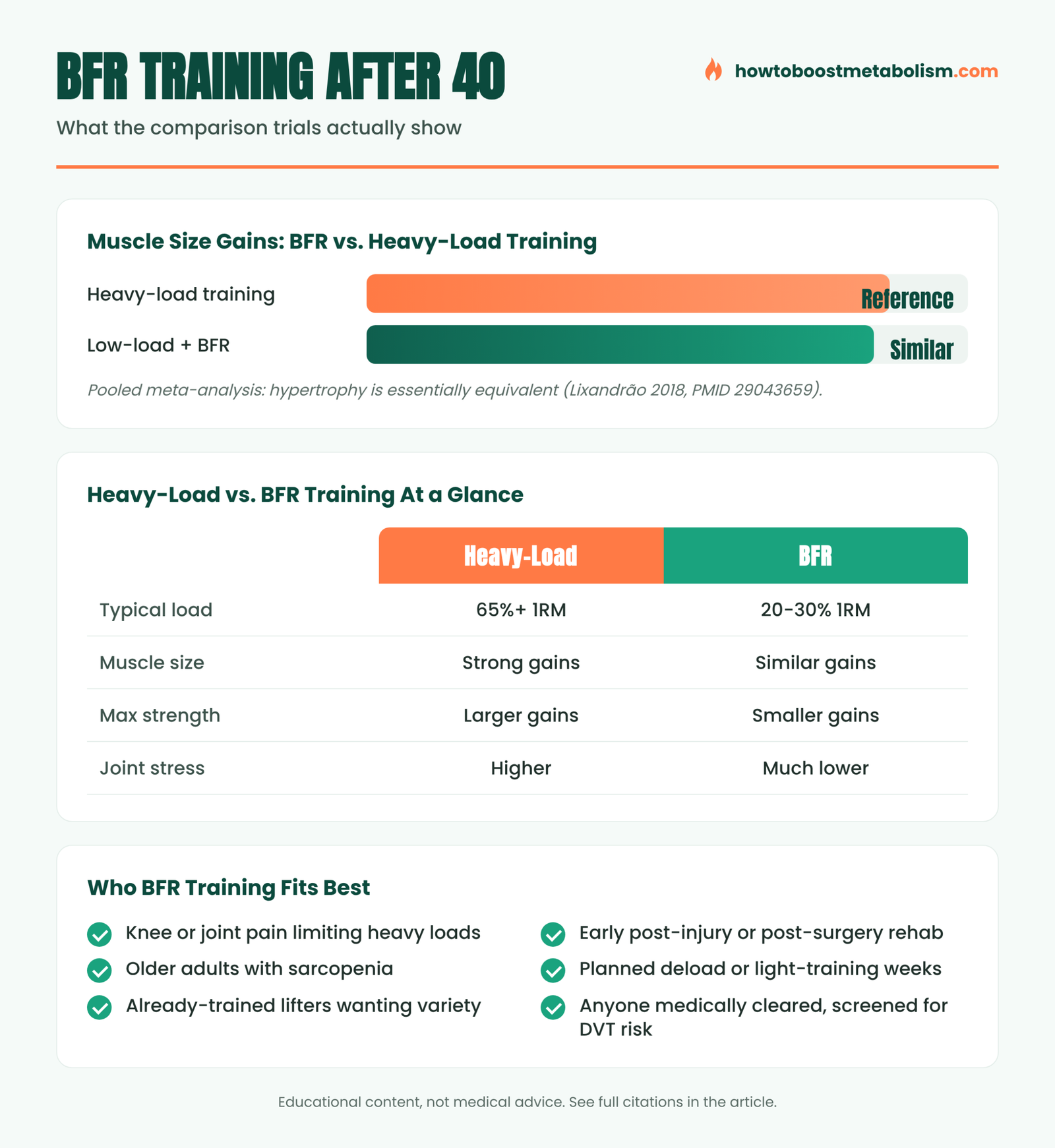
This is the part of the BFR story with the strongest evidence behind it. A 2018 systematic review and meta-analysis directly compared high-load resistance training (HL-RT, generally above 65% 1RM) against low-load BFR training (generally below 50% 1RM) (Lixandrão et al., 2018, Sports Med, PMID 29043659). The finding was clear and, honestly, a little surprising: heavy loading produced greater gains in maximal strength, but the two approaches produced similar increases in muscle size — regardless of cuff pressure, cuff width, or how occlusion pressure was prescribed.
A separate 2020 meta-analysis pooling sixteen studies and 310 participants reached a near-identical conclusion for strength specifically: low-load BFR training and heavy-load training produced statistically indistinguishable gains in maximal voluntary strength in healthy adults aged 20 to 80 (Grønfeldt et al., 2020, Scand J Med Sci Sports, PMID 32031709). In plain terms: for muscle size, and often for strength too, light-load BFR training is not a watered-down version of heavy lifting. It is a genuinely different route to a similar destination.
| Outcome | What the evidence shows | Source |
|---|---|---|
| Muscle size (hypertrophy) | Similar gains to heavy-load training | Lixandrão 2018 |
| Maximal strength (1RM) | Heavy-load training wins, on average | Lixandrão 2018; Grønfeldt 2020 |
| Joint and tendon loading | Substantially lower with BFR | Mechanistic / clinical trials below |
| Session discomfort | Higher — BFR is uncomfortable | Patterson 2020 |
Free download
🔥 The Metabolism Starter Kit
3 honest guides: a 7-day reset plan, a foods cheat-sheet and 12 metabolism myths debunked. No spam — unsubscribe anytime.
Who Benefits Most: Training Status Changes the Picture
A more recent 2024 meta-analysis dug into an important detail the earlier pooled analyses glossed over: training status. It found that already-trained lifters tended to gain more strength and size from BFR training relative to heavy-load training, while untrained beginners actually got superior strength gains (and similar hypertrophy) from heavy-load training (Geng et al., 2024, Sports Med Open, PMID 38773002). The practical read: if you are brand new to lifting and have no reason to avoid moderate-to-heavy loads, heavy-load training is still the more efficient default. BFR earns its place when heavy loading is off the table — not as a universal upgrade over it.
BFR for Joint Pain and Knee Osteoarthritis — What the Trials Actually Show
This is where BFR training becomes genuinely useful for a lot of people over 40: as a way to keep strengthening a joint that cannot currently tolerate heavy external load. A randomized trial in people with knee osteoarthritis found that BFR training produced meaningful gains in quadriceps strength and function with a fraction of the joint-compressive load of traditional resistance training (Ferraz et al., 2018, Med Sci Sports Exerc, PMID 29266093). A 2022 systematic review and meta-analysis pooling five trials in knee osteoarthritis patients found BFR training performed comparably to conventional resistance training on pain and function — while trending toward fewer adverse events (risk ratio 0.45, a difference that just missed statistical significance) (Wang et al., 2022, Arthritis Care Res, PMID 34549541). A 2025 randomized trial with a full year of follow-up reported that the benefits of a structured BFR rehabilitation program for knee osteoarthritis were still holding at 12 months (2025, Br J Sports Med, PMID 40846463).
The honest summary from that body of evidence: BFR training is not magically superior to conventional strength work for knee OA — it is roughly equivalent on outcomes, while asking much less of an already-irritated joint. That equivalence, not superiority, is exactly the selling point for anyone training around pain.
BFR for Sarcopenia and Older Adults
A 2024 randomized controlled trial compared low-load BFR training against conventional high-intensity resistance training in adults aged 65 and older who had been formally diagnosed with sarcopenia. Both approaches meaningfully improved body composition, knee extensor strength, walking speed, and several cardiovascular risk markers over twelve weeks. Conventional training edged out BFR on lean muscle mass gains specifically, while BFR training produced a significantly larger improvement in resting heart rate (Zhang et al., 2024, Sci Rep, PMID 39558011). For an older adult who cannot safely handle heavy external loads yet or is deconditioned after illness or injury, BFR training is a credible bridge back toward meaningful resistance training — not a permanent replacement for progressively heavier work once that becomes available again.
Is BFR Training Safe? The Blood Clot and Blood Pressure Questions
The idea of partially cutting off blood flow to a limb understandably raises safety questions, and this is an area where the research is reassuring but not a blank check. A 2020 systematic review of BFR training used therapeutically in people with musculoskeletal disorders found the overall rate of serious adverse events — including blood clots — to be low, broadly comparable to traditional exercise rehabilitation when appropriate cuff pressures were used and screening was done (Patterson et al., 2020, Am J Sports Med, PMID 31710505). Acute blood pressure does rise more during a BFR set than during an equivalent unrestricted set — a predictable response to the combination of restricted venous return and high-rep, near-fatiguing work — which is exactly why it needs a sensible screening step before you start, not because it is inherently dangerous for a healthy adult.
- A personal or family history of deep vein thrombosis (DVT), blood clotting disorders, or peripheral vascular disease
- Uncontrolled or poorly managed high blood pressure
- Pregnancy
- Sickle cell trait or disease
- Varicose veins severe enough that a clinician has flagged them, or recent limb surgery
None of that is a reason to avoid BFR training if it does not apply to you — it is a reason to clear it with a physician first if any of it does, and to use cuffs designed for the purpose (with a pressure gauge) rather than an improvised wrap at an unknown pressure.
How a BFR Session Actually Works
Most research protocols converge on a fairly consistent template, often credited to the pioneering work on KAATSU-style training:
- Load: 20–30% of your 1RM — light enough that 30 reps would feel genuinely easy without the cuff.
- Cuff pressure: typically 40–80% of limb occlusion pressure, which is why a dedicated BFR cuff with a gauge (not a blood pressure cuff guessed by feel) matters.
- Rep scheme: a common protocol is 30 reps, then three more sets of 15 reps, with only 30–60 seconds of rest between sets, cuff staying inflated throughout.
- Frequency: 2–3 sessions per week per muscle group, similar to a standard hypertrophy frequency.
- Duration: keep total occlusion time per limb per session under about 15–20 minutes as a conservative ceiling.
Old School New Body’s F4X method is built around efficient, joint-friendly strength training for people over 40 — a useful structured option if you’d rather follow a complete program than piece your own BFR and conventional sessions together.
Check It Out →Affiliate link — we may earn a commission at no extra cost to you. Disclosure
BFR vs. Other Joint-Friendly Options
BFR is not the only tool for building strength around a cranky joint. Isometric holds can provide short-term pain relief and are useful when any movement at all is irritating. Eccentric-focused training is the better-supported option specifically for tendinopathy. BFR’s particular niche is different again: it is for situations where the joint can move and bear some light load, but heavy external resistance is the problem — think early post-injury rehabilitation, an irritated knee that cannot yet handle a heavy leg press, or simply wanting to deload a joint while still training hard on a planned lighter week.
It also is not an excuse to abandon progressive overload altogether. The research above compares BFR to heavy loading in otherwise well-designed programs — it does not suggest light-load BFR work alone, done occasionally, will substitute for a consistent, progressively overloaded training plan over months and years.
What the Research Still Doesn’t Settle
A few honest gaps are worth flagging. Most BFR studies run for 6–12 weeks, so long-term outcomes over a year or more are less well characterized than for conventional resistance training, which has decades of longitudinal data behind it. The upper-body evidence base is also thinner than the lower-body one, since most clinical trials have focused on knee rehabilitation. And individual responses to a given cuff pressure vary with limb circumference and blood pressure, which is part of why a proper BFR cuff calibrates pressure to your own limb rather than using one fixed setting for everyone. None of that undermines the core finding — similar hypertrophy at a fraction of the external load — but it does mean BFR training is best treated as one well-supported tool in a broader program, not a complete replacement for everything else you know about progressive training.
Free download: our Metabolism Starter Kit — a protein calculator, a 7-day meal framework, and a one-page supplement checklist, with zero hype.
Get the Free Starter Kit →Frequently Asked Questions
What muscles can I use BFR training on?
The research base is strongest for limb muscles — quadriceps, hamstrings, calves, biceps, and triceps — since a cuff can only meaningfully restrict blood flow near the top of an arm or leg. It is not used for the trunk, chest, or back.
Do I need special equipment, or can I use a regular wrap?
Use a cuff specifically designed for BFR training with a pressure gauge. Guessing pressure with an elastic band or knee wrap is how people either get no training effect (too loose) or create an actual safety risk (too tight, or applied for too long).
Is BFR training supposed to hurt?
It is supposed to feel intensely uncomfortable — a deep, burning fatigue — which is part of the mechanism. It should not cause sharp pain, numbness, tingling, or skin discoloration; stop and loosen the cuff if any of those occur.
Can I do BFR training every day?
Most protocols use it 2–3 times per week per muscle group, similar to a normal hypertrophy frequency, rather than daily. There isn’t strong evidence that more frequent use produces faster results, and it adds unnecessary cumulative fatigue.
Should I switch entirely to BFR training instead of lifting heavy?
No, not if heavy lifting is available and pain-free for you. The evidence shows BFR training is a strong substitute when heavy loading isn’t an option — not a universally superior replacement for it.
This article is for educational purposes only and is not a substitute for professional medical or fitness advice. See our Medical Disclaimer for more.